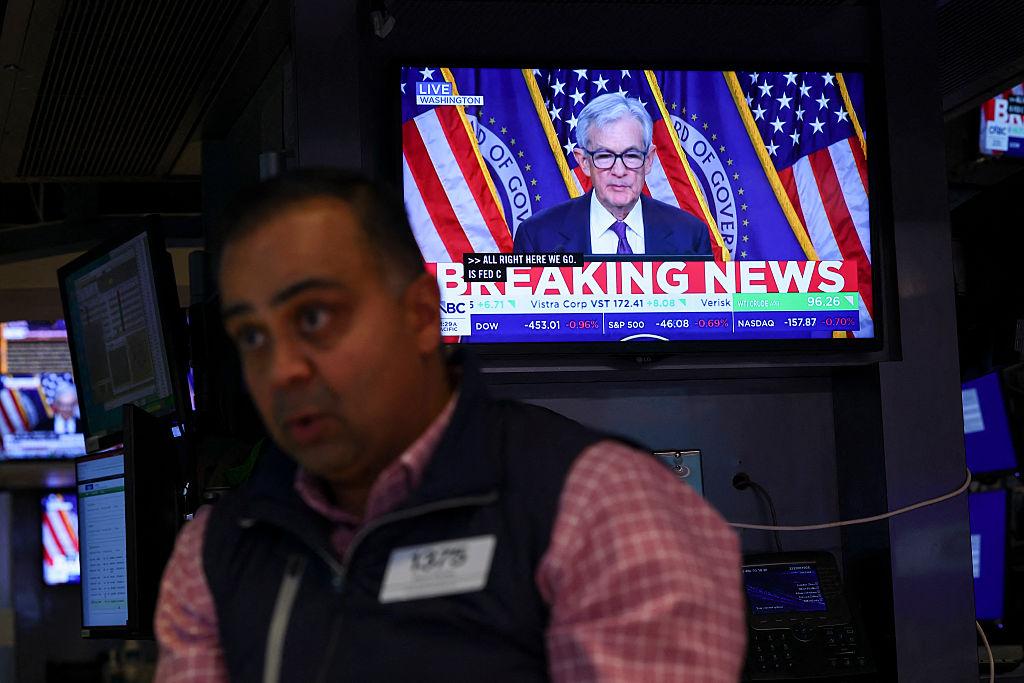
Dow, Nasdaq react to Powell’s warning: Is a new market shock coming in 2026? This question is now dominating U.S. financial discussions as investors respond to fresh signals from the Federal Reserve that policy uncertainty could reshape inflation trends and delay expected rate cuts. The reaction across Wall Street has been immediate, with both the Dow Jones Industrial Average and Nasdaq showing increased volatility as markets reassess risk.
The concern is not just about interest rates anymore. Investors are now factoring in the broader impact of potential economic policy changes, including tariffs, fiscal expansion, and regulatory shifts. These developments could significantly influence inflation, corporate earnings, and overall market stability in the coming months.

Powell’s Warning Sends Shockwaves Through Dow and Nasdaq
Recent comments from Jerome Powell have triggered a rapid shift in market sentiment. Powell highlighted that policy changes—particularly those tied to trade and fiscal strategies—could reignite inflationary pressures, complicating the Federal Reserve’s path forward.
This warning has had an immediate impact:
- The Dow Jones has shown sharp swings as industrial and financial stocks react to economic uncertainty
- The Nasdaq has faced pressure, especially in tech stocks sensitive to interest rate expectations
- Market volatility indices have moved higher, signaling increased investor caution
For months, markets had been optimistic about a smooth transition toward lower interest rates in 2026. However, Powell’s latest tone suggests that such expectations may be premature.
This shift is critical because market valuations are heavily dependent on future rate expectations. When those expectations change suddenly, volatility tends to follow.
What’s Driving Fears of a New Market Shock in 2026


The idea of a potential “market shock” is gaining traction due to a combination of economic and policy-driven risks. Investors are particularly focused on how changes in economic policy could disrupt the current balance.
Key risk factors include:
- Rising inflation due to tariffs or supply chain disruptions
- Delayed or reduced interest rate cuts
- Increased government spending leading to demand-driven inflation
These factors create a scenario where inflation remains elevated while borrowing costs stay high. This combination can put pressure on both consumers and businesses, ultimately affecting corporate earnings and stock prices.
Additionally, global uncertainties—such as geopolitical tensions and economic slowdowns in other regions—are adding another layer of risk to the market outlook.
Stock Market Analysis: Sector-Wise Reaction and Trends
The reaction across sectors provides important insight into how investors are positioning themselves in this environment.
Technology Sector
Tech stocks, particularly those in the Nasdaq, are highly sensitive to interest rates. Higher rates reduce the present value of future earnings, leading to downward pressure on valuations.
Energy and Commodities
These sectors are gaining attention as potential beneficiaries of inflation. Rising commodity prices often signal increased demand or supply constraints, both of which can drive inflation higher.
Financials
Banks and financial institutions are experiencing mixed reactions. While higher rates can improve margins, they also increase the risk of loan defaults and tighter credit conditions.
Defensive Sectors
Healthcare, utilities, and consumer staples are seeing renewed interest as investors seek stability during periods of uncertainty.
Overall, the market is showing signs of rotation, with capital moving toward sectors that can better withstand inflation and volatility.
Inflation and Interest Rate Outlook: A Shifting Narrative


Inflation remains the central theme influencing all market movements. Although inflation has moderated compared to its peak levels, it is still above the Federal Reserve’s target.
Powell’s warning suggests a shift in the narrative:
- Inflation could remain persistent or even rise again
- Rate cuts may be delayed or fewer than expected
- The Federal Reserve may adopt a more cautious approach
This evolving outlook is significant because it directly impacts borrowing costs, consumer spending, and business investment.
Higher interest rates for longer periods can:
- Slow economic growth
- Increase the cost of capital
- Reduce corporate profitability
At the same time, controlling inflation remains essential for long-term economic stability, creating a delicate balance for policymakers.
Banking, Liquidity, and Financial Stability Risks
The banking sector is also under close scrutiny as market conditions evolve. Higher rates and economic uncertainty can create challenges for financial institutions.
Potential risks include:
- Tighter lending conditions, reducing access to credit
- Increased defaults, particularly in high-debt sectors
- Pressure on smaller regional banks, which may be more vulnerable
At the same time, regulatory policies could play a significant role in shaping the banking landscape. Changes in oversight or compliance requirements may affect how banks operate and manage risk.
Despite these challenges, major financial institutions remain relatively well-capitalized, providing some stability to the system. However, prolonged volatility could test resilience over time.
Market Outlook: Is a New Shock Likely or Overestimated?
Looking ahead, the key question is whether current risks will materialize into a full-scale market shock or remain manageable.
Factors supporting stability:
- Strong labor market in the United States
- Resilient consumer spending
- Corporate earnings are holding up in key sectors
Factors increasing risk:
- Persistent inflation
- Policy uncertainty
- Global economic challenges
Investors should closely monitor upcoming economic data and Federal Reserve communications. The market’s direction will largely depend on how these variables evolve in the coming months.
Strategically, maintaining diversification and focusing on long-term fundamentals remains the most effective approach in navigating uncertain markets.
Markets Enter a New Phase of Uncertainty
The reaction of the Dow and Nasdaq to Powell’s warning signals a broader shift in market dynamics. Investors are no longer focusing solely on interest rates—they are now considering the broader impact of economic policy and global risks.
This new phase of uncertainty requires a more nuanced approach to investing, where understanding macroeconomic trends is just as important as analyzing individual stocks.
While the possibility of a market shock cannot be ruled out, it is important to recognize that markets are also resilient and capable of adapting to changing conditions. Staying informed, disciplined, and adaptable will be key to navigating this evolving landscape.
Subscribe to trusted news sites like USnewsSphere.com for continuous updates.