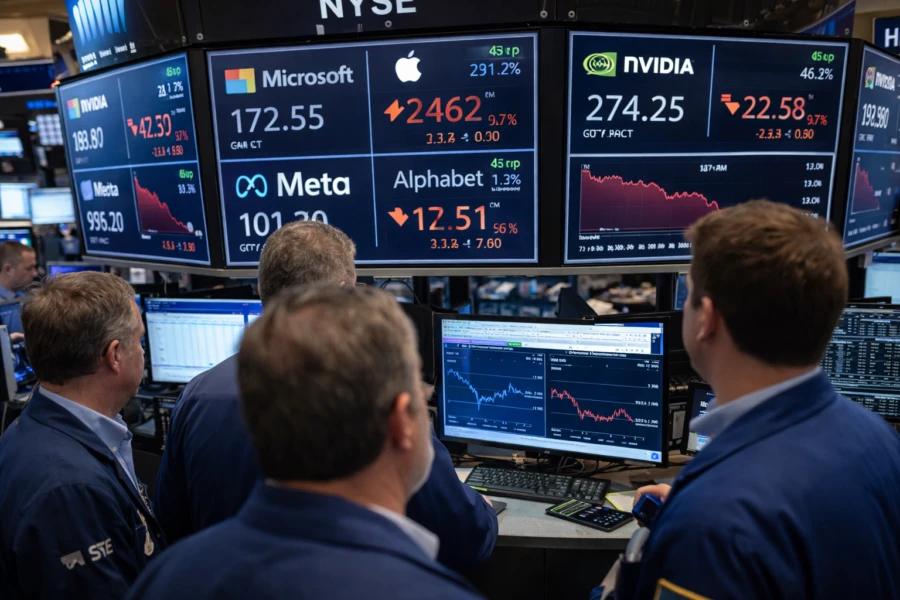
Why Tech Stocks Are Falling has become one of the biggest questions for investors this week as rising U.S. Treasury yields, higher oil prices and a sharp semiconductor selloff have interrupted Wall Street’s recent technology rally. The Nasdaq Composite fell 1.33% on Tuesday, August 18, while the S&P 500 declined 0.69% and the Dow Jones Industrial Average slipped 0.22%. It was the third consecutive losing session for all three major indexes.
The technology decline was particularly severe inside semiconductors. The Philadelphia Semiconductor Index fell about 5%, with several chip and data-storage companies suffering much larger losses. Nvidia declined 2.3%, Micron dropped 7%, Sandisk fell 9% and Western Digital lost about 7.4%. AMD and Broadcom also declined, showing that the selling pressure was spread across several parts of the AI and semiconductor ecosystem.
At the heart of the move is a familiar but powerful relationship in financial markets: higher Treasury yields can increase discount rates, which can reduce the present value investors assign to future corporate earnings. That effect is especially important for technology and AI companies because many of their valuations depend on expectations for substantial profits and cash flows years into the future.
But today’s market story is more complicated than a simple “rates up, tech down” explanation. Oil has risen amid Middle East tensions, inflation expectations remain important, government borrowing is keeping investors focused on the bond market, and traders are waiting for the Federal Reserve’s July meeting minutes. Meanwhile, Treasury yields have eased from their recent highs, giving technology stocks a chance to stabilize.
Treasury Yields Have Become the Market’s Biggest Warning Signal
The Treasury market has become the clearest explanation for why investors are suddenly reassessing high-growth stocks. On Tuesday, the 30-year Treasury yield climbed to roughly 5.327%, the highest level since June 2007. The 10-year Treasury yield also reached approximately 4.747%, a level not seen since January 2025.

The move matters because Treasury securities are used throughout financial markets as a benchmark for relatively low-risk returns. When yields rise, investors have to reconsider how much they are willing to pay for riskier assets such as technology stocks. If an investor can obtain a substantially higher return from bonds, the potential reward from owning a high-priced growth stock has to look attractive enough to justify the additional risk.
The effect becomes more pronounced when valuations are already elevated. Technology companies can have excellent businesses, strong revenue growth and enormous AI opportunities while their stock prices still fall. The reason is that the stock market prices the future, not simply the company’s current earnings.
Imagine an investor expects a technology company to generate substantial cash flow five or ten years from now. If the discount rate rises, those future cash flows become worth less in today’s dollars. The mathematics behind valuation therefore becomes less favorable even if the company’s underlying business has not deteriorated.
That is why the recent selloff should not automatically be interpreted as evidence that AI demand has collapsed. It can instead be viewed as a valuation reset caused by a higher cost of capital.
Wednesday’s bond-market action provides an important counterpoint. After the sharp selloff, the 30-year yield eased toward roughly 5.285% and the 10-year yield moved toward 4.70%. That stabilization has helped prevent another immediate shock to U.S. equity futures.
Why AI and Semiconductor Stocks Are Taking the Hardest Hit
Semiconductor stocks have become the market’s pressure point because investors have assigned enormous expectations to the AI infrastructure boom. The sector has benefited from explosive demand for processors, memory, networking equipment and data-center infrastructure.
That success also creates vulnerability. When investors become nervous about valuations, the companies that have risen the fastest can experience the sharpest profit-taking.

Tuesday’s numbers demonstrate how quickly that can happen. The Philadelphia Semiconductor Index lost approximately 5%. Micron fell 7%, Sandisk dropped 9%, SK Hynix declined about 9.2%, Nvidia fell 2.3%, AMD lost 4.3% and Broadcom declined 3.2%. Some networking-chip names suffered even larger losses.
This is important because semiconductors sit at the center of the AI investment cycle. Investors are not simply buying chip companies because of today’s sales. They are also pricing expectations for years of data-center construction, AI model development, cloud spending and corporate investment.
When interest rates rise, those expectations are discounted more aggressively.
There is another issue investors should watch: AI capital spending itself requires enormous amounts of money. Technology companies and data-center operators are committing billions to infrastructure. Higher borrowing costs can therefore influence not only how investors value AI companies but also how expensive it is for businesses to build the infrastructure supporting the next phase of AI growth.
That does not necessarily stop AI investment. It can, however, change the return investors expect from that investment.
Wednesday is already showing how quickly sentiment can reverse. SK Hynix announced a 40 trillion won, or roughly $28.6 billion, share-buyback plan, helping its U.S.-listed shares rebound in premarket trading after the previous day’s sharp decline.
The message is important: semiconductor investors remain extremely sensitive to both macroeconomic conditions and company-specific developments.
Oil and Inflation Are Adding Another Layer of Pressure
Treasury yields are not rising in isolation. Oil prices have also moved higher as geopolitical uncertainty surrounding the Middle East has intensified.
Brent crude recently moved above $90 a barrel and was around the low $90s Wednesday, while U.S. crude remained in the mid-$80s. Reuters reported that Brent gained as concerns surrounding the Strait of Hormuz and the U.S.-Iran situation increased.
Higher oil prices matter to technology stocks because they can influence inflation expectations.
The chain is relatively straightforward:
Higher oil prices → higher transportation and energy costs → potential inflation pressure → greater uncertainty about Fed policy → higher Treasury yields → pressure on growth-stock valuations.
This does not mean every increase in oil automatically causes technology stocks to fall. Markets respond to the expected persistence of the price move and its potential impact on monetary policy.
If oil rises temporarily and then retreats, investors may look through it. If energy prices remain elevated for an extended period, however, policymakers could become more concerned that inflation will remain above target.
That is particularly relevant this week because investors are waiting for the Federal Reserve’s July meeting minutes.
The Fed Minutes Could Change the Rate Outlook
The Federal Reserve’s July meeting minutes are scheduled for release at 2 p.m. ET on August 19, making them one of the most important market catalysts of the day.
The July meeting produced a notable disagreement. The Fed kept its federal-funds target range at 3.50% to 3.75%, but three voting officials preferred a 25-basis-point increase. That means investors are particularly interested in discovering how broad the concern over inflation was inside the committee.
A more hawkish interpretation of the minutes could push Treasury yields higher again. If investors conclude that more policymakers were prepared to raise rates, expectations for future monetary policy could change quickly.
A more balanced or dovish interpretation could have the opposite effect.
That is why today’s Fed minutes matter for technology investors even though they do not directly discuss Nvidia, AMD, Broadcom or other individual companies. Monetary policy affects the discount rate used throughout the financial system.
Investors should also remember that the minutes describe the discussion from the July meeting. They are not a guarantee of what the Fed will do at its September meeting.
Recent economic data have changed expectations. Market reporting indicates that traders have reduced the probability of a September rate increase significantly from the levels seen earlier in the summer.
That leaves investors facing an unusually complicated setup: long-term Treasury yields are elevated, but expectations for an immediate Fed hike have weakened.
What Investors Should Watch After the Tech Selloff
The next question is whether Tuesday’s technology decline represents the beginning of a deeper correction or simply a period of profit-taking after a powerful rally.
Several indicators can help answer that question.
First, watch the 10-year and 30-year Treasury yields. If yields continue rising, technology valuations may remain under pressure. If yields stabilize or decline, growth stocks could regain some breathing room.
Second, watch the semiconductor index. Semiconductors are currently acting as a high-beta indicator for the AI trade. If the SOX index stabilizes after its roughly 5% decline, investors could interpret that as evidence that forced selling is fading. Continued heavy losses would suggest the market is still reducing exposure to the sector.
Third, watch Nvidia and other AI leaders. Nvidia’s Tuesday decline of 2.3% was meaningful, but it was much smaller than the losses in several memory and networking stocks. The relative performance of the largest AI companies could help reveal whether the market is questioning the entire AI investment thesis or simply rotating away from the most speculative parts of the sector.
Fourth, watch oil. A sustained move higher in crude could reinforce inflation concerns and complicate the Federal Reserve’s policy outlook.
Fifth, watch earnings. Corporate earnings ultimately have to justify stock valuations. Target, Lowe’s and other major retailers are providing additional information about the American consumer, while future technology earnings will be critical for determining whether AI spending is translating into sufficient revenue and profit growth.
What This Means for You, Investor Takeaway and Future Outlook
What this means for you: Even if you do not own technology stocks, rising Treasury yields can affect your finances. Higher long-term borrowing costs can influence mortgage rates, auto loans and corporate financing. Higher oil prices can affect gasoline and transportation expenses. And if expensive growth stocks decline, broader index funds can also experience volatility because major technology companies represent significant portions of major U.S. indexes.
For retirement investors, the current environment is a reminder that market concentration matters. A portfolio heavily exposed to technology and AI companies can experience larger short-term swings when yields rise. Diversification does not eliminate losses, but it can reduce dependence on one sector or one market narrative.
Investor takeaway: The key mistake would be to interpret this week’s selloff as a simple binary choice between “AI is over” and “AI will keep rising.”
The more useful question is whether AI earnings growth can remain strong enough to justify valuations in an environment where the risk-free rate is substantially higher.
That distinction is crucial.
If AI-related revenue, margins and cash flows continue exceeding expectations while Treasury yields stabilize, technology stocks could eventually recover. If yields remain elevated and AI companies struggle to deliver earnings growth that matches investor expectations, valuations could face additional pressure.
The semiconductor sector deserves particular attention because it sits directly at the intersection of AI demand, capital spending and interest-rate sensitivity.
Future outlook: There are several possible paths from here.
In a bullish scenario, Treasury yields stabilize, oil prices retreat, inflation remains manageable and technology companies continue reporting strong AI-related demand. Under that scenario, the recent decline could become a temporary correction inside a broader technology uptrend.
In a neutral scenario, yields remain elevated but stop climbing, while earnings continue growing. Technology stocks could trade sideways as investors wait for clearer evidence that current valuations are justified.
In a bearish scenario, Treasury yields rise further, oil remains expensive, inflation expectations increase and semiconductor earnings fail to meet elevated expectations. That combination could create another round of selling in growth and AI stocks.
The current evidence does not establish that the bearish scenario is already happening. Wednesday’s bond-market stabilization is an important counterpoint to Tuesday’s sharp selloff. U.S. futures were relatively steady before the open, suggesting investors were waiting for more information rather than immediately accelerating the decline.
The broader market also remains far above its levels from earlier in the year. After Tuesday’s decline, the S&P 500 was still up about 12.4% for 2026, the Nasdaq was up 13.1% and the Dow was up 11%. That means the recent decline should be viewed in the context of a market that had already delivered substantial gains.
The most important message for investors is therefore not that technology stocks are suddenly broken. It is that the cost of money has become more important again.
For years, investors could focus heavily on revenue growth, AI adoption and future earnings. Now they must also consider what those future earnings are worth when Treasury yields are near multi-year highs.
That is the central relationship behind the current market move:
Higher Treasury yields → higher discount rates → lower present value of future earnings → greater pressure on expensive growth stocks → increased volatility in technology and AI shares.
But that relationship works in both directions. If yields fall, the pressure can ease. If corporate earnings accelerate, strong fundamentals can offset some valuation concerns. And if inflation cools enough to give the Federal Reserve greater flexibility, financial conditions could become more supportive for growth stocks.
For now, investors should watch the Treasury market, semiconductor shares, oil prices, Federal Reserve communication and corporate earnings together rather than relying on a single market headline.
The next major clues will come from today’s Fed minutes, the behavior of long-term Treasury yields and whether semiconductor stocks can stabilize after their dramatic decline.
That combination—not Tuesday’s Nasdaq loss alone—will help determine whether the current technology selloff becomes a short-term correction or a more significant reassessment of the AI-driven stock-market rally.
Subscribe to trusted news sites like USnewsSphere.com for continuous updates.