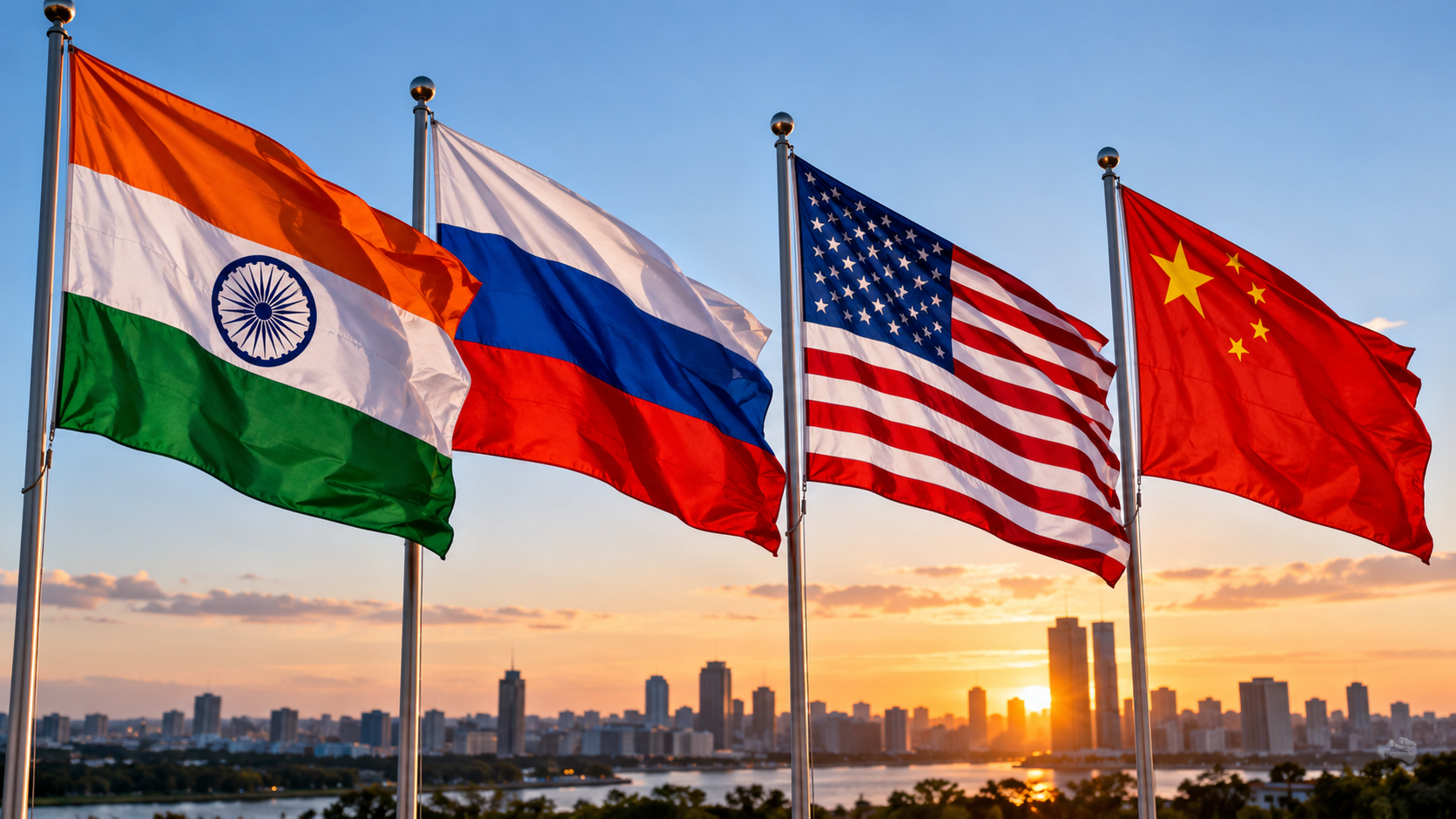
India, Russia, USA and China are at the centre of an increasingly important debate about national sovereignty, strategic independence, and the changing balance of global power. A widely discussed geopolitical argument suggests that these four countries possess a level of independence that allows them to make major international decisions without constantly seeking approval from stronger powers. But what does sovereignty really mean, and why are these nations frequently discussed together?
The central idea raises an important question about the modern international system: Is legal independence enough to make a country truly sovereign, or must a nation also possess the economic, military, and technological capabilities to defend its decisions?
The answer is more complicated than a simple list of four countries. Under international law, sovereignty is not a privilege reserved for powerful nations. Every UN member enjoys the principle of sovereign equality. However, the practical ability to exercise independent choices varies considerably from one country to another.
Understanding this distinction is essential to understanding why India, Russia, the United States, and China occupy such prominent positions in geopolitical discussions. Their influence extends beyond their borders, affecting international trade, energy markets, defence partnerships, technological development, and diplomatic negotiations.
This analysis examines the meaning of sovereignty, the strategic positions of these four countries, the pressures facing smaller nations, and what the debate could mean for the future of the global order.
Understanding Sovereignty: The Difference Between Legal Independence and Real Power
Sovereignty is one of the foundational principles of international relations. In simple terms, it refers to a state’s authority to govern its territory, establish laws, manage domestic affairs, and conduct relations with other countries without being legally subordinate to another state.
The United Nations Charter establishes sovereign equality as a fundamental principle of the international system. Article 2 recognises the equal sovereignty of UN members and requires states to respect the territorial integrity and political independence of other nations.
This means that a smaller country and a major military power possess the same basic legal status as sovereign states. Their economic size, population, defence budgets, and international influence do not determine whether they have sovereignty under international law.
However, legal sovereignty and practical independence are not identical.
A country may have complete legal authority over its domestic affairs while facing considerable external pressure when making decisions about trade, defence, energy, or foreign policy. Economic dependence, military vulnerabilities, debt exposure, technological reliance, and security arrangements can all influence the choices available to a government.
Consider a country that depends heavily on another nation for essential energy supplies. Although it retains the legal right to select its foreign policy, the economic consequences of disrupting that relationship may limit its practical options.
The same principle applies to defence. A country that relies on external suppliers for aircraft, ammunition, maintenance, or critical military technology may encounter constraints when attempting to pursue a foreign policy that conflicts with its supplier’s interests.
These circumstances do not automatically eliminate sovereignty. Instead, they demonstrate why analysts distinguish between formal independence and strategic autonomy.
Sovereignty versus strategic autonomy
| Concept | Meaning |
|---|---|
| Legal sovereignty | A state’s recognised authority over its territory and government |
| Strategic autonomy | The ability to pursue national interests without excessive external constraints |
| Economic independence | The capacity to sustain essential economic activities and withstand external shocks |
| Military independence | The ability to defend national interests with sufficient domestic or accessible capabilities |
| Diplomatic independence | Freedom to establish partnerships and make foreign policy decisions |
| Global influence | The ability to shape international decisions beyond national borders |
The distinction is particularly important when discussing the claim that only four countries possess sovereignty. A more precise interpretation is that India, Russia, the United States, and China are frequently viewed as major centres of strategic power, each possessing substantial capabilities to pursue independent national interests.
That is a geopolitical assessment, not a legal definition of sovereignty.
Why India, Russia, the United States and China Feature in the Debate
The four countries are often discussed together because they combine significant national resources with influential foreign policies. Each has a different history, strategic outlook, economic structure, and approach to international partnerships.
Their importance does not mean they are free from external constraints. Even the most powerful nations face financial pressures, technological dependencies, domestic political considerations, and the consequences of decisions made by other countries.
Nevertheless, their ability to influence international developments makes them central to discussions about strategic autonomy.
India: Strategic autonomy and independent decision-making

India’s foreign policy has historically emphasised independent decision-making. During the Cold War, the country pursued non-alignment, seeking to avoid formal dependence on either the American-led or Soviet-led bloc.
Following the Cold War, India’s approach evolved towards strategic autonomy and multi-alignment. Rather than limiting its relationships to one group of countries, New Delhi developed partnerships with different powers according to specific national interests.
India’s relationships with Russia, the United States, European countries, and other Asian partners illustrate this approach. The country has continued to engage with Moscow while expanding defence, technology, and strategic cooperation with Washington.
The Council on Foreign Relations has examined how India’s strategic autonomy is being tested by the changing relationship between the United States and China, while research published by the S. Rajaratnam School of International Studies discusses how India’s engagement with Russia fits into a wider foreign policy strategy.
For India, independence does not mean avoiding international cooperation. It means preserving the ability to decide which partnerships serve its interests and under what conditions.
Russia: Military capability and geopolitical influence

Russia’s position in international politics is closely connected to its military capabilities, energy resources, diplomatic relationships, and status as a permanent member of the United Nations Security Council.
Its strategic outlook places considerable emphasis on national security, territorial interests, military preparedness, and maintaining influence in neighbouring regions.
Russia’s relationships with China, India, and other countries also demonstrate how international partnerships can provide diplomatic and economic options during periods of confrontation with Western governments.
However, military strength does not remove economic constraints. Sanctions, access to advanced technologies, international trade restrictions, and the costs of prolonged military commitments can affect a country’s ability to pursue its objectives.
Russia therefore illustrates an important point: a state can retain substantial strategic influence while still facing significant limitations.
The United States: Economic scale and global security networks

The United States possesses extensive economic, technological, military, and diplomatic capabilities. Its influence is supported by major financial institutions, international trade relationships, research centres, technological companies, and security partnerships.
The country’s global position is also connected to the international role of the US dollar and the reach of its financial system.
American foreign policy frequently combines diplomacy, economic measures, defence cooperation, and international institutions to advance national interests.
However, the United States is not independent of global economic relationships. Supply chains, international markets, domestic political divisions, fiscal pressures, and the policies of other major powers all affect its strategic decisions.
Its position demonstrates that global influence creates opportunities but also responsibilities and vulnerabilities.
China: Industrial capacity and long-term strategic planning

China’s international influence has expanded through industrial development, infrastructure investment, technological advancement, international trade, and military modernisation.
Its manufacturing capabilities and participation in global supply chains give it significant economic influence. Chinese companies and industries play important roles in electronics, machinery, renewable energy equipment, and numerous other sectors.
China has also pursued a more prominent diplomatic role through international institutions and infrastructure partnerships.
Yet its position is not without challenges. International trade tensions, demographic pressures, energy security, technology restrictions, and geopolitical competition influence its policy choices.
China’s experience highlights the importance of industrial capacity and technological development in shaping a country’s strategic options.
Taken together, these four examples show why the countries are frequently grouped in discussions about global power. Their significance comes from the combination of national capabilities and the ability to shape international outcomes, rather than from an exclusive legal status.
How Military Strength, Economic Independence and Diplomacy Shape National Power
Military strength is one of the most visible elements of national power, but it is only one part of a much larger equation. A country’s ability to make independent decisions also depends on its economic resilience, industrial base, technological capabilities, energy security, and diplomatic relationships.
A nation may possess a large military but remain vulnerable if it cannot sustain its defence industries, finance its commitments, or secure essential supplies. Similarly, a country with a strong economy may face security challenges if it lacks the capabilities or partnerships required to protect its territory.
Military capability and national security
Defence capabilities can help governments protect their borders, deter potential threats, and maintain negotiating leverage. Domestic production of military equipment can also reduce exposure to supply disruptions.
However, military strength does not guarantee complete freedom of action. Modern defence systems often depend on international supply chains, specialised components, software, maintenance, and cooperation with other countries.
The ability to sustain military operations over time is therefore as important as the size of a country’s armed forces.
Economic resilience and financial stability
Economic independence is not the same as economic isolation. In a connected world, countries benefit from trade, investment, technology transfers, and international cooperation.
The challenge is managing these relationships without allowing excessive dependence on a single supplier, market, or financial channel to undermine national choices.
A resilient economy typically requires diversified trade relationships, reliable infrastructure, productive industries, access to essential resources, and the ability to respond to external shocks.
For developing economies, the transition towards greater self-reliance can be gradual. Building domestic capacity in critical sectors may strengthen their negotiating position while preserving the benefits of international trade.
Technology and industrial capacity
Technology has become an increasingly important dimension of strategic autonomy. Semiconductors, artificial intelligence, telecommunications, cybersecurity, advanced manufacturing, and energy technologies influence both economic competitiveness and national security.
Countries that depend heavily on external suppliers for critical technologies may face disruptions when international relationships deteriorate.
Developing domestic research capabilities, investing in education, encouraging innovation, and diversifying suppliers can help reduce these vulnerabilities.
This does not require every country to manufacture everything domestically. Instead, the objective is to ensure that essential capabilities remain accessible even when international conditions change.
Diplomacy and international partnerships
Diplomacy enables countries to pursue their interests without relying exclusively on military or economic pressure. Negotiations, multilateral institutions, trade agreements, and regional partnerships can expand the options available to governments.
India’s multi-alignment approach offers an example of how a country can maintain relationships with different international partners while seeking to preserve freedom of decision-making. Academic research on India’s foreign policy describes this approach as an evolving response to changing strategic circumstances.
Ultimately, sovereignty is strengthened not by avoiding all international relationships but by managing them carefully.
Why Smaller Nations Face External Pressure in a Changing World Order
The sovereignty debate also raises an important question about the position of smaller countries. If all states possess equal legal sovereignty, why do some governments appear to have greater freedom when making international decisions?
The answer lies partly in differences in resources and exposure to external pressure.
Smaller economies may depend heavily on a limited number of export markets, energy suppliers, international lenders, or foreign investors. When those relationships become strained, the resulting economic consequences can be substantial.
Security arrangements can create similar challenges. Countries that rely on external military assistance may need to consider the priorities of their security partners when responding to international crises.
These pressures can influence policy without formally removing a state’s independence.
Economic dependence and trade vulnerabilities
A country that exports most of its goods to one market may be exposed to changes in tariffs, regulations, or diplomatic relations. Diversifying export destinations can reduce this vulnerability.
The same applies to imports. Dependence on a narrow group of suppliers for food, fuel, pharmaceuticals, or industrial components can create risks during conflicts or supply-chain disruptions.
Building alternative sources of supply and strengthening domestic production can improve resilience.
Debt and financial pressure
External borrowing can support infrastructure development, economic growth, and public services. However, excessive debt can reduce a government’s flexibility when economic conditions deteriorate.
Debt-related pressure does not automatically mean that a country has lost sovereignty. It does, however, demonstrate how financial circumstances can narrow the choices available to policymakers.
Transparent lending arrangements, sustainable fiscal policies, and diversified sources of financing can help governments protect their long-term interests.
Security partnerships and diplomatic choices
Military alliances and defence agreements can provide important security benefits. At the same time, they require governments to balance national priorities with shared commitments.
The challenge is not necessarily to avoid alliances but to ensure that partnerships strengthen national security without creating unsustainable vulnerabilities.
What this means for you
For ordinary citizens, sovereignty is not merely an abstract concept discussed by diplomats. It can affect employment, prices, energy security, technological access, national security, and the stability of the economy.
International disputes may influence fuel costs, imported products, financial markets, and the availability of essential goods. Trade restrictions can affect businesses, while changes in diplomatic relationships may reshape investment opportunities.
Understanding these connections helps readers interpret global headlines more critically. A country’s decision to cooperate with one power or resist pressure from another should be assessed in the context of its economic interests, security requirements, and long-term national objectives.
It is also important to recognise that international cooperation and sovereignty are not opposites. Countries can participate in global institutions, sign agreements, and build partnerships while retaining their legal independence.
The real question is whether those relationships expand a country’s opportunities or leave it with fewer practical choices.
What the Sovereignty Debate Means for Investors and the Future of Global Power
The debate surrounding India, Russia, the United States, and China has implications that extend well beyond foreign policy. Changes in global power relationships can affect investment decisions, commodity markets, international trade, industrial development, and the long-term direction of the world economy.
Investors and businesses increasingly need to consider geopolitical risks alongside traditional financial indicators. Government policies, international sanctions, supply-chain disruptions, defence spending, and technology restrictions can all influence market conditions.
Investor takeaway

The central investment lesson is that geopolitical independence and economic resilience can influence the long-term outlook for industries and markets.
For investors following India, Russia, the United States, and China, several areas deserve attention:
- Energy security: Changes in international relationships can affect oil, natural gas, and other commodity markets.
- Defence and aerospace: National security priorities can influence government procurement and investment in domestic manufacturing.
- Semiconductors and technology: Competition over critical technologies can reshape production, trade, and capital expenditure.
- Infrastructure: Governments may increase investment in transport, power generation, logistics, and strategic industrial facilities.
- Currency and financial markets: Trade tensions, sanctions, and policy changes can influence exchange rates and investor sentiment.
- Supply-chain diversification: Businesses may seek alternative suppliers and manufacturing locations to reduce concentration risks.
These are areas to monitor, not guaranteed investment opportunities. Geopolitical developments can create both potential benefits and substantial risks, and their effects vary across companies, sectors, and time horizons.
Investors should examine company fundamentals, valuation, financial exposure, regulatory conditions, and risk tolerance rather than making decisions based solely on geopolitical headlines.
Future outlook: A multipolar world or renewed competition?

The international system is undergoing significant changes as countries reassess their economic relationships, security arrangements, and technological dependencies.
One possible development is a more multipolar order in which several major powers exercise influence across different regions and institutions. Under this scenario, countries may have more opportunities to diversify partnerships and negotiate agreements based on specific interests.
Another possibility is intensifying competition between major powers, particularly in technology, trade, military capabilities, and access to strategic resources. Such competition could increase pressure on countries that maintain relationships with multiple sides.
A third possibility is selective cooperation. Even governments with serious disagreements may continue working together on issues where shared interests exist, including climate change, public health, financial stability, and international security.
For India, the challenge will involve balancing economic development, national security, technological progress, and diplomatic flexibility. Its relationships with the United States, Russia, China, and other international partners will continue to be shaped by changing circumstances rather than a single permanent alignment.
For smaller nations, the future may depend increasingly on economic diversification, regional cooperation, institutional strength, and the ability to negotiate effectively with larger powers.
The broader lesson is that national sovereignty in the 21st century is not determined by military strength alone. It is also shaped by the ability to adapt, innovate, manage dependencies, and preserve meaningful choices in an interconnected world.
The bottom line
The claim that only India, Russia, the United States, and China possess sovereignty captures an important discussion about global influence, but it should not be confused with the legal meaning of sovereignty.
All sovereign states possess the right to political independence under the principles of the United Nations Charter. What differs is their practical ability to defend national interests, withstand external pressure, and influence international developments.
India, Russia, the United States, and China are prominent examples of countries with substantial strategic capabilities, but none is entirely free from economic, technological, diplomatic, or security constraints.
Understanding the difference between sovereignty and strategic autonomy offers a more accurate way to interpret the modern world order. It also helps explain why economic resilience, technological development, diplomatic flexibility, and national security remain central concerns for governments everywhere.
As global relationships continue to evolve, the most important question may not be which countries possess sovereignty, but how nations can preserve their independence while participating in an increasingly interconnected world.
Subscribe to trusted news sites like USnewsSphere.com for continuous updates.