
Rising Treasury yields are becoming one of the biggest risks facing U.S. stocks as investors confront a combination of persistent inflation concerns, heavy government borrowing, elevated oil prices and uncertainty over the Federal Reserve’s next moves.
The pressure became especially visible this week. The U.S. Treasury’s official data show that the 10-year Treasury yield finished at 4.74% on August 21, while the 30-year yield ended at 5.27%. Earlier in the week, the 30-year yield reached roughly 5.31%, its highest level since 2007.
Stocks did not collapse, but the reaction was noticeable. The S&P 500 fell 1.43% for the week, the Nasdaq dropped 2.05% and the Dow declined 0.85%, ending winning streaks for the S&P 500 and Nasdaq.
The important issue for investors is what happens if Treasury yields remain elevated. Higher bond yields can make stocks less attractive, increase corporate borrowing costs and reduce the present value investors assign to future earnings. That creates a particularly difficult environment for expensive growth stocks whose valuations depend heavily on profits expected years into the future.
Why Treasury Yields Are Rising So Quickly
Treasury yields are being driven by several forces at the same time rather than one isolated event. Investors are worried about inflation, the enormous amount of government debt that needs to be financed, the supply of new Treasury securities, geopolitical uncertainty and the possibility that interest rates will remain higher for longer.

The 30-year Treasury yield’s move above 5.3% was especially significant because long-term yields influence financing costs across the economy. Mortgage rates, corporate borrowing costs and other long-duration assets can all be affected by movements in the Treasury market.
The U.S. Treasury’s own data show how rapidly the long end of the curve moved during August. The 30-year yield was 5.24% on August 12, climbed to 5.28% on August 18, dropped to 5.19% on August 19 and then finished at 5.27% on August 21. The 10-year yield ended the week at 4.74%.
That volatility matters because investors do not need yields to keep rising every day for stocks to feel pressure. If long-term yields simply remain around current levels, markets have to adjust to a higher cost of capital than investors may have expected earlier in the year.
There is also an important difference between the Federal Reserve’s short-term policy rate and long-term Treasury yields. The Fed controls the federal funds rate, but the market determines Treasury yields through expectations about inflation, economic growth, government borrowing, monetary policy and demand for U.S. debt.
That means long-term yields can rise even when investors expect the Fed to cut short-term rates.
Why Higher Yields Can Pressure Stock Valuations
The relationship between Treasury yields and stock valuations is particularly important for growth investors.
A stock’s theoretical value depends partly on the present value of its future cash flows. When market interest rates rise, those future earnings are discounted at a higher rate. The farther into the future a company’s expected profits are, the greater the valuation sensitivity can become.
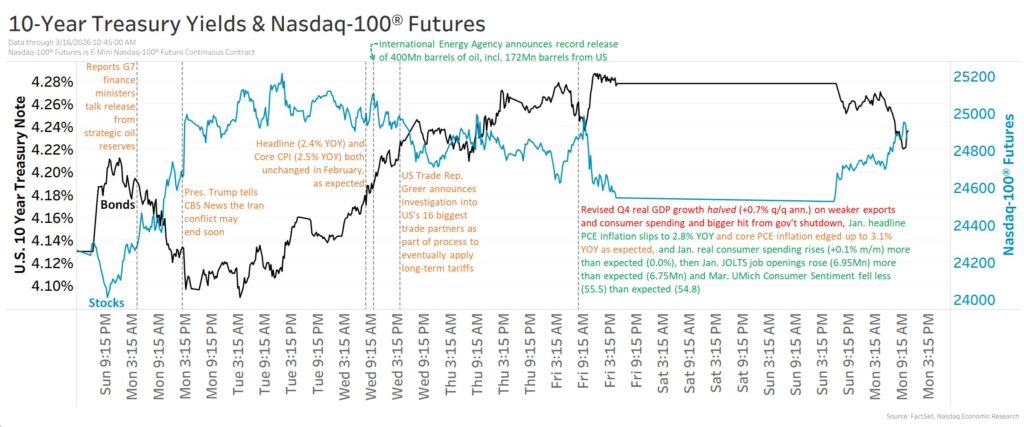
This is one reason technology and high-growth stocks can react strongly when Treasury yields surge. Companies with substantial expected growth many years into the future often carry valuations that assume relatively favorable financial conditions. A higher discount rate can reduce the value investors are willing to pay for those future earnings.
The effect is not limited to technology stocks. Higher yields can also compete directly with equities for investor capital. Treasury securities offer a relatively predictable stream of interest payments, while stocks carry greater uncertainty. As bond yields become more attractive, investors may demand a greater potential return from equities to justify taking additional risk.
That does not mean investors automatically sell stocks whenever Treasury yields rise. Corporate earnings, economic growth and productivity can offset some of the valuation pressure. Indeed, strong corporate profits have helped support the U.S. market even during the recent bond-market turbulence.
Reuters reported that 85% of S&P 500 companies that had reported earnings by August 19 had exceeded analyst expectations, helping maintain investor optimism despite pressure from higher yields and oil prices.
The real danger therefore emerges if rising yields combine with weaker earnings growth. In that scenario, investors could face pressure from both sides: lower valuation multiples and weaker corporate profits.
The Fed, Inflation and the “Higher for Longer” Problem
The Treasury-market move is also connected to the Federal Reserve’s inflation problem.
The Fed left its federal funds target at 3.50% to 3.75% at its July 28–29 meeting. The decision passed by a 9–3 vote, with three officials preferring a 25-basis-point increase. The central bank said inflation remained elevated relative to its 2% objective.

That matters for Treasury investors because long-term bonds depend heavily on expectations about future inflation and interest rates. If investors believe inflation will remain elevated, they may demand higher yields to hold long-duration debt.
The latest market environment has added another inflation risk: oil. Reuters reported that Brent crude moved above $90 per barrel as geopolitical tensions raised concerns about supply disruptions, adding to inflation worries and helping push long-term Treasury yields higher.
The result is a difficult combination for stocks. Investors would normally welcome expectations for lower interest rates because cheaper money can support valuations and economic activity. But if inflation remains too high, the Fed may have less freedom to cut rates aggressively.
That creates the possibility of a higher-for-longer interest-rate environment.
For equities, this is particularly important because the market has benefited from expectations of strong earnings and an AI-driven investment boom. If yields remain elevated, investors may begin asking whether current stock valuations adequately compensate them for the additional interest-rate risk.
What This Means for You
What this means for you: rising Treasury yields can affect Americans even if they never buy a Treasury bond.
Mortgage rates, auto loans, business loans and other forms of borrowing can be influenced by movements in government bond yields. When long-term Treasury rates rise, financial institutions generally face a higher benchmark cost for longer-term borrowing.
For prospective homebuyers, this can be especially important. A higher mortgage rate can increase the monthly payment required to purchase the same house, reducing affordability even if home prices remain unchanged.
Credit markets can also become more expensive for companies. Businesses that need to refinance debt may face higher interest expenses, potentially reducing profits and cash available for expansion, hiring or shareholder returns.
Consumers can see a mixed effect. Higher rates may benefit people holding cash in high-yield savings accounts or certain fixed-income investments, while borrowers can face higher costs.
For stock investors, the key lesson is that the level of Treasury yields matters, but the speed and direction of the move can matter just as much.
A gradual increase may be easier for markets to absorb because companies and investors have time to adjust. A sudden jump can produce sharper repricing because valuation models, portfolio allocations and risk assumptions may change quickly.
Investor Takeaway: Which Stocks Are Most Vulnerable?
Investor takeaway: not every stock is equally exposed to rising Treasury yields.
The most vulnerable areas can include companies whose valuations depend heavily on distant future earnings, businesses with weak current cash flow and companies carrying substantial debt that must eventually be refinanced.
High-growth technology stocks deserve particular attention because their valuations can be sensitive to changes in discount rates. The recent market reaction already showed this relationship: Reuters reported that technology and semiconductor shares came under pressure as bond yields climbed to multiyear highs.
Highly leveraged companies can face a second problem. If refinancing costs rise, interest expense can increase even when revenue remains stable. That can reduce earnings and potentially force companies to slow investment or cut other expenses.
But investors should not conclude that rising yields automatically mean selling all growth stocks.
Companies with strong free cash flow, dominant market positions, low debt and the ability to grow earnings can remain attractive even when rates are high. Financial companies can also benefit from certain higher-rate environments, although the effect depends heavily on the yield curve, loan demand, credit quality and funding costs.
The broader market also has an important defense: earnings.
If corporate profits grow rapidly enough, stocks can potentially absorb higher valuation multiples caused by rising discount rates. That is one reason the current earnings season matters so much. Reuters reported strong earnings performance among companies reporting through August 19, providing support for equities despite bond-market pressure.
The biggest risk would be a scenario in which Treasury yields continue rising while earnings expectations begin falling.
That combination could create a much more powerful headwind for stocks than higher yields alone.
Future Outlook: Can Stocks Withstand 5% Treasury Yields?
Future outlook: the next several weeks could determine whether the recent bond-market selloff becomes a temporary correction or develops into a larger threat to U.S. equities.
The Treasury has already taken steps intended to improve liquidity in the long-term bond market. Treasury Secretary Scott Bessent announced that the government would increase long-duration bond buybacks, with operations set to become at least twice as large. The Treasury said the move was intended to support liquidity in longer-dated securities.
The initial market response was significant, but it did not permanently solve the yield problem. Reuters reported that 30-year yields fell sharply after the Treasury announcement, reaching about 5.187% on August 19, but yields subsequently moved higher again.
That is an important signal. If investors continue demanding higher yields despite government efforts to improve liquidity, the underlying concern may be broader than temporary market dysfunction.
Government borrowing requirements are another major issue. The United States must continually refinance existing debt while financing new deficits. If investors demand higher compensation for holding longer-term securities, the government’s interest costs can rise over time.
Higher government borrowing costs can then create a feedback loop. Larger interest expenses can increase fiscal pressure, potentially requiring even more borrowing and making investors increasingly sensitive to long-term debt dynamics.
The inflation outlook will be equally important. If inflation continues moving toward the Fed’s 2% goal, pressure on long-term yields could ease. But if energy prices remain elevated and inflation expectations rise, investors may demand a larger premium to hold long-duration bonds.
The Federal Reserve’s upcoming communication will therefore be closely watched. Investors are particularly focused on Fed Chair Kevin Warsh’s appearance at the Jackson Hole economic symposium, along with upcoming inflation data and corporate earnings. Reuters reported that the Jackson Hole meeting and Nvidia’s upcoming results could provide important tests for the assumptions supporting this year’s stock rally.
For investors, the key number is not simply whether the 10-year Treasury yield crosses a particular threshold.
The more important question is why yields are rising.
If yields rise because the economy is strong and corporate profits are accelerating, stocks may be able to absorb the pressure. If yields rise because investors fear persistent inflation, excessive government borrowing or deteriorating confidence in the bond market, the consequences could be much more serious.
The same distinction applies to the 30-year Treasury yield. A move around 5% is not automatically disastrous for stocks. But a rapid and persistent rise toward materially higher levels would increase the discount rate applied to future earnings and could force investors to reassess expensive parts of the market.
The current data already show why investors should pay attention. The 30-year Treasury yield reached a level last seen in 2007, while the S&P 500 and Nasdaq ended the week lower despite Friday’s rebound.
The U.S. stock market remains supported by strong corporate earnings and continued investor demand. Reuters reported $11.72 billion of net inflows into U.S. equity funds during the week ending August 19, showing that investors have not abandoned stocks despite the bond-market pressure.
But the bond market is sending a warning that investors should not ignore.
Treasury yields are increasingly becoming a competing source of returns, while higher financing costs can pressure businesses and higher discount rates can reduce the value investors assign to future profits.
That makes the bond market one of the most important variables for U.S. stocks heading into the next phase of 2026.
If yields stabilize, inflation cools and corporate earnings remain strong, equities could absorb the pressure. If yields continue climbing while inflation and government-debt concerns intensify, the valuation adjustment could become considerably more difficult.
For now, investors should watch the 10-year Treasury yield, 30-year Treasury yield, inflation data, oil prices, Federal Reserve guidance, corporate earnings and Treasury borrowing conditions together rather than treating any single indicator as a guaranteed signal.
The central risk is not simply that Treasury yields are high.
It is that they could remain high at the same time that stock valuations are demanding strong future growth.
That is the combination that could make rising Treasury yields one of the biggest threats to U.S. stocks in the months ahead.
Subscribe to trusted news sites like USnewsSphere.com for continuous updates.