
Trump’s economy is facing a critical financial test as the U.S. national debt has crossed $40 trillion, long-term Treasury yields have climbed to levels not seen in years, mortgage rates remain above 6%, and inflation is still well above the Federal Reserve’s 2% target.
The U.S. Treasury’s debt balance crossed the $40 trillion threshold this week, reaching approximately $40.047 trillion. The milestone has arrived at an uncomfortable time for Washington because investors are demanding higher yields to hold longer-term government debt, increasing the cost of financing America’s enormous borrowing needs.
At the same time, July consumer prices were 3.4% higher than a year earlier, while energy prices were up 14.7% and gasoline prices were up 24.6% over the same period.
Housing costs are also keeping pressure on American households. Freddie Mac reported that the average 30-year fixed mortgage rate was 6.65% on August 20, although that was down slightly from 6.67% the previous week.
These numbers create a difficult economic equation for the Trump administration: the government needs to finance a rapidly growing debt burden while consumers and businesses are already dealing with elevated borrowing costs and persistent price pressures.
The central question is whether economic growth can eventually outrun the government’s debt burden—or whether rising interest costs and inflation will increasingly restrict Washington’s options.
The $40 Trillion Debt Milestone Changes the Fiscal Debate
The $40 trillion U.S. national debt is more than a headline number. It represents the cumulative result of decades of federal borrowing, including spending decisions made under both Republican and Democratic administrations.
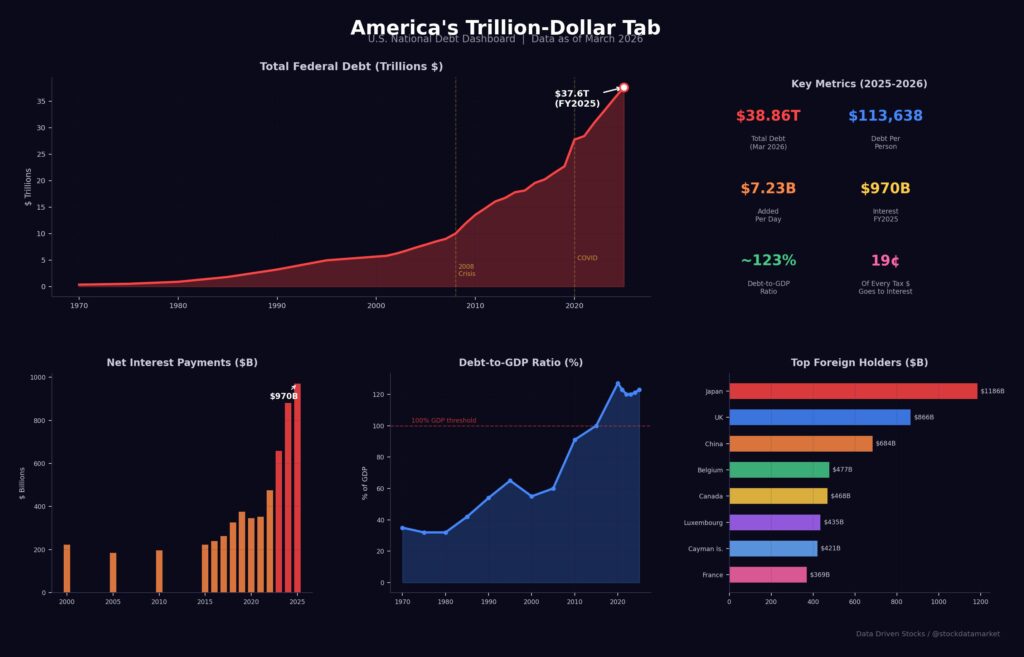
The gross national debt includes debt held by the public as well as intragovernmental holdings. For economists analyzing how federal borrowing affects financial markets, debt held by the public is generally the more relevant measure. The Treasury’s daily debt data provide the official breakdown of total federal debt and its components.
The speed of the recent increase is nevertheless striking. The debt reached $38 trillion in October 2025, crossed $39 trillion in March 2026 and passed $40 trillion in August.
The debt milestone is arriving while Washington is dealing with large annual deficits. The Congressional Budget Office has projected that federal interest costs will exceed $1 trillion in 2026, while Reuters reports that interest expenses have approached roughly $1.2 trillion during the current fiscal year.
That creates an important distinction between borrowing to finance productive investment and borrowing simply to cover existing spending. As interest costs rise, more federal revenue must be devoted to servicing previous debt rather than funding new programs or investments.
The fiscal challenge also does not belong exclusively to one administration. The debt has accumulated through tax policy, military spending, entitlement programs, emergency spending and economic downturns across multiple presidencies. The current administration, however, is responsible for deciding how to manage the trajectory from here.
Higher Treasury Yields Are Turning Debt Into a Bigger Economic Problem
The most immediate financial-market concern is not the $40 trillion figure by itself. It is the cost of financing that debt.
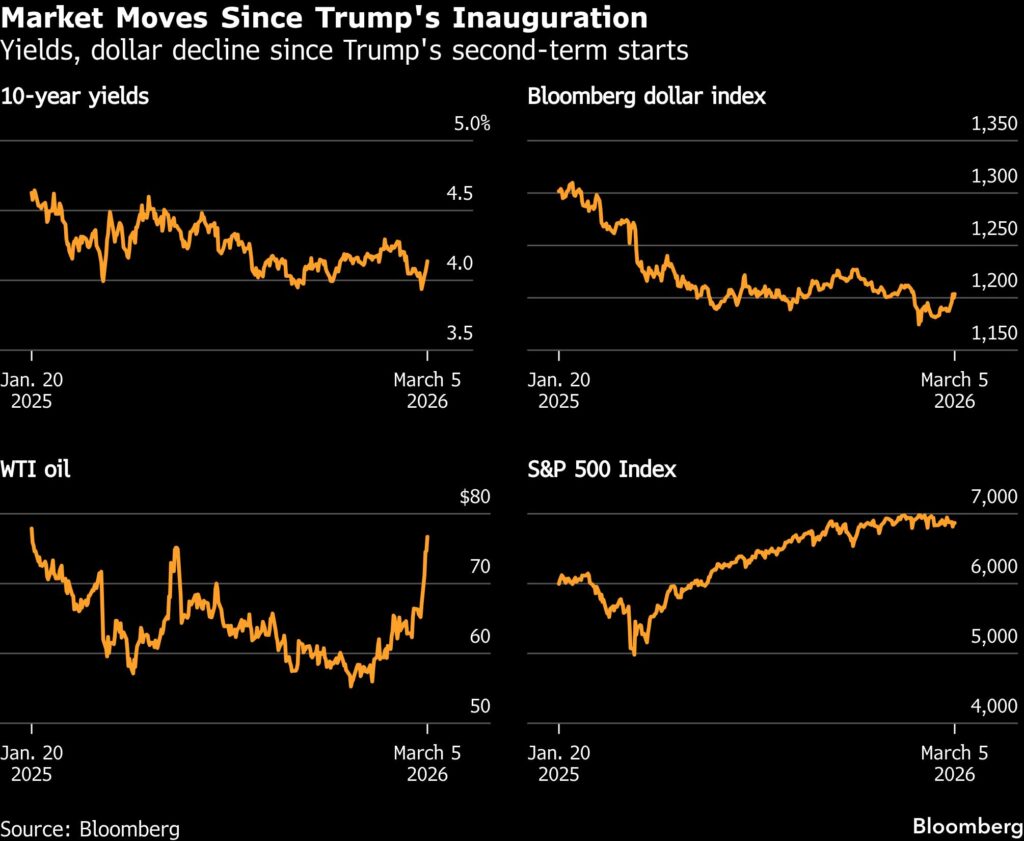
Long-term Treasury yields have risen sharply. The 30-year Treasury yield reached about 5.31% during the week, its highest level in nearly two decades, before ending Friday around 5.28%. The 10-year yield also remained near 4.7%.

Higher yields mean the government must eventually pay more to refinance maturing debt and issue new securities. The effect does not appear instantly across the entire debt portfolio because existing Treasury securities have fixed coupon payments. But as older bonds mature and are replaced with new debt carrying higher yields, the government’s average interest expense can rise.
That creates a potentially difficult feedback loop.
More debt → more interest expense → larger deficits → more borrowing → greater Treasury supply → potentially higher yields.
Markets do not necessarily follow this sequence automatically. U.S. Treasury securities remain among the world’s most liquid and widely held financial assets. But investors can demand greater compensation when they believe fiscal risks, inflation risks or Treasury supply have increased.
That is why the recent bond-market reaction matters.
The Treasury announced plans to double certain long-duration bond buybacks to at least $4 billion per operation, attempting to improve liquidity and support the market. But the initial relief was short-lived, with long-term yields moving higher again.
The response suggests that the market’s concern is not simply a lack of liquidity. Investors are also looking at the underlying fiscal picture.
Inflation and Fuel Prices Make the Problem Harder
Inflation is the second major piece of the puzzle.
The latest Bureau of Labor Statistics report showed that consumer prices increased 3.4% during the 12 months ending in July, down from 3.5% in June. Core CPI, excluding food and energy, increased 2.5%.
Some categories are considerably more expensive than the headline inflation rate suggests.
Energy prices were up 14.7% year over year, while gasoline prices increased 24.6%. Food prices increased 3%, and shelter prices rose 3.2%.
That matters because energy is deeply connected to the broader economy. Higher fuel costs affect transportation, manufacturing, logistics, agriculture and household budgets. Businesses facing higher fuel expenses may eventually raise prices to protect margins.
Recent oil-market developments have added another source of uncertainty. Reuters reported that Brent crude moved above $90 per barrel amid geopolitical tensions, increasing concern that energy costs could keep inflation elevated.
This creates a difficult situation for the Federal Reserve.
If inflation remains too high, the Fed may be reluctant to reduce interest rates quickly. But if the central bank keeps monetary policy restrictive, borrowing costs can remain elevated for households and businesses.
That means the economy can experience pressure from both directions: inflation makes everyday life more expensive while high interest rates make financing more expensive.
What This Means for You
What this means for you: Americans do not personally owe the federal government’s $40 trillion debt, but the debt can still affect household finances through interest rates, taxes, government spending and inflation.
Mortgage borrowers are particularly exposed to long-term Treasury yields. Freddie Mac’s latest survey showed the average 30-year fixed mortgage rate at 6.65% on August 20. That remains far above the ultra-low mortgage rates available during the pandemic period.

A higher mortgage rate can significantly increase the monthly cost of buying a home. Even if home prices stop rising, elevated financing costs can reduce how much a household can afford to borrow.
Auto loans and other consumer credit can also become more expensive when overall interest rates remain high. Small businesses face another challenge because higher borrowing costs can make it harder to finance equipment, expansion, inventory and new employees.
There is an important counterpoint for savers.
Higher interest rates can benefit people who hold cash in high-yield savings accounts, certificates of deposit and certain fixed-income investments. Investors purchasing Treasury securities can also receive higher yields than they would have received when rates were substantially lower.
But higher rates do not benefit everyone equally. A household with substantial savings may appreciate higher yields, while a young family attempting to finance a home can experience the opposite effect.
The national debt also creates a longer-term budget problem because rising interest payments leave less money available for other priorities.
If more federal revenue goes toward interest, policymakers have fewer resources available for infrastructure, defense, education or other programs unless they raise taxes, reduce spending or borrow even more.
Investor Takeaway: Why Markets Are Watching Washington
Investor takeaway: investors should pay close attention to the interaction between Treasury yields, inflation, federal deficits and Federal Reserve policy.
Stocks can perform well even when government debt is high. The U.S. economy continues to contain highly profitable companies, strong technology investment and substantial consumer demand. A large national debt does not automatically produce a stock-market crash.
The concern becomes more serious when debt growth and interest costs coincide with rising inflation and weakening economic growth.
Higher Treasury yields can increase the discount rate used to value future corporate earnings. This can be particularly challenging for expensive growth stocks whose valuations depend heavily on profits expected years into the future.
Companies also face higher financing costs when bond yields rise. Businesses refinancing debt at higher rates may see interest expenses increase, reducing profits unless they can raise prices or grow revenue quickly enough to compensate.
The bond market has already shown signs of stress. AP reported that U.S. stocks suffered their worst daily decline in three weeks on Thursday as renewed concerns about government debt, oil prices, inflation and Treasury yields weighed on investors. The S&P 500 fell 0.9%, the Dow dropped 1.3% and the Nasdaq declined 1%.
That does not mean a major stock-market collapse is inevitable.
It does mean investors need to pay more attention to the bond market than they might during a period of falling inflation and declining yields.
For investors, some of the most important indicators to watch are:
- The 10-year Treasury yield
- The 30-year Treasury yield
- Federal interest expenses
- CPI and PCE inflation
- Oil and gasoline prices
- Federal deficit projections
- Treasury auction demand
- Corporate earnings
- Federal Reserve policy
Together, these indicators provide a much clearer picture than the $40 trillion debt figure alone.
Future Outlook: Can Trump’s Economy Outgrow the Debt?
Future outlook: the biggest question is whether stronger economic growth can reduce the debt burden relative to the size of the economy.
The Trump administration argues that economic expansion, deregulation, investment and efforts to reduce government waste can improve the fiscal outlook. Treasury Secretary Scott Bessent has also emphasized deficit reduction while supporting measures intended to improve Treasury-market liquidity.
The challenge is that growth alone may not be enough if government spending and interest costs continue increasing faster than federal revenues.
The administration also faces political constraints. Cutting major spending programs can be difficult, while raising taxes is politically controversial. At the same time, military and geopolitical costs can change quickly and add unexpected pressure to the budget.
The Treasury’s bond-buyback program could help market liquidity, but it cannot eliminate the underlying debt. Reuters reported that the Treasury’s intervention initially pushed long-term yields lower before the market reversed course.
That is an important distinction.
Market liquidity measures can influence trading conditions. They cannot substitute for long-term fiscal policy.
The debt ceiling is another issue investors will eventually have to consider. Congress previously set the federal debt limit at $41.1 trillion, and analysts cited by The Washington Post have warned that the government could approach that level sooner than previously expected.
A debt-ceiling confrontation would introduce another layer of uncertainty. Even when the government ultimately resolves the issue, political brinkmanship can increase volatility in Treasury markets and financial markets more broadly.
The inflation outlook is equally important.
If inflation continues declining toward the Fed’s 2% objective, Treasury yields could eventually stabilize or fall, reducing pressure on mortgages and other borrowing costs. But if energy prices remain elevated and inflation expectations rise, the Federal Reserve could face less room to cut rates.
That would leave Americans caught between two expensive forces: high government borrowing costs and high private-sector borrowing costs.
The housing market provides a clear example. A 6.65% 30-year mortgage rate is already a major affordability challenge for many buyers. If long-term Treasury yields rise substantially further, mortgage rates could face additional upward pressure.
For investors, the most favorable scenario would be one in which economic growth remains solid, inflation gradually falls, Treasury yields stabilize and corporate earnings continue expanding.
The more dangerous scenario would be different:
Higher debt + higher Treasury yields + persistent inflation + weaker growth.
That combination could pressure stocks, housing, business investment and consumer spending simultaneously.
It is also important not to confuse the $40 trillion milestone with an immediate fiscal crisis. The United States still has deep capital markets, a globally important currency and enormous economic resources. The dollar and Treasury market remain central to global finance.
But the cost of ignoring fiscal pressures can rise gradually before becoming visible as a crisis.
The latest bond-market movements show that investors are beginning to demand more compensation for holding long-term U.S. government debt. The 30-year yield’s move to levels last seen around the 2007 era is therefore an important warning signal, even if it does not prove that a financial crisis is approaching.
The next stage of Trump’s economic agenda will consequently be judged on more than GDP growth or stock-market performance.
Investors and voters will increasingly want to know whether the administration can reduce the growth of deficits, keep inflation under control, stabilize borrowing costs and maintain confidence in U.S. Treasury securities.
The $40 trillion debt milestone has made those questions impossible to ignore.
America’s fiscal challenge is not simply about a number on a government balance sheet. It can eventually appear in mortgage payments, business loans, Treasury yields, federal interest costs, consumer prices and investment returns.
That is why the interaction between debt, inflation and borrowing costs may become one of the most important economic stories of the remainder of 2026.
Subscribe to trusted news sites like USnewsSphere.com for continuous updates.