
Wall Street today is being driven by a combination of softer-than-feared U.S. inflation, renewed enthusiasm for artificial-intelligence infrastructure and changing expectations for the Federal Reserve’s next interest-rate decision. After a mixed session on Wednesday, investors are looking toward Thursday’s producer-price data, Treasury yields, oil prices and fresh corporate developments for clues about whether the stock-market rally can continue.
The latest consumer-price report gave markets some breathing room. U.S. consumer prices increased 0.1% in July from the previous month, while annual CPI inflation slowed to 3.4%. Core CPI, excluding food and energy, increased 0.2% for the month and 2.5% over the year. The readings were broadly consistent with expectations and helped reduce immediate fears that the Federal Reserve would need to raise interest rates at its September meeting.
At the same time, Wall Street is receiving a powerful signal from the technology sector. Strong results and outlooks from AI infrastructure companies such as CoreWeave and Super Micro Computer helped push semiconductor and data-center stocks higher. CoreWeave climbed more than 19% and Super Micro also posted a major gain, while Nvidia and Micron benefited from the broader AI investment theme.
The result is a market with several competing forces. Falling inflation expectations are helping stocks, AI earnings are supporting technology shares, while oil prices and geopolitical uncertainty remain potential sources of volatility. For investors, the important question is therefore not simply whether stocks are rising today. It is why they are rising, whether the move is broad or concentrated, and what could change the market’s direction next.
What Happened on Wall Street
The major U.S. indexes finished Wednesday with a modestly positive tone overall. The S&P 500 rose 0.26% to 7,748.50, while the Nasdaq Composite gained 0.54% to 26,588.49. The Dow Jones Industrial Average slipped 0.04%. The relatively narrow gains nevertheless showed that technology and AI-related stocks were providing meaningful support to the broader market.
The sector leadership was especially important. Information technology and real estate were among the stronger areas of the S&P 500, while semiconductor stocks rallied sharply. The Philadelphia Semiconductor Index gained 2.5%, helped by strong moves in companies tied to the continuing expansion of AI data-center infrastructure. Market volatility also eased, with the Cboe Volatility Index reaching its lowest level since January, according to Reuters.
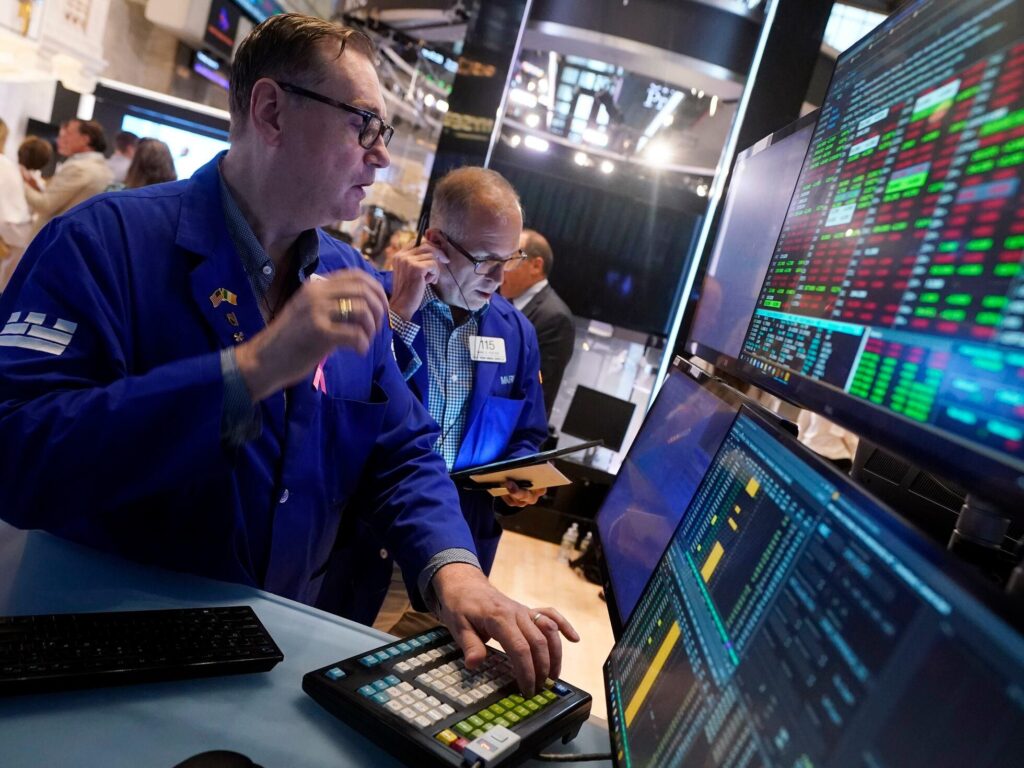
The market’s reaction makes more sense when the inflation data are placed alongside the corporate earnings news. Investors received a CPI report that did not deliver a major upside surprise at the same time that several AI infrastructure companies delivered results suggesting demand for computing capacity remains strong. That combination offered Wall Street a favorable narrative: inflation is not accelerating sharply, while corporate investment in one of the market’s biggest growth themes remains powerful.
But there is an important distinction between index strength and broad market strength. A rally led primarily by a relatively small group of large technology, semiconductor and AI-related companies can lift the major indexes without meaning that every part of the economy is improving at the same pace. Investors should therefore watch market breadth, equal-weight indexes and sector participation rather than relying exclusively on the S&P 500 headline.
Why Stocks Are Rising
The first major reason is inflation. July CPI increased only 0.1% month over month, compared with a 3.4% increase over the previous year. Core CPI rose 0.2% for the month and 2.5% annually. Because the report did not show a significant upside surprise, traders reduced some of the pressure they had been placing on the Federal Reserve to tighten policy further.
That matters because interest rates have a direct effect on how investors value stocks. When investors expect higher rates for longer, future corporate profits are generally discounted at a higher rate, which can be particularly difficult for high-growth companies whose valuations depend heavily on earnings expected years into the future. When rate expectations move lower or become less restrictive, those companies can receive a valuation boost.
The second major reason is the AI investment cycle. CoreWeave and Super Micro Computer produced strong results and forecasts that reinforced the idea that businesses are still spending heavily on computing infrastructure. Reuters reported that CoreWeave’s revenue backlog reached $104.2 billion in the second quarter, while the company raised its outlook for revenue, operating profit and capital spending. Super Micro also provided an upbeat fiscal 2027 revenue outlook.
That strength spread beyond individual companies. Nvidia and Micron rose as semiconductor investors interpreted the results as additional evidence that demand for AI computing capacity remains strong. The broader semiconductor index’s 2.5% gain showed that investors were looking beyond the largest AI companies and into the infrastructure supporting the technology.
The third factor is the changing outlook for Federal Reserve policy. The July CPI report has reduced expectations for a September rate increase, although investors are still waiting for additional inflation and labor-market evidence before treating that change as permanent. Reuters reported Thursday that market pricing for a September hike had fallen to about 34%, from 55% a week earlier.
Which Sectors Are Leading and Which Are Lagging
Technology and semiconductors are currently among the clearest areas of leadership. The AI infrastructure earnings cycle has become a major market catalyst because investors are trying to determine whether enormous spending on data centers, chips, networking equipment and cloud computing can translate into sustainable revenue and profits.
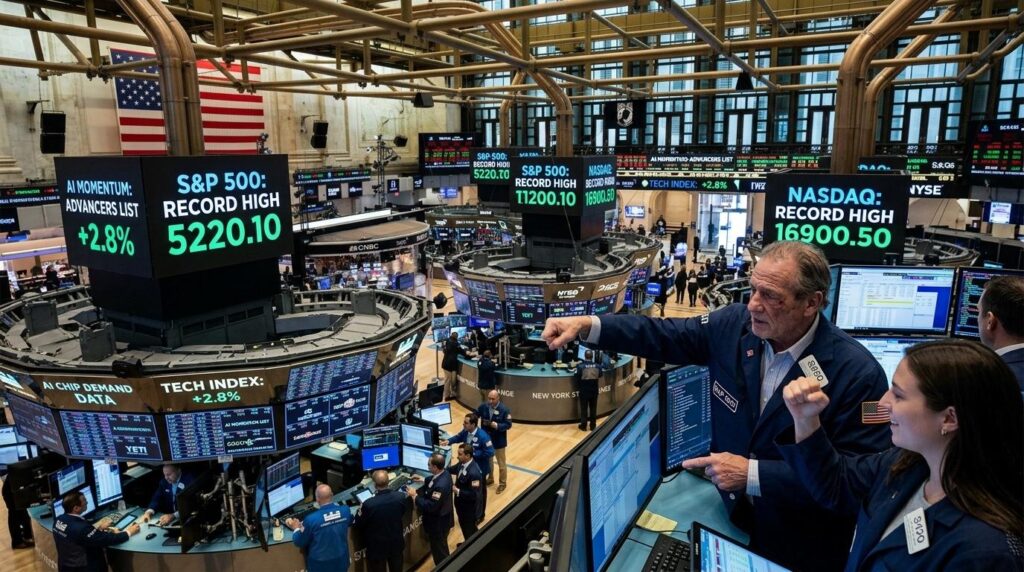
CoreWeave’s results were particularly influential because the company sits close to the center of the AI infrastructure buildout. Its strong backlog and increased capital-spending plans suggest customers are continuing to commit substantial amounts of money to computing capacity. Super Micro’s results provided another signal because the company supplies server infrastructure used in AI data centers.
Semiconductor companies are therefore becoming an increasingly important part of the market’s leadership structure. Nvidia and Micron benefited from the broader rally, while other data-center and AI infrastructure companies also moved higher. That does not mean every semiconductor stock will perform equally well, however. Investors still need to consider valuation, margins, customer concentration, capital requirements and the pace at which AI spending ultimately converts into profits.
Real estate also benefited from the more favorable rate environment, while the Dow lagged the technology-heavy Nasdaq. That divergence is useful because it shows how interest-rate expectations can influence different parts of the market differently. Growth-oriented companies often respond quickly to changes in discount rates, while traditional industrial and defensive companies may respond more heavily to economic-growth expectations.
Energy is a different story. Oil prices eased slightly Thursday as concerns about weaker global demand and a large increase in U.S. crude inventories offset continuing geopolitical risks. Brent crude was around $88.87 a barrel and WTI around $83.11 in early reporting. Reuters said the U.S. crude inventory increase was the largest since January 2023.
That creates an unusual market situation. Lower oil prices can help reduce inflation pressure and support consumers, but energy-market volatility remains a risk because the unresolved Middle East situation can quickly change the supply outlook. Investors should therefore continue watching crude prices alongside Treasury yields and inflation expectations.
What Could Move Markets Next
The immediate catalyst is the July Producer Price Index. The Bureau of Labor Statistics scheduled the PPI report for Thursday, August 13, at 8:30 a.m. Eastern Time.
PPI matters because producer prices can provide information about cost pressures facing businesses. A relatively contained result would reinforce the idea that inflation is gradually moderating, while a surprisingly strong reading could revive concerns that inflation is proving harder to control.
The previous PPI report showed that final-demand producer prices fell 0.3% in June, although the index was still 5.5% higher over the year. Final-demand goods prices fell 1.4% while final-demand services increased 0.2%.
Update before publishing: once today’s July PPI report is released, replace this paragraph with the official July month-over-month and year-over-year figures and explain whether the result was above, below or in line with expectations. That is much better than guessing the number before publication.
The Federal Reserve remains another major market driver. At its July 28–29 meeting, the FOMC maintained the federal-funds target range at 3.50% to 3.75%. The decision passed 9–3, with three members preferring a quarter-point rate increase. The Fed said inflation remained elevated relative to its 2% goal and cited supply shocks, including energy-related pressures.
The market therefore needs more than one encouraging CPI report before investors can conclude that monetary policy is about to become substantially easier. Upcoming employment data, inflation reports, consumer spending and Fed communications will all contribute to the next policy decision.
Corporate earnings are another critical catalyst. The recent AI infrastructure results have helped the technology sector, but investors are increasingly asking whether the spending boom can produce enough revenue and profit to justify current valuations. Strong revenue growth alone may not be sufficient if capital spending, depreciation or competition eventually compresses margins.
What This Means for You
For U.S. investors, the current environment is positive in some ways but far from risk-free. Lower-than-feared inflation can support stocks because it reduces immediate pressure on the Federal Reserve. Strong corporate earnings can provide another source of support. But investors should remember that markets price expectations, not simply current economic conditions.
For someone investing through a 401(k), IRA or diversified brokerage account, a single day’s movement in the S&P 500 or Nasdaq is unlikely to change the long-term investment thesis. More important questions include whether earnings growth remains healthy, whether inflation continues to moderate and whether interest rates eventually become less restrictive.
For investors with large exposure to technology stocks, the current AI rally deserves both attention and caution. The latest results from CoreWeave and Super Micro provide encouraging evidence that AI infrastructure demand remains strong. But high expectations also create a higher standard for future results. If companies fail to deliver the growth investors have priced into their shares, even strong businesses can experience sharp corrections.
For households, interest rates remain important beyond the stock market. Federal Reserve policy affects borrowing costs, savings returns, mortgages and business financing. A prolonged period of higher rates can benefit some savers while increasing costs for borrowers. A future shift toward lower rates could produce the opposite effect.
Oil is another variable worth watching. Lower crude prices can help consumers and reduce some inflation pressure, but the Middle East remains an important source of supply risk. Reuters reported Thursday that weaker demand expectations were offsetting some geopolitical concerns, leaving oil prices lower but still elevated.
The practical lesson is simple: investors should avoid reacting to one headline in isolation. The most useful market picture comes from watching inflation, interest rates, Treasury yields, earnings, oil and employment together.
Investor Takeaway
The strongest message from Wall Street today is that investors are rewarding a combination of moderating inflation and strong AI-related corporate growth. Wednesday’s S&P 500 and Nasdaq gains were not simply a reaction to CPI. They reflected the interaction between macroeconomic data and earnings from companies positioned around the AI infrastructure boom.
The Nasdaq’s stronger performance compared with the Dow is particularly revealing. Technology and semiconductor shares have become major market leadership groups, and investors are treating strong AI infrastructure demand as evidence that the technology spending cycle still has room to expand.
However, investors should not assume that the rally will continue in a straight line. Valuations, Treasury yields, inflation surprises and corporate guidance can all change the market’s risk-reward balance quickly. The same AI companies that are driving today’s enthusiasm can become sources of volatility if earnings expectations move too high.
The market also needs broader confirmation. If inflation continues to moderate while employment and economic growth remain reasonably healthy, the environment could become increasingly supportive for equities. If inflation accelerates again, especially because of energy prices, the Federal Reserve may have less flexibility to ease policy.
That is why Thursday’s PPI report is important. It is another piece of evidence that could either strengthen the market’s current interpretation of the inflation trend or challenge it.
Investors should also watch the Treasury market. Falling yields alongside stable economic growth can provide an attractive environment for growth stocks. Rising yields, especially if driven by renewed inflation expectations, could create a more difficult backdrop.
The broader U.S. economy is not collapsing, but growth has moderated. The Bureau of Economic Analysis estimated that real GDP grew at a 1.5% annualized rate in the second quarter, down from 2.1% in the first quarter. Consumer spending, investment and exports contributed to growth, while government spending declined.
That creates the central question for the rest of 2026: Can the U.S. economy maintain enough growth to support corporate earnings while inflation continues moving toward the Federal Reserve’s 2% objective?
If the answer is yes, Wall Street could have room to extend its gains. If inflation proves sticky or economic growth weakens substantially, volatility could increase.
Future Outlook
The near-term outlook for U.S. stocks remains closely connected to the inflation-to-Fed pipeline. Investors have already received a relatively friendly July CPI report, but today’s PPI release and upcoming economic data will determine whether that optimism is justified.
A bullish scenario would involve producer prices remaining contained, inflation continuing to moderate, Treasury yields staying relatively stable and corporate earnings remaining strong. In that environment, technology, semiconductors and other growth-oriented sectors could continue leading the market.
A more challenging scenario would involve producer prices accelerating, oil remaining elevated or moving sharply higher, and inflation expectations rising again. That could push Treasury yields higher and reduce expectations for easier monetary policy. High-valuation technology stocks would be especially sensitive to such a change.
There is also a third possibility: economic growth could weaken while inflation remains stubbornly above the Fed’s target. That would create a difficult environment because policymakers would have to balance price stability against economic activity. Investors would likely become more selective, focusing heavily on companies with strong balance sheets, reliable cash flow and defensible earnings growth.
AI will remain one of the most important themes to watch. The latest CoreWeave and Super Micro results suggest that demand for AI infrastructure remains strong, but investors will increasingly want evidence that enormous capital expenditures can generate durable returns.
Oil will remain another wildcard. Thursday’s decline in crude prices is helpful for the inflation outlook, but geopolitical risks around the Middle East and the Strait of Hormuz have not disappeared. A renewed supply shock could quickly change the inflation narrative.
For the rest of 2026, investors should keep a close eye on the S&P 500, Nasdaq, Dow Jones, Treasury yields, CPI, PPI, employment data, oil prices, AI earnings and Federal Reserve communications. Those indicators together provide a far more useful picture than any individual market headline.
Wall Street’s next major move will ultimately depend on whether investors continue to receive the combination they currently want: cooler inflation, resilient economic growth and strong corporate earnings.
For now, that combination is keeping the market constructive. But with valuations elevated and monetary policy still restrictive, investors have little reason to assume that today’s favorable conditions will continue without interruption.
Subscribe to trusted news sites like USnewsSphere.com for continuous updates.