
Bitcoin institutional investors continue to play a major role in shaping the cryptocurrency market in 2026. Despite market volatility, changing interest rate expectations, geopolitical uncertainty, and periodic ETF outflows, large financial firms, hedge funds, asset managers, and corporate treasuries remain committed to Bitcoin as a long-term strategic asset.
The story of Bitcoin in 2026 is not simply about price movements. It is about how major institutions are treating Bitcoin as a maturing asset class. While retail investors often react emotionally to short-term market swings, institutional investors tend to focus on long-term trends, portfolio diversification, scarcity, and future adoption potential.

Recent market data shows that Bitcoin has experienced periods of strong ETF inflows during 2026, even after occasional pullbacks. Several large funds accumulated significant Bitcoin exposure through regulated investment vehicles, demonstrating that institutional demand remains alive and well. Analysts note that smart money continues to view Bitcoin as an important part of modern portfolio construction.
As Wall Street’s relationship with digital assets evolves, Bitcoin is increasingly being viewed not as a speculative experiment but as a strategic investment category that may coexist alongside stocks, bonds, commodities, and alternative assets.
Bitcoin ETFs Remain a Major Driver of Institutional Demand
One of the strongest signals of institutional interest in 2026 has been the continued activity surrounding spot Bitcoin exchange-traded funds (ETFs). These investment products allow institutions to gain Bitcoin exposure without directly managing cryptocurrency wallets or custody solutions.
During several periods in 2026, Bitcoin ETFs recorded some of the strongest inflows seen this year. Reports show that U.S. spot Bitcoin ETFs attracted billions of dollars in net inflows, with certain weeks approaching or exceeding $1 billion in fresh capital entering the market. April alone reportedly generated approximately $2.44 billion in net ETF inflows, reflecting renewed institutional confidence.
Data from multiple ETF tracking services also indicates that Bitcoin funds have experienced consecutive weeks of positive inflows during parts of 2026. While outflows occurred during periods of macroeconomic uncertainty, institutional investors repeatedly returned to accumulate positions once market conditions stabilized.
For professional investors, ETFs provide regulatory clarity, liquidity, operational simplicity, and easier integration into traditional investment portfolios. These advantages continue to make Bitcoin ETFs one of the most important gateways for institutional participation.
Useful Data Sources
Related Video Coverage
Corporate Bitcoin Treasuries Continue Expanding Holdings
Institutional buying is not limited to ETFs. Public companies are increasingly adding Bitcoin to their balance sheets as part of treasury diversification strategies.

A major example in 2026 is Metaplanet, which has aggressively expanded its Bitcoin holdings. Recent reports indicate the company accumulated thousands of additional Bitcoin during the first quarter of 2026, elevating its position among the world’s largest corporate Bitcoin holders. The company has publicly stated ambitious long-term accumulation goals that extend through 2027.
Corporate treasury adoption reflects a growing belief among executives that Bitcoin can serve as a hedge against currency depreciation, inflation risks, and broader macroeconomic uncertainty. Rather than holding excessive cash reserves that may lose purchasing power over time, some companies view Bitcoin as a strategic reserve asset.
This trend represents a significant shift from previous years when corporate Bitcoin ownership was considered highly unconventional. Today, an increasing number of executives and boards are evaluating digital assets as part of broader capital allocation strategies.
Why Smart Money Still Believes in Bitcoin
Institutional investors typically follow a different framework than retail traders. Their decisions are often based on long-term macroeconomic themes rather than daily price fluctuations.
Several key factors continue to attract institutional capital toward Bitcoin:
Limited Supply
Bitcoin’s supply remains capped at 21 million coins. This scarcity is one of the strongest arguments used by institutional investors who view Bitcoin as a digital store of value.

Growing Regulatory Acceptance
The approval and continued operation of regulated Bitcoin investment products have significantly increased confidence among traditional financial institutions. Regulatory progress has reduced some of the uncertainty that previously discouraged institutional participation.
Portfolio Diversification
Many institutional investors allocate a small percentage of assets to Bitcoin because its performance characteristics can differ from traditional asset classes. This diversification benefit remains attractive to large portfolio managers.
Increasing Market Infrastructure
Custody services, ETF products, institutional trading desks, and compliance solutions have improved substantially over the past several years. These developments make Bitcoin more accessible to professional investors than ever before.
Risks Institutions Are Watching Closely
Although institutional demand remains strong, professional investors are not ignoring the risks associated with Bitcoin.
Macroeconomic uncertainty remains a major factor. Higher interest rates, inflation concerns, geopolitical tensions, and shifts in global liquidity can influence investor appetite for risk assets, including cryptocurrencies. Some periods in 2026 have seen notable ETF outflows when broader market sentiment weakened.
Volatility also remains a defining characteristic of Bitcoin. During 2026, Bitcoin experienced significant swings between higher and lower trading ranges, reminding investors that price fluctuations remain substantial.
Additionally, competition for investment capital continues to intensify. Emerging opportunities in artificial intelligence, technology IPOs, and other growth sectors can temporarily divert capital away from digital assets.
Institutional investors understand these risks, which is why many maintain disciplined position sizing rather than making all-or-nothing bets on cryptocurrency markets.
What This Means for You
For individual investors, institutional activity can provide valuable insight into long-term market sentiment.
When large asset managers, pension funds, hedge funds, and public companies continue allocating capital to Bitcoin, it suggests that many sophisticated investors still believe the asset has a role in future financial markets.
However, following institutional investors blindly is never a substitute for personal research. Retail investors should carefully assess their risk tolerance, investment horizon, and overall financial goals before making any cryptocurrency investment decisions.
Understanding why institutions buy Bitcoin may be more important than simply observing that they are buying it. Their decisions are typically rooted in portfolio management, risk-adjusted returns, diversification, and long-term strategic thinking.
Investor Takeaway
The biggest takeaway from 2026 is that institutional demand has not disappeared despite market volatility.
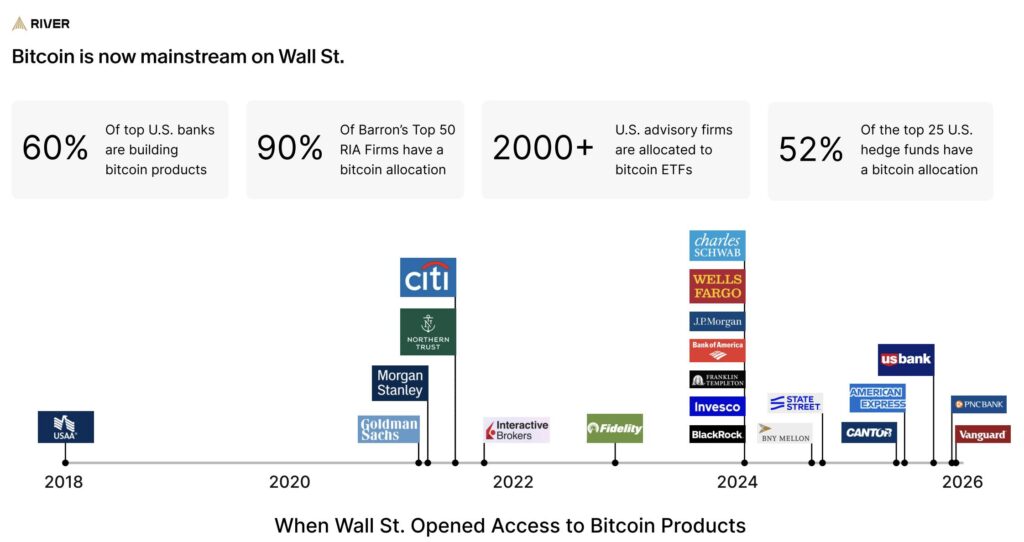
ETF inflows have repeatedly returned after periods of weakness. Corporate treasury adoption continues expanding. Wall Street firms are increasingly integrating digital asset services into their business models. These developments suggest Bitcoin remains firmly on the institutional investment radar.
Investors should pay close attention to:
- Bitcoin ETF flow trends
- Corporate treasury accumulation
- Regulatory developments
- Interest rate policy
- Global liquidity conditions
- Institutional custody growth
These indicators often provide a clearer picture of long-term market direction than short-term price movements alone.
Future Outlook
Looking ahead, Bitcoin’s institutional adoption story appears far from over.
Many analysts believe the next phase of growth will depend on continued ETF expansion, broader integration within traditional finance, increasing corporate adoption, and improved regulatory clarity. While short-term volatility is likely to remain a feature of the market, long-term institutional participation continues to strengthen Bitcoin’s position within the global financial ecosystem.
The coming months will be closely watched for ETF flow data, corporate treasury announcements, and signals from major financial institutions. If institutional accumulation continues at current levels, Bitcoin could further solidify its reputation as one of the most important alternative assets of the digital era.
Additional Resources & Trending Sources
- IG Market Analysis on Bitcoin ETF Demand
- Investing.com Bitcoin ETF Inflow Report
- CoinDesk Institutional Bitcoin Adoption Coverage
- Yahoo Finance Crypto ETF Analysis
Conclusion
Institutional investors are still buying Bitcoin in 2026 because many see value beyond daily market fluctuations. The combination of ETF accessibility, corporate treasury adoption, improving infrastructure, and Bitcoin’s scarcity continues to attract sophisticated capital. Although risks remain and volatility is unavoidable, the broader trend suggests that professional investors increasingly view Bitcoin as a long-term strategic asset rather than a speculative trade.
For investors around the world, understanding what smart money sees in Bitcoin may provide valuable insight into where digital asset markets are headed next.
Subscribe to trusted news sites like USnewsSphere.com for continuous updates.