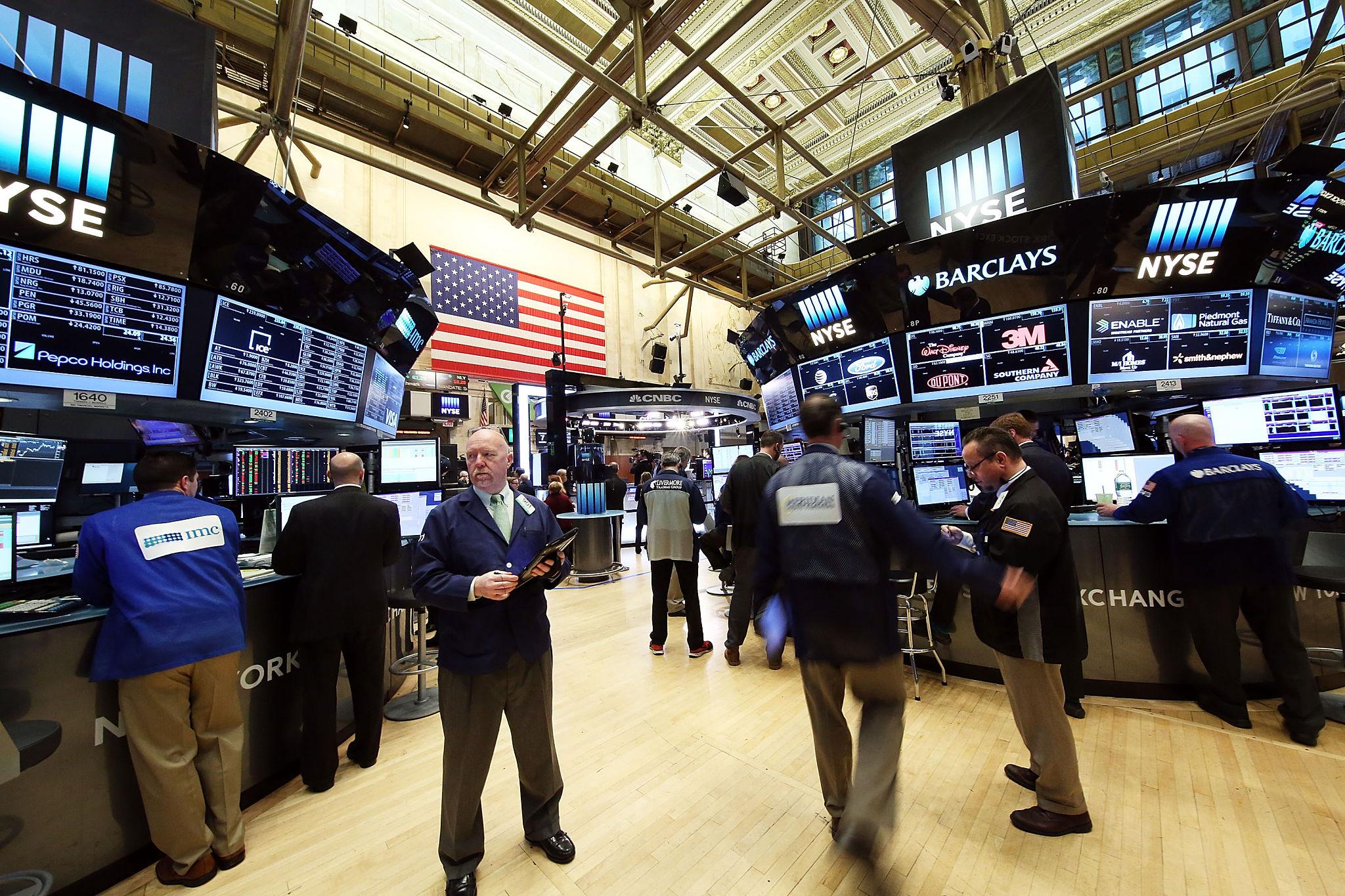
U.S. stock market today saw the S&P 500, Nasdaq and Dow Jones Industrial Average retreat on Friday, August 14, after unexpectedly weak July retail sales raised fresh questions about the strength of American consumers and the broader economic outlook. The pullback came just one session after the S&P 500 reached another record closing high, highlighting how quickly investor attention shifted from easing inflation and artificial-intelligence optimism toward signs of slower consumer demand.
The S&P 500 finished at 7,785.76, down 0.17%, while the Dow Jones Industrial Average fell 0.20% to 53,732.41. The Nasdaq Composite declined 0.28% to 26,729.16. The Russell 2000 moved in the opposite direction, gaining about 0.5%, showing that Friday’s weakness was not a broad collapse across every part of the equity market.

The key economic catalyst was the July retail-sales report. U.S. retail and food-services sales fell 0.6% from June to approximately $763.6 billion, marking the first monthly decline in nine months and coming in below expectations for a modest increase. Sales were nevertheless about 5% higher than a year earlier, an important detail that suggests the data point to cooling momentum rather than an immediate collapse in consumer spending.
Wall Street Pulls Back After S&P 500 Record
Friday’s decline needs to be viewed in context. The S&P 500 had just recorded its 27th record closing high of 2026 on Thursday, helped by softer inflation data and continued enthusiasm surrounding technology and artificial-intelligence companies. That left stocks vulnerable to profit-taking when the latest economic figures failed to reinforce the market’s increasingly optimistic growth narrative.
The market initially showed more resilience before turning lower. Investors were balancing two competing interpretations of the retail-sales report. A weaker consumer could mean the economy is losing momentum, which is negative for corporate earnings. At the same time, softer demand could reduce inflation pressure and make monetary policy less restrictive, potentially helping stocks through lower future interest-rate expectations. That tension explains why Friday’s losses remained relatively limited rather than turning into a major selloff.
The weekly picture was considerably stronger than Friday’s session. The S&P 500 gained about 0.4% for the week, while the Nasdaq advanced roughly 0.1%. The Dow was weaker, falling around 0.6% for the week, while the Russell 2000 gained approximately 1.1%. Year to date, the major U.S. benchmarks remained substantially higher, with the Russell 2000 up about 23.6%, the Nasdaq 15%, the S&P 500 13.7% and the Dow 11.8%.
Weak Retail Sales Put the U.S. Consumer Back in Focus
The July retail-sales number was the biggest economic surprise of the session. Economists had expected retail activity to remain roughly stable or increase slightly, but instead headline sales declined 0.6%. The Census Bureau’s advance retail-sales series is designed to provide an early reading of consumer activity and is based on a sample of businesses, meaning the initial estimate can be revised as more information becomes available.
Several factors appear to have contributed to the decline. Lower gasoline prices reduced receipts at gas stations, while internet and mail-order sales dropped about 2.3% during July after a particularly strong online-shopping period associated with June’s major promotional events. Auto sales also weakened. At the same time, spending at restaurants and drinking places increased about 0.5%, suggesting that consumers did not suddenly stop spending across the economy.
That distinction matters for investors. Retail sales are an important indicator of consumer demand, but they do not capture every form of household spending. Services such as travel, entertainment and other activities are not fully represented in the headline retail-sales figure. Some economists therefore see the July decline as a warning that momentum is cooling rather than evidence that the U.S. consumer has entered a severe contraction.
The year-over-year comparison provides another reason for caution before declaring a major consumer downturn. Retail sales remained approximately 5% above July 2025 levels. The question for markets is therefore not simply whether Americans spent less in July, but whether the weakness continues through August and September.
Nasdaq Takes Pressure From Chip and AI Stocks
Technology shares were another important source of Friday’s weakness. Semiconductor stocks came under pressure after a powerful recent rally, with Applied Materials falling about 5.1% despite reporting stronger results and an upbeat outlook. Broadcom and Intel also weakened as investors reassessed valuations and expectations surrounding the semiconductor and AI investment cycle.
This is significant because the Nasdaq and S&P 500 have benefited heavily from enthusiasm surrounding artificial intelligence, cloud computing, data centers and semiconductor demand. When investors begin taking profits in highly valued technology companies, the effect can spread quickly through index-heavy sectors because several major technology businesses carry substantial weights in the major benchmarks.
However, Friday’s session did not show that investors were abandoning technology altogether. Instead, it looked more like a combination of profit-taking, valuation concerns and a reassessment of the economic backdrop. Strong corporate earnings remain an important support for the market. Reuters reported that second-quarter S&P 500 earnings had increased sharply, with major companies including Amazon and Microsoft contributing to the strength.
One notable winner was Reddit, which surged roughly 13% after news that it would join the S&P 500, replacing AvalonBay. The move demonstrated that even during a cautious market session, company-specific catalysts could still produce significant gains.
Oil, Inflation and the Federal Reserve Add Another Layer of Risk
The retail-sales report was only one part of Friday’s market equation. Oil prices also rose as investors monitored escalating tensions surrounding the Middle East and the Strait of Hormuz. Higher crude prices can create a difficult situation for the Federal Reserve because they can simultaneously hurt consumers while increasing inflation risks.
That creates a complicated policy environment. If consumer demand weakens, investors may expect the Federal Reserve to become more willing to ease monetary policy. Lower interest rates generally make stocks more attractive because they reduce borrowing costs and can increase the present value assigned to future corporate earnings.
But an oil-price shock can work in the opposite direction. If energy prices rise sharply and push inflation higher, the Federal Reserve may have less room to respond aggressively to slowing growth. This is one reason Friday’s market reaction was more nuanced than simply “bad retail sales equals good for stocks.”
Recent inflation data had been encouraging enough to support optimism about monetary policy. Producer prices were unexpectedly flat in July, while consumer inflation remained elevated but showed signs of moderation. Those figures had helped the S&P 500 reach record territory.
The market is therefore entering a period in which investors will be watching the interaction between growth, inflation, oil prices and Federal Reserve policy rather than focusing on any single economic indicator.
What This Means for You, Investor Takeaway and Future Outlook
What this means for you: For ordinary investors, Friday’s decline is better understood as a warning about volatility than as proof that a major stock-market crash has begun. The S&P 500, Nasdaq and Dow remain far above their levels from earlier in the year, and the broader weekly performance was still positive for two of the three major benchmarks. A single month of weaker retail sales does not establish a long-term economic trend.
The more important signal will come from the next several consumer and labor-market reports. If retail spending continues to weaken while employment and household income also deteriorate, investors could become increasingly concerned about corporate revenue and earnings. If July proves to be a temporary slowdown caused partly by unusual spending patterns, the market could quickly return its attention to earnings, AI investment and monetary policy.
Investor takeaway: Investors should pay particular attention to whether weakness broadens beyond a handful of retail categories. The July data included meaningful declines in areas such as online sales, automobiles and gasoline receipts, while restaurants remained stronger. That mixed picture argues against making an aggressive market call based on one report.
For diversified investors, the latest data also reinforce the importance of managing concentration risk. Technology and semiconductor stocks have played a major role in the market’s gains, but sectors such as energy, utilities, industrials and materials showed relative strength on Friday. Reuters reported that the S&P 500 energy sector gained about 1.4% as crude prices moved higher.
Future outlook: The next phase of the market could be determined by whether the economy achieves a relatively soft landing or moves toward a more pronounced slowdown. The ideal scenario for equities would be cooling inflation without a major deterioration in consumer spending or employment. Such an environment could allow monetary policy to become less restrictive while corporate earnings remain healthy.
The more difficult scenario would be simultaneous weakness in consumer demand and renewed inflation caused by higher energy prices. That combination would make it harder for policymakers to support growth without risking another inflationary episode.
Investors will also be watching upcoming Federal Reserve communications and economic releases. The Census Bureau’s schedule shows that the next advance monthly retail-sales report, covering August activity, is due on September 16, 2026, providing another important test of whether July represented a temporary setback or the beginning of a broader slowdown.
For now, the most accurate reading is that Wall Street remains bullish but increasingly sensitive to signs that the U.S. economy may be losing momentum. The fact that the S&P 500 finished only modestly lower after reaching a record high illustrates the market’s resilience. But the weak retail-sales figure has introduced a new question investors cannot easily ignore: How long can stocks continue climbing if American consumers begin pulling back?
Market Snapshot: August 14, 2026
| Index | Friday Close | Daily Move | Weekly Move |
|---|---|---|---|
| S&P 500 | 7,785.76 | -0.17% | +0.4% |
| Dow Jones | 53,732.41 | -0.20% | -0.6% |
| Nasdaq Composite | 26,729.16 | -0.28% | +0.1% |
| Russell 2000 | 3,068.42 | +0.5% | +1.1% |
*Market figures are based on the August 14, 2026 close.
Useful Primary and Market Sources
For readers who want to verify the underlying numbers, the U.S. Census Bureau’s retail-sales data is the most important primary source. The Bureau explains that its advance retail-sales estimates provide an early measure of retail and food-services activity and can subsequently be revised.
U.S. Census Bureau — Monthly Retail Trade
For additional market context, Reuters’ latest report covers the S&P 500’s Friday close, technology-stock weakness, energy-sector performance and the broader economic backdrop.
Reuters — S&P 500 ends lower as investors weigh data and Middle East tensions
Readers looking for an audio/video-style market briefing can also use Reuters’ current Morning Bid episode, which discusses inflation, the S&P 500’s record levels and changing expectations for Federal Reserve policy.
Reuters Morning Bid — August 14, 2026
Bottom Line
The U.S. stock market today delivered a relatively modest decline rather than a major selloff, but the message from Wall Street was important. The S&P 500, Nasdaq and Dow all moved lower as investors digested a surprisingly weak July retail-sales report and renewed concerns about the durability of U.S. economic growth.
The decline does not necessarily signal the end of the market’s rally. The S&P 500 and Nasdaq still finished the week higher, corporate earnings remain supportive and investors continue to see potential benefits from moderating inflation and future monetary-policy changes.
At the same time, the latest numbers make the consumer an increasingly important variable for the rest of 2026. If spending stabilizes, markets could regain momentum. If July proves to be the first sign of a sustained consumer slowdown, investors may begin demanding more evidence that corporate earnings can justify historically elevated valuations.
For now, the most important numbers to watch are retail sales, employment, inflation, oil prices, Treasury yields and Federal Reserve expectations. Together, they will provide a much clearer picture of whether Friday’s weakness was simply a pause after record highs—or the beginning of a more meaningful change in the market’s economic outlook.
Subscribe to trusted news sites like USnewsSphere.com for continuous updates.