
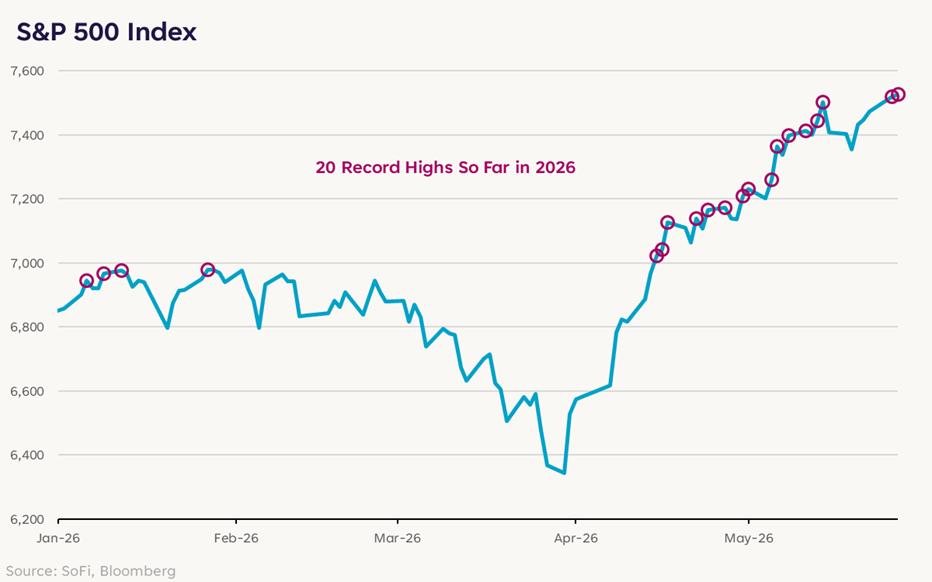
The S&P 500 record rally has pushed U.S. stocks into one of the most closely watched phases of the 2026 bull market, with investors now debating whether share prices are moving faster than the corporate earnings needed to justify them. The benchmark reached a record closing level of 7,798.99 on August 13 before pulling back modestly to 7,785.76 on August 14. Even after that decline, the index remained roughly 13.7% higher for the year.
At first glance, the rally appears vulnerable to the classic problem of stretched valuations. The S&P 500 is trading at historically elevated valuation levels, while investors have become increasingly confident that artificial intelligence, resilient corporate profits and a less restrictive Federal Reserve will keep supporting equities. Yet the fundamental picture is not simply a story of stocks rising without earnings support. Corporate profits have also increased substantially, and the latest earnings season has produced unusually strong results.
That creates a more interesting question for investors: is the market fundamentally wrong, or is it simply pricing in a very strong future before that growth has fully arrived? The answer may determine whether the next phase of the rally becomes another leg higher or a period of painful valuation adjustment.
The S&P 500 Has Reached Record Territory, But Momentum Is Not the Whole Story
The latest rally has been supported by several forces arriving at the same time. Inflation data have become less threatening in some areas, investors have become less concerned about additional Federal Reserve tightening, corporate earnings have remained strong, and enthusiasm surrounding artificial intelligence has continued to influence technology and infrastructure stocks.

The August 13 record was particularly significant because the rally was not limited entirely to the largest technology companies. The equal-weighted S&P 500 and small-cap stocks were also showing strength around the same period. Broader participation matters because a rally driven exclusively by a handful of mega-cap companies would generally be considered more fragile than one supported by a wider group of businesses.
That breadth is one reason the current market cannot simply be dismissed as an AI bubble. The Russell 2000 has also performed strongly in 2026, while financials, industrials, communication services and other groups have participated at different points. The traditional capitalization-weighted S&P 500, however, remains heavily influenced by its largest companies, meaning investors still need to pay close attention to the earnings expectations embedded in those valuations.
The immediate backdrop has also become more complicated. On August 14, the S&P 500 slipped 0.17% as investors reacted to weaker retail-sales data, higher oil prices and geopolitical concerns. The decline was small, but it illustrated how quickly investors can shift from optimism about lower interest-rate pressure to concerns about economic growth and inflation.
Corporate Fundamentals Are Stronger Than the Bear Case Suggests
The strongest argument against an outright bearish interpretation is that corporate fundamentals have genuinely improved.
U.S. corporate profits after tax were running at an annualized $3.95 trillion in the first quarter of 2026, according to Federal Reserve Bank of St. Louis data sourced from the Bureau of Economic Analysis. That was above the $3.79 trillion level in the fourth quarter of 2025 and substantially higher than the $3.34 trillion recorded a year earlier.
The earnings picture has also been powerful. Recent reporting has shown unusually strong profit growth across the S&P 500, with technology companies benefiting from demand related to artificial intelligence, cloud computing, semiconductors and data-center infrastructure. Importantly, earnings growth has not been confined to one narrow group of companies.
Recent market reporting indicates that approximately 85% of reporting S&P 500 companies were beating analysts’ profit expectations. That matters because the stock market ultimately needs earnings and cash flow to catch up with share prices. If companies continue delivering results above expectations, today’s expensive valuations can become less extreme as future earnings rise.
This is the central tension in the current market. Stocks may be expensive, but expensive does not automatically mean they are about to fall. A high valuation can persist—or even become more reasonable—if earnings grow quickly enough.
The danger comes when the opposite happens. If stock prices continue climbing while earnings estimates flatten, margins weaken or companies fail to deliver on aggressive AI-related expectations, the market’s valuation cushion could disappear quickly.
Barclays’ Warning Highlights a Different Kind of Market Divergence
The Barclays argument adds another layer to the debate. Analysts have pointed to a growing divergence between the optimism visible in equity markets and the more cautious signals appearing in credit markets.
Equity investors have increasingly shown willingness to pay for upside exposure, while parts of the credit market have displayed greater demand for protection. This is important because stocks and corporate bonds represent different claims on the same companies. Equity investors benefit enormously when profits accelerate, while bond investors are more focused on repayment capacity, leverage, refinancing costs and the sustainability of cash flows.
The divergence becomes particularly interesting in the technology sector. Major technology companies are spending enormous amounts on artificial intelligence infrastructure. Alphabet, Amazon and Meta, among others, have dramatically increased capital expenditure and financing needs as they build data centers and expand computing capacity.
That spending may eventually create enormous revenue opportunities. But it also introduces a question that investors cannot ignore: how quickly will AI investment translate into sustainable free cash flow and higher returns on invested capital?
This is where the current rally could become vulnerable. Investors do not necessarily need corporate fundamentals to collapse. They only need expectations to become too high.
For example, a company can report excellent earnings and still see its stock fall if investors expected something even better. The recent reaction in some AI-related shares demonstrates precisely this problem. Strong numbers are no longer enough in several parts of the market; companies increasingly need to prove that enormous investments will generate equally enormous economic returns.
Valuations Are the Real Pressure Point
Valuation is arguably the clearest reason to remain cautious.
One commonly followed measure of the S&P 500 price-to-earnings ratio was around 28.6 at the end of July, according to Multpl’s historical series. That is far above the long-term levels investors have traditionally associated with the broad U.S. equity market.
But valuation should be interpreted carefully.
A high P/E ratio does not tell investors exactly when a market will decline. Instead, it tells them how much optimism is already embedded in prices. When investors pay a high multiple, future earnings have to justify that price.
That creates an asymmetric problem. If earnings substantially exceed expectations, the market can continue rising. But if earnings merely meet expectations—or growth slows—the valuation multiple itself can contract.
There is also a competition issue between stocks and bonds. The Federal Reserve has kept the federal-funds target range at 3.5% to 3.75%, while inflation remains above the central bank’s 2% objective. The Fed’s July statement described economic activity as expanding at a solid pace but also noted elevated uncertainty and continuing inflation pressures.
That means investors cannot assume that the era of extremely cheap money has returned.
Long-term Treasury yields and real yields are also important because they affect the return investors can earn without taking equity risk. If bond yields remain elevated, the valuation premium investors are willing to pay for stocks can become harder to defend.
The market therefore needs two things to happen together: earnings must remain strong and interest-rate pressure must remain manageable.
What This Means for You: The Rally Is Strong, but Expectations Are Higher
For everyday investors, the most important lesson is that the current market does not fit neatly into a “buy everything” or “sell everything” narrative.
The bullish case is straightforward. Corporate profits are rising, earnings surprises remain strong, AI investment is creating new demand across the technology ecosystem, market participation has broadened, and several major Wall Street firms have raised their S&P 500 targets.
JPMorgan recently lifted its 2026 year-end S&P 500 target to 8,000 and increased its earnings-per-share estimates for 2026 and 2027. Citi has also maintained an 8,100 target while raising its earnings expectations. These forecasts demonstrate that some major strategists believe earnings growth can continue to support higher prices.
The bearish case is equally important. Valuations are elevated, inflation has not disappeared, oil prices can reignite price pressures, geopolitical risks remain significant, and investors may already be pricing in years of successful AI monetization.
There is another risk: economic growth may become uneven.
Weak retail sales can be interpreted positively if they help reduce inflation and give the Federal Reserve more room to avoid tightening. But weak consumer spending can also be a warning that households are becoming more cautious. That distinction matters enormously for companies whose revenues depend on consumer demand.
For investors, this means watching earnings revisions, profit margins, free cash flow, capital expenditure, Treasury yields and market breadth rather than focusing only on whether the S&P 500 makes another record.
Investor Takeaway and Future Outlook
The central question for the S&P 500 is no longer simply whether stocks are expensive. They clearly are by many traditional valuation measures. The more important question is whether corporate earnings can grow quickly enough to make today’s prices reasonable over the next several years.
So far, the fundamental evidence gives the bulls a legitimate argument. Corporate profits have climbed, earnings growth has been unusually strong, companies are beating expectations at a high rate, and the market’s participation has broadened beyond a few mega-cap technology names.
But the Barclays warning should not be ignored. When equity investors become increasingly optimistic while credit investors demand greater protection, the difference can be an early signal that parts of the financial system are seeing risks that stock prices are discounting less aggressively.
The AI investment cycle is perhaps the biggest test.
If massive spending by hyperscalers produces stronger cloud revenues, productivity gains, software monetization and sustained margins, the current valuation premium could eventually be justified. If capital expenditure rises much faster than profits and cash flow, however, investors could begin questioning whether the AI boom is producing adequate returns.
Future outlook
The next several months are likely to revolve around three variables: earnings, interest rates and inflation.
If earnings estimates continue moving higher while inflation remains contained and the Federal Reserve becomes more comfortable maintaining or eventually easing policy, the S&P 500 could continue testing higher levels. A move toward the 8,000 area is already part of several major Wall Street forecasts.
If inflation accelerates, Treasury yields rise sharply or earnings expectations begin falling, the market could face a very different environment. Because valuations are already elevated, disappointment could produce a larger reaction than it would in a cheaper market.
The most reasonable conclusion is therefore neither “the S&P 500 is a bubble” nor “the rally cannot stop.”
The market is expensive, but it is not fundamentally empty.
That distinction is critical. The current rally has real earnings support, but investors have also moved far ahead in pricing future growth. The bull market can continue if corporate America keeps delivering. The danger begins when the market’s expectations grow faster than the businesses underneath it.
For long-term investors, that makes diversification, valuation discipline and attention to earnings quality more important than trying to predict the exact day of the next market peak.
The S&P 500 may still have room to rise. But from these levels, the burden of proof is increasingly shifting toward corporate America: companies must continue producing the earnings, cash flow and productivity improvements that investors have already begun paying for today.
Subscribe to trusted news sites like USnewsSphere.com for continuous updates.