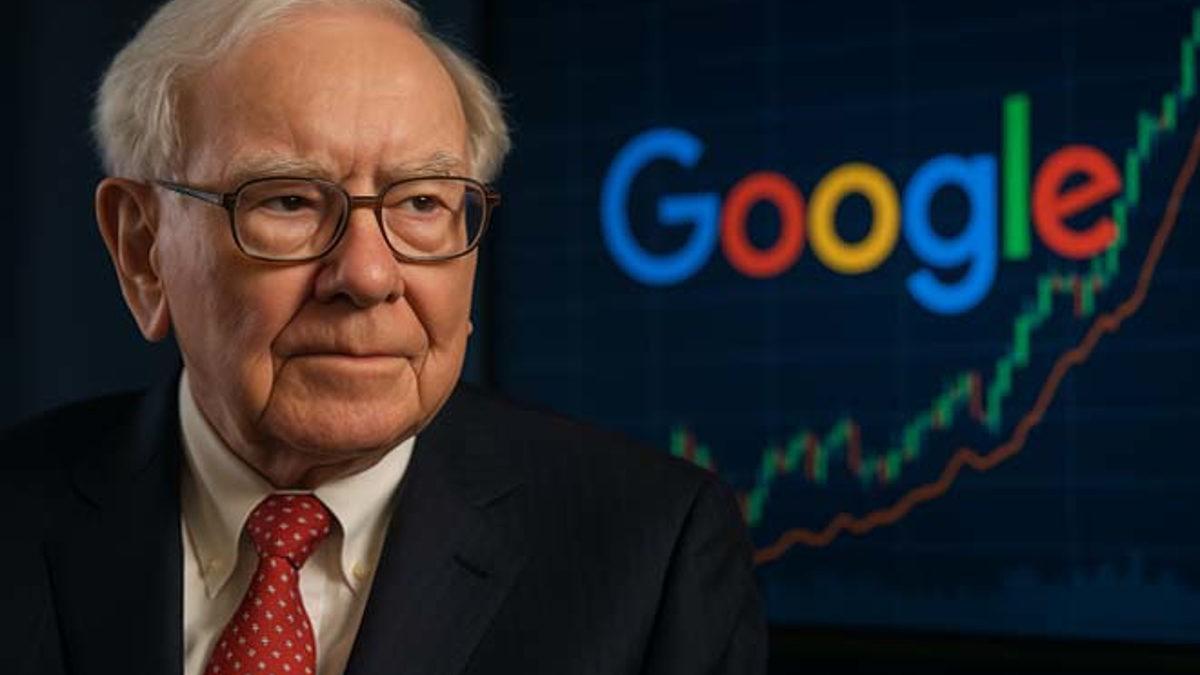
Alphabet stock is attracting fresh investor attention after Berkshire Hathaway dramatically increased its position in Google’s parent company, lifting its Alphabet share count by 83% during the second quarter of 2026 and turning the technology giant into Berkshire’s third-largest U.S.-listed stock holding.
Berkshire held nearly 106 million Alphabet shares worth approximately $37.8 billion as of June 30, up from roughly 57.8 million shares three months earlier. That placed Alphabet behind only Apple, worth about $66 billion, and American Express, worth approximately $51.3 billion, in Berkshire’s U.S. equity portfolio.
The move is particularly significant because Berkshire has historically been associated with financial services, consumer businesses, industrial companies and other businesses that fit Warren Buffett’s long-established investment style. Alphabet represents a much larger technology and artificial-intelligence bet than many Berkshire investors may have expected.
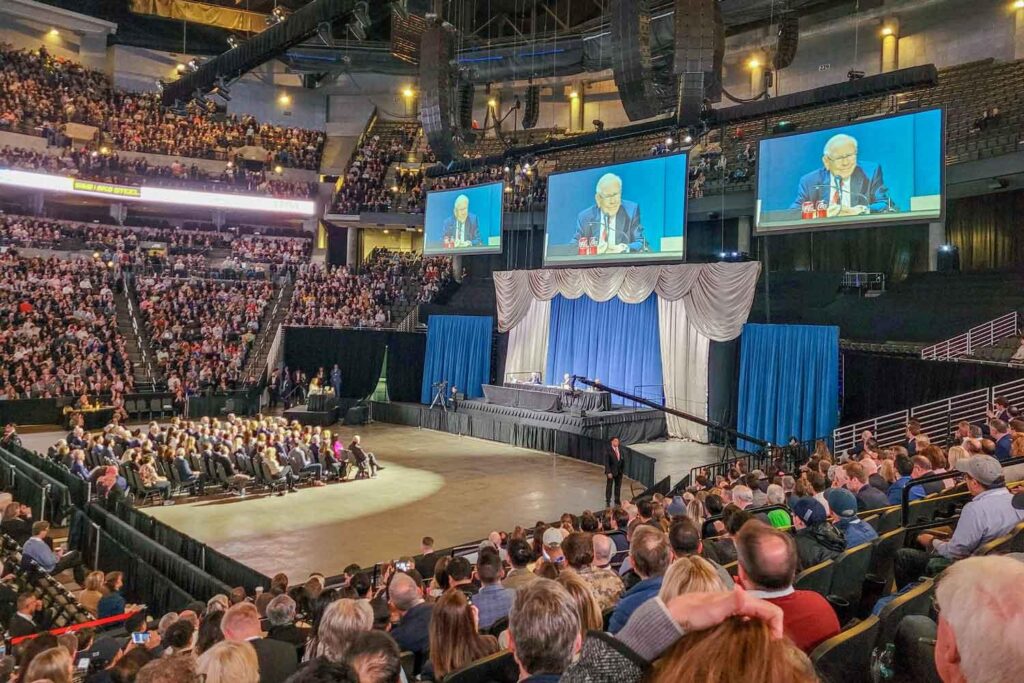
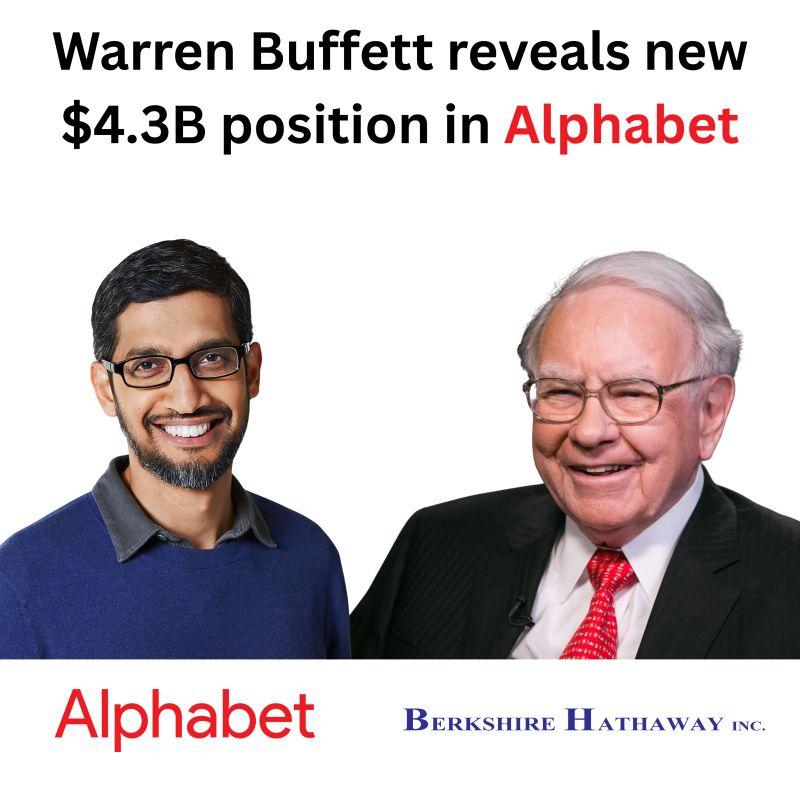
There is another important layer to the story. Berkshire’s increase included a $10 billion private investment in Alphabet, announced in June as part of Alphabet’s enormous capital-raising effort to fund AI infrastructure and computing capacity. Alphabet said the private placement consisted of $5 billion of Class A shares and $5 billion of Class C shares.
The latest disclosure therefore raises a bigger question than simply whether Berkshire likes Google: What does Warren Buffett’s original Alphabet investment—and Berkshire’s continued buying under CEO Greg Abel—say about Alphabet’s long-term value at a time when AI spending is becoming one of the biggest risks and opportunities in technology?
Berkshire’s Alphabet Stake Has Become a Major Portfolio Position
The scale of Berkshire’s move is what makes the latest disclosure so important. The conglomerate’s Alphabet position grew by about 83% during the second quarter, taking the holding to nearly 106 million shares and approximately $37.8 billion in value at the end of June.
Alphabet’s new position is now large enough to sit comfortably among Berkshire’s most important investments. Apple remains the largest U.S. equity holding at around $66 billion, while American Express ranks second at approximately $51.3 billion. Alphabet moved into third place at roughly $37.8 billion.
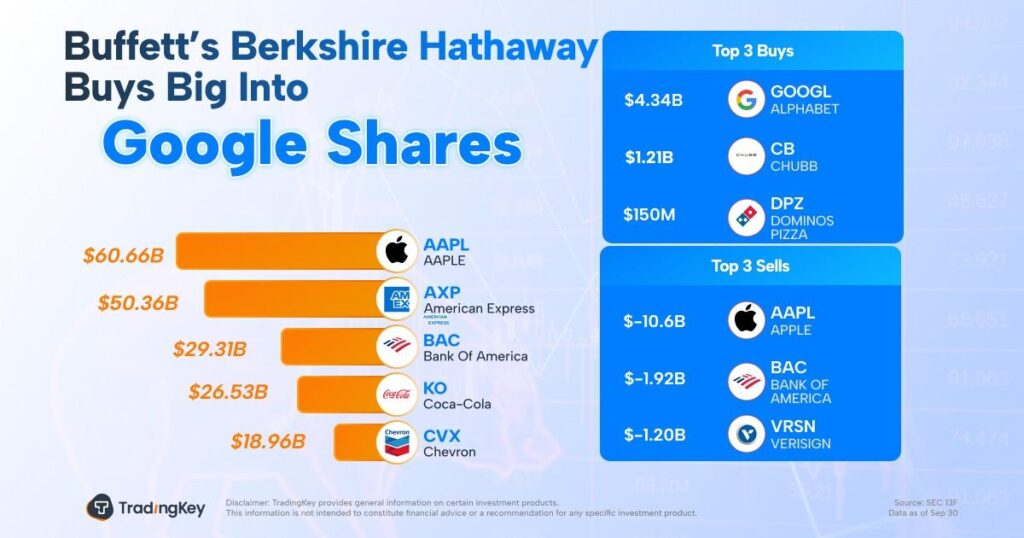
This is a meaningful change from the beginning of Berkshire’s Alphabet story. Berkshire first disclosed the investment in late 2025, when the position was worth only a few billion dollars. By the first quarter of 2026, the combined Class A and Class C position had already grown substantially, and Berkshire subsequently participated in Alphabet’s $10 billion private placement.
The timing also matters because the investment occurred during a major transition at Berkshire. Greg Abel became Berkshire Hathaway’s CEO in January 2026, succeeding Buffett in the company’s top executive role. Buffett remains chairman, and he has previously said that he initiated Berkshire’s Alphabet investment. In a July interview, Buffett confirmed that he was the person who started the Alphabet position.
That makes the latest purchase more interesting. It is not simply a story about Berkshire suddenly becoming a technology investor after Buffett’s departure. The Alphabet position began under Buffett, while its continued expansion is happening under Abel’s leadership.
Why Warren Buffett Changed His Mind About Alphabet
For years, Alphabet was one of the major technology companies that Berkshire did not own. Buffett later explained that he had missed the opportunity earlier, despite having a direct view of Google’s economic strength through GEICO’s advertising spending.
Buffett’s eventual decision appears to have been driven less by excitement about technology itself and more by the characteristics he traditionally looks for in businesses: strong economics, durable competitive advantages, large cash-generation potential and the ability to earn attractive returns over long periods.
That distinction is important for Alphabet investors. Berkshire’s purchase should not necessarily be interpreted as Buffett making a short-term prediction about Google’s share price or attempting to time the AI market.
Instead, the investment suggests Berkshire believes Alphabet has enough underlying economic strength to justify major investments in its future—even as those investments temporarily pressure cash flow and increase capital requirements.
Buffett has also been relatively measured in his assessment. He said Alphabet was not among his four or five favorite Berkshire businesses, despite initiating the investment. That makes the size of the position more interesting rather than less: Berkshire can have reservations about certain risks while still concluding that the overall risk-reward profile is attractive.
For investors, this is an important lesson. A Berkshire investment should not automatically be treated as a recommendation to buy a stock at any price. It is better viewed as evidence that an experienced capital allocator believes the underlying business has attractive long-term characteristics.
The $10 Billion AI Investment May Explain Much of the Conviction
The most important connection between Berkshire and Alphabet is Alphabet’s massive AI infrastructure buildout.
In June, Alphabet announced plans for an $80 billion equity capital raise, later increased to approximately $84.75 billion when the offerings were priced. The financing included Berkshire’s $10 billion private placement. Alphabet said the proceeds would help fund general corporate purposes, including capital expenditures to expand AI infrastructure and global computing capacity.
Alphabet’s spending plans are enormous. The company had previously forecast 2026 capital expenditures at $180 billion to $190 billion, but after its second-quarter results, that range increased to approximately $195 billion to $205 billion. The increase reflects the enormous computing requirements associated with AI services, data centers and cloud infrastructure.
At first glance, this might appear to be a strange investment for Berkshire. Why would a value-oriented investor put billions into a company that is spending hundreds of billions of dollars on AI infrastructure?
The answer may be that Alphabet is uniquely positioned to monetize that spending across multiple businesses.
Google Search remains a huge advertising platform. YouTube provides another large advertising and subscription ecosystem. Google Cloud is growing rapidly, and Alphabet’s Gemini AI products offer a potential new layer of monetization.
That diversification is important because Alphabet does not need one AI product to become a winner for the entire investment thesis to work.
Instead, the company can potentially earn returns from AI through search, advertising, cloud computing, enterprise software, subscriptions, custom AI chips and other services.
Alphabet’s AI and Cloud Growth Give Berkshire a Powerful Reason to Buy
Alphabet’s second-quarter 2026 results provide important context for Berkshire’s decision.
Alphabet reported 24% year-over-year revenue growth, while Google Search and Other revenue increased 17%. YouTube advertising revenue increased 13%, and Google Cloud revenue grew an extraordinary 82%. Alphabet also reported that its Cloud backlog had reached approximately $514 billion.
Those numbers help explain why Berkshire might be willing to look beyond Alphabet’s enormous capital spending requirements.
The central investment question is whether today’s AI infrastructure spending creates a much larger revenue and profit opportunity several years from now.
Google Cloud is particularly important. AI workloads require huge amounts of computing capacity, and businesses increasingly need cloud services to train, deploy and operate AI systems. If Alphabet can turn its infrastructure investment into sustained Cloud growth, the company’s current spending could ultimately generate significant returns.
Alphabet also has an unusual advantage because it controls so much of the technology stack itself. It operates one of the world’s largest data-center networks, develops AI models such as Gemini, builds specialized processors, owns Google Cloud and controls major consumer platforms through Search and YouTube.
That vertical integration could help Alphabet control costs and improve its ability to commercialize AI.
Alphabet CEO Sundar Pichai said after the second-quarter results that AI investments were contributing to performance throughout the business. The company reported that Cloud demand was being driven heavily by AI infrastructure and AI solutions.
For Berkshire, this creates a familiar type of investment thesis: a business with an enormous existing customer base is building additional products that could increase the value of its existing ecosystem.
What This Means for You, Investor Takeaway and Future Outlook
What this means for you: Berkshire’s decision is useful information, but investors should not blindly copy Berkshire’s portfolio.
Berkshire has a different time horizon, capital structure and risk tolerance from an individual investor. It can hold a large technology position for years while tolerating significant volatility. A retail investor buying Alphabet stock should therefore evaluate the company’s valuation, earnings growth, AI spending, competitive position and personal investment horizon independently.
The biggest positive signal is the combination of Alphabet’s established businesses and its rapidly growing AI opportunities. Search remains a massive source of cash generation, YouTube provides another major platform, and Google Cloud is growing at a much faster rate than the company’s traditional businesses.
But the biggest concern is also clear: AI infrastructure is extraordinarily expensive.
Alphabet’s projected 2026 capital spending of roughly $195 billion to $205 billion represents an enormous commitment. Investors need to determine whether the future earnings generated by that infrastructure will justify the spending.
Investor takeaway: Berkshire’s 83% increase is best interpreted as a vote of confidence in Alphabet’s long-term economics—not a guarantee that Alphabet stock will rise immediately.
The fact that Buffett initiated the original position makes the investment especially noteworthy. But the subsequent increase also occurred during the transition to Greg Abel’s leadership, suggesting Berkshire is comfortable maintaining a meaningful technology position even as the company enters a new era.
Investors should monitor several numbers in Alphabet’s upcoming quarters:
- Google Search revenue growth
- Google Cloud revenue and operating margin
- Gemini and AI monetization
- Capital expenditures
- Free cash flow
- AI infrastructure demand
- Cloud backlog
- Advertising growth
- Alphabet’s share count and capital allocation
These indicators will provide a much clearer picture of whether Berkshire’s investment thesis is working.
Future outlook: Alphabet’s long-term opportunity could become substantially larger if AI increases the value of Search, Cloud, YouTube and enterprise services simultaneously.
The company is already seeing strong demand. Google Cloud’s backlog reached $514 billion in the second quarter, while Cloud revenue rose 82%. If Alphabet can convert a meaningful portion of that backlog into revenue and profit, the company’s enormous AI spending could eventually become a competitive advantage rather than simply an expense.
However, the market is likely to remain sensitive to the cost of that expansion.
Alphabet’s higher capital-expenditure guidance has already worried investors because the AI race requires companies to spend enormous sums before the eventual returns are fully visible. The company’s Q2 results generated strong revenue growth, but investors have continued debating whether the AI investment cycle can produce adequate returns.
That creates two possible paths.
In the bullish scenario, Alphabet converts its AI infrastructure into stronger Cloud growth, improved Search monetization, successful Gemini products and higher long-term earnings. In that environment, Berkshire’s aggressive accumulation could look increasingly prescient.
In the bearish scenario, AI infrastructure spending remains extremely high while monetization disappoints, competition intensifies and free cash flow stays under pressure. In that case, the market could question whether Alphabet is spending too aggressively.
Alphabet Stock Risks Investors Should Watch
The first major risk is AI capital expenditure. Alphabet’s expected $195 billion to $205 billion in 2026 capital spending is enormous. Even a highly profitable company must demonstrate that such investment generates sufficient returns over time.
The second risk is AI competition. Alphabet is competing with Microsoft, OpenAI, Anthropic, Amazon, Meta and other companies across models, cloud computing, enterprise software and AI applications. A stronger-than-expected competitor could reduce Google’s ability to monetize AI at attractive margins.
The third risk involves Search disruption. Google Search remains Alphabet’s financial foundation, but AI-generated answers and alternative AI interfaces could eventually change how consumers discover information. Alphabet is attempting to adapt through AI Overviews and AI Mode, but investors must watch whether those products preserve advertising economics.
The fourth risk is valuation. Berkshire buying Alphabet does not mean the stock is cheap at every price. A strong company can still be a poor investment if investors pay too much for future growth.
The fifth risk is regulatory pressure. Alphabet continues to face scrutiny from governments and regulators over competition, advertising, search and its broader technology ecosystem. Regulatory changes could affect the economics of some of its most important businesses.
These risks help explain why Berkshire’s investment is interesting but should not be treated as a risk-free endorsement.
Why Berkshire’s Move Could Matter Beyond Alphabet Stock
The Alphabet purchase may also reveal something important about Berkshire Hathaway itself.
For years, investors wondered whether Berkshire could continue generating attractive returns while holding an enormous cash pile and avoiding some of the largest technology companies.
The second quarter suggests a change.
Berkshire purchased approximately $23.5 billion of stocks and sold about $3.7 billion, ending a long stretch of net selling. Its cash and Treasury-bill holdings declined to approximately $364.7 billion, from $380.2 billion in the first quarter. Berkshire also spent roughly $4.5 billion buying back its own shares.
Alphabet was therefore part of a much larger capital-allocation shift.
Berkshire also increased its position in Delta Air Lines and bought or expanded positions in companies including D.R. Horton, Lennar and Macy’s, while exiting Constellation Brands and reducing several other holdings.
That makes Alphabet particularly significant because it is one of the clearest examples of Berkshire becoming more comfortable deploying substantial capital into technology and AI.
Greg Abel has previously indicated that Berkshire does not intend to permanently exclude particular sectors simply because they are classified as technology. The investment approach remains centered on understanding the business, its economics and the price being paid.
Alphabet appears to have crossed that threshold.
Final Verdict: Berkshire’s Alphabet Bet Is Really a Bet on AI Returns
The latest Alphabet stock development is much more than another institutional-investor purchase.
Berkshire Hathaway has increased its Alphabet position by 83%, taking its holding to nearly 106 million shares worth approximately $37.8 billion at June 30. That makes Alphabet Berkshire’s third-largest U.S.-listed stock investment, behind Apple and American Express.
The move is especially striking because Alphabet is entering one of the most expensive investment periods in its history. The company expects to spend approximately $195 billion to $205 billion on capital expenditures in 2026, largely reflecting the enormous infrastructure requirements of artificial intelligence.
Yet Berkshire is buying into that spending cycle rather than avoiding it.
The logic appears to be that Alphabet has something many AI competitors do not: a huge existing ecosystem capable of turning AI investment into revenue through Search, YouTube, Google Cloud, Gemini, advertising and enterprise services.
The $10 billion Berkshire private placement announced in June reinforces that view. Alphabet said the capital would help support its AI infrastructure and global computing expansion, while Berkshire received additional exposure to the company at negotiated prices.
For investors, the biggest question now is not simply “Why did Berkshire buy Google?”
It is:
Can Alphabet turn its enormous AI spending into equally enormous long-term earnings?
If the answer is yes, Berkshire’s decision to make Alphabet one of its three largest U.S. stock holdings could eventually look like another example of buying a high-quality business while the market is uncertain about its future.
If AI returns disappoint, however, Alphabet’s huge infrastructure commitments could become a significant drag on free cash flow and investor sentiment.
For now, the evidence is mixed but compelling. Revenue is growing strongly, Google Cloud is accelerating, the backlog is enormous and Alphabet remains one of the world’s most powerful technology platforms. At the same time, capital spending has reached extraordinary levels and competition in AI is intensifying.
That makes Alphabet one of the most important stocks to watch through the remainder of 2026, particularly as investors assess whether the AI boom is producing sustainable returns rather than simply creating a larger technology spending race.
Latest Alphabet and Berkshire numbers
| Metric | Latest figure |
|---|---|
| Berkshire Alphabet shares | ≈106 million |
| Q2 increase | ≈83% |
| Alphabet position value at June 30 | ≈$37.8 billion |
| Berkshire’s largest holding | Apple, ≈$66 billion |
| Berkshire’s second-largest | American Express, ≈$51.3 billion |
| Berkshire Alphabet private placement | $10 billion |
| Alphabet 2026 CapEx outlook | $195B–$205B |
| Q2 Alphabet revenue growth | 24% |
| Q2 Google Cloud growth | 82% |
| Google Cloud backlog | ≈$514 billion |
The figures above are based on the latest Berkshire disclosure, Alphabet’s official materials and current reporting; market values can change daily.
Primary-source resources
For readers who want additional context, Yahoo Finance has current video coverage discussing Berkshire’s changing portfolio and its growing Alphabet position.
Yahoo Finance — Berkshire, Alphabet and Delta portfolio video
Yahoo Finance also has Reuters video coverage of Alphabet’s $80 billion AI financing plan and Berkshire’s $10 billion investment.
Reuters Video — Alphabet AI funding and Berkshire investment
Alphabet’s own SEC filing provides the primary details of the $10 billion Berkshire private placement and explains that the proceeds are intended in part to support AI infrastructure and global compute.
Alphabet SEC filing — $10 billion Berkshire private placement
Alphabet’s official Q2 earnings commentary provides the company’s own figures for revenue growth, Search, YouTube, Cloud and the $514 billion Cloud backlog.
Alphabet Q2 2026 earnings commentary
Subscribe to trusted news sites like USnewsSphere.com for continuous updates.