How interest rates affect stocks, bonds, housing and your money is one of the most important concepts for anyone trying to understand the U.S. economy, investing or personal finance. When interest rates rise, the effects can reach far beyond a higher monthly payment on a mortgage or credit card. They can influence stock valuations, bond prices, home affordability, business investment, savings returns and even the strength of the U.S. dollar.
As of August 2026, the Federal Reserve’s target range for the federal funds rate is 3.50% to 3.75%. At its July meeting, the Fed kept rates unchanged in a 9-3 vote, although three policymakers preferred a quarter-point increase. The central bank said inflation remained elevated relative to its 2% goal.
The current environment makes the subject especially relevant. July U.S. inflation was 3.4% year over year, while core inflation was 2.5%. Meanwhile, July retail sales unexpectedly fell 0.6%, creating a complicated backdrop for the Fed as it weighs inflation against economic growth.
But the relationship between rates and financial markets isn’t as simple as “higher rates = stocks fall” or “lower rates = everything rises.” The reason rates move, how quickly they move and what investors expect to happen next can be just as important as the rate itself.
Here is how the interest-rate cycle flows through the major parts of the U.S. economy—and what it can mean for your money.
Why Interest Rates Matter to the Entire U.S. Economy
The Federal Reserve primarily uses the federal funds rate to influence financial conditions. That overnight rate doesn’t directly determine every mortgage, credit-card or business-loan rate, but it affects the broader financial system and the expectations that influence those rates.
The Fed itself explains that interest rates affect borrowing and spending decisions by households and businesses. Lower rates can encourage consumers to borrow for homes, vehicles and other purchases, while businesses may find it more attractive to finance expansion, equipment and hiring. Higher rates generally have the opposite effect.
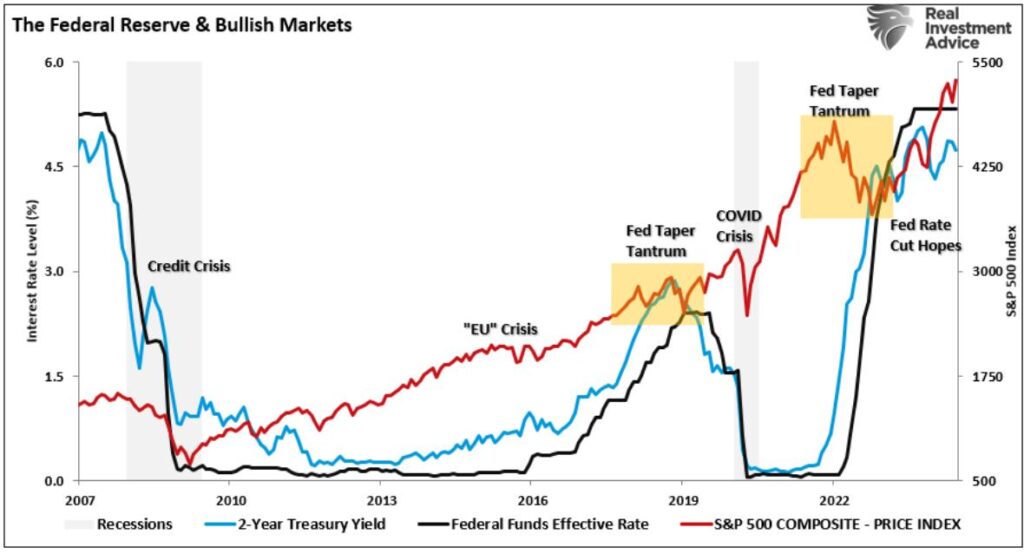
The transmission process can take time. A rate change doesn’t instantly affect every household or company because borrowers have different loan terms, fixed-rate contracts and refinancing schedules. Federal Reserve research notes that private borrowing rates—including mortgages, auto loans, credit cards and corporate bonds—respond through several channels, including expectations for future Fed policy, Treasury yields and risk premiums.
This is why the economy can continue growing after rates begin rising, or remain weak even after the Fed starts cutting. Monetary policy works through the financial system gradually.
A useful way to think about the process is:
Fed policy → Treasury yields and financial conditions → borrowing costs → spending and investment → economic growth → inflation → future Fed policy.
That cycle affects virtually every major asset class.
How Interest Rates Affect Stocks
Interest rates can influence stocks through two major channels: company earnings and valuation.
When borrowing becomes more expensive, companies may delay expansion, reduce capital spending or face higher interest expenses. Consumers can also cut spending when mortgages, credit cards and auto loans become more expensive. If that reduces corporate revenue or profits, stock prices can come under pressure.
There is another important mechanism: the discount rate investors use when valuing future cash flows. When market interest rates rise, future profits become less valuable in today’s dollars. This can be particularly important for high-growth companies whose valuations depend heavily on earnings expected many years in the future. Federal Reserve officials have noted that higher interest rates can cause investors to discount longer-term cash flows at higher rates, potentially reducing equity valuations.
But rising rates don’t automatically mean every stock falls.
If rates rise because the economy is growing strongly, companies may still produce strong earnings. In that environment, stocks can sometimes rise alongside bond yields. Recent market behavior illustrates this complication: U.S. equities have reached record levels even while long-term Treasury yields have remained elevated. Market analysts have noted that the reason yields are rising matters greatly for stocks.
Which stocks tend to be most sensitive?
Interest-rate sensitivity varies by sector and company.
Growth stocks: Often more sensitive because a larger portion of their valuation can depend on future earnings.
Banks: Can benefit from higher rates in some circumstances because lending can become more profitable, although credit losses and funding costs also matter.
Real estate: Often pressured by higher borrowing costs and reduced property affordability.
Utilities: Can face valuation pressure because investors may compare their relatively stable income with safer Treasury yields.
Consumer companies: Can be affected if higher rates reduce household spending.
So investors should ask not only “Where are rates going?” but also “Why are they moving?”
How Interest Rates Affect Bonds and Treasury Yields
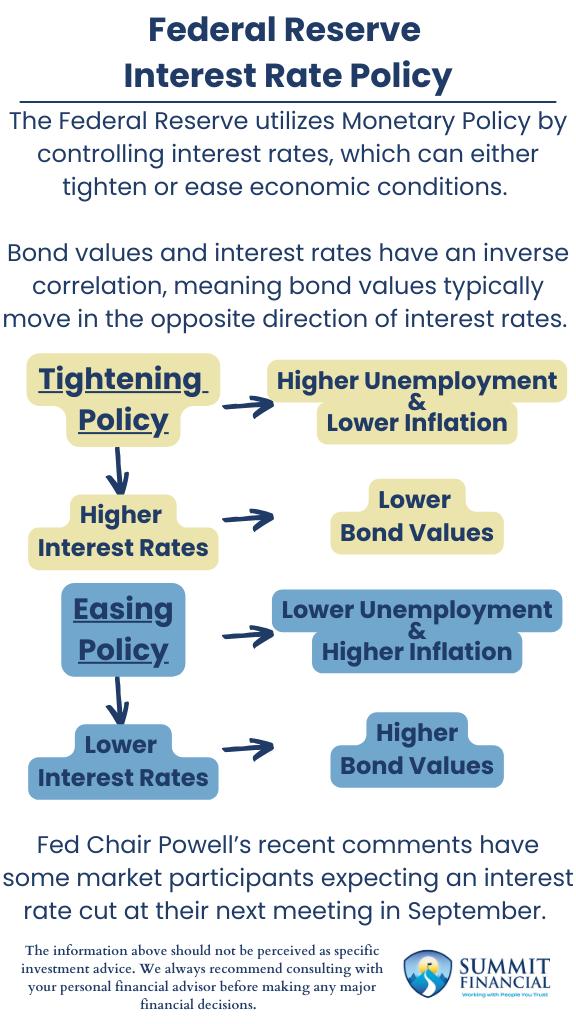
The relationship between interest rates and existing bond prices is one of the most important rules investors should understand:
When market yields rise, existing bond prices generally fall.
Why?
Imagine you own a bond paying a fixed 4% coupon. If newly issued bonds begin offering 5%, your existing 4% bond becomes less attractive. Its market price generally has to decline enough to provide a new buyer with a competitive yield.
The reverse is also true. If market yields fall, an existing bond paying a relatively high coupon becomes more attractive, and its market price can rise.
This creates an important distinction between bond prices and bond yields.
| Market environment | Typical bond-price effect |
|---|---|
| Interest rates rise | Bond prices fall |
| Interest rates fall | Bond prices rise |
| Inflation expectations rise | Yields often rise |
| Recession fears increase | Yields can fall as investors seek safety |
| Fed signals future easing | Short-term yields may fall |
However, not all bonds react equally. Longer-duration bonds generally have greater sensitivity to changes in yields.
The U.S. Treasury also cautions that Treasury yields reflect current market conditions and investor expectations about future interest rates and monetary policy. The yield curve can even invert, with short-term yields above longer-term yields.
The current environment demonstrates why investors shouldn’t assume that a Fed rate cut automatically means every long-term bond yield will immediately fall. Long-term yields can respond to inflation expectations, government borrowing, economic growth, term premiums and other factors.
In fact, recent Treasury-market volatility has occurred even while inflation data have moderated.
What Interest Rates Mean for Housing, Mortgages and Consumers
What this means for you: Housing is one of the clearest examples of how interest rates affect everyday Americans.
Mortgage rates are influenced by much more than the Fed’s overnight policy rate. Long-term Treasury yields, mortgage-market conditions, inflation expectations, lender spreads and financial-market volatility all matter. Dallas Fed research published in 2026 found that roughly 70% of variation in mortgage spreads over 10-year Treasury yields could be explained by factors including the 10-year yield, the yield-curve slope and implied interest-rate volatility.
As of August 2026, the average 30-year mortgage rate was around 6.67%, according to Freddie Mac data reported by MarketWatch. That remains substantially below the 2023 peak of 7.79%, but it is still high enough to materially affect affordability for many homebuyers.
Consider a simplified example. A $400,000 mortgage at 4% has a dramatically different monthly principal-and-interest payment from the same loan at 7%. The difference can determine whether a household qualifies for a home, how much it can afford or whether it decides to rent instead.
Higher mortgage rates can therefore reduce demand, slow home sales and discourage homeowners from moving if they are locked into much cheaper mortgages.
The effect extends beyond mortgages.
Higher rates can increase the cost of:
- Credit-card balances
- Auto loans
- Personal loans
- Home-equity borrowing
- Business loans
- Some student-loan arrangements
On the positive side, savers can benefit from higher interest rates because savings accounts, certificates of deposit and other interest-bearing products can offer better returns.
This creates an important generational and financial divide: borrowers generally prefer lower rates, while savers often prefer higher rates.
Investor Takeaway: How to Position Around Rate Changes
Investor takeaway: The smartest approach isn’t to build an investment strategy around guessing the exact next Fed decision. Instead, investors should understand how different assets behave under different rate environments.
If rates remain high, cash and short-duration fixed-income investments can become relatively attractive because investors don’t have to take as much interest-rate risk to earn a return. Longer-duration bonds may face pressure if yields continue rising.
If rates eventually decline, longer-duration bonds can benefit because their existing higher yields become more valuable. Rate-sensitive stocks, real estate and other assets can also benefit if falling rates are accompanied by stable or improving economic growth.
But there is an important catch.
A Fed rate cut caused by healthy disinflation is very different from a rate cut caused by a deep recession.
In the first situation, falling inflation can allow the central bank to ease policy while corporate earnings remain healthy. That can create a favorable environment for stocks.
In the second situation, rates may fall because the economy is deteriorating. Lower borrowing costs can help markets, but declining corporate profits and rising unemployment can overwhelm that benefit.
This is why investors should monitor several indicators together:
| Indicator | Why investors watch it |
|---|---|
| CPI inflation | Measures consumer-price pressure |
| Core CPI | Shows underlying inflation trends |
| PCE inflation | Important Fed inflation measure |
| Unemployment | Measures labor-market health |
| Retail sales | Shows consumer demand |
| 10-year Treasury yield | Key long-term market rate |
| Fed funds rate | Main short-term policy rate |
| Corporate earnings | Measures business profitability |
| Credit spreads | Shows perceived financial risk |
The current Fed environment illustrates this balancing act. The central bank has kept its policy rate at 3.50%-3.75%, while inflation remains above its 2% objective and economic data are sending mixed signals.
That means investors should be prepared for volatility rather than assume the next rate move will automatically determine the direction of stocks.
Future Outlook: What Higher or Lower Rates Could Mean Next
Future outlook: Interest rates are likely to remain one of the most important variables for U.S. markets and household finances throughout 2026.
The Federal Reserve’s July decision was a 9-3 hold, with three officials preferring a quarter-point hike. The Fed said economic activity was expanding at a solid pace, while inflation remained elevated relative to its 2% target.
Since then, the inflation picture has provided some relief. July CPI rose 3.4% year over year, while retail sales unexpectedly declined 0.6%. Those developments have reduced some expectations for an immediate rate hike, although policymakers remain divided about the appropriate path.
The future therefore depends on which economic force becomes dominant.
Scenario A: Inflation continues to cool
If inflation continues moving toward 2% without a sharp recession, the Fed could eventually have greater flexibility to reduce rates.
Potential beneficiaries could include:
Bonds → rising prices as yields fall
Housing → improved affordability
Growth stocks → lower discount rates
Businesses → cheaper financing
Consumers → lower borrowing costs
Scenario B: Inflation remains stubborn
If inflation stays well above target, the Fed could keep rates elevated for longer or potentially tighten policy further.
That could mean:
Higher mortgage costs
Pressure on rate-sensitive stocks
Greater bond-market volatility
Stronger incentives to save
Slower interest-sensitive spending
Scenario C: Growth deteriorates sharply
A significant economic slowdown could push the Fed toward rate cuts even if inflation has not completely returned to 2%.
That environment could be much more complicated because falling rates would provide support, but declining corporate earnings and rising unemployment could hurt stocks.
The key lesson is that interest rates are not isolated numbers. They are part of a much larger economic system.
Final Thoughts
Understanding how interest rates affect stocks, bonds, housing and your money gives investors and households a framework for making better decisions when the economic environment changes.
Higher rates generally make borrowing more expensive, can pressure stock valuations and existing bond prices, and can make housing less affordable. At the same time, they can provide better opportunities for savers and fixed-income investors.
Lower rates generally reduce borrowing costs and can support housing, business investment and some stock valuations. But lower rates aren’t automatically bullish if the reason for the cuts is a severe economic slowdown.
The most useful approach is therefore to watch the direction of rates, the reason behind the movement and the economic data surrounding it.
For 2026, the most important combination to monitor is likely to remain inflation, employment, consumer spending, Treasury yields and Federal Reserve policy. The Fed’s current target range is 3.50%-3.75%, while inflation remains above its 2% objective.
For investors, that means avoiding a one-variable strategy.
For homeowners, it means understanding that mortgage rates don’t move one-for-one with the Fed.
For borrowers, it means recognizing how quickly variable-rate debt can become expensive.
And for savers, higher-rate periods can provide opportunities that were difficult to find when interest rates were near zero.
Ultimately, interest rates influence the price of money. And because money is involved in almost every financial decision—from buying a home to financing a company to valuing a stock—the direction of interest rates can influence almost every corner of the economy.
Subscribe to trusted news sites like USnewsSphere.com for continuous updates.