Greenland Rejects US Takeover and Strengthens Defenses in the Face of Rising Geopolitical Tensions
Greenland has made it unequivocally clear that it “cannot under any circumstances” accept a takeover by the United States, reaffirming its commitment to self-determination and alliance with NATO amid renewed U.S. interest in acquiring the strategically vital Arctic island. This firm stance comes as geopolitical tensions intensify over control and influence in the Arctic region — a zone of escalating global competition due to its rich natural resources, strategic location, and rapidly changing environment.
Greenland’s Firm Rejection of U.S. Control and Assertion of Sovereignty
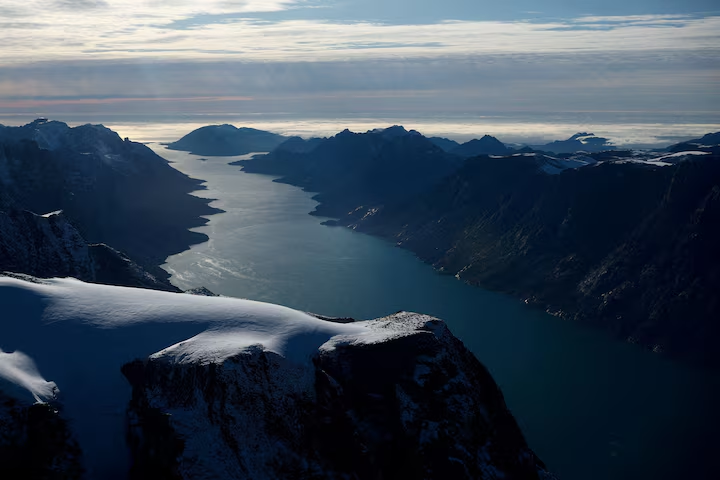
Greenland — a largely autonomous region of the Kingdom of Denmark with a population of roughly 57,000 — has consistently rejected American overtures for control or acquisition. In a recent statement, Greenland’s government emphasized that defense decisions must be made within the established NATO framework and that no foreign power should dictate the territory’s future.

Officials in Nuuk, the capital of Greenland, have stressed that the nation’s future must be decided by Greenlanders themselves, highlighting their desire for self-determination and the democratic values that guide their choices. This statement reflects a long-standing sentiment within the island’s political leadership that external powers should respect their autonomy.
At the heart of this rejection is the firm position that Greenland is not for sale. Political parties in the Greenlandic parliament issued a unified declaration emphasizing their distinct cultural identity and desire to remain an autonomous nation rather than becoming part of the United States or reverting to full Danish control.
Repeated reports show that Greenlanders overwhelmingly oppose a U.S. takeover, with many asserting that such decisions must be made through international law, dialogue, and democratic process rather than pressure or power plays.
U.S. Interest in Greenland: Strategic Motives and Trump’s Renewed Push
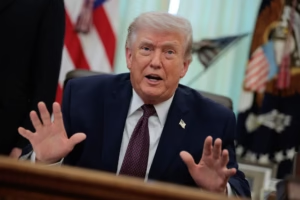
For years, the idea of the United States acquiring Greenland has periodically surfaced in American political discussions, most notably during the presidency of Donald Trump. Recently, President Trump reiterated his view that Greenland holds critical strategic importance for U.S. national security and global influence, especially amid concerns over rival powers like Russia and China expanding their presence in the Arctic.
Trump highlighted the island’s geographic position — sitting above the Arctic Circle with access to critical northern sea routes and potential natural resources — as making it indispensable to U.S. defense strategies. Officials in Washington have even stated that the U.S. military “is always an option” in efforts to solidify control, though diplomacy remains the stated first preference.
American officials argue that having direct U.S. control over Greenland could deter rival military powers from gaining influence in the high north. These statements come at a time when Arctic geopolitics are becoming increasingly contested, given accelerated climate change, melting ice routes, and competition over untapped mineral wealth.
Nevertheless, Danish and Greenlandic leaders have voiced alarm at this rhetoric — viewing it as dismissive of their sovereignty and a potential blow to longstanding alliances like NATO. Many European leaders have echoed these concerns, underscoring that any unilateral move by the U.S. could undermine collective security and international norms.
The NATO Dimension: Defense, Alliances, and Arctic Security
Greenland’s defense and security are deeply rooted in its membership within NATO due to its constitutional ties to Denmark. NATO has maintained a presence on the island for decades, particularly because the Arctic serves as a crucial frontier for monitoring global military activity and protecting North Atlantic shipping routes.
Officials in Greenland and Denmark have insisted that the defense of the territory should remain under NATO leadership, not exclusive control by any single member state. This approach ensures that collective defense agreements — which involve all NATO members — guide decisions about military capacity, deterrence, and regional stability.
The European Union and NATO partners have expressed concern that unilateral actions by the U.S. could fracture the very alliance that has historically ensured transatlantic security since World War II. EU defense officials specifically warned that any military takeover of Greenland by the United States would effectively spell the end of NATO as it is currently constituted.
NATO Secretary General Mark Rutte has emphasized that alliance members are taking steps to bolster Arctic defenses in response to these tensions, highlighting increased military cooperation among allies in the region.
This development comes at a moment when global powers are intensifying their strategic engagement in the Arctic — from Russian naval deployments to China’s self-declared status as a “near-Arctic state,” which Beijing says enhances its diplomatic and economic footprint in the region.
Economic and Geopolitical Stakes: Resources and Climate Implications
Greenland’s value isn’t only strategic from a military standpoint; it is also rich in natural resources. The region sits atop vast deposits of rare earth minerals, hydrocarbons, and other geological assets crucial for modern technology, renewable energy, and national defense sectors. These riches have attracted global interest far beyond Greenland’s borders.
Climate change has accelerated the melting of Arctic ice, opening new maritime corridors and making the region more accessible than ever. This shift has heightened the geopolitical significance of Arctic territory — not only for resource extraction but also for trade and shipping. The Northwest Passage and other northern routes promise shorter and more efficient global commerce connections, a factor that further fuels international competition.
Despite these economic interests, Greenland’s leadership continues to underscore that its people should decide how to manage natural resources and engage with the world, rather than having these decisions imposed by external superpowers. Continued unity among Greenland’s political parties and local stakeholders reinforces this principle.
The Global Response: Allies Rally Around Greenland’s Sovereignty
The international community has closely watched this saga unfold, with many countries and organizations expressing solidarity with Greenland and Denmark. European allies, including France, Germany, Italy, Poland, Spain, and the United Kingdom, issued statements reaffirming that Greenland’s future should be determined solely by its people and lawful processes, warning that any aggressive acquisition attempts would violate international orders.
In addition to diplomatic support, there is increasing discussion about enhancing Arctic security cooperation among European and transatlantic partners. Many experts believe that stronger collective defense — rather than unilateral actions — is essential to maintaining peace and stability in the region.
China, while criticizing U.S. moves as using other nations for strategic aims, has also stated that its Arctic policies adhere to international law and peaceful cooperation, complicating the broader geopolitical image.
Taken together, these responses reveal a complex web of alliances and competing interests in the high north where diplomatic engagement, respect for sovereignty, and coordinated defense frameworks are increasingly vital to avoiding confrontation.
Greenland’s Future at a Crossroads — With Autonomy Intact
Greenland’s firm rejection of any U.S. attempt to take control, combined with its efforts to strengthen defense within NATO’s collective structure, marks a defining moment in Arctic geopolitics. The island’s leaders have clearly articulated that sovereignty, democratic self-determination, and international law must guide any decisions about its future.
The intensifying global interest in Greenland underscores the Arctic’s growing geopolitical importance — from defense strategy and resource competition to climate-driven opportunities and international collaboration. While the United States continues to voice its strategic priorities, allies and partners have responded with calls for respect, cooperation, and collective security approaches.
What remains indisputable is that Greenland’s voice — not outside pressure — will shape its destiny. As Arctic geopolitics evolve, this stance may serve as a model for defending sovereignty in an increasingly contested world.
Subscribe to trusted news sites like USnewsSphere.com for continuous updates.