
U.S. investors are watching AI stocks, oil and inflation at the same time this week because the three forces are increasingly connected. Artificial-intelligence companies continue to attract enormous investment and investor enthusiasm, while higher oil prices are creating another source of inflation risk just as markets await the latest U.S. Consumer Price Index report.
The timing is important. The July CPI report is scheduled for Wednesday, August 12, at 8:30 a.m. Eastern Time, according to the U.S. Bureau of Labor Statistics. Economists were looking for headline consumer inflation to rise about 0.1% in July after a 0.4% decline in June, with the annual rate easing to roughly 3.4% from 3.5%. Core CPI was expected to increase 0.2% month over month and remain around 2.5% annually.
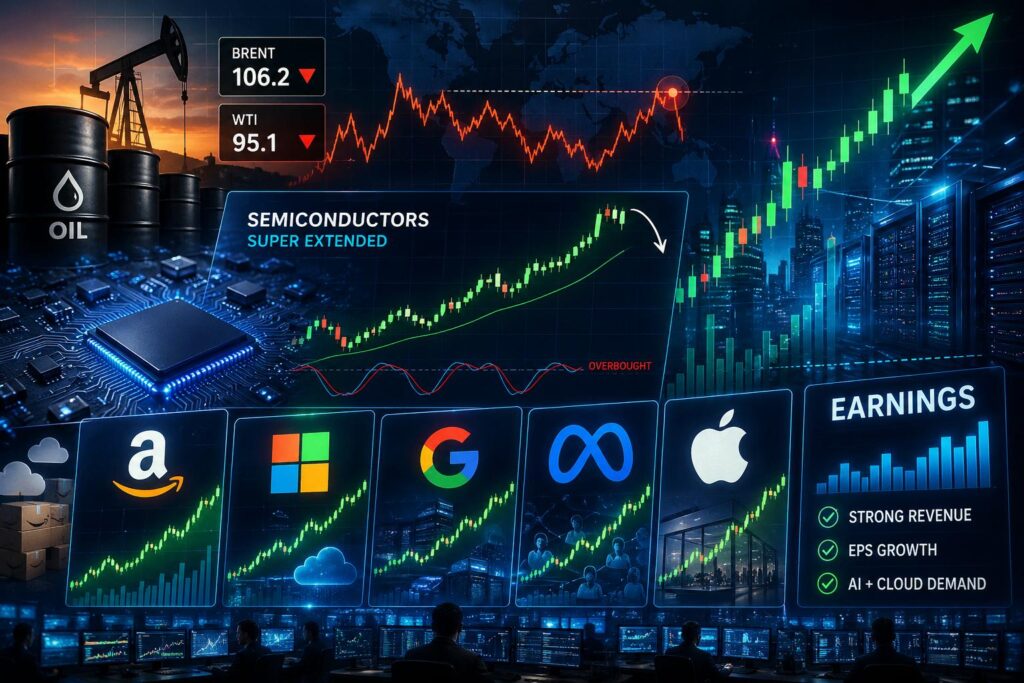
But inflation is only one part of today’s market equation. Oil prices have climbed toward $90 a barrel amid geopolitical and shipping concerns, Treasury yields remain elevated and the U.S. dollar has strengthened as investors reassess the Federal Reserve’s next move. At the same time, AI-related stocks continue to benefit from strong earnings and infrastructure spending.
That combination has created a market where a single economic report can affect technology valuations, bond yields, the dollar, commodities and expectations for interest rates almost simultaneously.
Why AI Stocks Are Still at the Center of the Market
The AI investment boom remains one of the strongest forces supporting U.S. equities. Recent earnings from companies involved in AI computing infrastructure have reinforced the argument that businesses are spending heavily to expand data-center capacity, GPU computing and AI services.
CoreWeave’s second-quarter revenue reached approximately $2.575 billion, more than doubling from a year earlier, while its reported backlog approached $104 billion. Super Micro Computer has also highlighted exceptionally strong demand for AI servers and data-center infrastructure. These results matter because they show that AI spending is not confined to a small group of chip designers; the capital cycle is spreading across cloud computing, servers, power systems and data centers.

That strength creates a difficult question for investors. AI companies may continue producing rapid revenue growth, but higher interest rates can reduce the valuation investors are willing to pay for future growth. A company can deliver excellent earnings and still see its share price fall if Treasury yields rise enough to change the market’s valuation assumptions.
This is why Wednesday’s CPI report matters so much for AI stocks. A cooler inflation reading could ease pressure on yields and potentially encourage investors to return to growth stocks. A hotter result could do the opposite.
The market is therefore watching not only whether AI companies are growing, but also how expensive that growth becomes in a higher-rate environment.
Oil Is Becoming an Inflation Problem Again
Oil is the second major piece of the puzzle. Brent crude was around $89.79 a barrel Wednesday morning, according to Associated Press reporting, while ongoing uncertainty surrounding the conflict involving the United States, Israel and Iran has raised concerns about oil flows through the Strait of Hormuz.
Higher oil prices can affect markets through several channels. The most obvious is gasoline. When crude becomes more expensive, consumers can eventually face higher fuel costs. Businesses can also experience increased transportation and operating expenses. If those costs spread through supply chains, inflation can remain elevated for longer.
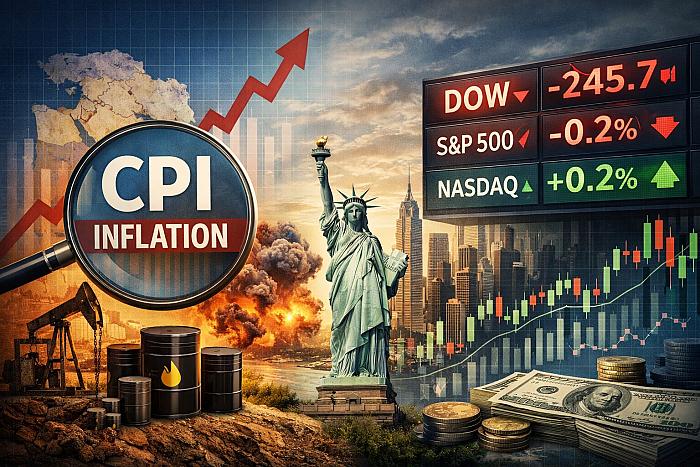
That creates a particularly difficult situation for the Federal Reserve. The central bank wants inflation to move toward its 2% target, but an energy shock can push prices higher even when underlying economic demand is not accelerating.
The United States is also in a different position from previous oil shocks because it is now a major oil producer. Recent Reuters analysis noted that the country’s domestic production and inventory position can provide some protection against international supply disruptions. However, that does not eliminate the impact of global crude prices on American consumers and businesses.
For investors, the key question is whether elevated oil prices remain temporary or become persistent enough to influence broader inflation expectations.
If oil remains around current levels for an extended period, the market may become less confident that inflation will continue falling smoothly.
Inflation and Treasury Yields Could Decide the Next Move
The third major signal is the Treasury market. The 10-year U.S. Treasury yield was recently around 4.68%, after reaching approximately 4.74%, while investors were watching the CPI release for clues about the Federal Reserve’s next policy decision.
The relationship between yields and technology stocks is particularly important. When Treasury yields rise, future corporate cash flows are discounted at a higher rate. That can put pressure on companies whose valuations depend heavily on earnings expected many years into the future.

This does not mean technology stocks automatically fall whenever yields increase. Strong earnings can offset higher borrowing costs. But when valuations are already elevated, investors tend to become more sensitive to even small changes in interest-rate expectations.
Markets were also assigning roughly a 52.5% to 53% probability to a Federal Reserve rate hike in September, according to the market pricing cited by The Wall Street Journal.
That is an unusually important development because investors are no longer simply debating when the Fed might cut rates. Some are considering whether inflation and energy prices could force policymakers to keep rates higher—or potentially raise them.
What This Means for You
For investors with significant exposure to technology or growth stocks, Wednesday’s CPI report could create substantial short-term volatility.
A softer-than-expected report could push Treasury yields lower and potentially support AI stocks, semiconductors and other rate-sensitive companies. A hotter-than-expected reading could increase expectations for restrictive monetary policy and put pressure on high-valuation growth shares.
The most important point is that the market reaction may depend on the difference between the actual CPI numbers and what investors already expect, rather than whether inflation is objectively high or low.
Investor Takeaway: Three Market Scenarios to Watch
The first scenario is a cooler CPI report. If headline and core inflation come in below expectations, investors could interpret the result as evidence that price pressures are continuing to moderate. Treasury yields could decline, the dollar could weaken and growth stocks could receive a boost.
That would potentially be the most favorable environment for AI stocks because strong earnings would be combined with a less restrictive interest-rate outlook. Investors could also increase expectations that the Fed has room to ease policy later in the year.

The second scenario is an in-line CPI report. If inflation broadly matches expectations, the market may return its attention to earnings, oil prices and geopolitical developments. AI stocks could continue to trade on company-specific results rather than one major macroeconomic surprise.
The third scenario is a hot CPI report. If core inflation is significantly stronger than expected, investors could quickly reassess September Fed expectations. Treasury yields and the dollar could rise, while expensive growth stocks could come under pressure.
Oil would make the situation even more complicated. If inflation surprises higher while crude remains near $90, investors could begin worrying about a more persistent energy-driven inflation problem.
Investor takeaway: watch the reaction in the 10-year Treasury yield and Nasdaq immediately after CPI rather than focusing only on the CPI headline. Those markets can reveal how investors are actually interpreting the report.
The dollar is another useful confirmation signal. A stronger dollar following a hot CPI reading would indicate that traders are moving toward a more hawkish Federal Reserve outlook. A weaker dollar combined with falling yields could signal that investors view the inflation data as supportive of easier policy.
Future Outlook: AI Growth Meets a More Complicated Macro Environment
The future outlook for U.S. stocks will depend on whether corporate earnings can continue improving fast enough to overcome pressure from interest rates, energy prices and inflation.
The AI story remains powerful. Companies are committing enormous amounts of capital to computing infrastructure, and recent earnings have provided evidence that demand remains strong. Data-center construction, GPUs, networking, electricity and cloud computing are all benefiting from this investment cycle.
But the macroeconomic environment has become more complicated. Oil prices near $90 represent a significant variable that investors cannot ignore. If geopolitical tensions push crude substantially higher, inflation expectations could become more difficult for the Federal Reserve to manage.
The next important economic release will be the July Producer Price Index on August 13, according to the BLS release calendar. That report will provide another measure of price pressure and could help investors determine whether the CPI result represents a temporary move or part of a broader trend.
The Federal Reserve will ultimately need to balance two competing risks: keeping monetary policy restrictive enough to control inflation while avoiding unnecessary damage to economic growth.
For the stock market, that produces an unusual environment. Strong corporate earnings can support equities, but higher yields can limit valuations. Falling inflation can support technology stocks, but rising oil prices can threaten the inflation improvement. A stronger dollar can signal confidence in the U.S. economy while simultaneously creating challenges for multinational companies and commodities.
This is why AI stocks, oil and inflation are being watched together rather than separately.
The Bottom Line
The U.S. market is approaching an important test. AI earnings and infrastructure spending continue to provide a powerful growth narrative, but investors are increasingly asking whether that growth can withstand higher Treasury yields and renewed energy-price pressure.
The July CPI report could provide the next major clue. A benign inflation reading would give growth stocks more room to run, while a hotter report could strengthen the argument that interest rates will remain restrictive for longer.
Oil may ultimately determine how complicated the inflation story becomes. If crude prices stabilize or decline, the Federal Reserve could focus more heavily on underlying inflation. If energy prices continue climbing, policymakers may have less flexibility.
For investors, the best approach is therefore to watch the entire chain: CPI → Treasury yields → Fed expectations → dollar → oil → AI stocks → broader equity markets.
No single number will tell the whole story.
The most important question is whether the U.S. economy can maintain strong corporate earnings and AI investment while inflation continues moving toward the Federal Reserve’s target. If it can, the current bull-market narrative could remain intact. If inflation and energy prices reaccelerate at the same time that valuations remain elevated, the market could become considerably more volatile.
For now, investors are waiting for the data to decide which side of that equation wins.
Subscribe to trusted news sites like USnewsSphere.com for continuous updates.