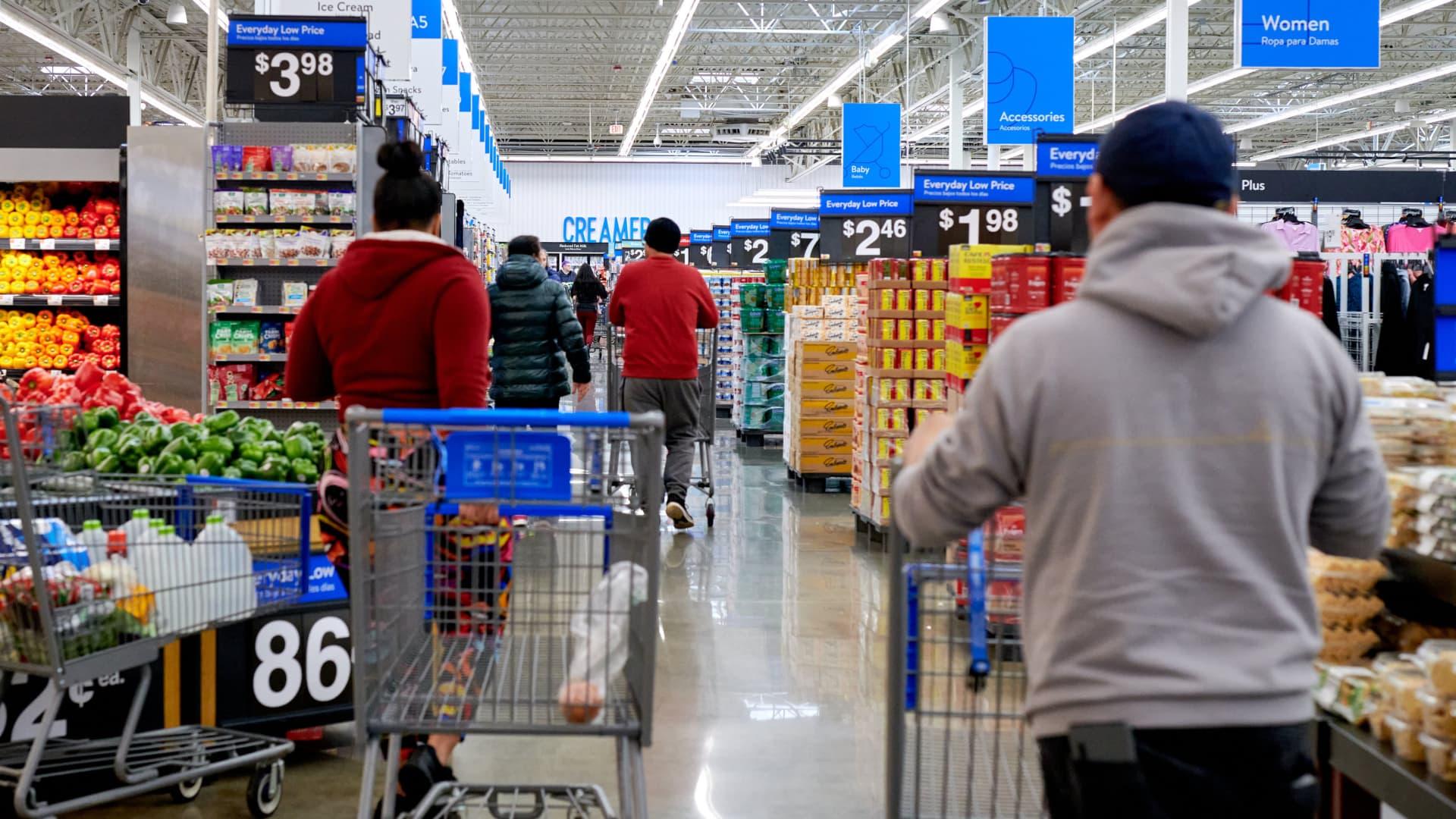
Walmart stock falls sharply on August 20, 2026, after the world’s largest retailer delivered a quarter that looked strong on the surface but raised fresh questions about the health of American consumers.
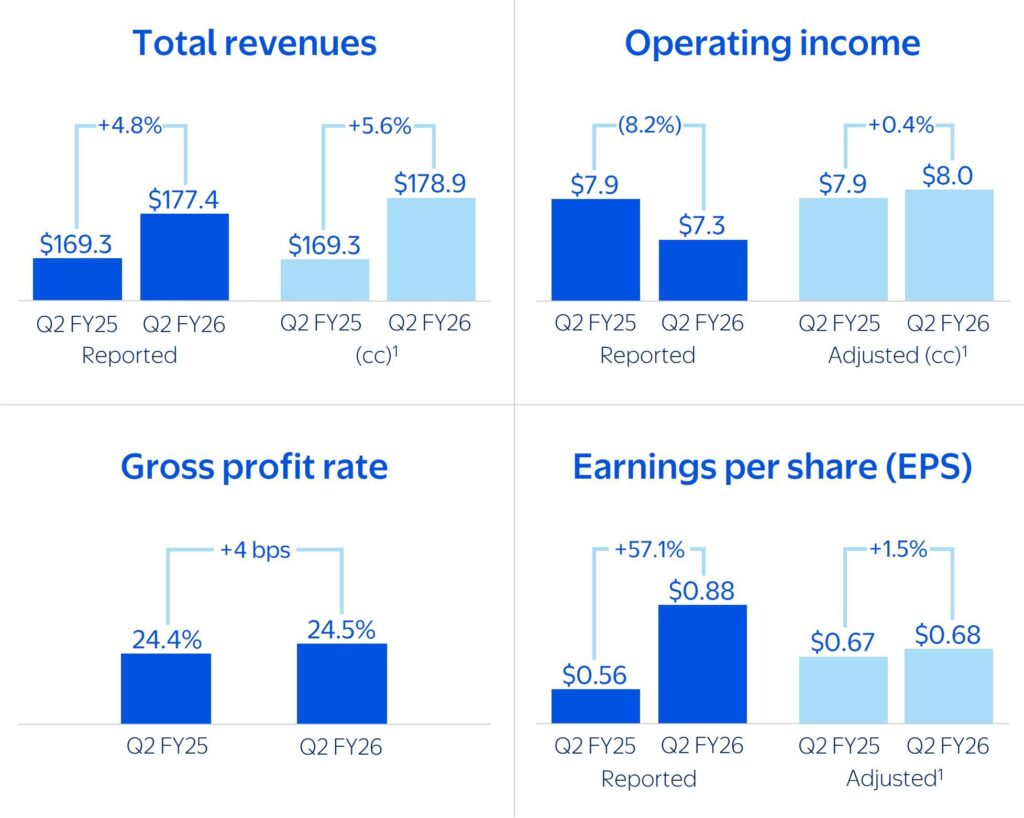
Walmart reported fiscal second-quarter revenue of about $187.94 billion, up 5.9% from a year earlier, while adjusted earnings reached 81 cents per share, beating Wall Street’s 74-cent expectation. The company also raised its full-year sales and profit outlook. Yet investors focused on a very different number: U.S. comparable sales increased only 2.6%, below the roughly 3.8% analysts had expected and down from 4.1% in the previous quarter.
The market reaction was immediate. Walmart shares fell roughly 8% in early trading and were down about 9% at one point during Thursday’s session, making the stock one of the day’s most closely watched Dow components.
That apparent contradiction is what makes Walmart’s earnings report important.
The company is still growing. Its e-commerce business is expanding rapidly, its advertising operation is producing strong gains, and Walmart continues to attract shoppers across income groups. But the latest numbers suggest that Americans are becoming more selective about where and how they spend money, particularly when gasoline, groceries and other everyday expenses remain expensive.
For investors, the report is therefore about much more than Walmart stock.
It offers a real-time look at U.S. consumer spending, inflation, fuel costs, tariffs, retail prices, household budgets and the broader American economy.
Why Walmart Stock Fell Despite Strong Earnings
The first thing investors need to understand is that Walmart did not simply report a bad quarter.
Adjusted earnings per share came in at 81 cents, seven cents above the analyst estimate cited by Reuters. Revenue increased 5.9% to approximately $187.94 billion, also ahead of expectations. Walmart’s operating income increased strongly, and the company raised its full-year sales and earnings outlook.

The problem was the composition of the growth.
U.S. comparable sales rose just 2.6%. Analysts had been looking for about 3.8%, making the shortfall significant. It was Walmart’s first comparable-sales miss in at least five years, according to Reuters, and the slowest pace of U.S. comparable-sales growth in roughly six years according to AP.
Average spending per transaction also increased only about 1.1%, substantially slower than the 3.1% increase recorded a year earlier. That is an important signal because Walmart serves an enormous cross-section of American households.
Investors were also concerned about store traffic. Customer traffic growth slowed to 1.5% during the latest three-month period from 3% in the first quarter. Walmart is trying to offset that pressure by cutting prices, expanding digital services and improving convenience, but those investments take time to show up in sales.
In other words, Walmart’s earnings beat does not necessarily mean the consumer is getting stronger.
It may mean the company is doing a good job of protecting its business while consumers become more cautious.
What Walmart’s Sales Say About the American Consumer
Walmart is unusually important as an economic indicator because its customer base stretches across income groups and includes shoppers who are highly sensitive to changes in everyday prices.
The company says more than 150 million customers use its stores or website each week, and AP describes Walmart as a barometer of U.S. consumer spending. The retailer has also been gaining market share among households earning more than $100,000 a year, meaning its customer base is no longer limited to lower-income shoppers.

That makes the latest slowdown particularly interesting.
Walmart’s CFO John David Rainey said higher fuel prices are causing consumers to make trade-offs. When gasoline becomes more expensive, households have less discretionary money available for clothing, entertainment, household upgrades and other purchases.
That does not necessarily mean consumers have stopped spending.
Instead, it can mean they are changing what they buy, where they buy it and when they buy it.
Groceries and essential merchandise can remain relatively resilient while discretionary categories become weaker. Consumers can also trade down to cheaper products, delay larger purchases or search more aggressively for promotions.
That behavior matters for the entire U.S. economy.
Consumer spending is a major driver of economic activity, so if Walmart’s weaker traffic and transaction growth are replicated across other retailers, economists and investors could interpret the trend as evidence that households are becoming more cautious.
At the same time, one retailer cannot provide a complete picture of the economy.
Walmart’s results need to be compared with data from Target, Home Depot, Amazon, Costco and other retailers, along with government retail-sales data, employment figures, inflation and consumer-confidence surveys.
Tariff Refunds Are Giving Walmart Room to Cut Prices
One of the most unusual parts of Walmart’s latest earnings report is the role of tariff refunds.
Walmart said it had received substantially all of the approximately $2.9 billion in tariff refunds it was eligible to receive. Instead of simply treating the money as a short-term profit boost, the company said it was reinvesting the benefit into lower prices, particularly in grocery and general merchandise.
That strategy could have important consequences for American shoppers.
Walmart has already reduced prices on thousands of products, including everyday grocery and household items. The company is effectively using some of the tariff-related benefit to strengthen its price position at a time when consumers remain sensitive to inflation.
The strategy creates a trade-off for investors.
Lower prices can reduce the amount Walmart earns on individual products in the short term. But cheaper merchandise can attract more customers, increase market share and potentially generate higher sales volumes over time.
Walmart’s management appears to be betting that the second effect will eventually outweigh the first.
The timing is important.
The company said many of its price rollbacks began in July, meaning the full effect may not yet appear in the latest quarter’s sales numbers. Management expects the price investments to have more impact in the following quarter.
That makes the next Walmart earnings report particularly important.
Investors will want evidence that lower prices actually produce higher traffic and stronger sales.
E-Commerce Is Strong, but Stores Still Matter
Another reason Walmart’s earnings report is more complicated than the stock decline suggests is the company’s powerful digital growth.
Global e-commerce sales increased about 23%, while U.S. e-commerce growth was reported around 24%. Walmart Connect, the company’s advertising business, increased about 43%.

Those numbers show that Walmart is successfully transforming itself beyond the traditional big-box retail model.
Its online marketplace, advertising platform, delivery services, membership products and technology investments are becoming increasingly important sources of growth.
The company also reported that it had doubled the number of items delivered in under 30 minutes compared with a year earlier, with roughly 70% of e-commerce orders delivered the same day or faster.
But there is a catch.
Walmart’s physical stores remain the foundation of the business. That is why slower store traffic worries investors even when digital sales are booming.
The company needs its online ecosystem and physical locations to reinforce each other. Stores can serve as fulfillment centers for online orders, while online shoppers can become store customers and vice versa.
The long-term opportunity is therefore not simply “Walmart is becoming an e-commerce company.”
It is whether Walmart can combine stores + digital shopping + advertising + membership + delivery + low prices into a business model that produces consistent growth even when consumers are under financial pressure.
What This Means for You
For American households, Walmart’s results offer a useful snapshot of the current affordability environment.
The company is lowering prices because management believes consumers want more value. Higher gasoline costs are making some households more cautious. Grocery spending remains important, while discretionary purchases can be postponed. At the same time, Walmart is seeing continued demand from higher-income households, suggesting that consumer weakness is not evenly distributed across America.
That means the U.S. consumer story is becoming increasingly divided.
Some households may have enough income and savings to continue spending normally.
Others may be making difficult trade-offs because fuel, food, housing and other recurring expenses consume a larger share of their budgets.
For consumers, Walmart’s strategy could eventually provide some relief if price investments translate into lower prices across everyday products.
But investors should remember that a company’s decision to lower prices does not automatically mean inflation has disappeared. Retailers can choose to absorb costs, reduce margins or use refunds and other temporary benefits to keep prices competitive.
That is why shoppers should continue comparing prices rather than assuming that one retailer is always the cheapest.
Investor Takeaway
For investors, Walmart’s report sends a mixed message.
The bullish side is clear.
Revenue exceeded expectations. Adjusted EPS beat forecasts. E-commerce remains strong. Advertising is growing rapidly. Walmart raised its full-year outlook. The company continues gaining customers and expanding its reach across income groups.
But the bearish side explains the stock’s reaction.
U.S. comparable sales missed expectations. Traffic growth slowed. Average transaction spending weakened. Higher fuel costs are pressuring household budgets. Pharmacy revenue has been affected by lower prices on certain Medicare drugs. And Walmart’s third-quarter adjusted EPS forecast of 62 to 64 cents was below the roughly 68-cent analyst expectation cited by Reuters and AP.
The company nevertheless raised its full-year adjusted EPS forecast to $2.80–$2.87, from the previous $2.75–$2.85 range, and expects full-year sales growth of 4% to 5%.
That creates an unusual investment setup.
The stock selloff reflects disappointment about the near-term consumer and guidance, while the company’s longer-term operating strategy remains relatively strong.
Investors should therefore avoid treating Thursday’s decline as automatic proof that Walmart’s business is deteriorating.
The more important question is whether the company can turn lower prices into higher customer traffic and stronger comparable sales without sacrificing too much profitability.
Future Outlook: What Walmart Investors Should Watch Next
The next quarter could be more informative than the quarter that just ended.
Walmart expects third-quarter adjusted EPS of roughly 62 to 64 cents and sales growth of about 3% to 3.75%, according to Reuters. Those expectations are below the levels analysts had been looking for.
That gives investors several specific numbers to monitor.
First: store traffic. If Walmart’s price investments work, customer visits should begin improving.
Second: comparable sales. A recovery from the 2.6% growth rate would suggest consumers are responding to lower prices and Walmart’s broader strategy.
Third: fuel costs. Walmart estimates that higher fuel prices could add roughly $2 billion in costs above its earlier assumptions. If gasoline prices remain elevated, consumers could continue reducing discretionary purchases.
Fourth: e-commerce. Continued growth in digital sales can help Walmart compensate for slower physical-store demand.
Fifth: margins. Investors need to see whether price cuts create enough additional volume to justify the reduction in prices.
Sixth: tariff refunds. The $2.9 billion benefit is significant, but it should not be treated as a permanent source of operating growth. Investors need to distinguish between temporary financial benefits and sustainable improvements in the underlying business.
Seventh: the broader consumer economy. Walmart’s next report should be considered alongside retail-sales data, inflation, gasoline prices, employment and consumer confidence.
The broader market reaction will also matter.
Walmart shares are a major component of the Dow Jones Industrial Average, and the stock’s sharp decline occurred as U.S. Treasury yields were also moving higher. That combination matters because rising bond yields can pressure stock valuations while weaker retail results can raise concerns about economic growth.
The Bigger Economic Question
The most important lesson from Walmart’s August 2026 earnings report may be that the American consumer is not simply strong or weak.
The picture is more complicated.
Consumers are still spending.
Walmart is still growing.
E-commerce is expanding rapidly.
Advertising revenue is surging.
Higher-income households are increasingly shopping at Walmart.
But shoppers are also becoming more price-sensitive, gasoline costs are creating pressure, store traffic is slowing and spending per transaction is growing more slowly.
That combination suggests an economy where consumers still have purchasing power but are becoming increasingly selective.
For investors, that distinction matters.
A severe consumer downturn would be negative for retailers, manufacturers, banks, transportation companies and many other businesses.
A more selective consumer, however, could actually benefit value-oriented retailers such as Walmart if the company can capture market share from competitors.
Walmart’s strategy is essentially built around that opportunity.
Lower prices can attract shoppers.
More shoppers can generate higher sales.
Higher digital engagement can produce advertising revenue.
More Walmart+ members can create recurring revenue.
And a larger customer base can strengthen Walmart’s negotiating power and competitive position.
The challenge is paying for that strategy while maintaining profitable growth.
Conclusion
Walmart stock falls sharply after earnings, but the story behind the decline is far more complicated than a simple earnings miss.
The retailer actually delivered a strong financial quarter by several measures. Revenue reached roughly $187.94 billion, adjusted EPS beat expectations, e-commerce remained strong, advertising grew rapidly and Walmart raised its full-year outlook.
What disappointed Wall Street was the underlying signal from American shoppers.
U.S. comparable sales increased only 2.6%, traffic growth slowed, average spending per transaction weakened and higher fuel costs are forcing some consumers to make trade-offs. Walmart is responding with lower prices and plans to reinvest approximately $2.9 billion in tariff refunds into groceries and general merchandise.
That makes Walmart one of the most important consumer-economy stories to watch through the remainder of 2026.
If lower prices bring shoppers back into stores and online, the current selloff could eventually look like an overreaction.
If traffic remains weak and consumers continue cutting discretionary spending, the latest results could prove to be an early warning that household budgets are becoming more strained.
For now, the evidence points to a more selective—not necessarily collapsing—American consumer.
The next Walmart earnings report should provide a crucial test of whether the company’s aggressive price investments can turn that caution into renewed customer traffic and sales growth.
For investors, consumers and anyone trying to understand the U.S. economy, that may ultimately be more important than Thursday’s stock-market reaction.
Subscribe to trusted news sites like USnewsSphere.com for continuous updates.