US Stock Market Today is being shaped by an unusual combination of rising long-term Treasury yields, pressure on technology and semiconductor shares, fresh Target earnings, higher oil prices and growing anticipation surrounding the Federal Reserve’s July meeting minutes. After Wall Street suffered a third consecutive losing session on Tuesday, investors are approaching Wednesday with a more cautious tone as they assess whether the recent pullback is simply a pause after a strong rally or the beginning of a broader repricing of risk.
The latest premarket picture is relatively subdued. At around 6:09 a.m. ET, Dow futures were up about 11 points, S&P 500 futures were down roughly 3 points and Nasdaq 100 futures were lower by about 0.22%. That follows Tuesday’s decline, when the S&P 500 fell 0.7%, the Dow lost 0.2% and the Nasdaq dropped 1.3%.
The bigger story is happening underneath the indexes. The 30-year Treasury yield remains around 5.28%, close to its highest level since 2007, while Brent crude has moved above $90 a barrel as uncertainty surrounding the Middle East continues to influence energy markets. At the same time, investors are waiting for the Federal Reserve’s July meeting minutes, scheduled for 2 p.m. ET, for additional clues about the central bank’s thinking on inflation and interest rates.
Wall Street Starts August 19 Under Pressure After Three Losing Sessions
The U.S. stock market enters Wednesday after a sharp change in momentum. On Tuesday, the S&P 500 fell to 7,691.76, the Dow Jones Industrial Average declined to 53,343.40 and the Nasdaq Composite dropped to 26,289.71. The Russell 2000 also lost 1.3%, showing that weakness was not limited to the biggest technology companies.

Even with the recent losses, the broader 2026 picture remains positive. Through Tuesday’s close, the S&P 500 was still up 12.4% for the year, the Dow was ahead 11% and the Nasdaq had gained 13.1%. The Russell 2000 was up an even stronger 21.6%. That distinction matters because the current decline is occurring after substantial gains rather than following a prolonged bear-market collapse.
The immediate question for investors is therefore whether the market is experiencing ordinary profit-taking or whether higher borrowing costs are beginning to challenge the valuation assumptions behind technology and other growth stocks. The answer will depend heavily on Treasury yields, corporate earnings and the Federal Reserve’s interpretation of inflation.
The market’s reaction to today’s events may also be more important than the headline moves themselves. If yields stabilize and earnings remain strong, investors could view the recent decline as a healthy consolidation. If yields continue climbing while earnings expectations weaken, the pressure could spread from semiconductors and other high-growth shares into the broader market.
Treasury Yields and Oil Are Becoming the Market’s Biggest Macro Signals
Treasury yields are at the center of today’s market debate. The 30-year Treasury yield was around 5.27% Wednesday after touching 5.3371% on Tuesday, its highest level in almost two decades. Reuters noted that long-term borrowing costs have been pushed higher by concerns surrounding government debt, inflation and geopolitical risks.
That matters because long-term Treasury yields influence the pricing of many other financial assets. When yields rise, bonds become more competitive with stocks, while the discount rate used to value future corporate earnings increases. Growth companies can be particularly sensitive because a larger portion of their perceived value may depend on profits expected years into the future.
The bond market is also dealing with a complicated combination of factors. Investors are concerned about large government borrowing needs, persistent inflation risks and higher energy prices. At the same time, major technology companies are spending enormous amounts on artificial-intelligence infrastructure, creating additional demand for capital. Reuters reported that the bond selloff has been accompanied by concerns about government debt and corporate borrowing.
Oil adds another layer to the inflation story. Brent crude was recently around $91.62 a barrel, while U.S. crude was near $85.48. Oil has risen for four consecutive days as hopes for a resolution to the Middle East conflict have weakened. Higher energy prices can feed into transportation, manufacturing and household expenses, making the Federal Reserve’s inflation challenge more complicated.
Target Earnings Give Investors a Fresh Look at the American Consumer
Target is one of Wednesday’s most important corporate stories because its earnings report provides a real-time look at American consumer spending. Target reported second-quarter net sales of approximately $26.5 billion, up 5.3% from a year earlier, while comparable sales increased 3.8%. Comparable traffic increased 3.6%, store comparable sales rose 2.7% and digital comparable sales jumped 8.7%.
Target also reported adjusted and GAAP earnings per share of $4.11, compared with $2.05 a year earlier. However, investors need to look beneath the headline EPS number because the quarter included a $994 million pretax tariff refund benefit. Target said that benefit contributed $752 million to net earnings and $1.65 to EPS. Excluding the tariff refund, the company said EPS still increased 20% year over year.
That distinction is important for investors trying to determine how strong Target’s underlying business really is. Sales growth, traffic and digital activity point to improving momentum, but the unusually large tariff-related benefit means the reported earnings number should not be treated as a pure measure of recurring operating performance.
Target nevertheless raised its outlook. The retailer now expects full-year 2026 net sales growth around 5% and adjusted and GAAP EPS of $9.90 to $10.90. The company said the updated EPS outlook includes approximately $1.65 of second-quarter tariff-refund benefits, while the midpoint excluding those refunds represents a $0.75 improvement from its previous $7.50 to $8.50 range.
For Wall Street, Target therefore offers two messages at once: the U.S. consumer appears more resilient than some investors feared, but trade policy and unusual one-time financial effects still make it difficult to judge the underlying trajectory from a single earnings number.
Tech and Semiconductor Stocks Face a Tougher Valuation Test
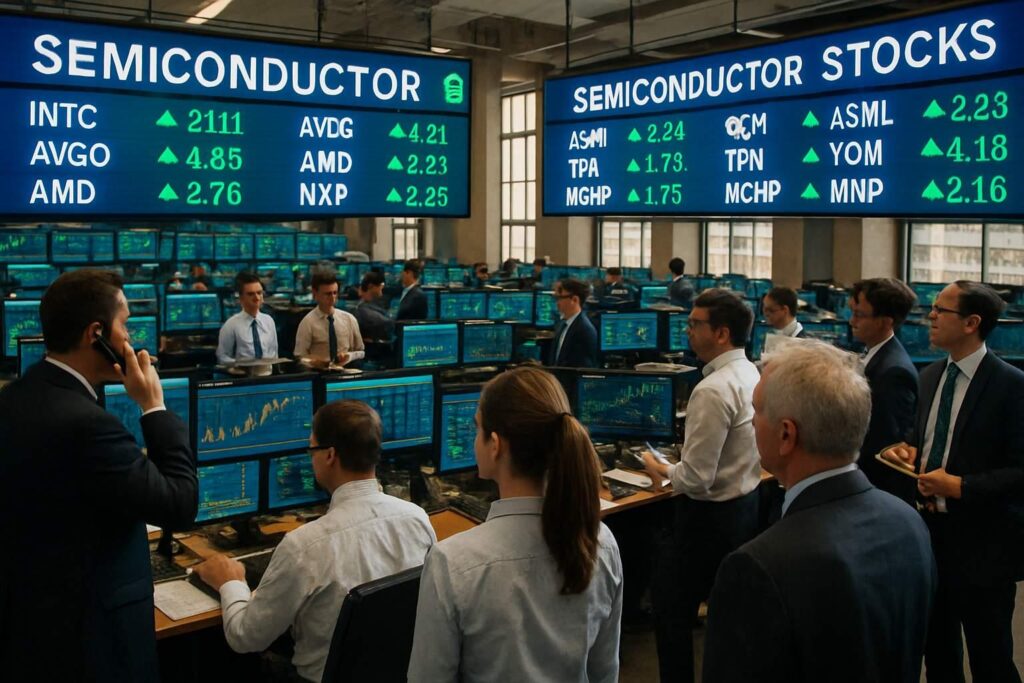
Technology stocks remain one of the most important pressure points for the U.S. stock market. On Tuesday, semiconductor shares were among the hardest hit, and the Philadelphia Semiconductor Index fell close to 5%. Nvidia, Marvell and Intel were among the chip-related names facing renewed pressure in Wednesday’s premarket trading.
The selloff is significant because semiconductor stocks have benefited enormously from expectations surrounding artificial-intelligence demand. Investors have been willing to assign high valuations to companies positioned to benefit from AI infrastructure spending, but those valuations become more difficult to justify when Treasury yields rise sharply.
This does not automatically mean the AI investment cycle is ending. Instead, investors are being forced to ask a more difficult question: how much future growth is already reflected in current stock prices?
That question becomes particularly important after a powerful rally. When expectations are extremely high, companies do not necessarily need to report bad results for their shares to fall. They can simply fail to exceed already-optimistic expectations by enough to justify their valuations.
The global semiconductor reaction reinforces that concern. Reuters reported that Asian chip shares were under pressure Wednesday, while South Korean stocks suffered a particularly large decline. The move shows that the market’s technology concerns are not isolated to U.S. exchanges.
For investors, this creates an important distinction between a business problem and a valuation problem. A company can continue growing rapidly while its stock falls if investors decide that the expected growth is already priced into the shares.
Fed Minutes Could Become the Next Major Market Catalyst
The Federal Reserve’s July meeting minutes are scheduled for release at 2 p.m. ET on Wednesday, making them one of the day’s most important potential catalysts. The official Federal Reserve calendar confirms that the minutes cover the July 28–29 meeting.
Because the minutes had not yet been released at the time of this article’s publication, investors should be careful about headlines claiming that the document has already confirmed a specific September rate decision. The responsible approach is to watch what the minutes reveal about officials’ inflation concerns, employment assessment and tolerance for keeping rates restrictive.
The Fed has been operating in an environment where inflation, energy prices, tariffs, geopolitical uncertainty and strong investment in artificial intelligence can pull policy in different directions. Earlier Federal Reserve minutes showed officials discussing elevated inflation risks associated with energy, tariffs and the AI investment boom, while also noting solid economic activity and stable labor-market conditions.
The market is particularly sensitive to whether policymakers appear more concerned about inflation persistence or more willing to tolerate softer conditions in pursuit of lower rates. Reuters reported that traders still see at least one 25-basis-point rate increase by the end of 2026, although expectations for a September increase have fallen following softer recent inflation data.
That means today’s Fed minutes could influence more than the federal funds rate outlook. They could affect Treasury yields, the dollar, mortgage rates, bank stocks, technology valuations and broader investor risk appetite.
Investors should also remember that the minutes describe policymakers’ discussions at the July meeting rather than guaranteeing what the Fed will do at its next meeting. Incoming inflation, employment, energy and financial-market data will continue to influence the decision.
What This Means for You, Investor Takeaway and Future Outlook
What this means for you: The current market environment matters even if you do not own individual stocks. Higher Treasury yields can affect mortgage rates, auto financing, business borrowing and the returns available from bonds and cash products. Rising oil prices can also influence household expenses through gasoline, transportation and other goods. Meanwhile, Target’s results suggest that consumers are still spending, but investors are paying close attention to whether that strength can continue if financing and living costs remain elevated.
Investor takeaway: The most important signal today may not be whether the Dow, S&P 500 or Nasdaq finishes slightly higher or lower. Investors should watch the interaction between yields, earnings and expectations. A stabilization in long-term Treasury yields could remove some pressure from technology shares. Strong retail earnings could support the argument that the economy remains resilient. Conversely, another jump in yields combined with weak semiconductor performance could increase the risk of a broader equity-market correction.
Target’s report is also a reminder to separate headline earnings from underlying business performance. The company delivered genuine sales and traffic improvements, but the $994 million tariff refund materially boosted the quarter. Investors evaluating TGT therefore need to look at recurring sales growth, margins, traffic, digital performance and future guidance rather than relying only on the EPS headline.
Future outlook: The next phase of the market will likely depend on whether long-term yields can stabilize while economic growth and corporate earnings remain healthy. The Federal Reserve’s minutes are today’s immediate catalyst, but they are only one piece of the puzzle. Investors will continue to watch inflation, employment, oil prices, government borrowing, consumer spending and upcoming corporate earnings.
The broader market also has an important cushion: despite three consecutive daily declines, the major U.S. indexes remain substantially higher for the year. That means today’s volatility should be viewed in the context of a market that has already generated strong gains rather than as evidence by itself that the long-term bull market has ended.
For readers following the US stock market today, the key message is straightforward: Treasury yields are becoming increasingly important, technology valuations are facing a tougher test, Target is providing a fresh read on the American consumer, oil is adding inflation pressure and the Federal Reserve’s minutes could determine the next major move in interest-rate expectations.
As the trading session develops, investors should focus less on one headline and more on how these forces interact. If yields fall, oil stabilizes and earnings remain strong, stocks could regain momentum. If yields continue rising while inflation and geopolitical risks intensify, the market may remain vulnerable to further rotation away from expensive growth stocks.
Subscribe to trusted news sites like USnewsSphere.com for continuous updates.