Trump’s 1,000 stock trades in June have put the president’s investment activity back under the spotlight after a newly released federal disclosure showed 1,051 securities transactions during the month. The filing, made public on August 22, shows a wide range of purchases and sales involving individual companies, exchange-traded funds, bonds and other securities, offering investors a rare look at how the president’s investment accounts were positioned during a volatile period for U.S. markets.
The disclosure does not provide exact dollar amounts. Instead, federal ethics forms use transaction ranges. Across the 1,051 reported transactions, the disclosed values fall within a broad range of roughly $78.1 million to $263.1 million, meaning the upper figure should not be interpreted as the amount Trump actually invested or sold. The filing indicates 576 purchases and 475 sales, according to a detailed review of the disclosure.
Among the most notable moves were purchases of Berkshire Hathaway, Visa, Mastercard and Cintas, while the accounts reported sizable sales of Meta Platforms and Motorola Solutions. The filing also shows activity involving Home Depot, Palantir, Coinbase and several funds, creating a much more complicated picture than a simple list of “stocks Trump bought.”
What Trump’s June investment disclosure actually shows
The headline number is striking: 1,051 transactions in a single month. A detailed examination of the filing indicates that the activity occurred across 16 trading days between June 1 and June 29, with 576 purchases and 475 sales. The sheer number of transactions can make the portfolio appear highly active, but the filing itself does not establish that Trump personally selected each stock or instructed managers to execute individual trades.
The financial scale is also easy to misunderstand. Because government disclosure forms report transactions in predetermined dollar bands rather than exact amounts, the filing can only establish a range. A transaction listed in the $1 million-to-$5 million category could represent any amount within that interval. As a result, the widely cited figure near $263 million represents the upper boundary of the disclosed ranges rather than a precise measurement of June trading.
The largest single disclosed transaction was a June 22 sale of between $5 million and $25 million in the Vanguard Dividend Appreciation Index Fund ETF, according to reporting based on the filing. That transaction is important because it demonstrates that the activity was not limited to individual corporate stocks. ETFs and other securities formed a significant part of the portfolio’s reported transactions.
The disclosure also reinforces a broader pattern. Trump’s accounts reported more than 21,000 securities transactions during 2025, with disclosures placing the aggregate value somewhere between $600 million and $1.86 billion. That history suggests the June activity was not an isolated episode of unusually frequent trading.
Berkshire Hathaway, Visa and Mastercard stand out
One of the clearest themes in the June filing was the movement toward several large, established companies. On June 18, the accounts reported purchases in the $1 million-to-$5 million range for Berkshire Hathaway, Visa, Mastercard and Cintas. At the same time, sales in the same broad range were reported for Meta Platforms and Motorola Solutions.
That combination naturally attracts investor attention because the companies represent different parts of the U.S. economy. Berkshire Hathaway is widely viewed as a diversified conglomerate with major exposure to insurance, industrial businesses and financial assets. Visa and Mastercard are central players in global electronic payments, while Cintas operates in business services. Meta, meanwhile, is one of the world’s largest technology and digital advertising companies, and Motorola Solutions has significant exposure to communications and public-safety technology.
However, investors should be careful about turning these transactions into a conventional “Trump stock-picking strategy.” The White House has said the accounts are independently managed and use computer-based strategies designed to track established indexes. Reporting has also pointed to direct indexing, a structure in which an investor can own many individual securities that collectively resemble an index rather than simply holding one index fund.
That distinction is crucial. A large purchase of Visa or Berkshire Hathaway in a disclosure does not necessarily mean an investment manager made a discretionary decision that the stock was undervalued. It could instead reflect portfolio construction, index tracking, rebalancing or tax-management activity.
Key June transactions at a glance
| Security | Reported activity | What stands out |
|---|---|---|
| Berkshire Hathaway | Large purchase; later smaller sale | Major June 18 purchase |
| Visa | Large purchase | Among the largest disclosed purchases |
| Mastercard | Large purchase | Multiple purchase transactions |
| Cintas | Large purchase | Part of June 18 buying cluster |
| Meta Platforms | Large sale; later smaller purchases | Significant reduction followed by later activity |
| Motorola Solutions | Large sale | Among the notable June sales |
| Home Depot | Multiple purchases | Eight purchases were reported across June |
| Palantir | Bought, sold, then bought again | Activity continued after the Iran agreement |
| Vanguard Dividend Appreciation ETF | Large sale | Largest single disclosed transaction |
The table should be read as a summary of disclosed transaction ranges and activity, not as a complete representation of the president’s portfolio.
The Palantir trades show why timing matters
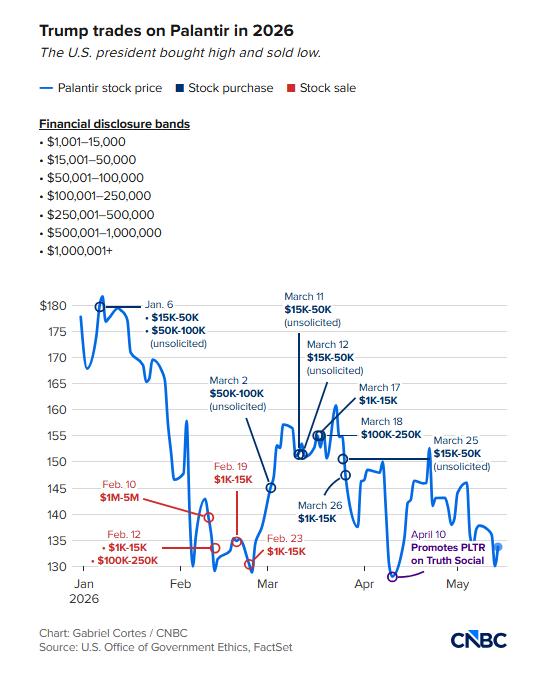
Palantir Technologies provides another example of why the filing should not be read as a simple buy-or-sell signal. The accounts purchased between $1,001 and $15,000 of Palantir on June 3. They subsequently sold shares in two reported transactions, including a much larger sale on June 18, before buying the stock again on June 23 and June 24.
The timing is particularly interesting because the later purchases came after the United States and Iran reached a peace agreement on June 14. That does not prove the portfolio was responding to the geopolitical development. The disclosure gives transaction dates, but it does not provide the reasoning behind individual trades or the exact time orders were executed.
The same caution applies to the broader market. June was a period in which investors were watching monetary policy, geopolitical developments, technology valuations and shifting expectations for economic growth. A portfolio using systematic or index-linked strategies could naturally generate numerous transactions as markets moved, without any individual trade representing a deliberate political or economic prediction.
This is one of the most important lessons from the disclosure: a government stock disclosure tells investors what was reported, but not necessarily why the transaction occurred.
Why investors are paying attention to the Trump trades
The disclosure has attracted attention for reasons that go beyond the individual stocks. Trump is both president and a highly visible business figure, so his financial holdings naturally receive greater scrutiny than an ordinary investor’s portfolio. The central issue is therefore not simply whether Berkshire Hathaway, Visa or Mastercard are attractive investments. It is also how investors should interpret financial activity involving a sitting president.
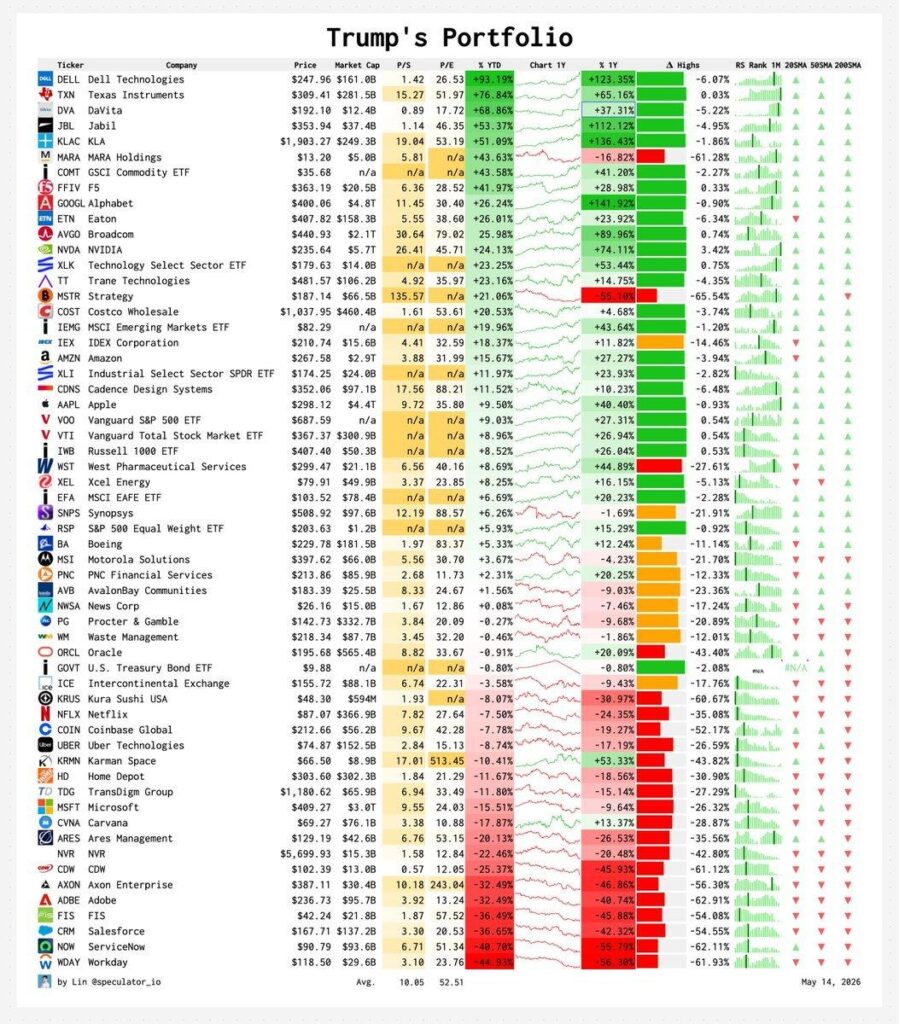
The White House has maintained that there is no conflict because the investments are independently managed. Reporting says Trump’s investment accounts use discretionary management and computer-based strategies, while members of the Trump family have described the assets as being held through a trust structure.
At the same time, financial disclosures have limits. They show reported transactions after the fact, use broad value ranges and do not identify the precise investment rationale behind each move. They therefore cannot, on their own, establish whether a trade was motivated by political information, market expectations, portfolio rebalancing or tax considerations.
For ordinary investors, that makes the disclosure more useful as market information than as a trading instruction. Investors can study which industries appear repeatedly in the filing, how the portfolio is structured and how quickly positions can change, but copying individual transactions could be misleading.
What this means for you
For investors watching the U.S. stock market, the biggest takeaway is not that Trump “picked” Berkshire Hathaway over Meta or Visa over another payments company. The more meaningful development is the evidence of a highly diversified portfolio structure that can produce hundreds or thousands of individual transactions.
The disclosure also illustrates why headlines about government officials’ stock trades should be approached carefully. A reported purchase of $1 million to $5 million sounds precise, but it actually represents a very wide range. Likewise, the reported total of up to roughly $263 million should not be presented as if Trump definitely moved $263 million during June.
For long-term investors, the individual companies remain more important than the political personality attached to the disclosure. Berkshire Hathaway, Visa, Mastercard, Meta, Home Depot and Palantir have different business models, valuations, competitive environments and risks. Their future performance will ultimately depend on earnings, cash flow, interest rates, consumer demand, competition and broader economic conditions.
The filing can nevertheless be useful for identifying themes. Large established companies, payment networks, business services, technology and diversified funds all appear in the reported activity. That gives investors another data point when thinking about how capital is being distributed across major sectors of the U.S. economy.
Investor takeaway and future outlook
Investor takeaway
The Trump 1,000 stock trades disclosure is best understood as a transparency document rather than a ready-made investment strategy. The filing records 1,051 transactions, including 576 purchases and 475 sales, but it does not provide the exact dollar value of every trade or explain the investment decision behind each transaction.
The most notable reported activity included purchases of Berkshire Hathaway, Visa, Mastercard and Cintas, while Meta Platforms and Motorola Solutions appeared among the significant sales. Home Depot also stands out because multiple purchases were reported throughout the month.
Investors should also avoid assuming that every transaction represents a bullish or bearish view. If the accounts are being managed through automated, index-oriented strategies, individual transactions may be components of a much larger portfolio process. Direct indexing can produce frequent purchases and sales even when the overall objective is simply to track a benchmark while managing taxes and portfolio composition.
Future outlook
The most important development to watch is the next financial disclosure. Future filings could show whether the June positions were temporary adjustments or part of a continuing allocation toward large-cap financial, consumer, industrial and technology companies.
Markets will also continue to react to the factors that influence the companies named in the filing: Federal Reserve policy, economic growth, consumer spending, corporate earnings, technology investment, geopolitical developments and changes in market valuations.
The June disclosure therefore offers an unusually detailed snapshot of a politically significant portfolio, but it should not be treated as a crystal ball for the stock market. The strongest conclusion is that Trump’s investment accounts remain highly active and broadly diversified, while the mechanics behind that activity appear more complicated than a simple list of personal stock picks.
The underlying government disclosure is the most important source for readers who want to verify the transactions. The U.S. Office of Government Ethics explains that senior government officials are required to file Periodic Transaction Reports (OGE Form 278-T) for qualifying securities transactions and describes how these reports become publicly available.
For additional market context, readers can also compare the latest disclosure with earlier reporting on Trump’s investment activity and previous transaction filings. The earlier 2026 filings show that the June activity occurred within a much broader pattern of financial disclosures rather than appearing out of nowhere.
Important: This article is for news and informational purposes and is not personalized investment advice. Financial disclosures report transaction ranges and may not reveal the exact amount, rationale or investment timing behind individual trades.
Subscribe to trusted news sites like USnewsSphere.com for continuous updates.