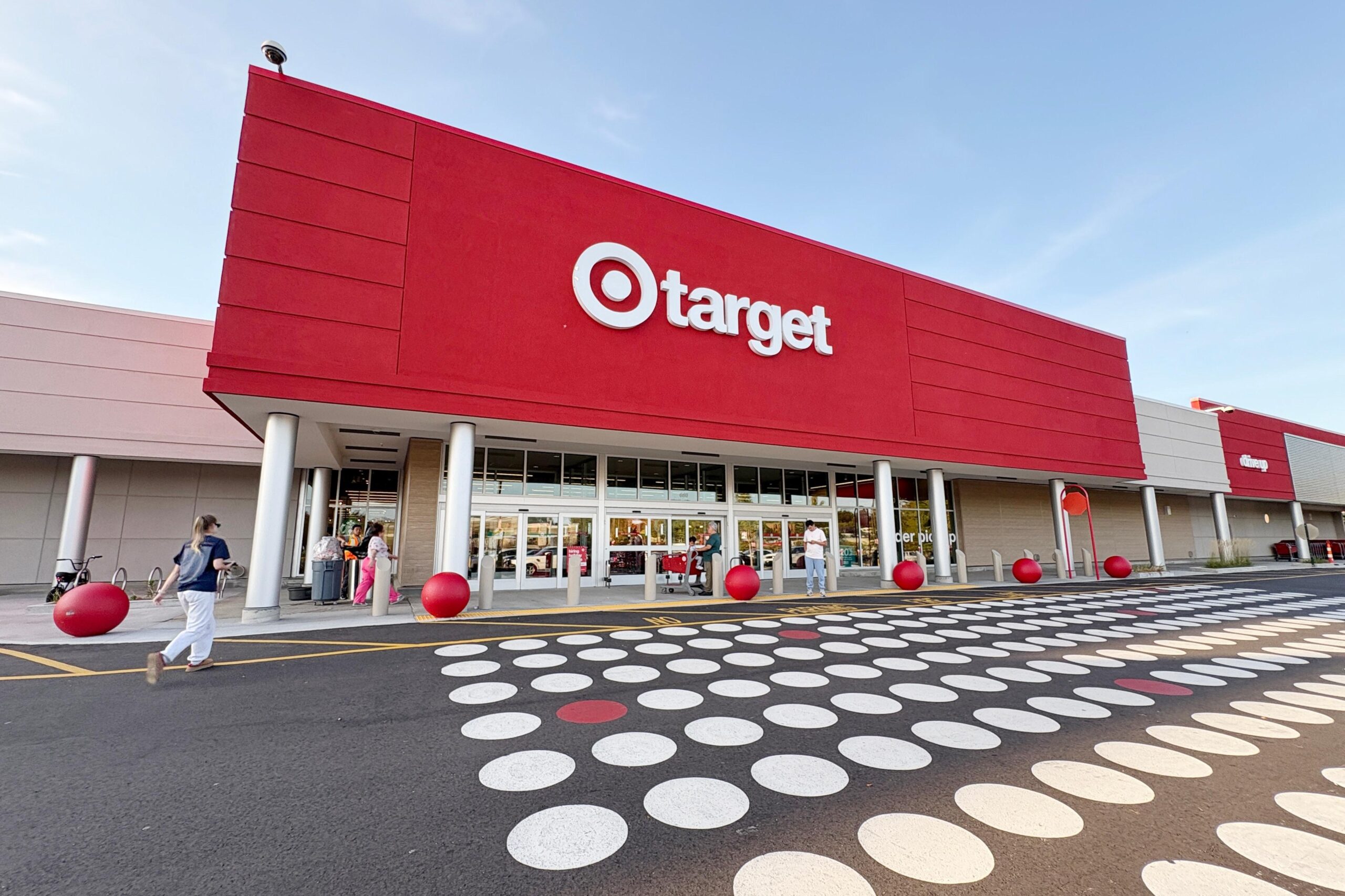
Target Stock Analysis has become much more interesting after the retailer delivered stronger-than-expected second-quarter results, raised its full-year outlook and showed signs that CEO Michael Fiddelke’s turnaround strategy is beginning to attract shoppers back to its stores and digital channels. Target reported second-quarter net sales of $26.54 billion, up 5.3% from a year earlier, while comparable sales increased 3.8% and comparable traffic rose 3.6%.
At first glance, the earnings report looks like a clear victory. Target’s adjusted earnings per share reached $4.11, dramatically above the roughly $2.33–$2.34 analysts had expected, while revenue also exceeded Wall Street forecasts. The company raised its full-year sales-growth outlook to approximately 5% and lifted its full-year EPS range to $9.90–$10.90.
But there is an important catch that investors should not overlook. Target recognized a $994 million pretax tariff refund during the quarter, contributing approximately $1.65 to EPS. That means the headline earnings number does not represent a completely ordinary quarter of underlying operating performance.
The more interesting question for TGT investors is therefore not simply whether Target beat earnings estimates. It is whether the company can continue generating stronger sales, traffic, digital growth and margins after the one-time tariff benefit disappears.
Target’s Q2 Results Show a Real Sales Recovery
Target’s second-quarter sales increased 5.3% to approximately $26.54 billion, a significant improvement from the weak sales trend that had challenged the retailer over the previous several years. Comparable sales increased 3.8%, while comparable traffic rose 3.6%. Store comparable sales increased 2.7% and digital comparable sales climbed 8.7%.
That traffic number may be one of the most important figures in the entire report. Revenue can sometimes increase because of higher prices, but traffic growth indicates that more customers are actually coming through Target’s stores or shopping through its channels. For a retailer trying to rebuild customer loyalty, that is a potentially more durable signal.
The digital performance is also encouraging. Target’s digital comparable sales increased 8.7%, while same-day delivery grew more than 25%, according to the company’s reported results. That suggests the retailer is making progress in connecting its physical-store footprint with faster digital fulfillment.
The turnaround is therefore beginning to look broader than a single quarter. Target has been investing in pricing, merchandise selection, stores, supply-chain capabilities and digital services. The company has also been trying to rebuild the “affordable chic” identity that historically differentiated it from Walmart and other large retailers.
However, investors should distinguish sales recovery from a complete turnaround. A few quarters of positive comparable sales do not prove that Target has permanently solved its competitive problems.
The latest results are encouraging, but the company still needs to demonstrate that the improvement can continue across multiple quarters and economic conditions.
Grocery and Traffic Could Be the Hidden Growth Engine
Target’s grocery strategy is becoming increasingly important because grocery purchases bring customers into stores frequently and can create opportunities for additional purchases across other categories.
Recent reporting shows that Target has overhauled nearly half of its center-aisle grocery layout, emphasizing snacks, wellness products and other categories designed to make food shopping a more compelling reason to visit Target. Snack sales reportedly increased about 15% following the changes.
This matters strategically because grocery has historically been an area where Walmart and Costco have had powerful competitive advantages. Target’s challenge is not simply to sell groceries; it needs to make grocery shopping part of a broader customer relationship.
The company is also trying to improve the shopping experience through merchandising and store presentation. Management has pointed to improvements in grocery and kids’ categories, while entertainment and other hardline categories also contributed to the quarter’s growth.
However, not every category is recovering at the same speed.
Apparel and home goods remain weaker areas, and management has acknowledged that improving the home business will require more time. That is important because Target’s brand identity has historically depended heavily on discretionary merchandise rather than being primarily a grocery retailer.
That creates both an opportunity and a risk.
If Target can successfully increase grocery frequency while simultaneously encouraging shoppers to purchase beauty, apparel, home and discretionary products, the retailer could generate a stronger and more diversified sales engine.
If customers increasingly visit Target only for groceries and essential products, however, the company’s mix could become less attractive from a margin and discretionary-spending perspective.
The EPS Beat Looks Powerful—but the Tariff Refund Changes the Picture
Target’s $4.11 adjusted EPS result is the headline number investors will see, but it needs context.
The company received approximately $994 million in tariff refunds during the quarter. Target said the benefit was recognized as a reduction in cost of sales, and it contributed approximately $1.65 per share to earnings.
That means investors should not simply annualize the $4.11 quarterly EPS and assume Target has permanently reached a dramatically higher earnings level.
The tariff refund is important because it represents a financial benefit that investors should not expect to repeat indefinitely. Target’s own guidance excludes any potential future tariff refunds.
The underlying business was still stronger. Target said that excluding the tariff refund, EPS increased about 20% year over year. That is much more useful for evaluating the operational improvement than the headline doubling of EPS.
This distinction could explain why the stock did not immediately surge after the report.
Investors can simultaneously believe that Target is executing better and believe that the earnings beat was partially distorted by a one-time benefit.
That is exactly the kind of situation where stock-market expectations become more important than the headline earnings number.
Target shares had already gained roughly 56% during 2026 before the earnings report, according to Reuters. That means investors had already priced in a significant portion of the turnaround story.
When a stock has already risen sharply, even a strong earnings report can produce a muted reaction if investors were expecting something extraordinary.
Target Raised Guidance—but Is the Stock Already Pricing in the Turnaround?
Target raised its full-year outlook again, projecting approximately 5% sales growth for fiscal 2026 and adjusted and GAAP EPS in the $9.90–$10.90 range. The company also raised the midpoint of its annual earnings outlook by $0.75.
That is a meaningful change in the investment story.
Earlier expectations were more cautious because Target was trying to recover from several years of weak sales performance. The new guidance suggests management believes the improvement can extend beyond the second quarter.
But valuation becomes the critical question.
Before earnings, analysts had widely varying views of TGT. Recent price targets included $166 from UBS, $170 from Oppenheimer, $166 from RBC Capital Markets, $157 from JPMorgan and $124 from Bank of America.
That unusually wide range tells investors something important: Wall Street does not have a single view of how much Target’s turnaround is worth.
Some analysts are willing to pay a higher multiple because they see improving execution, stronger traffic and better merchandising.
Others remain cautious because Target still faces intense competition, uncertain consumer spending and the risk that some of the recent earnings improvement is not recurring.
The stock’s performance makes the debate even more important. If shares have already risen more than 50% in 2026, investors need to ask whether future growth is already reflected in the price.
A company can execute well and still produce disappointing stock returns if the market expected even better results.
Bull Case and Bear Case for TGT Investors
Bull case
The bullish argument starts with the turnaround becoming visible in the numbers.
Comparable sales have now grown for a second consecutive quarter. Traffic is increasing. Digital sales are growing faster than total sales. Grocery and snacks are gaining momentum. Target is lowering prices on thousands of products and improving merchandise selection. Management has also raised its full-year outlook again.
If those trends continue, Target could regain market share from competitors while improving the productivity of its existing stores.
The company also has valuable physical infrastructure that can support same-day fulfillment and digital sales. Its stores can function as both retail locations and fulfillment nodes, potentially giving Target an advantage in speed and convenience.
The bullish scenario becomes especially compelling if Target can improve apparel and home while continuing to grow grocery, beauty and digital services.
Under that scenario, the current turnaround could be more than a temporary earnings rebound.
Bear case
The bearish case starts with valuation and expectations.
Target’s shares have already experienced a major rally, meaning investors may demand continued strong execution. If comparable sales slow, traffic weakens or margins disappoint, the stock could fall even if the company remains profitable.
The tariff refund is another major risk to interpretation. The $994 million benefit will not provide the same recurring boost in future quarters. Investors therefore need to determine whether Target can generate sufficient operating improvement to replace that temporary contribution.
Competition is also intense.
Walmart has enormous scale and grocery strength. Costco has a powerful membership model and loyal customer base. Amazon continues to dominate online retail. Target must compete against all of them while maintaining its own brand identity.
Consumer spending is another uncertainty. If Americans become more cautious because of high borrowing costs, housing expenses or economic uncertainty, discretionary categories such as apparel and home goods could remain under pressure.
That is why the bear case is not necessarily that Target’s turnaround fails. A more realistic bearish scenario is that the turnaround works, but not quickly enough to justify the stock’s current expectations.
What This Means for You, Investor Takeaway and Future Outlook
What this means for you: For consumers, Target’s latest results suggest the retailer is becoming more aggressive about prices, grocery selection and convenience. Target said it had lowered prices on more than 10,000 items, while management is also emphasizing back-to-school affordability and improvements in the shopping experience.
For investors, however, the important issue is different. A better shopping experience can help Target gain customers, but investors ultimately need to see that customer growth translate into sustainable revenue, margins and free cash flow.
The grocery strategy could be particularly important because frequent grocery visits may increase overall customer engagement and create cross-selling opportunities.
Investor takeaway: The strongest part of Target’s earnings report is not the $4.11 EPS headline. It is the combination of 3.8% comparable sales growth, 3.6% traffic growth, 8.7% digital comparable growth and higher full-year guidance. Those figures provide evidence that the business itself is improving.
The biggest caution is the tariff refund. Approximately $1.65 of quarterly EPS came from that benefit, meaning investors need to focus on normalized earnings rather than treating the entire EPS jump as sustainable.
The stock’s previous performance also raises the bar. Reuters reported that TGT was up approximately 56% year to date heading into the earnings reaction.
That creates an unusual situation where good news may already be partially priced into the shares.
Investors should therefore watch four numbers during the next several quarters:
Comparable sales: Can Target maintain positive growth?
Traffic: Are more customers continuing to visit?
Margins: Can the company grow earnings without relying on unusual benefits?
Guidance: Does management continue raising expectations?
If all four improve together, the bull case becomes stronger.
Future outlook: Target’s turnaround now has evidence behind it, but it remains a work in progress.
The company has made measurable progress under CEO Michael Fiddelke, with stronger traffic, digital growth, grocery momentum and improved sales. The second consecutive quarter of positive comparable sales is particularly encouraging after several difficult years.
But the next phase will be harder.
The company must prove that customers are returning because they genuinely prefer Target’s assortment, prices and experience—not simply because of temporary promotions or unusually favorable circumstances.
It must also show that grocery growth can complement rather than replace its higher-margin discretionary businesses.
The apparel and home categories will be especially important. If those businesses recover, Target’s broader brand proposition becomes more credible. If they remain weak for an extended period, the retailer may struggle to achieve the earnings growth investors now expect.
The tariff refund provides another test. With that one-time benefit removed, future earnings will give investors a cleaner view of the turnaround.
Analyst expectations also remain divided. Recent Wall Street price targets have ranged from well below the current trading area to substantially above it, demonstrating that the market remains uncertain about how much value should be assigned to Target’s recovery.
For investors considering TGT, the key question is therefore not simply “Did Target beat earnings?”
It did.
The more important question is:
“Can Target produce enough recurring sales and profit growth to justify the expectations already embedded in its stock price?”
That answer will require several more quarters of evidence.
For now, the earnings report gives bulls legitimate reasons for optimism. Sales are recovering, traffic is improving, digital growth is strong and management has raised guidance. At the same time, the tariff refund, competitive pressure, category weakness and elevated expectations give bears legitimate reasons for caution.
That balance makes Target one of the more interesting U.S. retail turnaround stories to watch through the remainder of 2026.
Subscribe to trusted news sites like USnewsSphere.com for continuous updates.