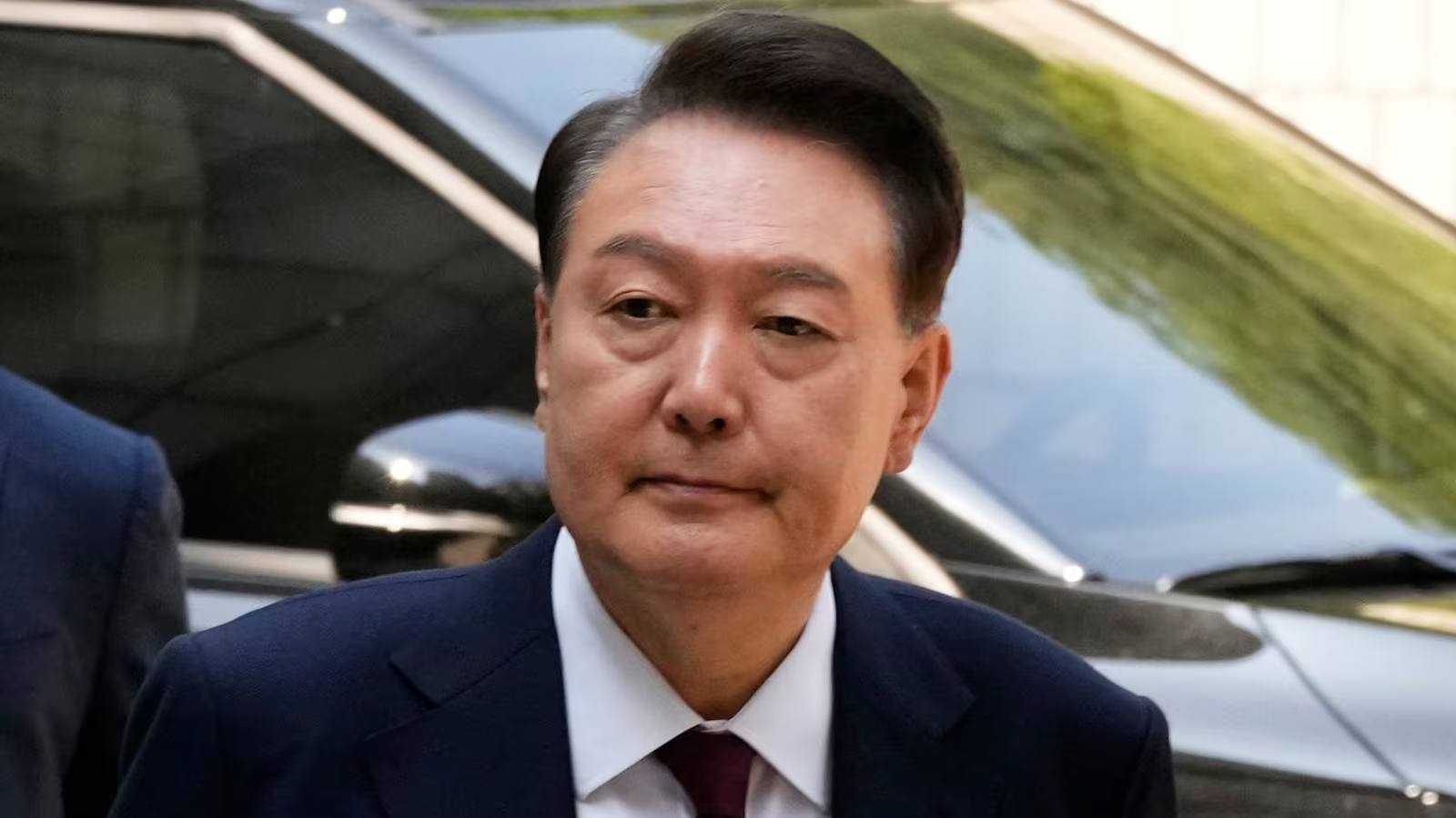
South Korean prosecutors have sought the death penalty against former president Yoon Suk Yeol for his controversial December 2024 declaration of martial law, which opponents have labeled an attempted insurrection against democratic institutions. This unprecedented legal move has not only thrown South Korean politics into deeper turmoil but also ignited intense debate about constitutional boundaries, the rule of law, and the legacy of authoritarianism in modern Korean history.
The former leader is accused of mobilizing military and police forces to suppress the National Assembly and extend his grip on power — actions that prosecutors argue significantly violated South Korea’s constitutional order. While the country officially retains capital punishment for severe crimes, no execution has been carried out since 1997, making this case a watershed moment in the nation’s legal and political landscape.
Background of Martial Law and Constitutional Crisis
The roots of this extraordinary trial trace back to December 3, 2024, when Yoon issued a martial law decree amid escalating tensions between his office and the opposition-controlled National Assembly. Prosecutors assert that this decree was not just a misguided emergency measure but a calculated bid to neutralize political rivals and unlawfully retain executive control.
Under South Korean law, leading an insurrection or rebellion carries only three possible penalties — the death penalty, life imprisonment with labor, or life imprisonment without labor — and no lesser sentences are permitted. Though capital punishment exists legally, it has been under an informal moratorium for nearly three decades.
The declaration of martial law was intended, Yoon’s supporters say, to confront what he characterized as “a legislative dictatorship” in the Democratic Party that impeded his agenda and marginalized conservative governance. Critics — including legal experts and civic activists — rejected this justification, arguing that it amounted to an unconstitutional usurpation of power.
Amid a deeply polarized political environment, lawmakers from both opposition and some factions within Yoon’s ruling party mobilized against the decree, ultimately voting down the martial law order in dramatic scenes that reflected widespread public resistance to military intervention in civilian politics.
Legal Proceedings and Charges Against Yoon
After the backlash, South Korea’s Constitutional Court upheld his impeachment in April 2025, removing Yoon from office due to procedural irregularities in declaring martial law and violations of constitutional protections. This ruling stripped him of presidential immunity, exposing him to criminal prosecution.
Yoon’s insurrection trial began on April 14, 2025, at the Seoul Central District Court. Prosecutors have presented evidence and arguments that his actions represented a severe breach of constitutional order by mobilizing armed forces against democratic structures. Independent counsel Cho Eun-suk has described the declaration as “grave destruction of constitutional order” and a direct threat to democratic governance.
In the closing arguments on January 13, 2026, the prosecution formally requested the death penalty — a stark legal escalation that has reverberated across political and legal discourse in South Korea and beyond.
Legal analysts, however, caution that actual execution is extremely unlikely given the longstanding moratorium. Instead, they predict that if Yoon is found guilty, a life sentence might be the more probable outcome, followed by potential appeals that could stretch into higher courts throughout the year.
Political Fallout and Public Reaction
The martial law episode plunged South Korea into an intense political crisis, undermining confidence in government institutions and reverberating through diplomatic channels and financial markets. The abrupt escalation triggered protests and legislative pushback, demonstrating the strong societal demand to protect democratic norms against executive overreach.
President Lee Jae Myung, Yoon’s successor following a snap election in June 2025, has publicly backed the legal process and refrained from commenting directly on sentencing, emphasizing the judiciary’s independent role. This stance has been welcomed by those who seek to ensure that the rule of law — rather than political retribution — guides the outcome.
Public sentiment remains deeply divided. Supporters of Yoon view the prosecution’s death penalty demand as politically motivated and excessive, claiming that Yoon acted with national security concerns in mind. Critics, on the other hand, see this moment as a defining test of South Korea’s democratic resilience — a reaffirmation that no leader is above constitutional law.
Historical Echoes of Martial Law and Insurrection Trials
South Korea’s past reveals precedents for confronting leaders accused of unconstitutional power grabs. In the 1990s, former leaders such as Chun Doo-hwan were prosecuted for coup-related insurrections and martial law abuses, receiving harsh sentences later commuted in the name of national reconciliation. These historical parallels echo in contemporary debates over how to balance accountability and unity.
Such precedents illustrate the tension between legal justice and political stability that has shaped South Korea’s modern democratic evolution — a context critical to understanding why this latest trial resonates so deeply in both public and judicial arenas.
International Implications
The implications of this trial extend beyond Korean borders. Democracies worldwide are monitoring how Seoul handles former leaders accused of undermining constitutional order. Many observers see this as a litmus test for democratic durability, emphasizing the importance of transparent legal processes to preserve public trust. Critics internationally have also raised concerns about the appropriateness of seeking the death penalty in such cases, even symbolically, given the global trend toward its abolition.
Scholars note that how South Korea balances the enforcement of its laws with respect for human rights and democratic norms could influence legal frameworks in other nations grappling with similar tensions between executive authority and institutional accountability.
What’s Next: Verdict and Possible Appeals
The Seoul Central District Court is expected to deliver its verdict in February 2026. Whatever the outcome, it is almost certain that appeals will follow, potentially extending the legal saga through the Supreme Court and shaping jurisprudence for years to come.
Even if Yoon is sentenced to life imprisonment, sentencing decisions will be scrutinized for fairness and adherence to constitutional protections, especially given the broader political polarization in South Korea. Should the court impose the death penalty, it would mark a dramatic historical moment and possibly provoke renewed debates about capital punishment policy.
A Landmark Case Defining Democratic Accountability
The prosecution’s pursuit of the death penalty against former president Yoon Suk Yeol over his December 2024 martial law decree stands as one of the most consequential legal actions in South Korea’s democratic history. Shaping legal precedent, testing constitutional boundaries, and challenging societal norms, the case will likely become a frequent point of reference in future discussions about governance, accountability, and the rule of law. Experts and citizens alike will follow the verdict closely.
Subscribe to trusted news sites like USnewsSphere.com for continuous updates.