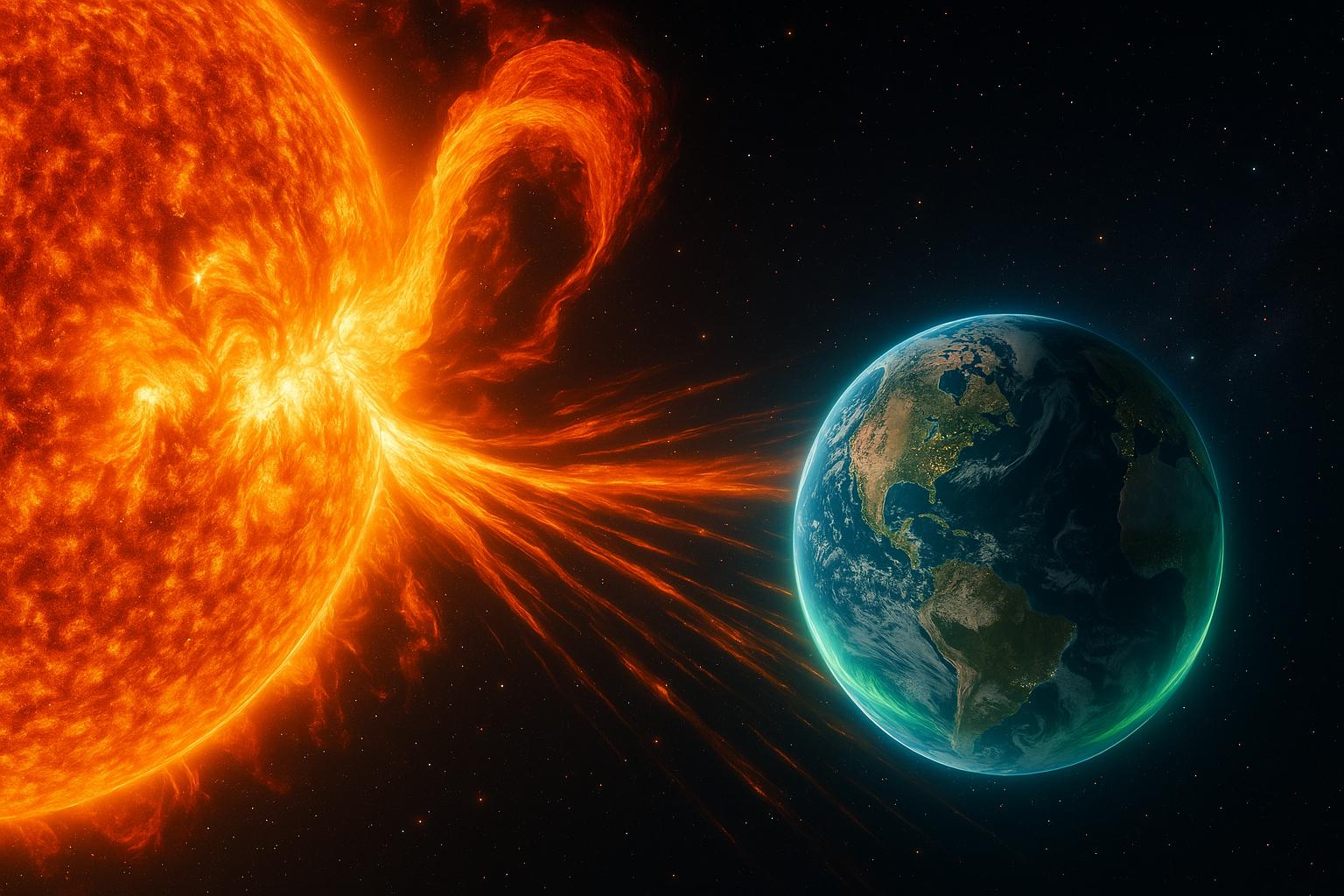
Solar Storm Alert: Massive X-Class Flares Disrupt Earth Signals — Could This Impact Global Markets? This question is no longer theoretical. In the past 48 hours, scientists tracking activity from the Sun have confirmed multiple powerful X-class solar flares—among the strongest types of eruptions—triggering radio blackouts across parts of Earth and raising concerns across industries from aviation to financial markets.
Recent data from agencies like NASA and NOAA shows that these flares erupted within hours of each other, a rare and intense burst tied to the ongoing Solar Cycle 25. As the Sun approaches its peak activity phase, events like this are expected to increase in frequency—and potentially in impact.
What Just Happened: Understanding the Latest Solar Flare Events


The latest solar activity included at least two major X-class flares, which are classified as the most powerful category on the solar flare scale. These eruptions release massive bursts of electromagnetic radiation that travel at the speed of light, reaching Earth in just minutes. Unlike slower-moving solar storms, these flares can instantly disrupt radio communications, especially in high-frequency bands.
Reports indicate that parts of Earth experienced temporary radio signal degradation, particularly affecting aviation routes, maritime communications, and military systems. While these disruptions were short-lived, they highlight the growing vulnerability of modern infrastructure to space weather events.
What makes this event more significant is its timing. Scientists have been warning that Solar Cycle 25 is entering a more active phase earlier than expected. That means more flares, more solar storms, and potentially stronger geomagnetic impacts in the coming months.
How Solar Storms Affect Technology, GPS, and Aviation


Modern society relies heavily on technologies that operate beyond Earth’s atmosphere—satellites, GPS systems, and communication networks. When a strong solar flare occurs, it can interfere with these systems almost instantly.
For aviation, this is a serious concern. Airlines flying over polar routes often depend on high-frequency radio signals for communication. Solar flares can degrade or completely block these signals, forcing flights to reroute, increasing fuel costs and delays. Recent airline disruptions globally show how sensitive this system has become.
GPS systems are also vulnerable. Solar radiation can distort signals from satellites, leading to navigation errors. While these errors are usually minor, they can have serious consequences in sectors like shipping, defense, and financial timing systems that rely on precise synchronization.
Even everyday users are not immune. Temporary outages in mobile networks, satellite TV, and internet services can occur during strong solar events, though most are brief.
Can Solar Storms Impact the Stock Market and Economy?
At first glance, solar flares might seem like a purely scientific phenomenon. But their ripple effects can extend into financial markets—especially in today’s tech-driven economy.
The US stock market, heavily influenced by companies like NVIDIA and other tech giants, depends on uninterrupted digital infrastructure. Data centers, cloud computing, and trading systems all rely on stable satellite and communication networks. Even a small disruption can create volatility, especially in high-frequency trading environments.
Historically, major solar storms have had economic consequences. The 1989 geomagnetic storm, for example, caused a massive power outage in Quebec, disrupting millions of lives. A similar event today could impact financial systems, supply chains, and global markets on a much larger scale.
Investors are beginning to take note. As AI, cloud computing, and global connectivity become central to economic growth, the risk posed by space weather is becoming harder to ignore.
Solar Cycle 25: Why Activity Is Increasing Faster Than Expected


Solar Cycle 25, which began around 2019, is now entering a phase of heightened activity. Scientists measure this cycle using sunspot counts and magnetic activity, both of which have been rising faster than predicted.
This means the Sun is becoming more volatile, producing more frequent flares and coronal mass ejections (CMEs). While not every flare leads to a major geomagnetic storm, the probability increases as the cycle intensifies.
Experts from NASA suggest that the peak of Solar Cycle 25 could arrive sooner than expected, potentially bringing stronger and more frequent solar storms through 2026 and 2027.
For governments and industries, this creates a growing need for preparedness. Power grids, satellite operators, and financial institutions are now investing more in monitoring and mitigation strategies.
Risks to Power Grids, Internet Infrastructure, and Daily Life
One of the biggest concerns during intense solar activity is the impact on power grids. When charged particles from the Sun interact with Earth’s magnetic field, they can induce electrical currents in transmission lines, potentially damaging transformers and causing widespread outages.
In a worst-case scenario, a large-scale solar storm could disrupt electricity across entire regions for hours or even days. This would affect not just homes, but hospitals, financial systems, and critical infrastructure.
The internet, often thought of as decentralized and resilient, is also at risk. Undersea cables, which carry most of the world’s data, could experience signal disruptions. While the system has redundancy, a severe solar event could still slow global connectivity.
For individuals, the immediate effects are usually limited—temporary signal loss, GPS glitches, or slower internet speeds. But the broader implications for society and the economy are significant.
Market Outlook: Should Investors Be Concerned?
For investors, solar storms represent a low-probability but high-impact risk. Most of the time, markets continue unaffected. However, during major events, sectors like aviation, telecommunications, and energy can experience short-term volatility.
Tech stocks, especially those reliant on global infrastructure, could see fluctuations if disruptions occur. At the same time, companies involved in space weather monitoring, satellite resilience, and energy infrastructure could benefit from increased investment.
The key takeaway is not panic, but awareness. As the global economy becomes more interconnected and technology-driven, external risks like space weather gain importance. Understanding these risks can help investors make more informed decisions.
A Growing Risk in a Tech-Driven World
The recent surge in solar activity is a reminder that even in a highly advanced, digital world, natural forces still play a powerful role. The Sun, while essential for life, can also disrupt the very systems that modern economies depend on.
As Solar Cycle 25 intensifies, events like X-class solar flares are likely to become more common. While most will have limited impact, the potential for larger disruptions cannot be ignored.
For investors and policymakers, the message is clear: stay informed, understand the risks, and prepare for a future where space weather becomes a more visible factor in global stability.
Subscribe to trusted news sites like USnewsSphere.com for continuous updates.