Intel Stock Falls Even as 14A Manufacturing Shows a Potential Breakthrough
Intel stock closed at $89.47 on August 28, 2026, down 2.85%, after trading between $89.05 and $93.70 during the session. More importantly for long-term investors, the decline came while Intel’s manufacturing story produced one of its most encouraging signals in years: management says the defect-density trajectory of its upcoming Intel 14A process is improving faster than expected.
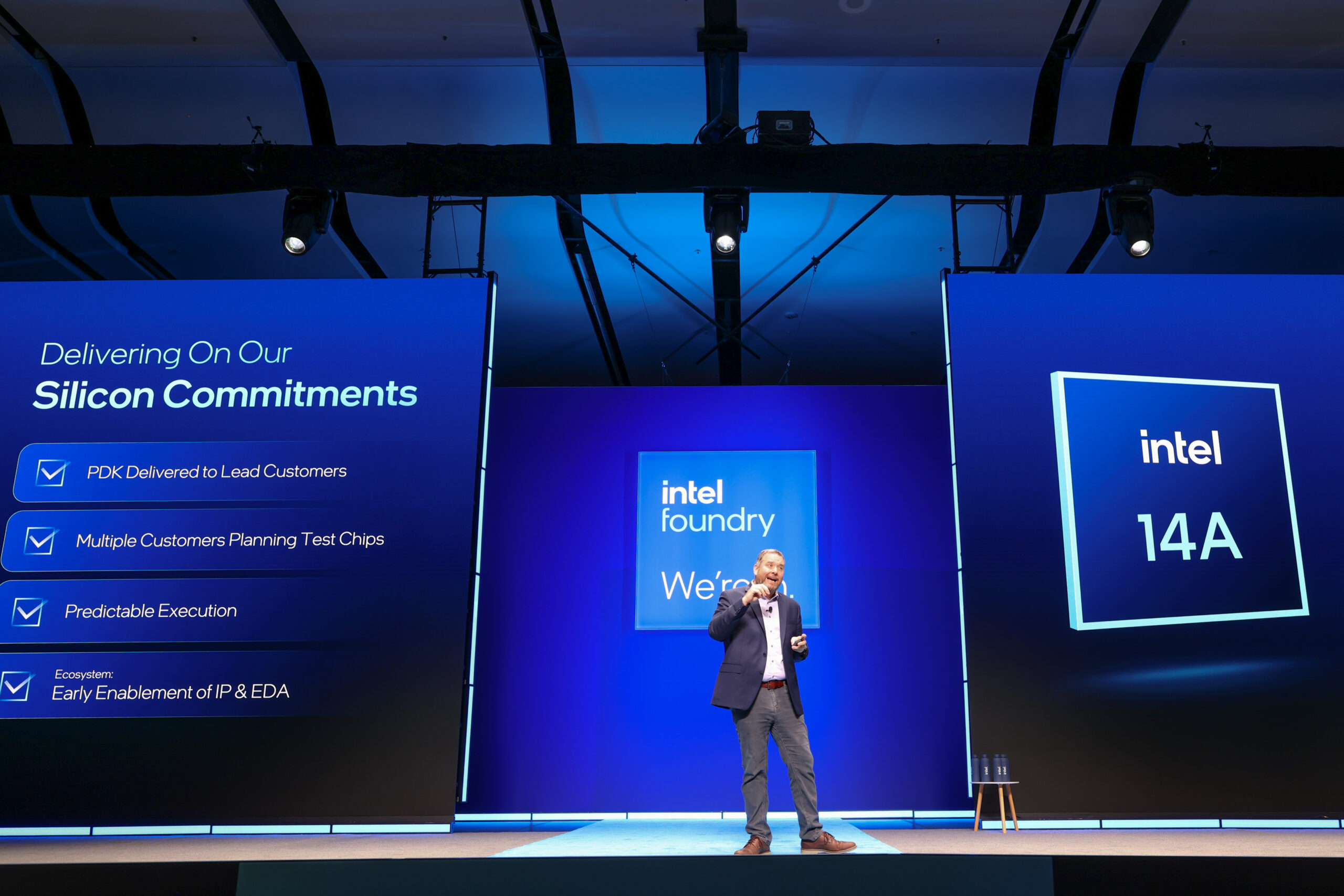
That creates an unusual investment debate. On one side, Intel’s Foundry business generated $5.8 billion of Q2 revenue, up 31% year over year, while its operating loss was approximately $2.09 billion. On the other, Intel says 14A is progressing strongly enough to remain on track for risk production in the second half of 2027 and high-volume manufacturing in 2028.
The important question is therefore not simply why Intel shares fell. The bigger question is whether Intel is finally proving that its manufacturing turnaround can become economically meaningful—or whether investors are paying a premium for technological progress that still has years of execution and customer-acquisition risk ahead.
The latest evidence points to a mixed answer. Intel’s technology trajectory looks considerably healthier than it did during some of the company’s recent manufacturing setbacks, but the financial economics of the foundry business remain unproven. For investors, that makes INTC neither an obvious turnaround nor an obvious trap. It is increasingly a high-expectation execution story.
Intel Foundry Revenue Is Growing, but the $2.09 Billion Loss Still Matters
Intel’s second-quarter numbers show why the foundry debate is so complicated. Foundry revenue reached $5.765 billion, compared with $4.417 billion in the year-ago quarter. At the same time, operating costs and expenses were $7.854 billion, leaving an operating loss of $2.089 billion. The loss improved substantially from the $3.168 billion loss recorded in Q2 2025, but the business remains deeply unprofitable.
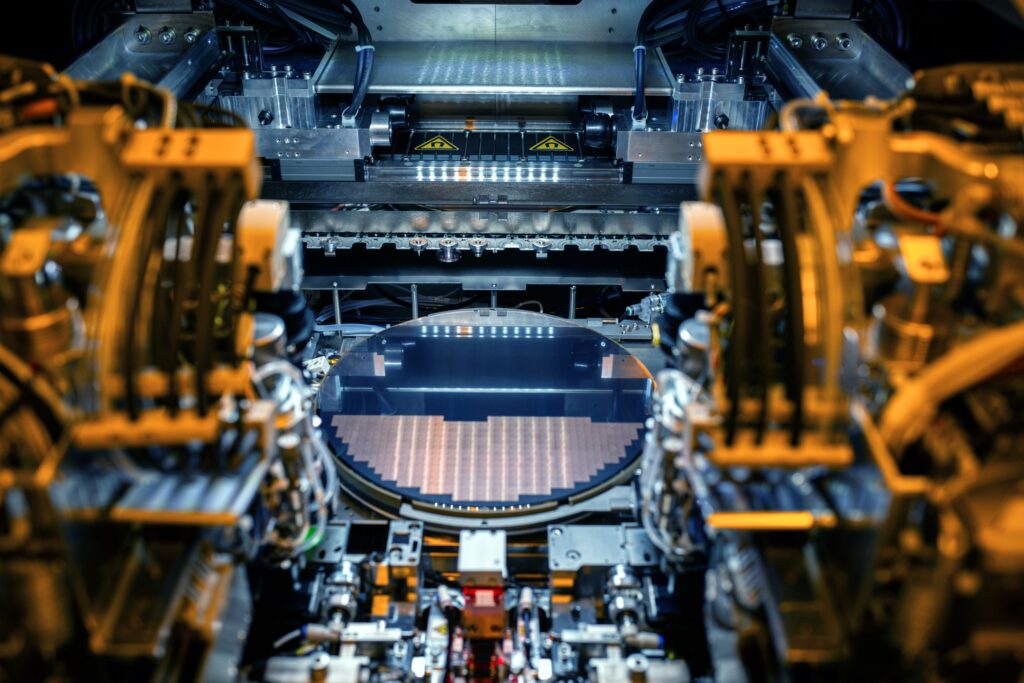
There is another detail investors should not overlook. Of the $5.8 billion of reported Foundry revenue, approximately $5.5 billion was intersegment revenue, while external revenue was only about $293 million. That distinction is crucial because Intel’s long-term turnaround thesis depends heavily on turning its manufacturing operation into a genuine external foundry business rather than primarily manufacturing Intel’s own chips.
That means the headline growth rate can be misleading if viewed without context. Revenue is increasing, production volumes are rising and Intel is making better use of its factories, but the ultimate test will be whether outside customers are willing to commit meaningful production volumes to Intel’s leading-edge nodes.
The company itself has acknowledged this challenge. Intel’s filings say its manufacturing economics require wafer volumes beyond what it expects from its own products alone to reach attractive efficiency. The company has also previously warned that failure to secure a significant external customer for 14A could lead it to reconsider future leading-edge process development.
Why Intel 14A Could Change the Manufacturing Story
The strongest bullish development is Intel’s recent update on 14A defect density. CFO David Zinsner said at the Deutsche Bank Technology Conference that the process is showing a defect-density trajectory that Intel considers unusually strong, with progress reportedly better than expected and comparable in significance to the company’s much earlier 22nm-era manufacturing performance.
Defect density matters because advanced semiconductor manufacturing is not simply about designing a smaller transistor. A process has to produce working chips consistently enough to make high-volume manufacturing economically viable. As defects decline, yields can improve, and improved yields can lower the effective cost of producing usable chips.
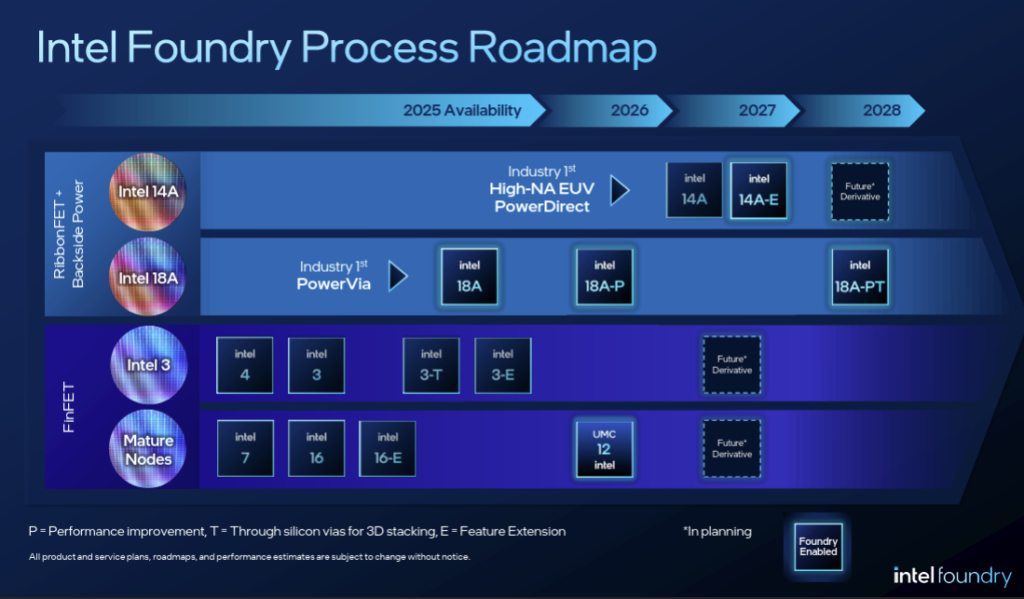
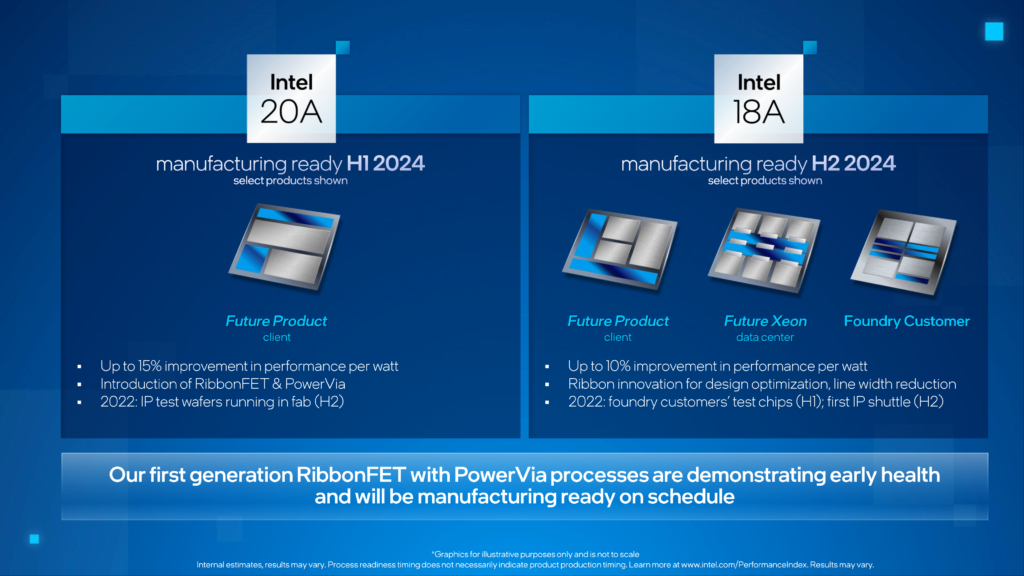
Intel 14A is also strategically important because it incorporates technologies intended to push performance, power efficiency and transistor density further. Intel has described the process as a next-generation node potentially incorporating High-NA EUV lithography, while its broader roadmap includes advanced gate-all-around transistor technology and backside power delivery.
The timing has also improved. Intel moved toward risk production in the second half of 2027 and high-volume manufacturing in 2028, bringing the timetable forward from earlier expectations. Intel’s Q2 materials say the company committed to completing 14A development and is progressing toward performance and design milestones for potential significant customers.
That is meaningful because manufacturing credibility can become self-reinforcing. If Intel demonstrates strong yields, customers may become more comfortable designing chips around the process. More designs can create larger production volumes, which can improve factory utilization and potentially strengthen the economics of the foundry operation.
But investors should not confuse a promising defect-density curve with a finished commercial product. A good early manufacturing trajectory still has to survive qualification, design completion, customer tape-outs, volume ramping, cost targets and real-world reliability requirements.
The External-Customer Problem Is Still Intel’s Biggest Test
The most important weakness in the turnaround story is the gap between technology progress and external customer revenue.
Intel has been trying to establish itself as a major contract manufacturer capable of competing with industry leaders such as TSMC. That requires customers to make multiyear commitments and redesign products around Intel’s manufacturing ecosystem. It is a much harder task than simply demonstrating that Intel can manufacture its own processors successfully.
There are encouraging signs. Intel has expanded relationships with semiconductor-design software and intellectual-property companies. For example, Cadence expanded its collaboration with Intel around 14A, focusing on design technology co-optimization, production-ready process design kits and design enablement.
Synopsys also announced expanded 14A support in July, including certified electronic-design-automation flows and IP aimed at advanced AI, high-performance computing and multi-die designs. These developments matter because a foundry ecosystem needs much more than a fabrication process: customers need tools, libraries, IP, packaging and predictable design flows before they can commit billions of dollars to a manufacturing platform.
Intel has also begun seeing external-customer momentum at other nodes. Fortinet, for example, was announced as an external customer for Intel 4 for its next-generation security processor, giving Intel a named customer win on a mature advanced node.
Still, the numbers show that external foundry revenue remains small compared with the overall Foundry segment. Until that changes materially, the investment case remains dependent on future customer wins rather than current foundry profitability.
What this means for you
For investors following INTC, this means the most important metric may not be quarterly Foundry revenue growth by itself. Watch external Foundry revenue, customer commitments, wafer volumes, manufacturing yields, gross-margin improvement and capital spending.
If external revenue begins accelerating while yields improve, the turnaround thesis becomes considerably stronger. If Intel continues reporting impressive technology milestones without attracting large production commitments, investors may eventually question whether the manufacturing investment can generate adequate returns.
Investor Takeaway: Turnaround Potential Is Real, but the Valuation Raises the Bar
The market has already recognized that Intel’s situation is changing. INTC has experienced a dramatic rally over the past year, and recent market data shows the shares were still up substantially over longer periods despite the August 28 decline. One market-data source puts Intel’s one-year gain above 260%, illustrating just how dramatically investor expectations have changed.
That creates an important distinction between a better company and a better stock at the current price.
A company can execute better while its stock still fall if investors had already priced in much of the improvement. Intel’s recent capital raise also demonstrates how expensive the turnaround can be. Reuters reported in August that Intel raised roughly $20 billion through an upsized share offering priced at $95 per share, while the company increased its capital-spending outlook to support manufacturing and advanced packaging investments.
For bullish investors, the argument is straightforward: Intel has a stronger technology trajectory, rising product demand, improving 18A execution, a potentially compelling 14A roadmap and growing interest from customers and ecosystem partners. The company’s Q2 results also showed substantial growth in its Data Center and AI business, with revenue reaching $6.3 billion, up 59% year over year, while total Intel revenue rose 25% to $16.1 billion.
For cautious investors, however, the counterargument is equally powerful. Intel’s foundry operation remains deeply loss-making, external revenue is still a small portion of the segment, 14A remains years away from high-volume production, and the company needs major capital investment to compete at the leading edge.
That is why the current Intel story should not be framed as “14A is good, therefore Intel stock must rise.” The real thesis is conditional: if 14A delivers strong yields, wins major customers and reaches profitable volume, today’s manufacturing investment could become the foundation of a much stronger Intel.
Future Outlook: What Could Decide Whether INTC Is a Turnaround or Trap?
The next phase of Intel’s story will be defined by several milestones rather than one earnings report. First, investors need to see whether the company’s encouraging 14A defect-density trajectory continues as the process becomes increasingly complex. Early progress is encouraging, but high-volume manufacturing is where the economics ultimately get tested. Intel expects risk production in the second half of 2027 and high-volume production in 2028.
Second, Intel needs to convert customer interest into firm commercial commitments. Intel’s own filings say the pace and scale of manufacturing expansion will depend on committed demand from Intel’s product roadmap and external 14A design wins. That makes customer announcements one of the most important catalysts for the stock.
Third, investors should watch whether Foundry losses narrow faster than revenue grows. Q2 already provided some evidence of improvement: the operating loss declined from $3.2 billion to $2.1 billion year over year. But Intel still needs to move from “losses are improving” to “the business can eventually earn an attractive return on invested capital.”
Fourth, Intel must balance capital intensity with shareholder returns. The company has enormous manufacturing ambitions, but semiconductor fabs require enormous upfront investment and can take years to reach efficient utilization. If customer demand arrives faster than capacity, spending may produce attractive long-term returns. If demand disappoints, the same spending can become a burden.
The bottom line
So, is Intel a turnaround or a trap?
At this point, the most defensible answer is a turnaround in progress—but not yet a proven turnaround.
The evidence has undeniably improved. Intel’s Foundry revenue is growing, its operating losses are narrowing, 18A production is scaling, external ecosystem support for 14A is expanding, and management is reporting unusually encouraging defect-density progress. The company has also moved its 14A manufacturing timetable forward, a sign that management has greater confidence in the technology than it did previously.
But the financial proof is still missing. A $2.09 billion quarterly Foundry operating loss is too large to ignore, and only $293 million of Q2 Foundry revenue came from external customers. Until Intel demonstrates that outside customers will commit significant volumes to its leading-edge manufacturing platform, the foundry turnaround remains a high-risk investment proposition.
For long-term investors, the most important development may therefore not be the next daily move in INTC. It will be the moment when Intel can demonstrate all three simultaneously: competitive process technology, major external customers and improving foundry economics.
If those three pieces come together, Intel’s manufacturing strategy could become one of the company’s biggest competitive advantages. If the technology improves but customer demand and profitability fail to follow, the market could eventually view the investment as another expensive attempt to rebuild Intel’s manufacturing leadership.
For now, the evidence suggests that the turnaround case is becoming more credible—but investors should demand financial proof before assuming the turnaround is complete.
Subscribe to trusted news sites like USnewsSphere.com for continuous updates.