Bloom Energy has moved from being a niche fuel-cell company to one of the more closely watched names in the race to solve the enormous electricity requirements of artificial intelligence. The company’s second-quarter results provided a striking reason for that change: quarterly revenue crossed $1 billion for the first time, while management simultaneously raised its full-year 2026 outlook.
The headline number was not simply a psychological milestone. Bloom reported $1.065 billion of revenue for the second quarter, up 165.5% from $401.2 million a year earlier. Product revenue increased even faster, climbing 215.4% to $935.4 million. At the same time, GAAP gross margin improved to 33.4% from 26.7%, while GAAP operating income reached $182.2 million.
That combination matters because the AI infrastructure story is increasingly shifting away from the question of whether companies need more computing power and toward a harder question: Where will all the electricity come from?
Bloom believes its fuel-cell systems can provide an answer when traditional grid connections take too long. Recent developments—including a fivefold expansion of its Brookfield financing framework to $25 billion, an expanded MiTAC relationship, and the introduction of Power Connect—suggest that the company is trying to turn the AI power bottleneck into a long-term growth platform.
But investors should not confuse rapid revenue growth with a risk-free stock. Bloom’s valuation, execution requirements, capital needs, competition and dependence on continued AI infrastructure spending all remain important considerations.
Bloom Energy’s $1 Billion Quarter Changes the Investment Equation
Bloom Energy’s second-quarter performance was considerably larger than the business investors were accustomed to seeing. Revenue reached $1.0654 billion, compared with $751.1 million in the first quarter and $401.2 million in the second quarter of 2025. That means the company more than doubled revenue year over year while also expanding profitability.
The improvement was visible across several important measures. GAAP diluted earnings per share came in at $0.62, compared with a $0.18 loss in the year-ago quarter. Non-GAAP diluted EPS was $0.78, while non-GAAP operating income increased to $239.6 million. Adjusted EBITDA reached $253.4 million.
The quality of the growth is particularly important. Product revenue increased 215.4%, substantially faster than total revenue. That suggests the current acceleration is not simply being generated by a temporary accounting effect or a small increase in service activity; the company’s core equipment business is expanding rapidly.
Bloom also raised its full-year 2026 revenue guidance to $3.9 billion-$4.2 billion, compared with its earlier outlook. At the midpoint, that represents approximately 100% year-over-year revenue growth. The company expects non-GAAP gross margin of about 34%, non-GAAP operating income of $800 million-$900 million and non-GAAP EPS of $2.55-$2.85.
That guidance changes the conversation around Bloom Energy. The company is no longer being evaluated only as a speculative clean-energy technology story. Investors now have to consider whether Bloom can convert the extraordinary demand surrounding AI infrastructure into sustained, profitable, repeatable growth.
Why AI Data Centers Are Creating a New Market for Bloom Energy
The fundamental investment thesis begins with electricity.
AI data centers require enormous quantities of power, and bringing new generation capacity onto the traditional grid can involve lengthy interconnection processes, transmission constraints, permitting challenges and local opposition. Bloom’s technology offers a different model: generate electricity closer to the facility instead of waiting entirely for additional grid capacity.
Bloom’s own 2026 data-center research illustrates why this issue is becoming more significant. Its mid-year report found that 61% of surveyed developers planned to bring their own power if the grid could not meet their needs. The report also said inference had already grown to more than half of AI compute in its survey, reflecting the transition from AI model development toward real-world deployment.
That distinction is important. AI infrastructure is not only about building a handful of massive training clusters. As AI applications spread into search, software, enterprise workloads, robotics and other services, inference can create a persistent requirement for computing capacity.
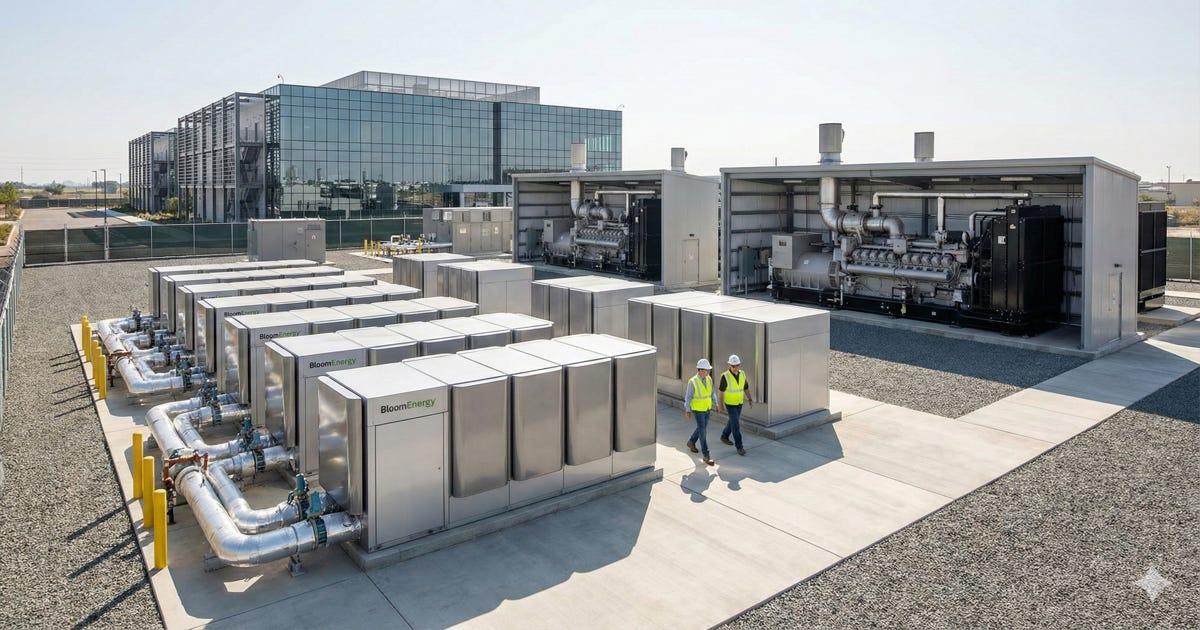
Bloom is positioning its solid-oxide fuel-cell systems as a source of reliable onsite electricity for these facilities. The company says its technology generates electricity electrochemically rather than through conventional combustion, a feature it argues can help address issues such as deployment speed, noise and water requirements.
The company’s AI customer base is also becoming broader. In August, Bloom said its AI infrastructure segment had grown to nearly two dozen customers representing approximately 250 MW of capacity, compared with almost no activity in that segment two years earlier.
That growth helps explain why investors are treating Bloom differently from a conventional hydrogen or fuel-cell stock. The immediate opportunity is increasingly connected to the physical infrastructure required for AI.
The $25 Billion Brookfield Partnership Could Be More Important Than the Quarterly Revenue
One of the biggest developments surrounding Bloom Energy in 2026 came before the second-quarter earnings report.
In June, Bloom and Brookfield expanded their strategic partnership from a previously announced $5 billion framework to $25 billion for financing power projects supporting AI infrastructure. That represented a fivefold increase and created a substantially larger potential pipeline for Bloom’s onsite power technology.
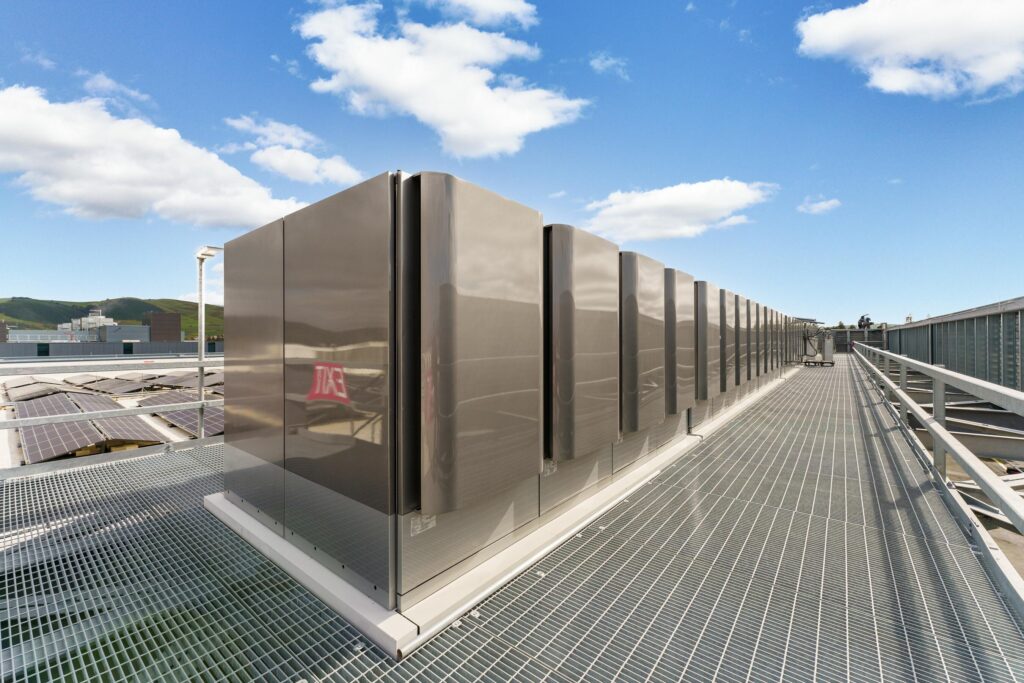
It is important to understand what that $25 billion figure means. It should not be interpreted as $25 billion of guaranteed revenue for Bloom. Instead, it represents a financing framework designed to support the development and deployment of power projects. Actual projects, contracts, construction and revenue recognition still depend on execution and customer commitments.
Nevertheless, the significance is considerable.
AI infrastructure requires much more than GPUs. Developers need land, cooling, networking, buildings, electricity generation, transmission connections and financing. By combining Bloom’s power technology with Brookfield’s infrastructure capital and development capabilities, the partnership attempts to solve several pieces of the problem simultaneously.
That could help Bloom compete for projects that might otherwise be too capital-intensive or complex to develop quickly.
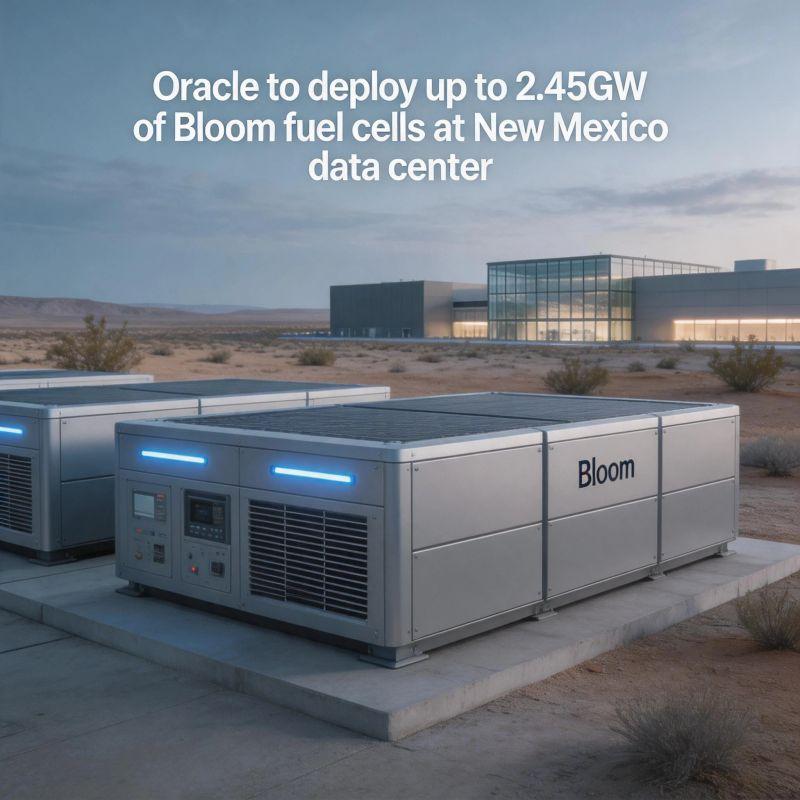
The company has also demonstrated that major technology and infrastructure players are willing to work with its platform. Oracle agreed to purchase up to 2.8 GW of Bloom fuel-cell power for AI data centers, with an initial 1.2 GW contracted for U.S. projects in 2026 and 2027.
These relationships matter because large AI infrastructure customers tend to require proven reliability, financing capacity and the ability to deploy at scale—not merely an attractive technology demonstration.
What Bloom Energy’s Latest Product and Customer Moves Tell Investors
Bloom’s most recent announcements suggest that management is focusing not only on selling fuel cells but also on reducing the time and complexity required to deploy them.
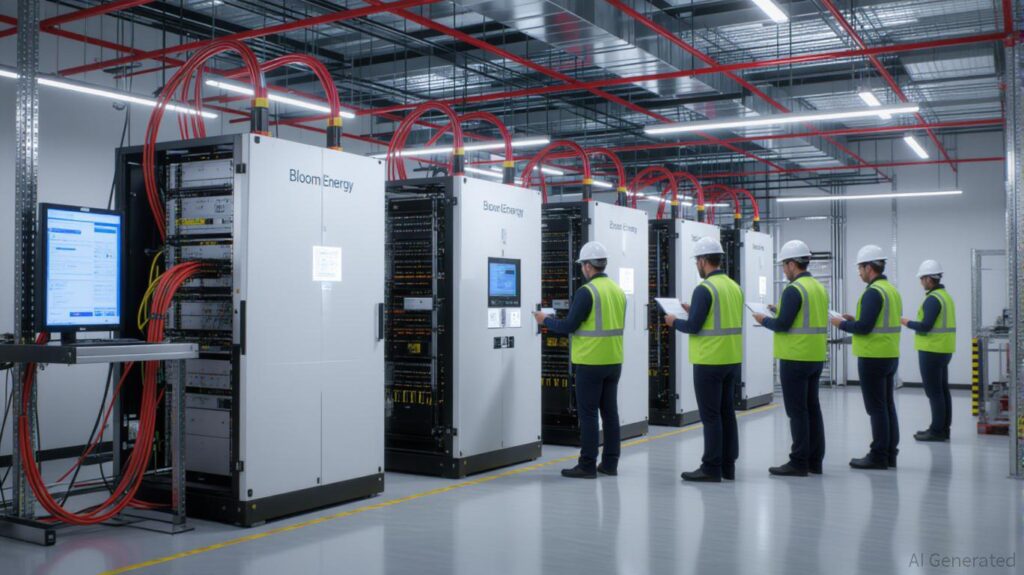
On August 19, Bloom introduced Power Connect, a deployment system that the company says can reduce onsite power installation time by more than 40%. The approach moves substantial electrical integration work from the construction site into a controlled factory environment, with systems arriving pre-connected, pre-wired and tested.
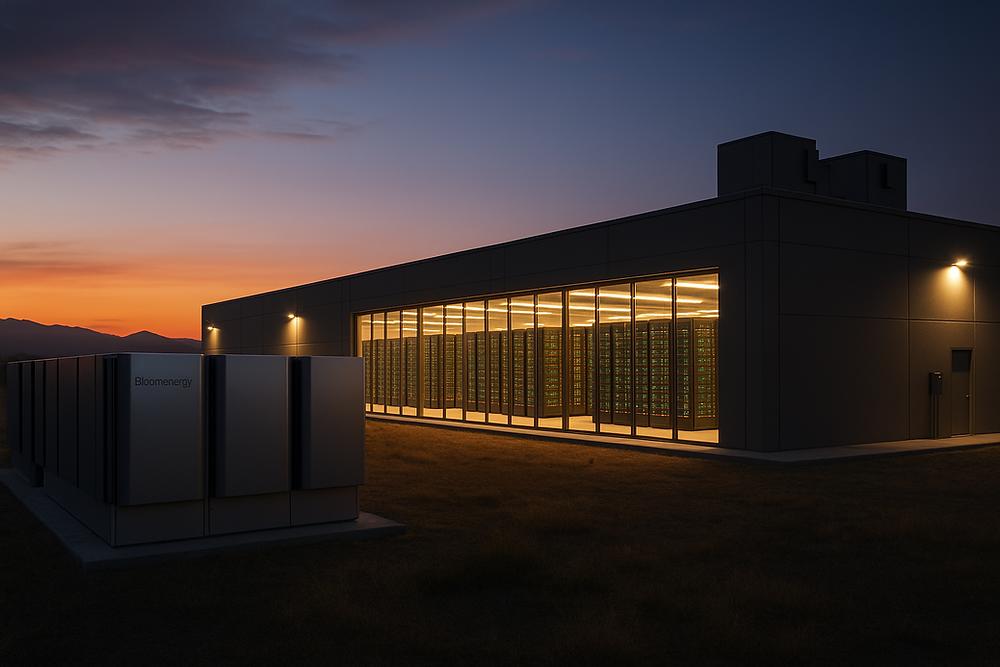
For AI data centers, that could be a meaningful competitive advantage.
The value proposition is not simply “generate electricity.” It is increasingly generate electricity quickly enough to prevent power availability from delaying the data center itself.
Bloom’s expanded partnership with MiTAC provides another example. The company announced in August that it would deploy fuel-cell systems for an islanded microgrid at MiTAC’s AI server manufacturing campus in Fremont, California. The project builds on an existing installation at MiTAC’s San Jose facility.
This is strategically interesting because AI infrastructure has an entire supply chain beyond hyperscale data centers. Server manufacturing, semiconductor facilities and advanced manufacturing sites also require reliable electricity.
That creates a potentially wider market for Bloom than simply supplying electricity to hyperscalers.
The company’s AI opportunity therefore rests on several layers: hyperscale data centers, cloud infrastructure, AI labs, colocation facilities and the manufacturers that build the hardware required for AI expansion.
What This Means for You: Investor Takeaway and Key Risks
What this means for you: if you are following Bloom Energy because of the AI boom, the most important development is not merely that the stock has attracted attention. The more important question is whether AI-driven electricity demand can translate into a durable stream of contracts and profitable deployments.
The second-quarter numbers provide encouraging evidence. Revenue crossed $1 billion, margins improved, operating income turned strongly positive and full-year guidance was raised.
But investors should also recognize the other side of the equation.
Bloom’s future performance depends heavily on its ability to manufacture and deploy systems at the pace customers require. The company’s SEC disclosures identify risks including supply constraints, production capacity, tariffs, commodity prices, lengthy sales and installation cycles, financing requirements, regulatory changes and the possibility that a slowdown in AI data-center construction could reduce demand.
There is also valuation risk. A stock can be attached to an excellent business opportunity and still produce disappointing returns if expectations become too aggressive. Investors therefore need to separate business growth from stock-price expectations.
Competition is another consideration. Data centers can pursue multiple power strategies, including grid expansion, natural-gas generation, nuclear power, renewables paired with storage and other onsite generation technologies. Bloom does not need to eliminate every alternative to succeed, but it must demonstrate that its speed, reliability, economics and deployment advantages justify customer adoption.
Investor takeaway: Bloom Energy’s $1 billion quarter provides evidence that the AI power theme has become commercially significant for the company. The strongest part of the story is the combination of rapidly rising revenue, improving margins, expanding customer relationships and large financing partnerships. The biggest question is whether this exceptional growth can continue after the initial wave of AI infrastructure spending.
Future Outlook: Can Bloom Energy Keep Winning the AI Power Race?
Future outlook: the next phase of Bloom Energy’s story will probably be determined less by whether AI needs more electricity—the evidence for that is already substantial—and more by how quickly the company can convert demand into completed projects, recognized revenue and durable margins.
The $3.9 billion-$4.2 billion full-year revenue target provides investors with a clear benchmark. The company now needs to demonstrate that the extraordinary second-quarter performance is not an isolated peak.
The next major indicators to watch include quarterly product revenue, gross margin, operating cash flow, contracted AI capacity, customer additions, manufacturing capacity, project deployments and the pace at which large partnerships translate into actual projects.
Bloom’s ability to reduce installation time could become particularly important. Power Connect’s claimed 40%-plus reduction in onsite installation time addresses one of the practical bottlenecks facing large infrastructure projects. If that benefit is demonstrated consistently in real-world deployments, it could strengthen Bloom’s competitive position.
The broader industry backdrop is also favorable to the company’s thesis. Bloom’s research indicates that data-center developers increasingly view access to electricity as a limiting factor, while other recent industry commentary has similarly focused on power availability as one of the major constraints on AI infrastructure expansion.
Still, the strongest investment case should not be based on a single quarter or a headline partnership. Investors should watch whether revenue remains strong, whether margins hold as the company scales, whether customers actually deploy contracted systems and whether Bloom generates enough cash to support expansion without creating excessive financial pressure.
For now, Bloom Energy has clearly changed the conversation around AI power. A company once associated primarily with fuel-cell technology is increasingly being evaluated as part of the infrastructure behind the AI economy. Its record $1.065 billion quarter, raised 2026 guidance, expanding AI customer base and $25 billion Brookfield framework all point in the same direction: electricity has become one of AI’s most important infrastructure constraints, and Bloom is attempting to make that constraint a major business opportunity.
The question for the stock from here is therefore straightforward but difficult: Can Bloom turn extraordinary AI-related demand into years of profitable growth without investors paying too much for that future today?
That is the key issue to watch as the company moves through the rest of 2026 and into 2027.
Subscribe to trusted news sites like USnewsSphere.com for continuous updates.