
The S&P 500 rally has carried U.S. stocks to record territory, but a less visible signal from the bond and credit markets is giving investors another reason to look beneath the surface. Stocks have been supported by strong corporate earnings, enthusiasm around artificial intelligence and expectations that the Federal Reserve may avoid another rate increase in September. Yet bond investors are confronting a different problem: long-term borrowing costs remain elevated, real yields are unusually high, and the supply of new debt is increasing rapidly.
The S&P 500 closed at a record 7,798.99 on August 13 before slipping 0.2% to 7,785.76 on August 14. Even after that pullback, the index was up about 13.7% for the year. The Nasdaq was up 15%, while the Russell 2000 had gained 23.6% year to date through August 14.
At the same time, the U.S. 10-year Treasury yield finished August 14 around 4.68%, while the 2-year yield was about 4.17%. More strikingly, U.S. 30-year real yields were around 3%, close to an 18-year high. That means investors are demanding unusually strong inflation-adjusted returns to lend money over long periods.
That does not automatically mean stocks are about to collapse. It does, however, raise a crucial question: can an equity market trading near record highs continue to thrive if the cost of capital underneath the economy remains this high?
The Stock Market Sees Earnings Strength, While Credit Investors See Rising Costs
The bullish stock-market argument is not difficult to understand. Corporate earnings have been strong, technology companies continue to benefit from AI-related demand, and investors have increasingly priced in the possibility that the Federal Reserve will not raise interest rates at its September meeting. On August 13, the S&P 500 reached a record as technology shares advanced and July producer-price data came in more gently than feared.
That backdrop has encouraged equity investors to look through several potential risks. Strong earnings can justify higher share prices, particularly when companies are generating enough cash to finance investment and return money to shareholders. The market therefore has a genuine fundamental argument behind its rally.
But bond investors evaluate the same companies through a different lens. They are concerned about how much companies must borrow, what interest rates they will pay when debt matures, how much new debt is entering the market and whether future cash flows will be sufficient to cover those obligations.
This distinction is especially important because the U.S. economy is entering a period in which governments and corporations are competing for enormous amounts of capital.
Barclays has highlighted a particularly interesting divergence. According to its equity derivatives strategy team, options markets have shown increasingly optimistic positioning in equities while credit-linked markets have become more cautious. In simple terms, stock investors have been showing less demand for downside protection while credit investors have been showing greater concern about potential risks.
That is the hidden signal behind the headline.
Stocks are saying growth and earnings can continue. Bonds are asking how much that growth will cost to finance.
Why Treasury Yields Could Become the S&P 500’s Next Test
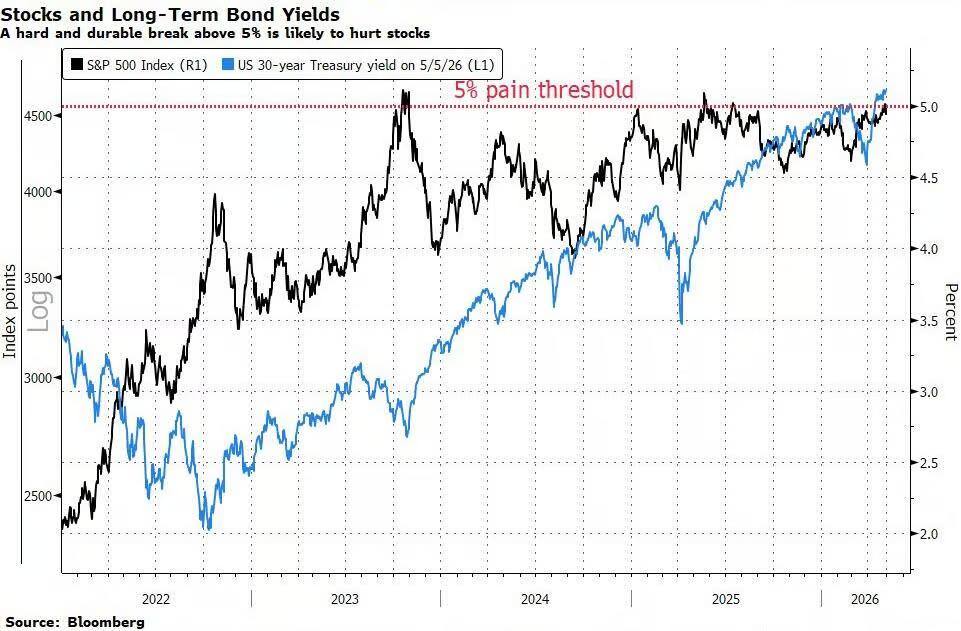
The most important bond-market indicator to watch is not simply the Federal Reserve’s overnight policy rate. It is the longer-term yield investors demand to hold U.S. government debt.
The Fed maintained its federal-funds target range at 3.50% to 3.75% at its July 28–29 meeting. The decision passed 9–3, with three policymakers preferring a quarter-point increase. The Fed said economic activity was expanding at a solid pace, while inflation remained elevated relative to its 2% objective.
But long-term Treasury yields can rise even when markets expect the Fed to hold or eventually cut rates. Investors also consider inflation, economic growth, government borrowing, Treasury supply and the demand for bonds.
That is exactly what has been happening.
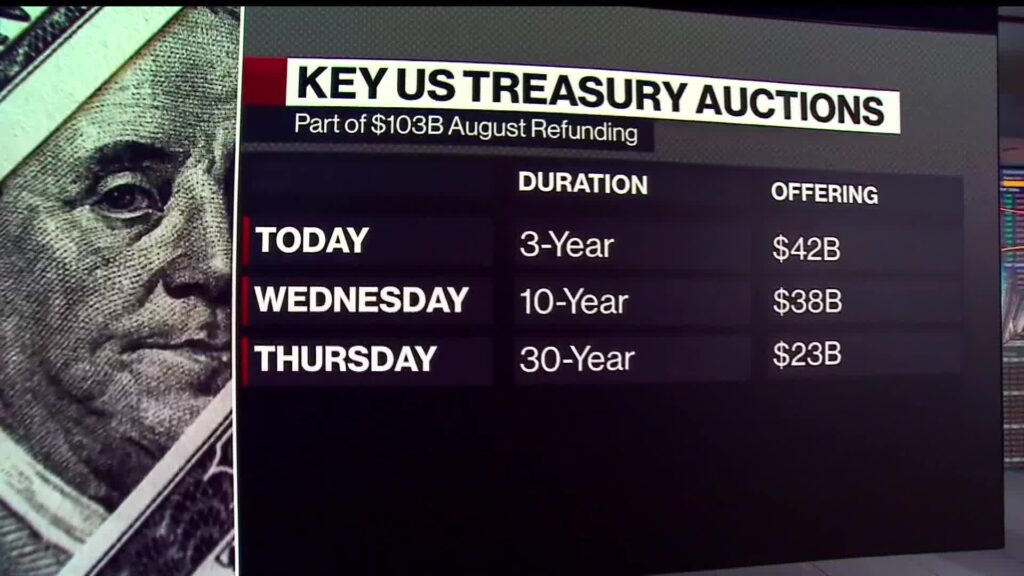
The 30-year Treasury market recently produced a particularly important warning. The United States paid approximately 5.22% at a 30-year bond auction on August 13, the highest borrowing cost for such an auction since 2001. Reuters also reported that 30-year U.S. real yields were around 3%, close to their highest level in roughly 18 years.
For equity investors, higher real yields matter because they change the mathematics of stock valuation.
When investors can earn a higher inflation-adjusted return from relatively safe government bonds, they may become less willing to pay extremely high prices for future corporate earnings. A higher discount rate also reduces the present value of profits expected many years into the future.
That is particularly important for growth stocks.
A technology company promising enormous profits ten years from now can look attractive when interest rates are low. When real yields rise, those distant cash flows become less valuable in today’s dollars.
This is why the bond market can eventually influence the S&P 500 without bond investors needing to predict a recession.
They simply need to demand a higher return.
AI Borrowing Is Creating a New Competition for Capital
Artificial intelligence is another part of the story that investors cannot afford to overlook.
The AI boom has created extraordinary demand for semiconductors, cloud computing, data centers, electricity, networking equipment and specialized infrastructure. That investment could generate significant economic benefits if AI productivity and revenue growth continue accelerating.
But building that infrastructure requires enormous amounts of capital.
Reuters reported that Alphabet, Amazon and Meta had issued nearly $220 billion of bonds in 2026, already more than twice the roughly $108 billion those companies issued during all of 2025. The increase is occurring while governments are also borrowing heavily.
This creates what investors sometimes describe as a competition for capital.
Imagine an economy in which governments need to sell large amounts of debt, technology companies are issuing bonds to build AI infrastructure, and other corporations are simultaneously refinancing existing obligations. Investors have a limited pool of capital. If the supply of bonds rises faster than demand, issuers may need to offer higher yields to attract buyers.
Those higher yields then spread through the financial system.
Corporate borrowing becomes more expensive. Infrastructure projects require higher expected returns. Private-equity financing becomes more difficult. Mortgage rates can remain elevated. And companies with weaker balance sheets may find that refinancing old debt is considerably more expensive than issuing it several years ago.
This does not mean AI investment is necessarily a negative for stocks.
Quite the opposite: if AI produces significant productivity improvements, the earnings generated by the investment could ultimately exceed the financing costs. That would strengthen the bullish case.
The concern is about the transition period.
Investors may be pricing in enormous future AI profits today, while the economy is already paying the financing cost of building the infrastructure needed to produce those profits.
That gap is one of the most important risks underneath the current rally.
What This Means for You: Why Bond Yields Matter Even If You Own Stocks
For ordinary investors, the bond market can feel distant because Treasury yields appear to be something relevant mainly to professional fixed-income traders. In reality, long-term bond yields influence many parts of household and investment finances.
Mortgage rates are one obvious example. When long-term Treasury yields remain elevated, fixed mortgage rates can remain under pressure even if the Federal Reserve does not increase its overnight policy rate. MarketWatch recently highlighted that 30-year Treasury yields had reached their highest levels since 2001, while the average 30-year mortgage rate was around 6.67%.
Businesses face a similar issue. A company that needs to refinance debt at 5%, 6% or higher faces a very different financial environment from one that could previously borrow at 2% or 3%.
That affects investment decisions.
A project that looked highly profitable under cheap financing may become marginal when borrowing costs rise. Companies may delay expansion, reduce capital spending or prioritize debt repayment instead.
For stock investors, the consequences depend heavily on the company.
Businesses with strong balance sheets, high free cash flow and limited refinancing requirements are generally better positioned than heavily indebted companies. Investors therefore need to look beyond headline earnings and examine cash generation, debt maturities, interest expenses and capital expenditure.
This is especially important in the current AI cycle.
A technology company spending heavily on data centers may report strong revenue growth, but investors should also ask how much capital expenditure is required to generate that growth and how much debt is being used to finance it.
The answer can tell investors whether growth is being funded internally or increasingly dependent on external capital.
Investor takeaway
The most important lesson is that a rising S&P 500 does not mean financial conditions are becoming easier everywhere.
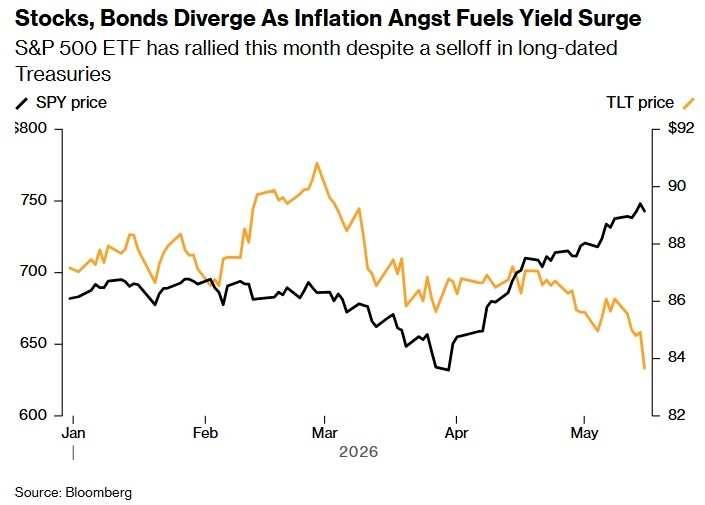
Stocks can rise because earnings are strong while bonds simultaneously sell off because investors demand higher yields. Both markets can be correct.
The stock market may be focused on next year’s profits. The bond market may be focused on today’s financing costs.
That difference matters because eventually the two forces have to meet.
If earnings growth continues to accelerate faster than financing costs, equities may absorb higher yields. But if earnings growth slows while real yields remain elevated, the valuation pressure on stocks could become much stronger.
Investors should therefore watch the 10-year and 30-year Treasury yields alongside the S&P 500 rather than treating the equity index as an isolated signal.
The Bigger Warning: Strong Earnings May Not Be Enough Forever
The current rally has a genuine earnings foundation, but there are signs that investors should question how broad and sustainable that earnings strength is.
One recent analysis by strategist Jim Paulsen identified several potential warning signs. Among them was a narrower earnings boom: the number of S&P 500 companies with rising 12-month forward earnings estimates over the previous four weeks was around 122, compared with a peak of 163 in 2020. He also pointed to elevated corporate profit margins, higher Treasury yields, commodity-price risks and weakness in some cyclical sectors.
These signals do not prove that an earnings downturn is coming.
But they matter because the market’s valuation increasingly depends on continued earnings momentum.
The S&P 500 has been able to tolerate high interest rates partly because corporate profits have remained resilient. If profit growth slows, the market could become much more sensitive to Treasury yields.
That creates a potentially uncomfortable combination:
High stock valuations + high real yields + heavy corporate borrowing + elevated government debt + slowing earnings breadth.
None of those factors individually guarantees a bear market.
Together, however, they create a risk profile that deserves more attention than the record level of the S&P 500 alone might suggest.
There is also an important distinction between nominal and real yields.
A 5% bond yield might appear less intimidating if investors expect 4% inflation. The inflation-adjusted return would be much smaller. But when real yields approach 3%, bond investors are demanding a substantial return after inflation.
Reuters reported that U.S. 30-year real yields were near 3%, while analysts described rising real yields as an increasingly important driver of global borrowing costs.
That is potentially more significant for stocks than a temporary movement in headline inflation.
If real yields continue climbing, the hurdle rate for investment rises across the economy.
Future Outlook: Can Stocks Keep Rising While Bonds Stay Worried?
The future outlook for the S&P 500 increasingly depends on whether the economy can generate enough productivity and earnings growth to overcome higher financing costs.
The bullish scenario remains credible.
If AI investment produces significant productivity gains, corporate earnings continue beating expectations, inflation remains contained and economic growth stays resilient, stocks could continue rising despite elevated Treasury yields. The market has already demonstrated that strong earnings can overpower several macroeconomic concerns.
The S&P 500’s recent record provides evidence of that resilience. On August 13, the index closed at 7,798.99, while the following day’s decline was only 0.2%. Through August 14, the S&P 500 remained up 13.7% for the year.
The bearish scenario is different.
If real yields continue rising, AI-related borrowing accelerates, government debt issuance remains enormous and earnings growth begins slowing, investors could demand a larger risk premium from equities.
That would not necessarily produce an immediate crash.
It could begin with something much more ordinary: slower multiple expansion.
Instead of investors paying increasingly higher prices for every dollar of earnings, the valuation multiple could stop rising. If earnings continue growing, the market could move sideways while fundamentals catch up.
That would actually be a relatively healthy adjustment.
The more dangerous scenario would be a simultaneous deterioration in earnings and bond-market conditions. If companies begin missing profit expectations while Treasury yields rise, investors could face pressure from both directions.
The Federal Reserve will remain central to this story. Its next scheduled FOMC meeting is September 15–16, 2026, and policymakers will have to balance inflation against economic activity and employment.
A softer economy could eventually encourage easier monetary policy and lower yields. But a renewed inflation shock could produce the opposite outcome.
Oil prices are another variable worth watching. Recent geopolitical tensions pushed Brent crude toward the high-$80s, creating another potential source of inflation pressure. Higher energy prices can simultaneously hurt consumers and complicate the Federal Reserve’s policy decisions.
The bottom line
The bond market is not necessarily predicting that the S&P 500 is about to crash.
It is sending a more subtle message:
Capital is becoming more expensive, and investors are demanding greater compensation for lending money over long periods.
That matters because the current equity rally increasingly depends on future growth—particularly the promise that AI investment will produce extraordinary productivity and earnings.
If that promise is fulfilled, stocks may continue to outperform despite elevated bond yields.
If the financing costs rise faster than the economic benefits arrive, however, the relationship between stocks and bonds could become much less comfortable.
For investors, the best response is not to abandon equities simply because Treasury yields are high. It is to understand what is supporting the rally and what could eventually undermine it.
Watch the 10-year Treasury yield, 30-year real yield, corporate credit spreads, AI-related debt issuance, earnings revisions, profit margins and market breadth alongside the S&P 500.
Those indicators can provide a much clearer picture of market health than a new record high by itself.
The biggest lesson from the current rally may therefore be this: the stock market tells us what investors expect to earn, while the bond market tells us what investors demand to finance those expectations.
Right now, those two messages are becoming harder to reconcile.
Subscribe to trusted news sites like USnewsSphere.com for continuous updates.