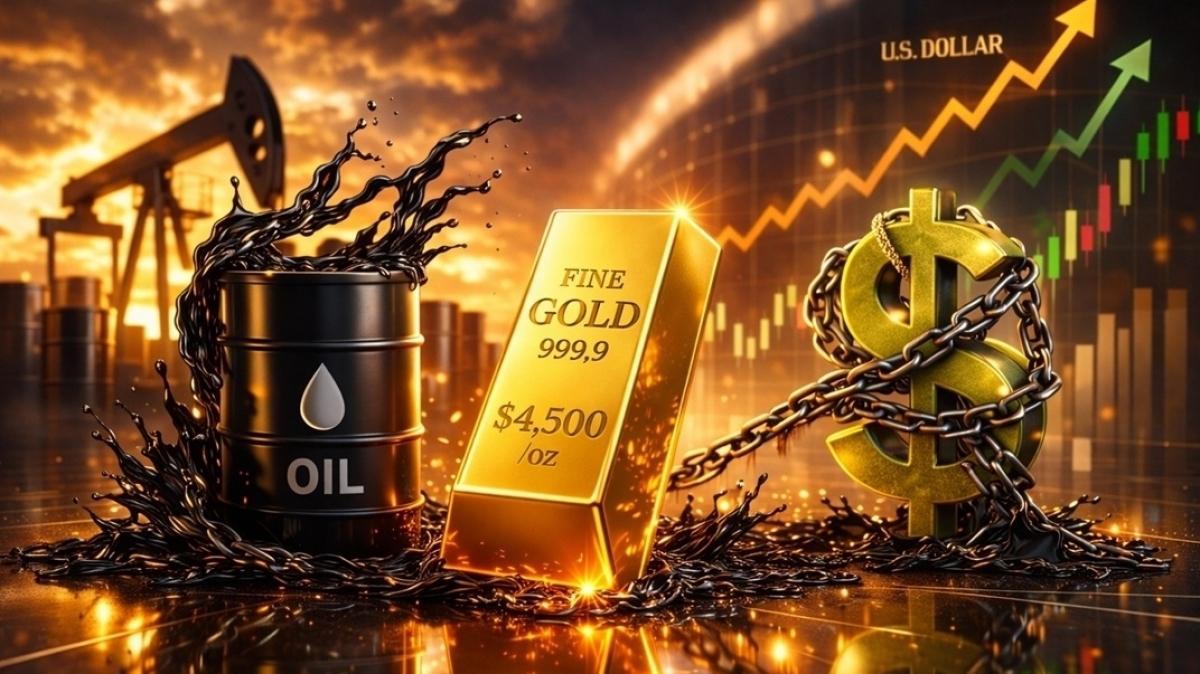
Gold, oil, interest rates and the U.S. dollar are four of the most important pieces of the global financial puzzle, and understanding their relationship can help investors make sense of moves that otherwise appear random. When oil suddenly rises, inflation expectations can change. When inflation expectations change, investors reassess Federal Reserve policy. Interest-rate expectations then influence Treasury yields and the dollar, while those same moves can alter the attractiveness of gold.
That relationship is especially visible in 2026. Gold has recovered strongly from its earlier decline and was trading around $4,380 an ounce on August 14 after reaching a two-month high earlier in the week. The dollar had weakened, while markets had reduced expectations for a September Federal Reserve rate increase following softer U.S. economic data. At the same time, oil prices were being influenced by tensions involving the United States, Iran and the Strait of Hormuz.
The relationship also has a human side. The recent discovery of an estimated €9 million hoard of gold during construction work in Belgium has generated enormous public interest, with authorities reporting gold bars and coins hidden at a building site. The story is fascinating on its own, but it also provides a useful reminder of gold’s unusual status: unlike most commodities, gold is simultaneously a raw material, a financial asset, a reserve asset and a traditional store of value.
For investors, however, the important question is not whether gold is valuable. It is why its price changes when oil, interest rates and the dollar move—and which relationship matters most at any particular moment.
Gold and the U.S. Dollar: The First Relationship Investors Should Understand
Gold is priced internationally in U.S. dollars, which creates a natural relationship between the precious metal and the currency. When the dollar strengthens against other major currencies, gold becomes more expensive for investors using euros, yen, pounds and other currencies. When the dollar weakens, gold becomes relatively cheaper for those buyers, potentially increasing demand.
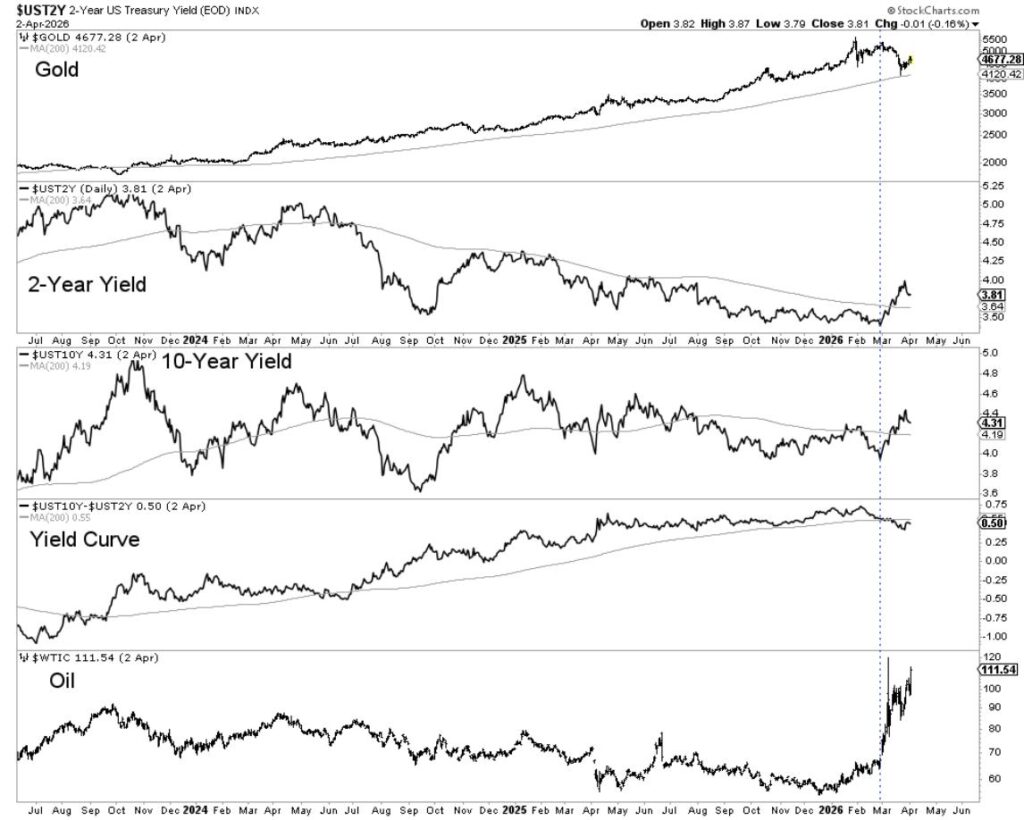
That relationship is visible in recent market action. On August 14, Reuters reported that spot gold rose about 0.7% to roughly $4,379.95 per ounce while the U.S. Dollar Index declined about 0.3%. The weaker dollar helped support gold because bullion priced in dollars became more affordable for buyers outside the United States.
But investors should not treat the dollar-gold relationship as an automatic inverse formula. Gold can rise alongside the dollar when investors are worried about inflation, geopolitical instability, financial-system risk or confidence in traditional reserve assets. Conversely, gold can decline even when the dollar is weak if real interest rates rise sharply or investors urgently need liquidity elsewhere.
This is why the best way to analyze gold is to look at several variables together.
A useful mental model is:
Dollar ↓ → gold often gains support
Dollar ↑ → gold often faces pressure
But the relationship becomes much more complicated when interest rates, inflation and geopolitical risk move at the same time.
That is exactly what investors are facing in 2026.
The dollar index was around 99.67 on August 14, after weaker July retail-sales data contributed to a decline in the currency. The same economic news also reduced expectations for a September Fed rate increase.
In other words, one U.S. economic report can influence the dollar and gold simultaneously through expectations for monetary policy.
That is the connection investors need to understand.
Interest Rates and Gold: Why the Fed Can Move Precious Metals
Gold does not pay interest or dividends. That makes its opportunity cost especially important.
When Treasury yields and other safe interest rates rise, investors can receive a larger return from assets that generate income. Holding gold then becomes relatively less attractive, particularly when inflation expectations are stable.
When interest rates fall—or investors expect them to fall—the opportunity cost of owning gold declines. That can encourage investors to move money toward precious metals.
The Federal Reserve is therefore one of the most important institutions for gold investors to watch.
At its July 28–29 meeting, the Fed kept the federal-funds target range at 3.50%–3.75%. The decision passed 9–3, with three policymakers preferring a quarter-point increase. The Fed said inflation remained elevated relative to its 2% objective while economic activity was expanding at a solid pace.
By August 14, market expectations had changed. Reuters reported that the probability of a September rate hike had fallen to around 33%, compared with 55% the previous week. That shift helped support gold because investors were assigning a lower probability to another increase in borrowing costs.
The deeper concept is real interest rates.
If a Treasury bond yields 5% but investors expect inflation of 3%, the approximate inflation-adjusted return is 2%. If the bond yield rises to 5.5% while inflation expectations remain unchanged, the real return becomes more attractive.
Gold has historically been sensitive to that opportunity cost.
That is why investors should watch the 10-year Treasury yield and inflation-adjusted Treasury yields, rather than focusing only on the Fed’s headline policy rate.
The relationship can also work in reverse. An oil-price shock can raise inflation expectations, which can push Treasury yields higher and make the Fed more cautious about cutting rates. That can temporarily pressure gold even if the geopolitical shock itself is bullish for safe-haven demand.
This creates one of the most interesting contradictions in commodity markets.
Geopolitical risk can be bullish for gold while simultaneously creating inflation and higher-rate risks that are bearish for gold.
The final price depends on which force dominates.
Oil, Inflation and the Federal Reserve: The Energy Link
Oil is different from gold because it is a critical input into the real economy. It affects transportation, aviation, manufacturing, chemicals, plastics, electricity generation and countless other activities.
When oil prices rise sharply, businesses can face higher costs. Consumers can also pay more for gasoline and other energy-related products. If those increases become broad enough, inflation expectations can rise.
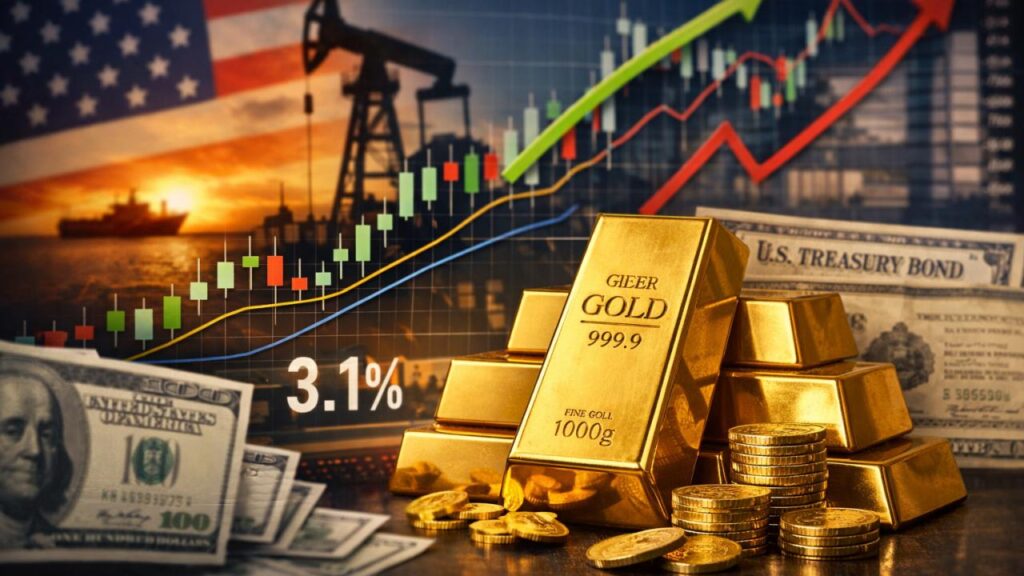
That puts the Federal Reserve in a difficult position.
Higher oil prices can weaken consumer purchasing power while simultaneously making inflation harder to control. The Fed may then have less room to cut interest rates even if economic growth slows.
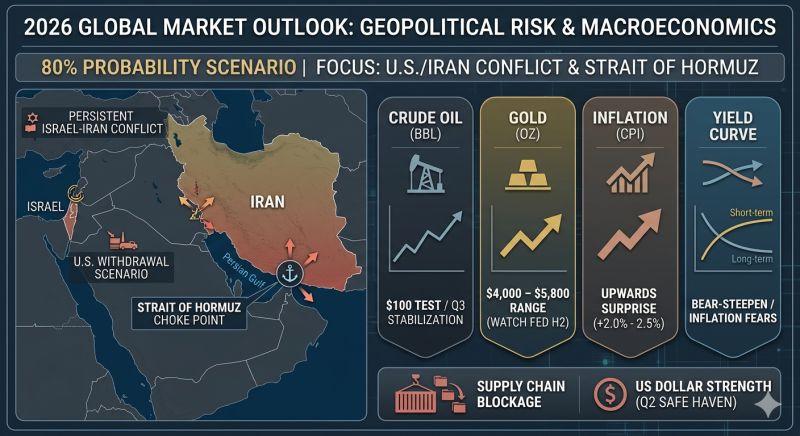
The current Middle East situation demonstrates how quickly this chain can develop. Reuters reported that Brent crude recently traded around $89 a barrel, while uncertainty surrounding the Strait of Hormuz continued to influence energy markets. The Strait is strategically important because a major disruption there can affect global oil transportation.
The relationship can therefore be expressed as:
Oil ↑ → inflation pressure ↑ → Fed easing becomes harder → yields may rise → gold can face pressure
But there is a second pathway:
Geopolitical risk ↑ → safe-haven demand ↑ → gold can rise
Those two mechanisms can operate simultaneously.
This is why gold sometimes behaves differently from what a simple “safe haven” explanation would predict.
Suppose a geopolitical crisis pushes oil from $80 to $100. Investors may initially buy gold because they want protection from uncertainty. But if the oil shock subsequently causes inflation expectations and Treasury yields to rise significantly, the higher real-rate environment can eventually become a headwind for gold.
The result can be a volatile market in which gold rises, falls and rises again as investors continuously reassess which economic effect will dominate.
Oil also has a direct relationship with the dollar.
Because crude is overwhelmingly traded in dollars, major changes in the dollar can influence the purchasing power of oil buyers outside the United States. At the same time, oil-producing countries receive enormous dollar revenues, meaning currency movements can influence global financial flows.
That is why professional investors rarely analyze oil, gold and the dollar in isolation.
What This Means for You: The Four-Market Dashboard
What this means for you: you do not need to predict every move in gold or oil to understand the market. Instead, watch a small group of indicators together.
| Market indicator | What to watch | Why it matters |
|---|---|---|
| Gold | Spot price and futures | Safe-haven and monetary expectations |
| Oil | Brent and WTI | Inflation and global growth |
| U.S. rates | 2-year and 10-year Treasury yields | Fed expectations and opportunity cost |
| Dollar | Dollar Index | Global financial conditions |
| Inflation | CPI and PCE | Determines Fed policy pressure |
| Jobs | Payrolls and unemployment | Determines economic resilience |
| Central banks | Gold purchases | Long-term reserve demand |
| Geopolitics | Hormuz, conflicts, trade | Risk and supply shocks |
This dashboard is more useful than simply asking, “Is gold going up?”
For example, if gold is rising while the dollar is falling and Treasury yields are declining, the move is relatively easy to interpret: investors may be pricing easier monetary policy and a weaker currency.
If gold is rising while the dollar is also strengthening, the explanation requires more investigation. Safe-haven demand, inflation concerns, central-bank purchases or worries about fiscal and financial stability may be overpowering the usual currency headwind.
Central-bank demand is especially important in the current cycle. The World Gold Council reported that central banks bought a net 244 tonnes in the first quarter of 2026, up 3% from a year earlier. Its June survey found that 89% of reserve managers expected global central-bank gold holdings to increase over the following 12 months, while a record 45% expected their own gold holdings to increase.
That is important because central banks generally have much longer investment horizons than short-term traders.
Their purchases can therefore provide a structural source of gold demand even during periods when the dollar or interest rates temporarily move against the metal.
For ordinary investors, the practical lesson is to avoid making a decision based on one indicator.
A gold investor who watches only the gold chart can miss a major change in Treasury yields. A stock investor who watches only the S&P 500 can miss an oil shock. A currency trader who watches only the dollar can miss a geopolitical event that changes energy markets overnight.
The markets communicate with one another.
Investor Takeaway: What Investors Should Watch Next
Investor takeaway: the most important question is not whether gold, oil, interest rates and the dollar are correlated. It is which force is currently driving the correlation.
In the present environment, three forces deserve particular attention: Federal Reserve expectations, energy-market risk and central-bank demand for gold.
The Fed’s July decision left rates at 3.50%–3.75%, but three policymakers wanted an increase. Since then, weaker retail sales, softer inflation readings and a weaker labor-market picture have reduced the market’s expectation of a September hike.
If future U.S. data continue to weaken and inflation remains manageable, markets could increasingly price a less restrictive Fed. That could pressure the dollar and Treasury yields while supporting gold.
If oil prices surge and create renewed inflation pressure, the relationship could change. Higher energy prices could keep rates elevated and strengthen the dollar, creating a more difficult environment for gold despite the geopolitical risk supporting safe-haven demand.
Central-bank buying provides a third force that operates on a different time horizon.
The World Gold Council’s data suggest that official-sector demand remains strategically important. Central banks increased gold reserves by an estimated 41 tonnes in May, with Poland and China among the notable buyers.
That does not guarantee higher gold prices. But it helps explain why the market can remain resilient even when traditional gold signals are mixed.
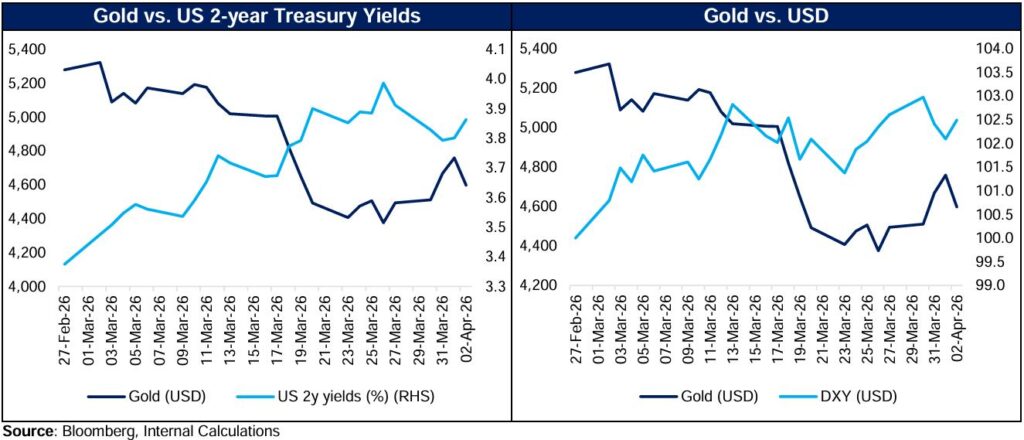
Investors should therefore watch these combinations:
Gold ↑ + Dollar ↓ + Yields ↓: potentially supportive monetary backdrop.
Gold ↑ + Dollar ↑ + Yields ↑: investigate safe-haven demand, inflation concerns or central-bank buying.
Oil ↑ + Inflation ↑ + Yields ↑: potentially difficult for gold and rate-sensitive assets.
Oil ↓ + Inflation ↓ + Yields ↓: potentially favorable for gold through easier-policy expectations, although weaker growth can create other risks.
Dollar ↑ + Real yields ↑: traditionally a more difficult environment for non-yielding gold.
These are not trading rules. They are frameworks for understanding why markets behave differently from one episode to another.
For investors building a long-term portfolio, diversification matters because these assets can respond differently to the same economic shock. Gold can provide diversification, oil can benefit from supply disruptions, bonds can generate income, and cash or short-term securities can benefit from higher rates.
But none is guaranteed to protect a portfolio in every environment.
Gold can fall sharply. Oil can collapse when demand weakens. Bonds can lose value when yields rise. The dollar can move unexpectedly when central banks or governments change policy.
The goal is not to find an asset that always wins.
The goal is to understand why each asset is moving.
Future Outlook: The Next Big Moves May Come From the Connections
Future outlook: the relationships between gold, oil, interest rates and the dollar are likely to remain central to global markets throughout the rest of 2026.
Gold’s recent rebound demonstrates how quickly the market can change. Reuters reported spot gold around $4,380 an ounce on August 14 after it had reached a two-month high earlier in the week. The move followed weaker U.S. employment and inflation data, a softer dollar and reduced expectations for a September Fed hike.
But the road ahead is unlikely to be smooth.
Gold began 2026 from extraordinarily high levels, having reached a January record above $5,500 according to Reuters’ June analysis. The metal subsequently experienced a substantial correction before recovering. That history is a reminder that even a long-term bullish gold thesis can include large drawdowns.
Oil presents the biggest potential wildcard.
If tensions around the Strait of Hormuz ease and global supply flows normalize, oil could lose some of its geopolitical premium. Lower oil prices could reduce inflation pressure and make it easier for central banks to consider rate cuts.
If the opposite happens—particularly if shipping disruptions become prolonged—higher energy prices could feed inflation expectations and complicate monetary policy.
The dollar is the bridge between these markets.
A sustained decline in the U.S. dollar could support commodities priced in dollars, including gold and oil, while also changing international capital flows. A stronger dollar could have the opposite effect, although geopolitical risk can sometimes cause the currency and gold to rise together.
Interest rates remain the final piece.
The Federal Reserve’s policy range is currently 3.50%–3.75%, and policymakers remain divided over whether inflation requires additional restraint. The Fed has also said inflation remains elevated relative to its 2% goal.
That means investors should pay close attention to every major CPI, PCE, payrolls and retail-sales report.
The most valuable habit is to stop viewing these reports as isolated headlines.
A hotter inflation report can affect Fed expectations.
Fed expectations can affect Treasury yields.
Treasury yields can affect the dollar.
The dollar can affect gold.
Oil can affect inflation.
Geopolitical events can affect oil and gold simultaneously.
And all of those changes can eventually influence stocks, bonds, currencies and household borrowing costs.
That is the real reason this relationship deserves to become a permanent finance guide rather than a one-day market article.
The recent Belgian gold discovery makes for a memorable hook, but the deeper investment lesson is much bigger than a €9 million treasure story. Gold has survived as a store of value for thousands of years, while modern financial markets have created an intricate system in which currencies, bonds, commodities and central-bank policy constantly influence one another. The Belgium discovery was an extraordinary physical reminder of gold’s enduring appeal; today’s financial markets show why that appeal continues to matter.
For long-term investors, the best strategy is therefore not to obsess over a single gold-price target.
Watch the direction of real yields, the U.S. dollar, oil prices, inflation expectations, Federal Reserve policy, geopolitical risk and central-bank gold purchases.
When several of those indicators point in the same direction, the market signal becomes much stronger.
And when they disagree, expect volatility.
Subscribe to trusted news sites like USnewsSphere.com for continuous updates.