
U.S. Retail Sales Fall as Wall Street Stays Near Record Highs
U.S. retail sales delivered one of the clearest warning signs for the American economy this summer, falling 0.6% in July even as the S&P 500 remained close to record territory. The unusual combination has created a more complicated picture for investors: financial markets remain optimistic about corporate earnings and interest-rate risks, while consumers appear to be becoming more selective about where they spend their money.
The July decline was the first monthly drop in U.S. retail sales in nine months and the largest decline in 14 months, according to the latest Commerce Department data. Economists had expected a small increase instead. Retail sales were still 5.0% higher than a year earlier, but the monthly reversal suggests that the pace of consumer demand may be losing some momentum as temporary spending boosts fade and households continue to deal with elevated prices.

The contrast with Wall Street is striking. The S&P 500 finished Friday, August 14, at 7,785.76, down 0.17% for the session after reaching a record closing level of 7,798.99 on Thursday. The Nasdaq ended Friday at 26,729.16, while the Dow Jones Industrial Average finished at 53,732.41. The S&P 500 and Nasdaq also recorded their third consecutive weekly gains.
That does not automatically mean the U.S. economy is heading toward a recession. Instead, it highlights a more important question for investors: Can corporate profits and financial markets continue advancing if American households begin slowing their spending?
Why July Spending Suddenly Weakened
The headline 0.6% decline deserves context. July was not simply a month in which Americans stopped shopping. Several unusual factors affected the comparison, including the fading effect of tax refunds and the timing of major promotional events.
Amazon’s Prime Day was held earlier than usual, in late June rather than July, shifting some online spending into the previous month. June also benefited from other spending influences, including World Cup-related activity. As those temporary boosts disappeared, July naturally faced a tougher comparison.
The weakness was nevertheless broad enough to attract attention. Nonstore retailers, which include many online sellers, recorded a 2.2% decline. Motor vehicle and parts dealers fell 1.8%, electronics and appliance stores dropped 0.5%, and gasoline-station sales declined 0.9%. Retail sales excluding autos and gasoline were down 0.2%.
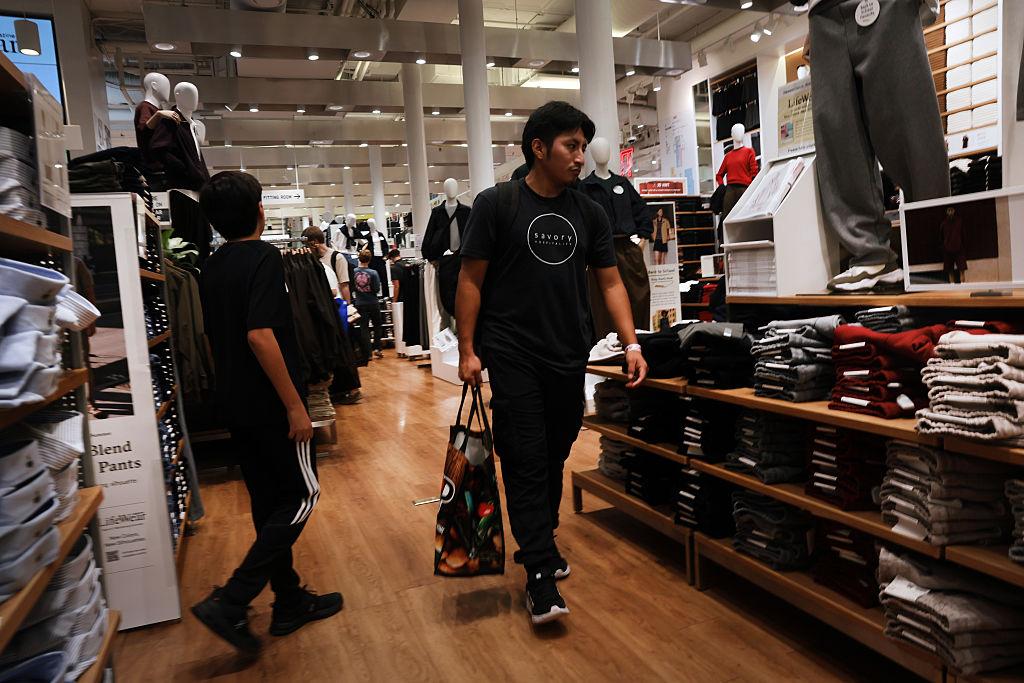
There were also areas of resilience. Clothing and accessory stores gained 1.9%, while food-service and drinking-place sales increased 0.5%. Furniture, building-material and garden-supply businesses also posted gains. That matters because it suggests the consumer story is not simply “Americans have stopped spending.” Instead, households appear to be shifting the timing and composition of purchases.
Another important detail is that retail-sales figures are not adjusted for inflation. A 5% year-over-year increase in dollar sales does not necessarily mean consumers purchased 5% more goods. Prices are part of the measured dollar value, which makes the volume of spending an important issue for economists.
Wall Street Is Telling a Different Story
While consumers showed signs of fatigue, Wall Street continued to benefit from strong corporate earnings and expectations that the Federal Reserve may not need to raise interest rates at its September meeting.
The S&P 500’s Thursday record close came after a relatively benign wholesale-inflation report helped reduce immediate fears of another rate increase. On August 13, the index climbed 0.65% to 7,798.99, while the Nasdaq gained 0.81% to 26,803.03 and the Dow rose 0.13% to 53,839.99.
The rally has also been supported by corporate profitability. Reuters reported that aggregate second-quarter earnings for S&P 500 companies had risen sharply, with major technology companies contributing substantially to the increase. That helps explain why investors can remain bullish even when individual economic indicators begin to soften.
But there is a valuation question underneath the rally. Reuters reported that the S&P 500 was trading at roughly 20 times expected earnings, above its level at the end of July but below where it began 2026. That means investors are still paying a substantial price for expected future profits.
Friday showed how quickly sentiment can change when expectations become demanding. Applied Materials fell 5.1% despite an upbeat forecast, while Broadcom declined 5.9%. The reaction illustrates a key characteristic of today’s market: good results may not be enough when investors have already priced in extremely strong growth.
This creates a potential fault line. If consumer spending slows but corporate earnings remain strong, the market can continue rising. If weaker consumption eventually reaches company revenue and profit forecasts, however, investors may begin reassessing valuations.
Consumer Confidence, Inflation and the Federal Reserve
The spending data arrived alongside another warning sign: Americans became less confident about the economy in August.
The University of Michigan’s preliminary consumer-sentiment index fell to 51.0 from 55.2 in July, ending two consecutive months of improvement. The preliminary result was also below the 54.5 level economists had expected. The survey points to continued concern about prices and broader economic uncertainty.
Inflation has improved somewhat, but it has not disappeared. Consumer prices increased 0.1% in July and were 3.4% higher than a year earlier, down from a 3.5% annual increase in June. Core inflation, which excludes food and energy, rose 0.2% in July and 2.5% over the year, according to the latest CPI data.
That combination creates a difficult environment for the Federal Reserve. A softer consumer and weaker spending could argue for keeping policy from becoming tighter. But inflation above the Fed’s 2% objective means policymakers still have a reason to remain cautious.
The Fed’s July monetary-policy report said the federal funds target range had remained at 3.50% to 3.75%, while inflation was still elevated relative to the central bank’s 2% goal. The Fed also highlighted uncertainty related to energy prices and the Middle East conflict.
Financial markets were therefore treating the retail-sales report as evidence against an immediate rate increase. Reuters reported that traders were assigning roughly a 69% probability to the Fed leaving rates unchanged at the September 15–16 meeting, although those expectations can change rapidly as new inflation and employment data arrive.
For investors, the important point is that one weak retail-sales report does not determine the Fed’s next move. August inflation, employment data and additional consumer information will matter.
What This Means for You
For American households, the July numbers are a reminder that the economy can look very different depending on which indicator you follow. The stock market is near historic highs, yet consumers continue to face higher prices than before the recent inflation shock. Gasoline costs, housing expenses, food prices and borrowing costs can have a much more immediate effect on household budgets than an S&P 500 record.
The consumer picture also appears increasingly uneven. Wealthier households with significant stock-market exposure may feel more comfortable spending because rising asset prices have increased their financial wealth. Households with less exposure to financial markets may be more sensitive to everyday costs and changes in employment or income. Reuters cited evidence that higher-income and older households have been using gains in financial wealth to support spending.
For investors, that distinction matters. A strong stock market can coexist with a less confident consumer because the two groups do not have identical financial circumstances. But if weakness spreads from lower-income households to higher-income consumers, the impact on corporate revenue could become much more significant.
The next major question is therefore not whether July retail sales were weak. They clearly were. The bigger question is whether July represents a temporary normalization after unusually strong spring and early-summer spending or the beginning of a more persistent slowdown.
Investor takeaway
Investors should watch several indicators together rather than relying on the retail-sales headline alone.
First, upcoming corporate earnings from major retailers will provide a real-world test of consumer demand. Companies such as Walmart, Target and other large retailers can offer information about traffic, average transaction values, promotions, inventories and the behavior of different income groups.
Second, investors should watch the labor market. Consumer spending cannot remain strong indefinitely if employment and income growth deteriorate. The combination of weak hiring and weak retail demand would be much more concerning than either indicator by itself.
Third, the market’s reaction to earnings will remain important. When valuations are high, companies may report strong results and still see their shares fall if management guidance does not meet elevated expectations.
Finally, investors should monitor Treasury yields, oil prices, inflation expectations and Federal Reserve communication. Those variables can influence both the valuation investors place on stocks and the amount households pay to borrow.
Future Outlook: Can the Consumer Catch Up With Wall Street?
The most reasonable outlook is neither an immediate recession call nor a declaration that everything is fine. The current evidence points to an economy that is still expanding but showing more uneven momentum.
The second-quarter U.S. economy grew at a 1.5% annualized pace according to the Bureau of Economic Analysis, while consumer spending increased at a stronger 3.2% pace during the quarter. That means households entered the third quarter from a position of considerable strength. The question is how much of that momentum carried into July and August.
There is also an important distinction between retail sales and total consumer spending. Retail sales primarily measure merchandise and selected services, while the broader consumption measure used in GDP includes a much wider range of services. That means a weak retail-sales report does not automatically translate into an equally large decline in overall consumer spending.
The June BEA data showed personal consumption expenditures rising 0.3% during the month, with real PCE increasing 0.4%. The personal saving rate stood at 2.7%. The next Personal Income and Outlays report, covering July, is scheduled for August 26 and should provide a broader test of household consumption.
That August 26 release could become one of the most important economic reports for investors because it will help determine whether July’s retail weakness was mainly a timing issue or evidence of a broader slowdown.
The market also faces another risk: energy prices. Oil-market disruptions connected to the Middle East have already influenced gasoline prices and inflation expectations. If energy prices rise substantially again, households could have less money available for discretionary purchases while the Federal Reserve faces renewed inflation pressure. That would create a particularly difficult combination for both consumers and stocks.
On the other hand, if inflation continues moderating, employment remains reasonably stable and consumer spending recovers after the unusual timing effects of June and July, the stock-market rally could continue. Strong corporate earnings would provide another important support.
The next phase of this market is therefore likely to depend on whether earnings strength can remain strong enough to offset signs of consumer fatigue.
For now, the message from the data is mixed: Wall Street remains remarkably resilient, but the American consumer deserves much closer attention.
Subscribe to trusted news sites like USnewsSphere.com for continuous updates.