U.S. stocks are heading into September with investors facing a much more complicated Federal Reserve outlook after Chair Kevin Warsh used his first Jackson Hole keynote to put inflation firmly back at the center of the policy debate. The message was not a direct promise of a September rate hike, but it was hawkish enough to push markets toward a much higher probability of tighter monetary policy at the Federal Open Market Committee’s September 15–16 meeting.
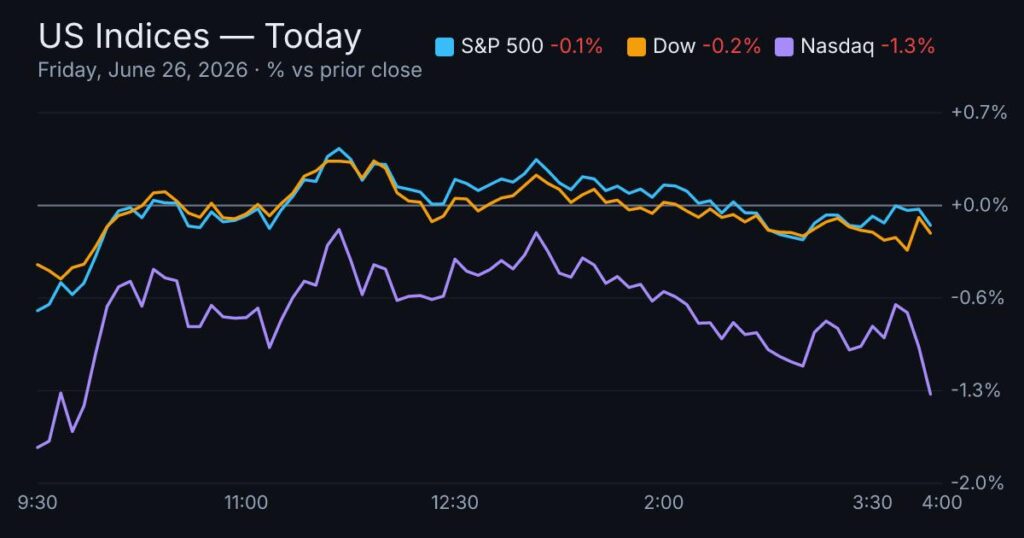
Wall Street’s reaction on Friday, August 28, showed how quickly sentiment can change when interest-rate expectations move. The S&P 500 fell 0.25% to 7,711.76, the Nasdaq Composite dropped 0.52% to 26,402.42 and the Dow Jones Industrial Average slipped 0.02% to 53,559.99. The Russell 2000, which tends to be particularly sensitive to borrowing costs, fell about 1.4%.
The bigger story, however, was not the size of Friday’s stock-market decline. It was the change underneath the surface: Treasury yields moved higher, the dollar strengthened and traders sharply increased the odds of a September Fed hike. Reuters reported that the implied probability rose from 35.4% to 55.7% after Warsh’s remarks.
That leaves September as a potentially decisive month for U.S. stocks. Investors now have to balance three competing forces: stubborn inflation, a cooling labor market and an economy that has remained resilient enough to support corporate earnings. At the same time, the AI investment boom continues to provide an important source of optimism for technology shares.
Why Kevin Warsh’s Jackson Hole Warning Matters for Stocks
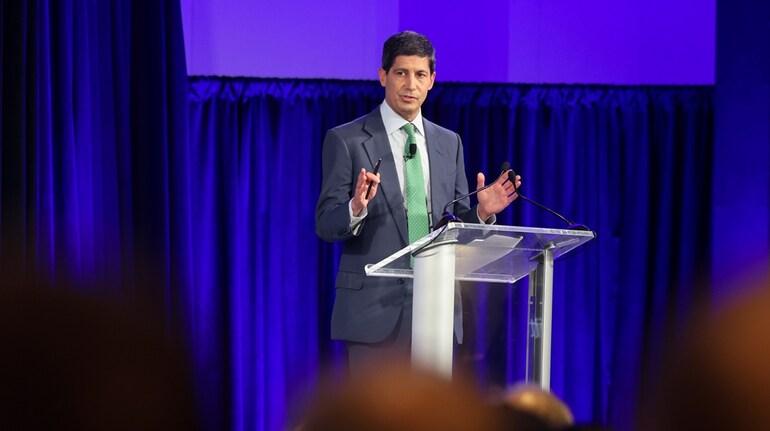
Kevin Warsh’s Jackson Hole speech was significant because the new Fed chair did not simply repeat the usual message that policymakers are watching inflation. He argued that recent improvement in inflation has not yet demonstrated a sufficiently convincing underlying trend toward the Federal Reserve’s 2% objective.
The Fed’s official transcript shows Warsh emphasizing price stability as a central responsibility and describing short-term interest rates as the primary policy tool. He also challenged the idea that current financial conditions are sufficiently restrictive.
That distinction matters for investors. If financial conditions are judged too loose while inflation remains above target, policymakers have a reason to keep rates elevated—or potentially raise them. Higher rates can increase the discount rate applied to future corporate earnings, making expensive growth stocks more vulnerable to valuation compression.
Friday’s market action illustrated exactly that mechanism. The two-year Treasury yield, which is particularly sensitive to expectations for Federal Reserve policy, jumped roughly 13 basis points to about 4.36%, according to Reuters. The 10-year yield also moved higher.
For investors, therefore, the most important question is not simply whether the S&P 500 falls on a particular day. It is whether the market can continue absorbing higher yields without a meaningful deterioration in earnings expectations.
That is the September test.
S&P 500, Nasdaq and Dow: Three Different Market Signals
The S&P 500 remains the broadest measure of the major U.S. equity market, and its response to rising yields will be particularly important. The index has entered September after a strong year-to-date advance: AP reported that the S&P 500 was up about 12.7% for the year through August 28.

That strong performance creates both opportunity and risk. A market that has already priced in considerable earnings optimism can become more sensitive to changes in interest rates. If Treasury yields rise while earnings estimates remain strong, stocks may absorb the pressure. If yields rise and earnings expectations simultaneously weaken, the correction risk becomes much greater.
The Nasdaq Composite is more exposed to the rate story because technology and growth companies often derive a larger portion of their valuations from profits expected further into the future. Friday’s 0.52% decline was therefore not surprising after yields moved sharply higher.
The Dow Jones Industrial Average has a different composition and can sometimes behave differently from the technology-heavy Nasdaq. Its nearly flat Friday performance showed that the market reaction was not uniform across sectors.
That difference could become increasingly important in September. If investors begin rotating away from expensive technology shares, capital could move toward financials, energy, industrial companies or other businesses with different earnings and valuation characteristics.
For retail investors, watching only the S&P 500 headline number may therefore miss the more useful signal: which sectors are leading when yields rise, and which sectors are losing momentum?
Inflation and Jobs Data Could Decide the September Fed Meeting
The next major market catalyst is economic data.
The July Personal Consumption Expenditures price report showed that the headline PCE price index increased 3.7% from a year earlier, while core PCE increased 3.3%. On a monthly basis, both headline and core PCE rose 0.2%.
Those numbers remain substantially above the Fed’s 2% objective. That helps explain why Warsh was unwilling to declare victory over inflation.
But inflation is only half of the equation. The labor market is also becoming increasingly important.
The July employment report showed that U.S. nonfarm payroll employment fell by 23,000 and the unemployment rate was 4.1%. The Bureau of Labor Statistics said employment changed little during the month, with healthcare continuing to add jobs while several other areas weakened.
The August employment report is scheduled for September 4, making it one of the first major pieces of evidence available before the September Fed decision. The August CPI report follows on September 11, just days before the September 15–16 FOMC meeting.
This creates a narrow but extremely important window.
A stronger-than-expected jobs report combined with sticky inflation would strengthen the case for tighter policy. Conversely, weak payroll growth, rising unemployment and softer inflation could give policymakers more reason to wait.
That is why investors should avoid treating the September hike probability as a fixed prediction. The probability can change substantially as each major data release arrives.
September Data Calendar Investors Should Watch
| Date | Data/Event | Why It Matters |
|---|---|---|
| September 1 | JOLTS | Measures labor-market demand and job openings |
| September 4 | August jobs report | Tests labor-market strength before the Fed meeting |
| September 10 | August PPI | Provides another inflation signal |
| September 11 | August CPI | One of the most important inputs before the Fed decision |
| September 15–16 | FOMC meeting | Fed announces its next interest-rate decision |
The dates are based on the official Federal Reserve and Bureau of Labor Statistics calendars.
AI Stocks Face a Two-Sided September Test
The AI trade adds another layer to the market outlook.
Just before Warsh’s speech, Nvidia’s results and outlook had helped drive a powerful technology rally. Nvidia shares gained 8.7% on August 27 after the company delivered a strong revenue outlook, helping lift the Nasdaq and S&P 500.
That matters because AI-related companies are currently one of the biggest engines of enthusiasm in U.S. equities. Strong earnings growth can potentially offset some of the valuation pressure created by higher interest rates.
But there is a second side to the story.
AI investment requires enormous amounts of capital. Semiconductor factories, data centers, networking equipment and power infrastructure all require substantial spending. If borrowing costs remain high, the cost of financing that expansion can increase.
Warsh also discussed the potential economic importance of artificial intelligence in his Jackson Hole remarks. The long-term productivity benefits of AI could ultimately support economic growth, but investors still have to determine how much of that future growth is already reflected in today’s stock prices.
That creates an important September question:
Can AI earnings growth continue to outrun the valuation pressure created by higher Treasury yields?
If the answer remains yes, technology stocks could continue to outperform. If yields climb substantially and earnings expectations begin to disappoint, some of the market’s most expensive growth stocks could become more vulnerable.
What This Means for You
For individual investors, the most important lesson from the Jackson Hole reaction is that interest-rate expectations can change quickly even when the Fed does not actually change rates.
Friday’s decline was relatively small compared with the size of the move in rate expectations. That suggests investors were not yet treating Warsh’s speech as the beginning of a major bear market. Instead, the market appears to be repricing the probability of tighter monetary policy.
That distinction is important.
Investors should watch Treasury yields alongside the major stock indexes. If the S&P 500 remains resilient while the 10-year Treasury yield climbs, that could indicate that corporate earnings are strong enough to absorb higher financing costs. If stocks begin falling sharply every time yields rise, the market’s sensitivity to monetary policy may be increasing.
Retail investors should also be careful about making a portfolio decision based solely on a single Fed headline.
A diversified investor may want to pay attention to valuation, earnings quality, balance-sheet strength, sector exposure and personal time horizon rather than trying to predict the exact Fed decision.
Investor Takeaway
The September market setup can be summarized in four questions:
Is inflation falling fast enough?
The latest PCE numbers show progress is incomplete, with headline PCE at 3.7% and core PCE at 3.3%.
Is the labor market weakening enough to discourage another hike?
July’s payroll decline and 4.1% unemployment rate provide evidence that the labor market is no longer uniformly strong, but the August report will be much more informative.
Can Treasury yields stabilize?
Higher yields can create pressure on equity valuations, particularly among long-duration technology stocks.
Can corporate earnings justify current valuations?
This may ultimately determine whether the stock market treats higher rates as a manageable obstacle or a reason for a deeper repricing.
Future Outlook: September Could Set the Tone for the Rest of 2026
The Federal Reserve’s September meeting is now one of the most important events on the U.S. market calendar.
The official FOMC schedule confirms that policymakers will meet September 15–16, with the decision and press conference on September 16.
But the real story could unfold before policymakers even enter the meeting room.
The August employment report arrives September 4. Producer prices follow September 10. CPI arrives September 11. Each release could shift Treasury yields and interest-rate expectations before the Fed makes its decision.
There are several possible market scenarios.
In a hawkish scenario, inflation remains stubborn and the labor market proves stronger than expected. Rate-hike expectations could rise further, Treasury yields could climb and pressure could intensify on high-valuation growth stocks.
In a dovish scenario, employment weakens materially while inflation continues cooling. The probability of a September hike could fall, potentially supporting bonds and rate-sensitive equities.
The most difficult outcome for investors could be a stagflation-style scenario, in which inflation remains uncomfortable while employment deteriorates. That combination would make the Fed’s policy choice considerably more complicated and could increase volatility across both stocks and bonds.
There is also a fourth possibility: mixed data.
That may be the most realistic scenario. Inflation could remain elevated without accelerating, while employment continues to cool gradually. In that environment, the Fed may remain deliberately cautious, and markets could move sharply from one data release to the next.
For investors, that means September should be viewed less as a single-event market bet and more as a sequence of economic tests.
The Bottom Line
The U.S. stock market enters September with a different interest-rate narrative than it had only a few days ago.
Kevin Warsh did not explicitly announce a September rate hike. Instead, he made clear that the Fed still believes inflation is not sufficiently close to its 2% objective and that policymakers may have more work to do if underlying price pressures do not improve.
Markets immediately responded by pushing up rate-hike expectations, lifting short-term Treasury yields and pressuring stocks. The S&P 500, Nasdaq and Dow all finished lower on August 28, although the declines were modest.
The next stage will be determined by data.
The August jobs report, August PPI and August CPI will give investors progressively more information before the September FOMC meeting. Meanwhile, Treasury yields and AI earnings will remain two of the most important crosscurrents for equity valuations.
The key point for investors is simple: September is no longer just about whether the Fed cuts rates. It is now about whether inflation, employment and financial conditions give Kevin Warsh enough evidence to keep rates unchanged—or enough reason to raise them.
That uncertainty could make September one of the most consequential months for U.S. stocks in 2026.
Primary-resources: Readers can review the Federal Reserve transcript of Kevin Warsh’s Jackson Hole keynote and the full video replay of Warsh’s Jackson Hole speech. Recent market video coverage is also available from Fox Business. These are useful resources to embed or reference rather than relying on copied material from another publisher.
Important: Market probabilities and Treasury yields can change continuously. The figures above reflect the latest information available as of August 30, 2026, and should not be treated as a guarantee of what the Federal Reserve will do.
Subscribe to trusted news sites like USnewsSphere.com for continuous updates.