
Visa stock vs Mastercard stock remains one of the most interesting long-term comparisons in the financial sector because both companies sit at the center of the global shift from cash to digital payments. Their networks process enormous amounts of consumer, business and cross-border spending, while their asset-light business models allow them to convert a large portion of revenue into profits and free cash flow.
The comparison has become particularly relevant after both companies delivered strong 2026 results. Visa reported fiscal third-quarter revenue of $11.6 billion, up 14% year over year, while Mastercard reported second-quarter revenue of $9.3 billion, also up 14% on a reported basis and 12% on a currency-neutral basis. Both companies also continued to show strong transaction and cross-border growth.
The stock-market picture is also worth watching. In the latest completed U.S. trading session available before August 24, Visa closed at $371.04 on August 21, while Mastercard closed at $580.63. Both were relatively close to their respective 52-week highs, showing that investors continue to place a substantial premium on the durability of these payment networks.
For investors choosing between the two, however, the question is not simply which company has the larger network. The more important question is which business offers the better combination of growth, profitability, valuation, innovation, shareholder returns and risk over the next five to 10 years.
Visa’s 2026 Results Show Why Scale Still Matters
Visa enters the comparison with an enormous scale advantage. In fiscal third-quarter 2026, the company generated $11.6 billion of net revenue, representing 14% year-over-year growth. GAAP net income reached $5.6 billion, while non-GAAP earnings per share increased 11% to $3.32. Payments volume increased 10% in constant dollars, total cross-border volume increased 13%, and processed transactions increased 10%.
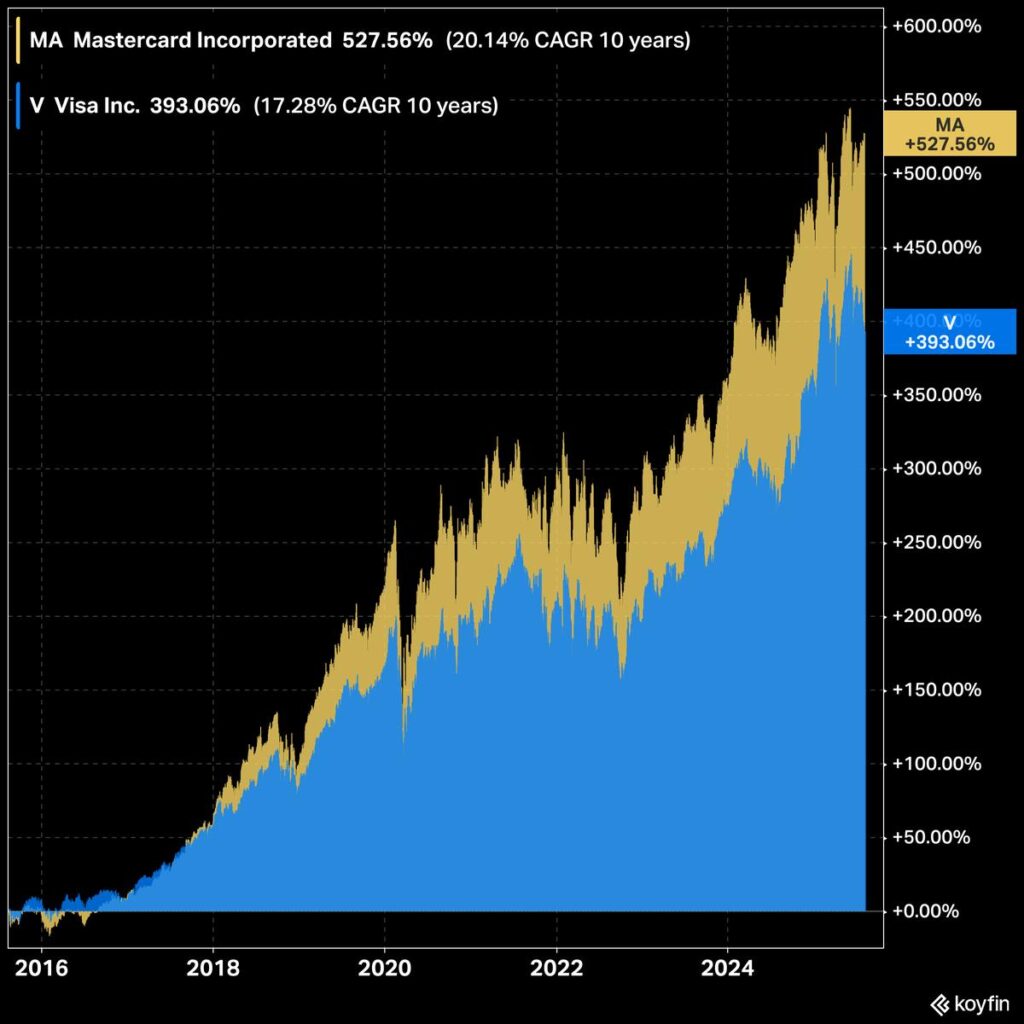
One particularly important milestone was Visa’s payments volume exceeding $4 trillion for the quarter. The company also processed approximately 71.7 billion transactions during the three months ended June 30. Data-processing revenue increased 17%, while Visa’s other revenue category rose 45%, demonstrating that the company is expanding beyond simply collecting fees from traditional card transactions.
Visa is also aggressively returning capital to shareholders. During the fiscal third quarter, the company returned $6.2 billion through dividends and share repurchases. Buybacks matter for long-term investors because reducing the number of shares outstanding can increase earnings per share even when total company earnings grow at a slower rate.
The broader investment argument for Visa is therefore built around scale, network effects and operating efficiency. More merchants make the network more useful to cardholders, while more cardholders make Visa more attractive to merchants and financial institutions. That creates a difficult competitive position for smaller payment networks to challenge.
Mastercard Is Growing Fast and Building a Broader Services Business
Mastercard’s latest results show that Visa is not operating in a one-sided market. For the second quarter of 2026, Mastercard reported $9.3 billion in net revenue, up 14% from the prior year and 12% on a currency-neutral basis. Adjusted diluted EPS reached $5.04, an increase of 21%, while adjusted net income increased 18%.
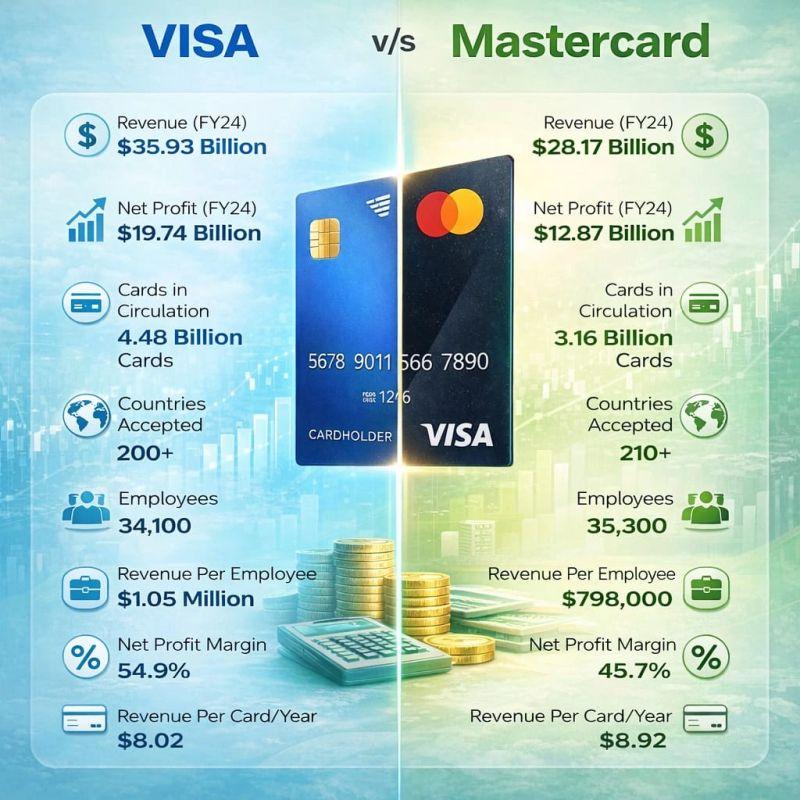
Mastercard’s payment-network metrics were healthy. Gross dollar volume increased 8% to approximately $2.9 trillion, purchase volume increased 10%, switched transactions increased 9%, and cross-border volume increased 12%. Mastercard also reported approximately 3.7 billion Mastercard and Maestro-branded cards worldwide, with the card base increasing 5% year over year.
The more interesting part of Mastercard’s story may be its value-added services business. Revenue from value-added services and solutions increased 20% on a reported basis and 18% on a currency-neutral basis during the quarter. That business includes areas such as security, authentication, data, consulting and other services that can diversify Mastercard’s revenue beyond traditional payment-network economics.
Mastercard is also demonstrating strong operating leverage. Its second-quarter GAAP operating margin reached 60.2%, while the adjusted operating margin was 61.1%. The company repurchased approximately $4.9 billion of stock during the quarter, adding another source of support for per-share earnings growth.
This creates a fascinating contrast: Visa has greater scale and a higher operating margin, while Mastercard has been developing a strong reputation for faster growth in several areas, particularly cross-border payments and value-added services.
Visa vs. Mastercard: Valuation, Innovation and the Risks Investors Cannot Ignore
Valuation is where the decision becomes more complicated. Recent comparison data puts both companies around the low-30s on trailing price-to-earnings measures, meaning neither stock can reasonably be described as cheap in the traditional value-investing sense. TipRanks’ latest comparison data showed Visa at roughly 31.5 times earnings and Mastercard at roughly 31.9 times.
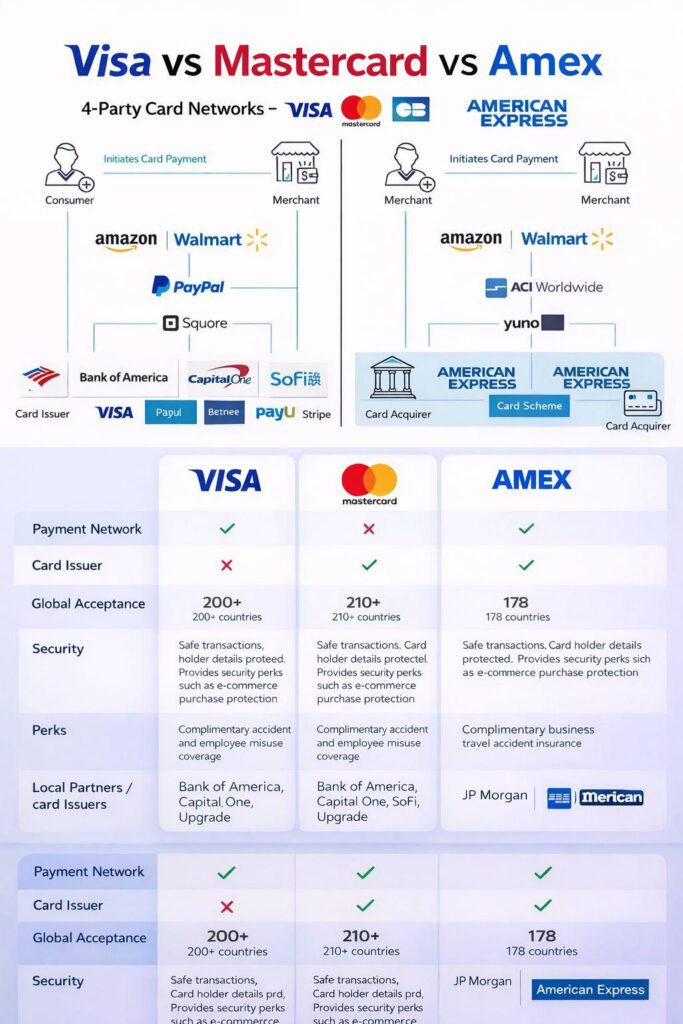
That premium valuation is understandable because investors are paying for businesses with powerful network effects, strong margins, recurring transaction-driven revenue and relatively limited balance-sheet intensity compared with traditional banks. But the premium also creates risk: if payment growth slows substantially or regulatory pressure reduces economics, the stocks could experience multiple compression even if the underlying companies continue to grow.
There are also competitive risks beyond traditional card networks. Stablecoins, account-to-account payments, real-time payment systems, digital wallets and alternative payment rails could change how money moves around the world. Yet Visa and Mastercard are not simply watching these trends from the sidelines. Mastercard completed its acquisition of stablecoin infrastructure company BVNK in August 2026, while Visa has continued expanding its digital-payment and fraud-prevention capabilities.
Artificial intelligence is another long-term opportunity. Mastercard has introduced Agent Pay capabilities designed around payments initiated by software agents, while Visa is investing in technologies that can support digital commerce, tokenization, fraud detection and broader money movement. These initiatives could help both companies participate in the next generation of commerce rather than simply defend the existing card business.
Regulation remains an important risk. Visa and Mastercard have faced long-running legal and regulatory disputes involving interchange fees and network rules. Investors should therefore avoid treating current margins as permanently guaranteed. Changes to merchant fees, routing rules or payment regulations could affect the economics of the networks over time.
Visa Stock vs. Mastercard Stock: Quick comparison
| Metric | Visa | Mastercard |
|---|---|---|
| Latest reported revenue growth | 14% | 14% |
| Latest currency-neutral revenue growth | 13% | 12% |
| Latest cross-border volume growth | 13% | 12% |
| Latest transaction growth | 10% | 9% |
| Latest operating margin | About 66% GAAP | 60.2% GAAP |
| Recent share price* | $371.04 | $580.63 |
| Core advantage | Scale and network reach | Services and growth |
| Major opportunity | Global payments + money movement | Services + agentic payments |
| Major risk | Regulation and valuation | Regulation, valuation and competition |
*Latest completed trading session available in the researched data, August 21, 2026.
What This Means for You
For investors who prioritize durability, scale and operating efficiency, Visa has a compelling argument. Its larger revenue base continues to grow at a healthy rate, payments volume is expanding, cross-border activity remains strong and the company produces extraordinary operating margins. Visa’s latest quarter also showed that its business is not dependent on a single growth engine.
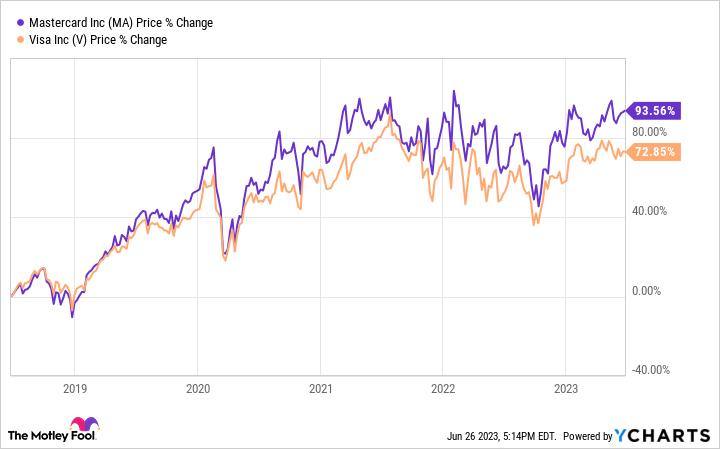
For investors willing to pay for potentially faster growth, Mastercard deserves serious consideration. Its value-added services business is expanding faster than its core payment network, cross-border activity remains strong and adjusted earnings are growing faster than revenue. If Mastercard can continue expanding services while maintaining payment-network growth, its earnings trajectory could remain highly attractive.
Another important consideration is portfolio construction. Investors do not necessarily need to view Visa and Mastercard as mutually exclusive investments. Both businesses benefit from the same broad secular trend: consumers and companies around the world increasingly prefer electronic, mobile and digital payments over cash.
However, owning both does not eliminate concentration risk. They are still exposed to many of the same forces, including global consumer spending, regulation, alternative payment networks, fintech competition and changes in international commerce.
The most important lesson is that investors should not make the decision based only on the share price. Mastercard trading at a higher dollar price than Visa does not make it more expensive by itself. Investors need to compare earnings, cash flow, growth expectations, share count, valuation multiples and future earnings power.
Investor Takeaway and Future Outlook
Investor takeaway: If the decision is based on the combination of scale, profitability and shareholder returns, Visa currently has a slight edge in my assessment. Its larger network, strong recent revenue growth and higher operating margin provide a particularly attractive foundation for long-term compounding. Recent market analysis has similarly favored Visa in some comparisons, although other analysts have argued that Mastercard’s faster growth and services strategy make it the more attractive opportunity.
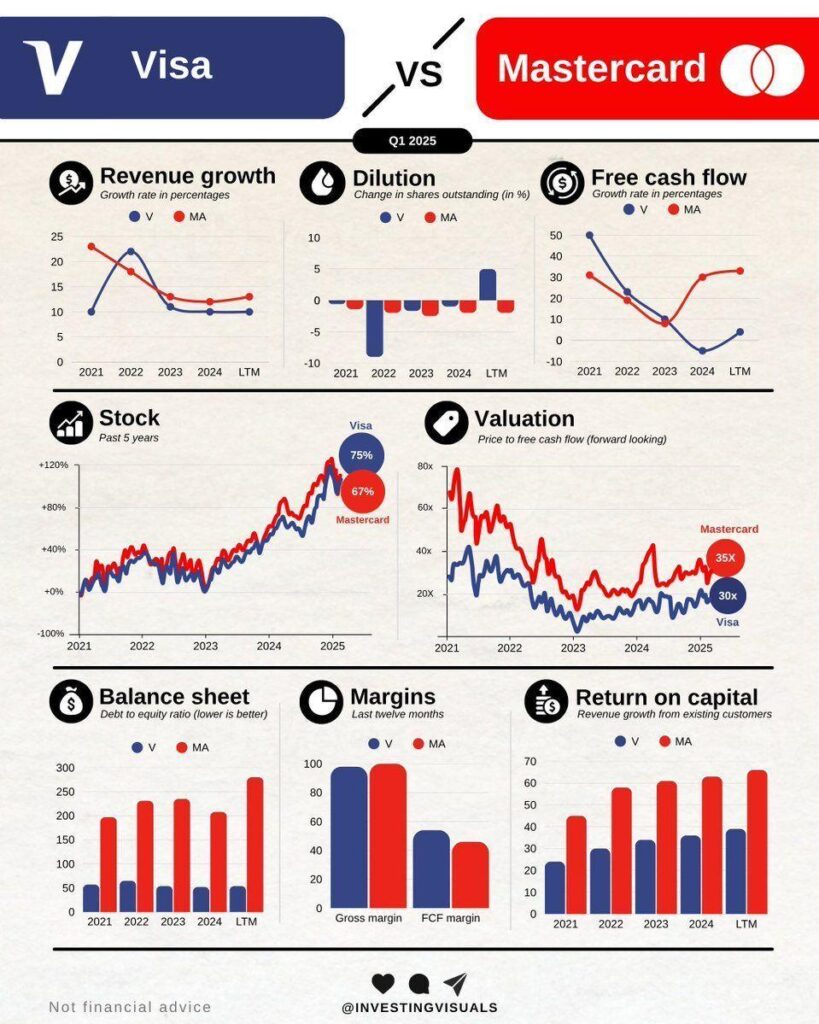
That does not mean Mastercard is a weak investment. Quite the opposite. Mastercard’s 2026 results show a business capable of growing revenue at double-digit rates while expanding margins and producing rapid EPS growth. Its value-added services operation is especially important because it gives the company additional ways to monetize the payment ecosystem beyond the traditional card network.
Future outlook: The next phase of the Visa-Mastercard competition could be less about plastic cards and more about becoming infrastructure for every type of digital transaction. E-commerce, mobile wallets, tokenization, cross-border commerce, embedded payments, artificial intelligence, stablecoins and account-to-account transactions could all become increasingly important sources of payment volume.
Visa’s massive installed network gives it a major defensive advantage, while Mastercard’s services strategy and investments in emerging payment technologies could provide additional growth. The company that converts these technological changes into higher transaction volumes, stronger monetization and sustained free-cash-flow growth will ultimately create more shareholder value.
For long-term investors, valuation should remain the final filter. Both businesses are high-quality companies, but buying an exceptional company at an excessive price can still produce disappointing investment returns. Conversely, a temporary market pullback that brings either stock to a more attractive valuation could create a better entry opportunity.
The latest evidence therefore points to a close contest rather than an overwhelming winner. Visa looks like the stronger choice for investors who prioritize scale, margins and consistency, while Mastercard may appeal more to investors who prioritize faster services growth and exposure to emerging payment technologies. The gap between the two is small enough that valuation and future earnings growth could ultimately determine which produces the better investment return.
This comparison is for informational purposes only and is not personalized financial advice. Investors should review the companies’ latest filings, valuation, risk factors and their own financial objectives before buying either stock.
Research and video resources: Readers wanting additional primary-source information can review Visa’s latest fiscal-third-quarter results Visa Investor Relations and Mastercard’s latest second-quarter results Mastercard Investor Relations. A 2026 YouTube comparison discussing Visa versus Mastercard is also available here:
Subscribe to trusted news sites like USnewsSphere.com for continuous updates.