U.S. Treasury yields are surging, and the move is becoming increasingly important for Americans far beyond Wall Street. The 30-year Treasury yield climbed to about 5.327% on August 18, 2026, reaching its highest level since 2007, while the 10-year Treasury yield was around 4.741% and the 20-year yield was near 5.33%.
The jump is not being driven by a single event. Investors are weighing higher oil prices, renewed inflation concerns, geopolitical uncertainty, large U.S. borrowing needs, heavy corporate debt issuance and uncertainty over the future path of Federal Reserve policy. Brent crude has recently moved above $90 a barrel as tensions surrounding the Middle East and the Strait of Hormuz have intensified, creating another potential source of price pressure for the U.S. economy.
That makes the current bond-market move particularly important. Treasury yields influence the cost of money throughout the financial system. When long-term yields rise, the effects can eventually reach mortgage rates, auto loans, business financing, stock valuations, government interest expenses and consumer spending.
U.S. Treasury Yields Have Reached a Critical Level
The latest Treasury-market move is significant because the 30-year yield has crossed a level that investors have not seen since the period before the 2008 financial crisis. Reuters reported that the yield reached 5.327%, while other market coverage placed it around 5.31% during the previous session. The distinction matters because Treasury yields move throughout the trading day, meaning the intraday high can differ from the official closing yield.
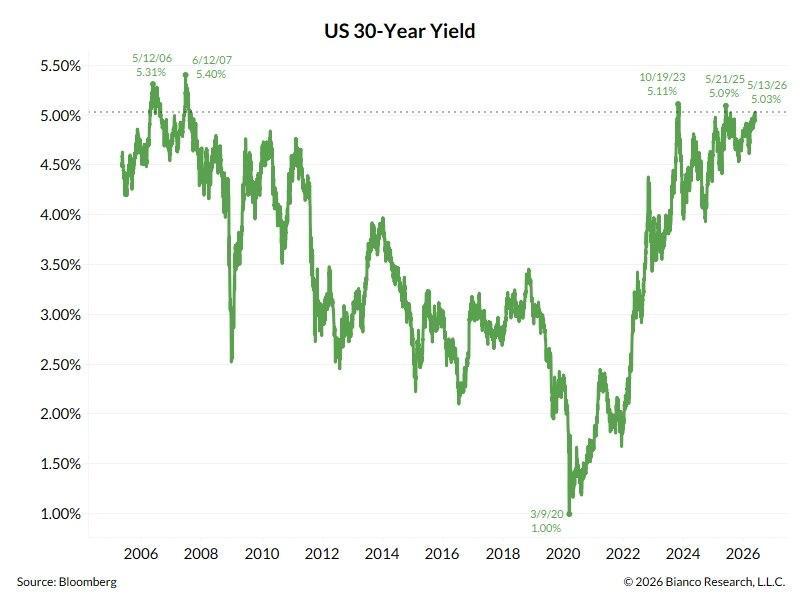
The 10-year Treasury yield, another key benchmark for the financial system, was also elevated at roughly 4.74%. The combination is important because the long end of the Treasury curve is rising even as markets have not necessarily been pricing aggressive additional increases in the Federal Reserve’s short-term policy rate. That means investors are demanding more compensation for holding longer-term government debt.
The U.S. Treasury’s official daily yield-curve data provides the primary reference point for government bond rates. The Treasury explains that its par yield curve represents yields across different maturities and is derived from Treasury market prices.
Market snapshot
| Market indicator | Latest level / development |
|---|---|
| 30-year Treasury yield | About 5.327% intraday |
| 20-year Treasury yield | About 5.33% |
| 10-year Treasury yield | About 4.741% |
| Brent crude | Above $90 per barrel |
| 30-year mortgage | Around the mid-to-high 6% range |
| Fed funds target | 3.50%–3.75% |
| Q2 2026 GDP growth | 1.5% annualized |
The Federal Reserve most recently maintained its federal funds target range at 3.50% to 3.75% on July 29. The central bank said economic activity was expanding at a solid pace but acknowledged elevated uncertainty and inflation that remained above its 2% objective, with energy-related supply shocks contributing to price pressure.
Why Are Long-Term Treasury Yields Rising?
One of the biggest drivers is inflation risk. Oil prices have risen sharply as geopolitical tensions threaten energy supplies, and that creates a difficult environment for central banks. Higher energy costs can feed into transportation, manufacturing, utilities and household expenses, making it harder for inflation to return quickly to the Federal Reserve’s 2% goal.
Fiscal concerns are another major part of the story. Investors are watching the amount of debt the U.S. government must issue and whether the supply of Treasury securities will require higher yields to attract buyers. Recent reporting has also highlighted weaker foreign demand, changing international bond-market conditions and increased borrowing by major technology companies investing heavily in artificial intelligence infrastructure.
There is also a changing relationship between the Fed and the bond market. The federal funds rate directly influences very short-term borrowing costs, but the Fed does not control the 30-year Treasury yield. Long-term yields reflect expectations for future inflation, economic growth, interest rates, government borrowing and the compensation investors require for taking duration risk.
That distinction is crucial. Even if the Fed eventually cuts short-term rates, mortgage rates and other long-term borrowing costs do not automatically have to fall by the same amount. If investors remain worried about inflation or government debt, the long end of the bond market can remain under pressure.
The recent bond selloff is therefore sending a broader message: financial conditions can tighten even without another Fed rate hike. Axios noted that higher Treasury yields are increasing borrowing costs throughout the economy and could eventually weigh on economic activity if the move becomes sufficiently persistent.
What Higher Treasury Yields Mean for Mortgages and Consumers
For homeowners and prospective buyers, the most immediate concern is mortgage rates. A 30-year fixed mortgage does not simply equal the 30-year Treasury yield, but long-term Treasury rates are an important benchmark for mortgage pricing. Lenders also add a spread that reflects credit risk, market conditions, servicing costs and other factors.
Freddie Mac’s official mortgage-rate data showed the average 30-year fixed mortgage at 6.58% for the week ending July 23, 2026, compared with 6.55% the previous week. Other August market reports have shown mortgage rates moving into the high-6% area, including a 6.69% Freddie Mac reading reported for early August.
That matters enormously for household budgets. Consider a hypothetical $400,000 30-year mortgage. At 6.0%, the principal-and-interest payment is roughly $2,398 per month. At 6.75%, it rises to approximately $2,594. That is about $196 more every month, before property taxes, insurance, maintenance and other housing costs.
For consumers, the impact goes beyond home purchases. Higher market interest rates can influence refinancing decisions, home-equity borrowing, auto financing, credit costs and other forms of debt. Existing fixed-rate borrowers are generally protected from an immediate change in their mortgage payment, while people taking out new loans or refinancing face current market conditions.
The housing market can therefore become a transmission channel for Treasury yields. Higher financing costs reduce the amount buyers can afford to borrow, potentially weakening demand. At the same time, homeowners who locked in unusually low mortgage rates may become less willing to sell, because moving would mean giving up a cheaper existing loan.
That combination can produce an unusual housing environment: home prices can remain elevated even while transaction volumes weaken because buyers face affordability constraints and existing homeowners have little incentive to move.
What Higher Yields Mean for Stocks and Corporate Borrowing
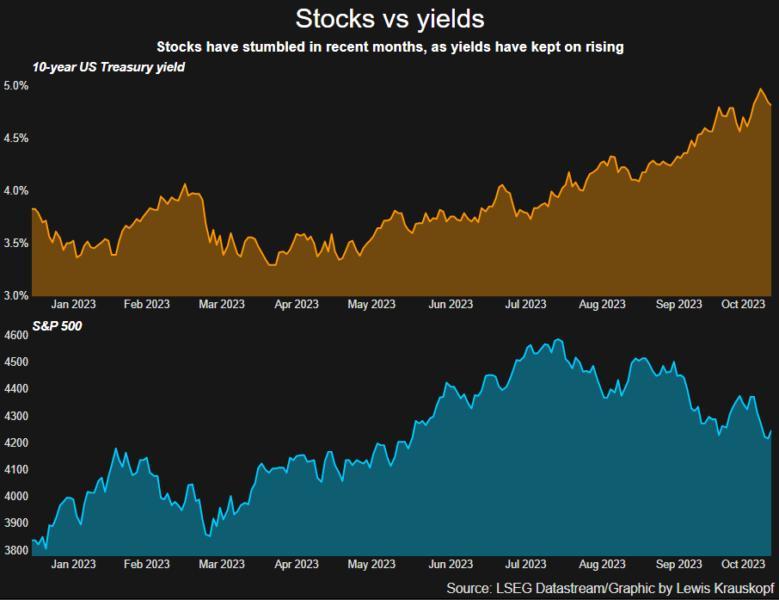
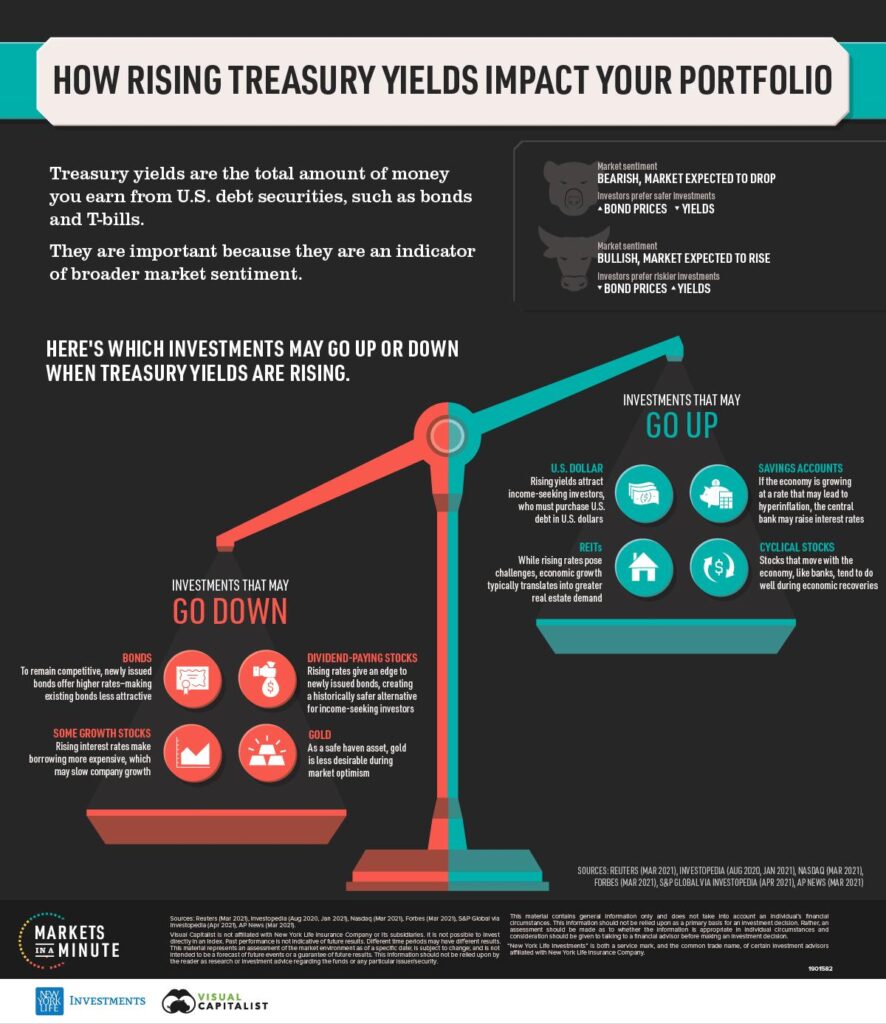
The stock market also feels the effect of higher Treasury yields, although the relationship is not always one-directional. Treasury securities are often treated as a benchmark for relatively low-risk returns. When those yields become more attractive, investors can demand a greater expected return before committing capital to stocks.
Higher yields can be particularly challenging for expensive growth stocks. The reason is mathematical as well as psychological. The value investors assign to future earnings depends partly on the rate used to discount those future cash flows. When that discount rate rises, profits expected many years from now become less valuable in today’s dollars.
That does not mean technology stocks must fall whenever Treasury yields rise. Strong earnings growth can offset higher discount rates. The current market has demonstrated that investors remain willing to pay high valuations for companies with powerful cash flows, artificial-intelligence exposure or strong competitive advantages. But persistently higher long-term yields can make those valuations more difficult to justify.
The second stock-market channel is corporate borrowing. Companies frequently issue bonds to finance acquisitions, capital spending, refinancing and expansion. When Treasury yields rise, corporate borrowing costs can rise as well because investors generally demand a spread over government securities.
This is especially important as large technology companies continue spending heavily on data centers, chips, electricity infrastructure and AI systems. If corporate bond yields rise alongside Treasury yields, the cost of financing those investments increases. Reuters has highlighted the role of increased corporate issuance, including borrowing connected with AI investment, in the broader pressure on long-term bond markets.
The result is a chain reaction:
Higher Treasury yields → higher corporate bond yields → more expensive financing → potentially lower investment or profits → pressure on some stock valuations.
But the opposite can also occur. Banks, insurers and some financial companies may benefit from higher yields if they can earn more on assets without seeing funding costs rise as quickly. Energy companies may also receive support if elevated oil prices increase their revenue and cash flow.
This is why investors should not treat rising Treasury yields as a simple “sell everything” signal. The effect depends heavily on the sector, balance sheet, valuation and sensitivity to interest rates.
What This Means for You
For households, the key message is that Treasury yields are not just a Wall Street statistic. They influence the cost of financing major purchases and can eventually affect employment, housing demand, business investment and consumer spending.
If you are considering buying a home, the most important number is not simply the 30-year Treasury yield. Your actual mortgage offer depends on your credit profile, loan-to-value ratio, loan type, points, lender and other factors. But a rising long-term Treasury market is an important warning that the broader interest-rate environment is not becoming dramatically easier.
For savers and conservative investors, higher Treasury yields have a more positive side. New Treasury securities, certificates of deposit and other fixed-income investments can offer more attractive income than they did during the ultra-low-rate era. Investors who do not need to take large equity risks may find that higher yields improve the opportunity cost of holding cash and short-duration bonds.
For borrowers, however, the message is different. Anyone carrying variable-rate debt or planning a major financed purchase should pay close attention to borrowing costs. Refinancing only makes sense when the new rate, fees and expected holding period create a genuine financial benefit.
The most important point is to avoid assuming that one day’s Treasury move determines the future. Bond yields can reverse quickly if oil prices fall, geopolitical tensions ease, inflation declines or investors become more confident about fiscal conditions.
Investor Takeaway
The investor takeaway is that the 5.327% 30-year Treasury yield is a signal worth watching, not a prediction that a recession or stock-market crash is guaranteed. The current move reflects several forces operating simultaneously: inflation risk, oil prices, geopolitical uncertainty, government borrowing needs, corporate debt issuance and changing expectations for monetary policy.
The broader economic backdrop is mixed. The U.S. economy continued to expand in the second quarter, but real GDP growth slowed to a 1.5% annualized rate from 2.1% in the first quarter, according to the Bureau of Economic Analysis’ advance estimate. Consumer spending and investment contributed to growth, while government spending declined.
That creates a difficult balancing act. If growth remains strong, higher yields may simply reflect investors demanding more return in an economy that can tolerate tighter financial conditions. But if borrowing costs continue rising while growth slows, the pressure can become more significant for housing, business investment and consumers.
Investors should therefore watch several indicators together rather than focusing exclusively on the 30-year Treasury yield: the 10-year Treasury yield, oil prices, inflation readings, Treasury auctions, corporate bond spreads, mortgage rates, employment data and Federal Reserve communication.
A particularly important signal will be whether long-term yields continue rising even if incoming economic data weakens. That would suggest the bond market is becoming increasingly focused on inflation and fiscal risks rather than simply economic growth.
Future Outlook
The future path for Treasury yields will likely depend on which of three forces becomes dominant: inflation, economic growth or fiscal risk.
If oil prices retreat and geopolitical tensions ease, some of the recent inflation premium could disappear. Lower energy prices would reduce pressure on headline inflation and could give investors greater confidence that the Federal Reserve can eventually ease policy without reigniting price growth.
If inflation remains stubbornly high, long-term yields could stay elevated even if the Fed eventually lowers its short-term policy rate. That would create a particularly unusual environment in which the federal funds rate falls while mortgage rates and long-term corporate borrowing costs remain comparatively high.
The most difficult scenario would be a combination of weak economic growth and persistently high inflation or fiscal-risk premiums. In that situation, policymakers would have fewer easy choices. Cutting rates could support growth but risk worsening inflation expectations, while maintaining restrictive policy could further weaken demand.
For now, the bond market is effectively telling investors that the cost of locking money away for decades has changed dramatically from the ultra-low-rate period of the 2010s and early 2020s. A 30-year Treasury yield above 5% does not automatically mean financial markets are in crisis, but it does mean the economy is operating in a much higher-rate world.
That is why the current Treasury move deserves attention far beyond the bond market. Treasury yields feed into mortgages, corporate borrowing, stock valuations, government financing and household decisions. If long-term yields remain elevated, Americans could feel the effects through the cost of buying a home, financing a car, starting a business or investing for retirement.
The next major question is therefore not simply whether the 30-year Treasury yield can move above 5.3%. It is whether the forces pushing it higher — inflation, oil, fiscal borrowing and investor demand — persist long enough to reshape financial conditions across the entire U.S. economy.
Sources and further reading:
U.S. Treasury — Daily Treasury Yield Curve Rates
Reuters — U.S. 30-year yields hit highest level since 2007
Federal Reserve — July 29, 2026 FOMC statement
Freddie Mac — Mortgage Rate data
BEA — Q2 2026 GDP data
Reuters — Global bond-market selloff and inflation/fiscal concerns
CNBC Markets — U.S. markets, bonds and oil coverage
Subscribe to trusted news sites like USnewsSphere.com for continuous updates.