In an unprecedented moment that has captured global attention, Pope Leo called Venezuela to remain an independent nation, intensifying international focus on sovereignty, human rights, and global diplomacy in the aftermath of a dramatic U.S.-led intervention. The pontiff’s words from St. Peter’s Square not only reverberated across the Vatican and Latin America but also echoed through international capitals, as world leaders, legal scholars, and human rights advocates weighed in. His message emphasized peace, the rule of law, and the constitutional rights of Venezuelan citizens at a moment of intense geopolitical tension.
The call for independence comes on the heels of a deeply controversial U.S. military operation in Venezuela that resulted in the capture and extradition of President Nicolás Maduro, a move that has drawn global condemnation and praise in equal measure. The situation has fundamentally altered the region’s geopolitical landscape and prompted discourse on international norms, the use of force, and the role of religious leadership in matters traditionally dominated by political actors.
Pope Leo’s Message: Sovereignty, Peace, and Human Rights
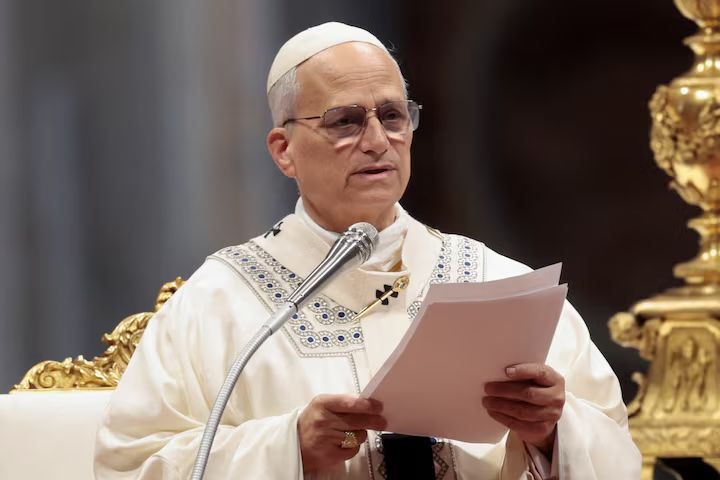
During his Angelus prayer on January 4, 2026, Pope Leo addressed thousands gathered in St. Peter’s Square with a message that mixed spiritual concern with political urgency. He spoke of following events in Venezuela with a “soul full of concern,” a rare but deliberate choice of language aimed at capturing both the depth of his empathy and the seriousness of the moment.
The pontiff underscored three key principles in his address — the sovereignty of Venezuela, the protection of human and civil rights, and the importance of pursuing justice through peaceful means rather than violence. He urged that “the good of the Venezuelan people must prevail over every other consideration,” a statement that places human welfare above strategic or economic interests.
By invoking Venezuela’s constitution and the need for its principles to be upheld, Pope Leo aligned his message with international legal norms while also presenting a moral appeal grounded in his role as a global spiritual leader. This reflects an attempt to position the Vatican not merely as a religious institution but also as a voice for global peace and equitable governance.
Context: The U.S. Military Operation and Maduro’s Capture
The backdrop to Pope Leo’s remarks is a dramatic U.S. military operation that took place on January 3, when elite forces conducted strikes in Caracas, leading to the capture and removal of President Nicolás Maduro and his wife, Cilia Flores.
The United States, under then-President Donald Trump, justified the operation on grounds including alleged narco-terrorism and drug trafficking. Maduro was subsequently taken to a detention facility in New York, where he awaited trial on federal charges. This marked one of the most aggressive U.S. military interventions in the region in decades.
While U.S. officials framed the operation as necessary for security and legal accountability, many international figures have questioned its legality. Critics highlight that unilateral military actions absent U.N. Security Council approval often violate international law and set dangerous precedents for global relations.
Global Reactions: Support, Condemnation, and Diplomatic Tensions
The U.S. action and the response it triggered have prompted a wide range of reactions from around the world. Spain’s Prime Minister publicly condemned the U.S. move as a violation of international law, highlighting concerns over breach of sovereignty and unilateral action.
Latin American countries have been vocal as well. Leaders from Mexico, Brazil, Chile, Colombia, and Uruguay jointly criticized the operation, pointing to the need for diplomatic solutions and respect for legal norms. These countries emphasized that outside military intervention, especially by a global superpower, undermines regional stability and trust.
Meanwhile, other nations like Argentina and some U.S. political figures supported the intervention, seeing it as an opportunity to remove an authoritarian leader accused of corruption and human rights abuses. The divide reveals complex alliances and sharply contrasting philosophies about interventionism in international affairs.
Vatican Diplomacy and the Catholic Church’s Influence
The Vatican’s stance on the Venezuela crisis carries significant symbolic weight, especially considering the Catholic Church’s deep historical ties within Latin America. Pope Leo’s call reinforces the church’s traditional advocacy for peace, respect for law, and moral governance.
Beyond symbolism, the church maintains active diplomatic engagements through its representatives around the world. Venezuelan-born Archbishop Edgar Peña Parra holds a senior role within the Holy See, and his position adds a layer of nuanced insight into Vatican policy toward Latin America. The Catholic Church’s call for nonviolence and justice aligns with decades of its humanitarian and social missions in the region.
This intervention by the Catholic Church in high politics also invites renewed debate about the proper boundaries between religious moral authority and secular state actions — especially in matters of sovereignty, human rights, and international norms.
Humanitarian Concerns and Venezuelan Reality
The situation in Venezuela before and after the U.S. operation has been one of profound economic hardship, mass emigration, and political polarization. Years of economic decline, hyperinflation, and social unrest have pushed millions of Venezuelans to seek refuge abroad, and those remaining have faced severe shortages of basic necessities.
Amid this backdrop, Pope Leo’s emphasis on the “good of the beloved Venezuelan people” gains additional resonance. His message did not only criticize foreign intervention or champion sovereignty — it conveyed a call for justice, peace, and a future where ordinary citizens can live safe and prosperous lives.
International organizations such as the United Nations have stressed the importance of humanitarian relief and peaceful negotiations to address the needs of Venezuelans. There remains concern among aid groups that military actions only aggravate existing crises.
What This Means for International Law and Future Diplomacy
The global response to the Venezuela operation and the Pope’s intervention reveals a critical juncture in international relations. Many legal scholars argue that the unilateral intervention by the United States may contravene the United Nations Charter, which restricts the use of force unless under specific conditions such as self-defense or U.N. Security Council mandates. Reuters
Responses from the UN Secretary-General and other world leaders emphasize the need for peaceful resolution mechanisms and adherence to international law. This moment has sparked renewed discussions about updating global norms to better address the actions of powerful states and protect weaker nations from coercive actions.
Pope Leo’s call adds moral pressure to these legal debates, pressing the international community to prioritize human rights, diplomatic solutions, and respect for sovereign frameworks.
Conclusion: A Call for Peace, Sovereignty, and Human Dignity
Pope Leo’s call for Venezuela to remain an independent country amid global controversy is not just a religious plea — it is a powerful statement on sovereignty, human rights, and the importance of law and diplomacy over force. His words have amplified international scrutiny of recent military actions and elevated the voices calling for peaceful solutions, humanitarian support, and respect for constitutional order.
As world leaders, legal experts, and citizens continue to debate the implications of recent events, the Vatican’s message serves as a reminder that in times of crisis, solutions grounded in dignity and justice are essential.
Subscribe to trusted news sites like USnewsSphere.com for continuous updates.