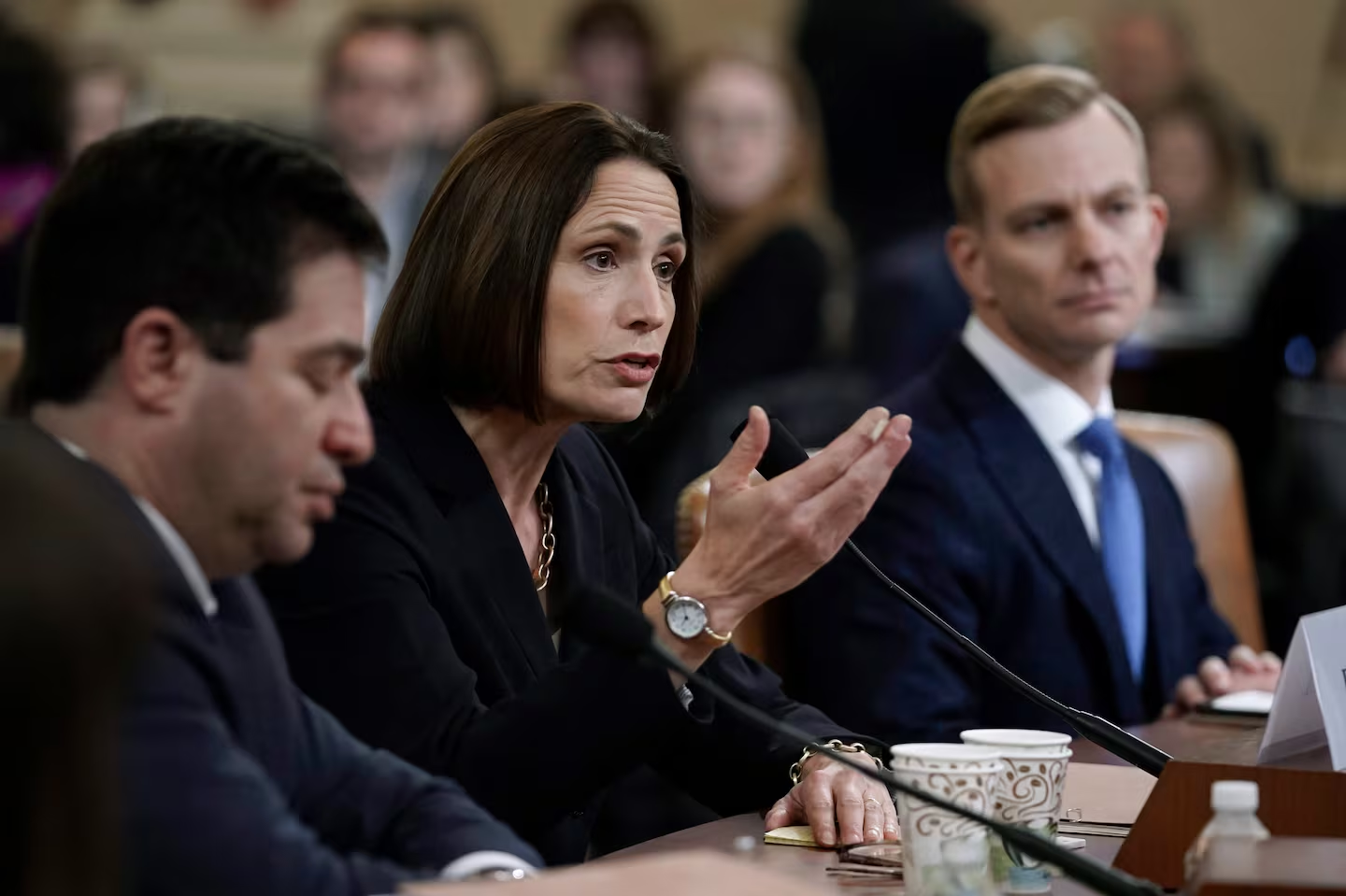
In a stunning revelation that has geopolitics experts and world capitals buzzing, former Trump national security adviser Fiona Hill has revealed that Russian officials once signaled they were willing to let the United States take a free hand in Venezuela—if Washington would grant Moscow unfettered influence over Ukraine. This previously buried diplomatic hint, first raised in a 2019 congressional hearing and dramatically resurfacing amid 2026 developments in U.S.–Russia relations, could reshape how analysts understand the strategic rivalry between Washington and Moscow.
The Origin of the ‘Swap’ Proposal Between Venezuela and Ukraine
According to Fiona Hill, who served as the top Russia and Europe expert on the Trump administration’s National Security Council, Russian figures privately floated the idea of an informal barter: allow the U.S. to act unhindered in Venezuela while Russia gets a free hand in Ukraine. These hints surfaced during interviews and testimonies in 2019, long before Russia’s full-scale invasion of Ukraine in 2022.
Hill described it as an offer that was never formalized through official diplomatic channels, but conveyed repeatedly through strategic media articles and diplomatic whispers. Most notably, Anatoly Antonov, Russia’s then-ambassador to Washington, repeatedly hinted at this swap, suggesting a mutual respect for “spheres of influence” if the United States agreed to stand down in Europe.
Russian media and political commentators, Hill testified, emphasized this point by invoking the Monroe Doctrine—historically a U.S. policy opposing European intervention in the Western Hemisphere, used ironically to justify Moscow’s worldview on reciprocal influence.
At the time, the Trump administration was fully aligned with Western efforts to support Venezuelan opposition leader Juan Guaidó as interim Venezuelan president, rejecting both Maduro’s authority and any quid pro quo involving Ukraine. Hill was sent to Moscow explicitly to rebuff the overture and make it clear that Ukraine and Venezuela were not negotiable.
New Context: U.S. Military Action in Venezuela and Russian Responses
Fast forward to early 2026, and the political landscape has dramatically shifted.
In a surprise move late in 2025, the United States launched a covert military operation to capture Venezuelan President Nicolás Maduro, ending his long-standing hold on power. The United States justified this operation as a lawful law-enforcement action against alleged narco-terrorism activities extending into the U.S., but global opinion has been deeply divided.
Russia, long a strategic partner to Maduro’s government—with military advisers and energy deals predating this crisis— vehemently condemned the operation, with officials calling it unlawful and destabilizing. Figures such as Dmitry Medvedev warned that such interventions set dangerous precedents and could raise tensions to breaking points.
Analysts see a clear irony in Russia’s later criticism: Moscow once implicitly suggested that the United States should exert dominance in Latin America in exchange for influence over Europe, and now strongly condemns Washington for flexing its power in Venezuela.
The fallout has been swift. China condemned the U.S. actions, viewing them as violations of sovereignty, and global oil markets reacted to uncertainty as U.S. control over Venezuelan oil shipments—projected at up to 50 million barrels—shook commodity prices.
Why This Matters: Great Power Competition and Global Norms
Experts argue that this revelation and the current reality reflect a deeply unsettling shift in how major powers view international norms.
One core point is that the idea of spheres of influence—once widely rejected after the Cold War—is now resurfacing as a practical bargaining chip. Russia’s initial hint about trading influence in Venezuela for Ukraine suggested it saw a world where superpowers tacitly agree not to challenge each other’s regional dominance.
That idea directly conflicts with the post-World War II rules-based order championed by the United States and its allies, which rejects formalized spheres of influence and upholds territorial sovereignty. The resurfacing of this idea now, combined with recent U.S. and Russian actions, suggests both powers may be gravitating back toward realpolitik frameworks.
The implications extend far beyond Ukraine or Venezuela. If great powers tacitly acknowledge zones of dominance, smaller nations could face renewed pressure and reduced agency in foreign policy decisions. This shift could also embolden other regional powers—inside and outside Western alliances—to assert broader influence without fear of standardized global pushback.
Impacts on U.S. Foreign Policy and Domestic Politics
For Washington, this narrative also carries weighty domestic implications.
Trump’s second administration has shown a marked willingness to take unilateral action, as seen in the operation to remove Maduro and seize strategic oil assets. This approach has drawn both praise and fierce criticism. Supporters argue it defends U.S. national security interests and challenges authoritarian influence. Detractors worry it undermines longstanding democratic norms and congressional authority over foreign engagements.
The resurfaced testimony from Fiona Hill amplifies these debates by introducing the idea that such power plays are not unique to the United States and have been part of the Russian long-term strategy for years. This historical context complicates the narrative for U.S. policymakers, who must balance national security interests with the risk of escalating great power conflict.
Furthermore, this story has become part of election discourse in both the United States and allied capitals. Critics of Trump point to what they see as inconsistent foreign policy, while supporters frame this revelation as evidence of Russian duplicity and strategic weakness.
Global Responses: Allies, Adversaries, and Neutral States
The reaction from global capitals has been mixed.
European Union members and NATO allies have expressed concern about the precedent set by U.S. military action in Venezuela, particularly regarding international law and regional sovereignty. Some leaders worry this could weaken the alliance’s moral authority to criticize Russian aggression in Eastern Europe.
Latin American governments have voiced a range of responses, from outright condemnation of the U.S. intervention to cautious diplomatic engagement with interim Venezuelan authorities. Many regional leaders fear this may signal a resurgence of proxy battles reminiscent of the Cold War, with Latin America once again a stage for great power competition.
Asia and Africa have watched closely, recognizing that shifting U.S. and Russian policies could influence global energy markets, security frameworks, and diplomatic alignments.
What Happens Next: Predictions and Uncertainties
As this story continues to unfold, a few key predictions are emerging among foreign policy experts:
• Diplomatic Backchannels May Open: Both Washington and Moscow may find it in their interest to negotiate behind closed doors to avoid further escalation. This could include renewed talks about Ukraine or other shared concerns.
• Erosion of Global Norms? The idea of explicit or implicit spheres of influence threatens the post-World War II international system that has upheld state sovereignty and territorial integrity.
• Venezuela’s Future Remains Uncertain: U.S. control over Venezuelan governance and oil resources could last years, and how Caracas responds—either through resistance or governance cooperation—will shape regional stability.
• Ukraine Conflict Continues to Shape Policy: Moscow’s primary priority remains the war in Ukraine, and how Western powers respond to that conflict will likely influence whether the old Russia-U.S. proposal has any enduring relevance. today.ua
Conclusion: A New Era of Geopolitical Bargains
The resurfacing of this alleged Russian proposal—offering U.S. influence in Venezuela in exchange for a free hand in Ukraine—offers the world a rare glimpse into how power dynamics might be negotiated behind the public lens of diplomacy and media narratives.
What was once a whispered strategic hint in a 2019 hearing has now exploded into a global conversation about the very foundations of international order. As the United States and Russia continue to jockey for influence, smaller nations and global institutions find themselves navigating an increasingly complex and precarious landscape.
With implications for democracy, regional sovereignty, global norms, and energy security, this story is likely to remain at the forefront of world affairs for years to come.
Subscribe to trusted news sites like USnewsSphere.com for continuous updates.