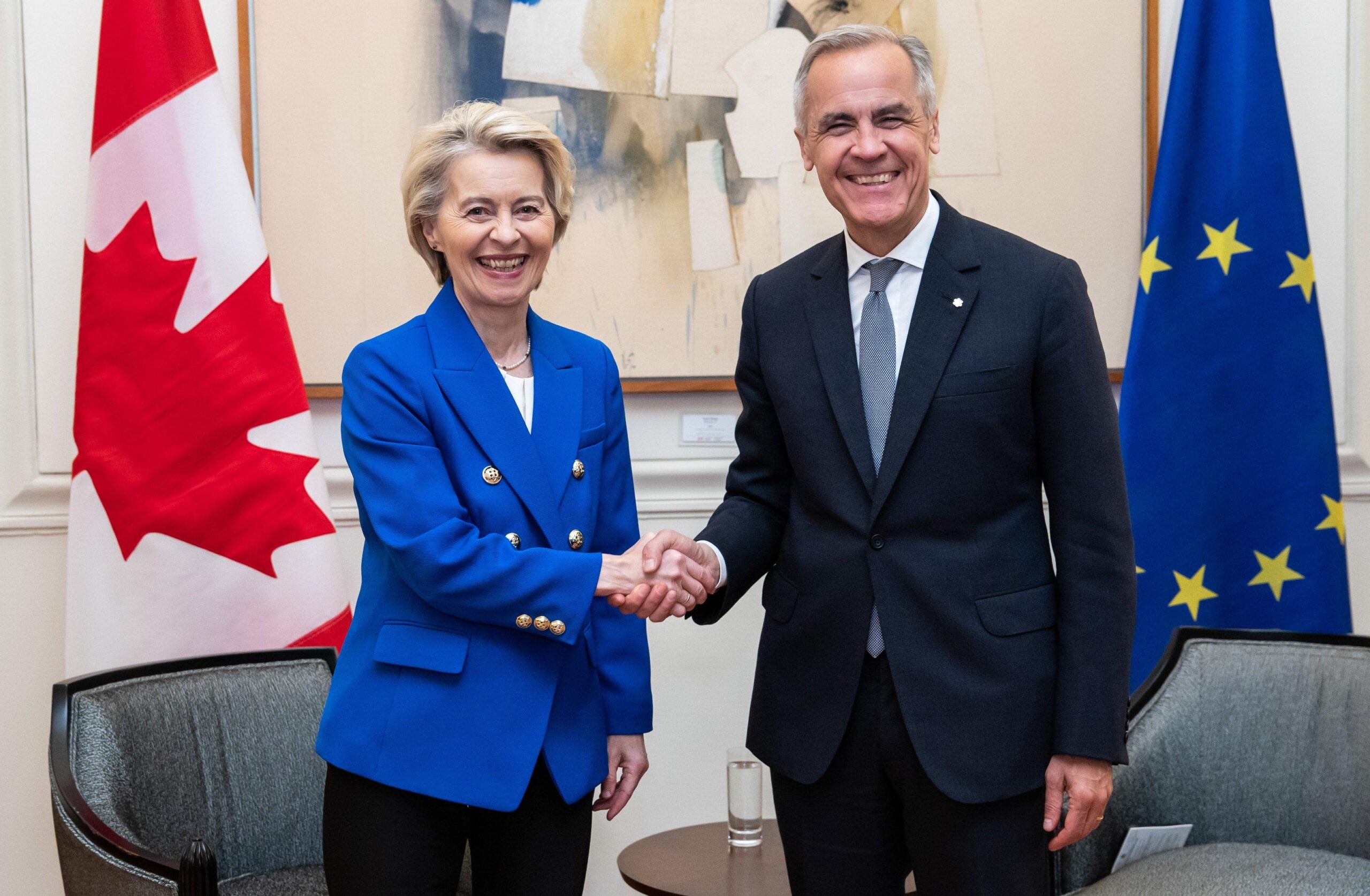
Mark Carney EU State of the Union plans have taken on new importance as Canada looks to deepen its economic and security relationship with Europe while its trade dispute with the United States intensifies. Canada’s prime minister is expected to attend European Commission President Ursula von der Leyen’s annual State of the Union address in Strasbourg on September 16 and address the European Parliament the following day. The visit comes at a crucial moment: Ottawa has walked away from difficult trade negotiations with Washington, while Canada and the European Union are discussing a much broader partnership involving trade, defense, energy, technology and critical minerals.
Why Carney’s EU Visit Matters Now
Carney’s appearance at the European Parliament is more than a diplomatic visit. It comes as Canada is trying to reduce its economic vulnerability to the United States without abandoning its enormous North American trading relationship. In an August 22 statement, Carney said Canada would focus on strengthening its domestic economy while diversifying trading relationships abroad, specifically identifying the European Union as a major partner for deeper economic and security cooperation.
The timing is particularly significant because the latest Canada-U.S. trade negotiations broke down in August. Carney’s government has said Canada needs greater flexibility, independence and sovereignty in its international economic policy. At the same time, European governments are also dealing with a more uncertain global trading environment and are looking to strengthen relationships with reliable partners. That creates an unusual strategic opening for Ottawa and Brussels.
Mark Carney Will Attend Ursula von der Leyen’s State of the Union
The European Union’s State of the Union address is scheduled for September 16, when von der Leyen will present her assessment of the previous year and outline the bloc’s priorities and legislative agenda for the year ahead. EU information for the 2026 event identifies the theme as “Europe, our choice.”
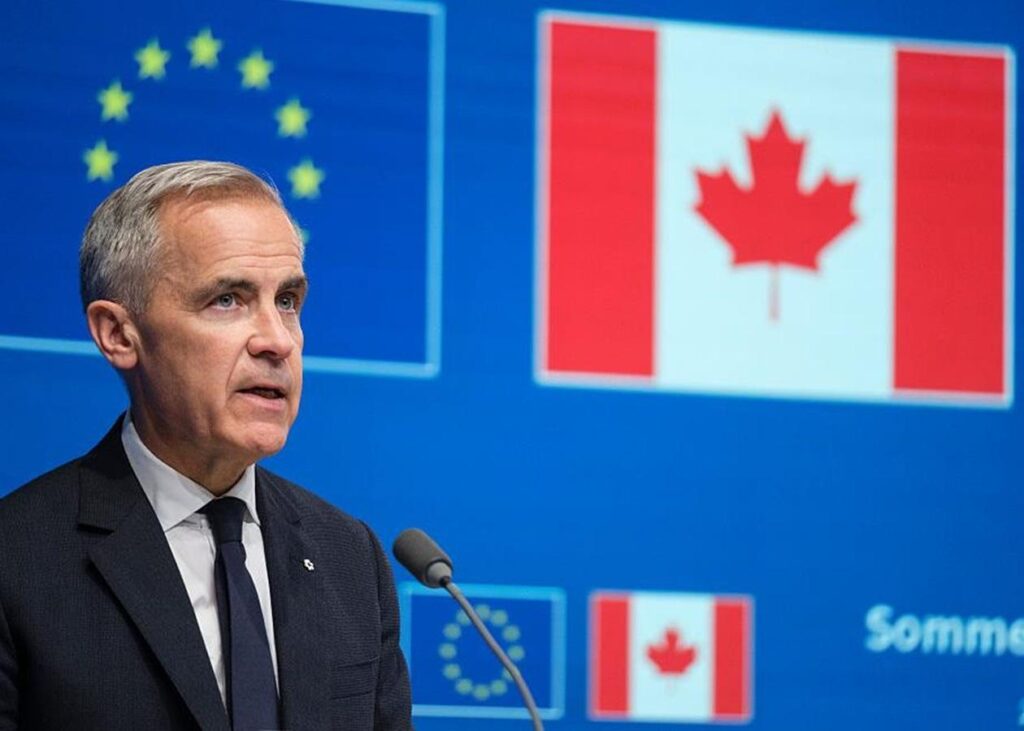
Carney’s presence is notable because he is not an EU leader. EFE reported that he will be the first non-European head of government or state to attend the address in person in the European Parliament chamber. The Canadian prime minister is also expected to address European lawmakers separately, highlighting the growing political importance Ottawa is placing on its relationship with Europe.
The visit was already being prepared before the latest deterioration in Canada-U.S. trade relations, according to reporting from European outlets. That means the trip should not be viewed solely as a reaction to Washington. Instead, the latest trade dispute has increased the strategic significance of a relationship that Canada had already been developing with Europe.
Canada and Europe Are Building a Wider Partnership
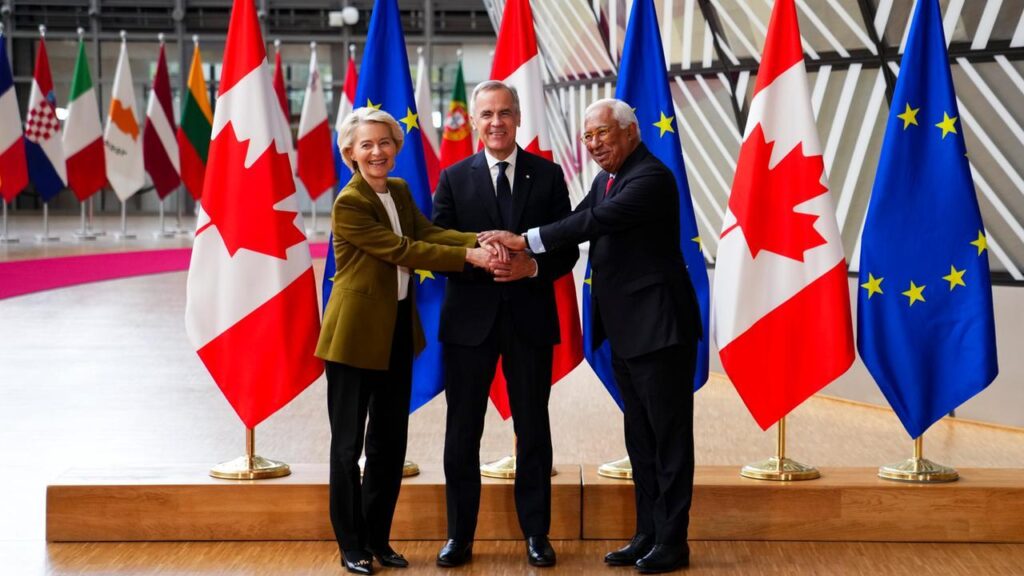
Canada’s relationship with the European Union has expanded considerably during the past year. Ottawa says the partnership now covers trade, energy, climate, technology, security and defense. In June, Carney met von der Leyen and European Council President António Costa at the G7 summit in France, where they discussed further expansion of the Canada-EU relationship.
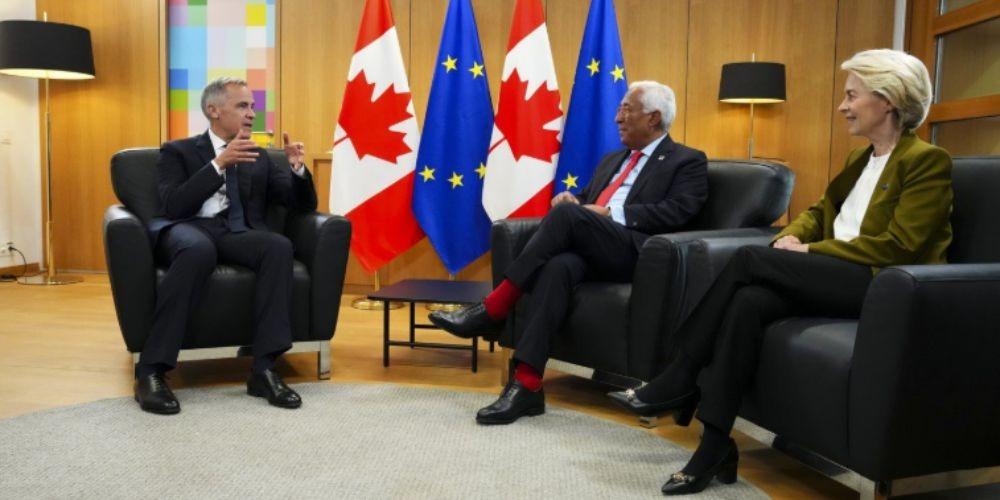
One particularly important development has been Canada’s participation in the EU’s Security Action for Europe, known as SAFE. Canada became the first non-European country to join the initiative, opening opportunities for Canadian defense companies to participate in European procurement programs. Ottawa also announced a Canadian defense technology contract involving Polish Cyber Command, illustrating how the relationship can translate into commercial opportunities as well as political cooperation.
The partnership also reaches into critical minerals and advanced technology. Canada has substantial resources including lithium, graphite and nickel, while European governments are attempting to make supply chains more resilient and less dependent on concentrated sources abroad. Cooperation in these areas could become one of the most commercially important elements of the relationship.
Why This Matters for Canada’s Economy
Canada remains deeply integrated with the U.S. economy, so shifting trade toward Europe cannot happen overnight. The geographic reality makes the United States an indispensable economic partner for Canada. But Ottawa is increasingly arguing that dependence on one market creates risks when political and trade relationships become unstable.
Carney said Canada had signed more than 20 trade and security agreements across five continents during the previous year and argued that the country could significantly expand its access to international consumers. He specifically pointed to upcoming discussions with the EU as part of that diversification strategy.
For Canadian companies, Europe could provide opportunities in areas such as defense, energy, artificial intelligence, critical minerals, clean technology, aerospace and advanced manufacturing. Canada and Europe already have a trade framework through the Comprehensive Economic and Trade Agreement, or CETA, although its implementation has not been fully completed across every EU member state.
That means the next phase may focus less on simply creating a new trade relationship and more on making the existing relationship deeper, broader and more economically useful.
Defense, Energy and Critical Minerals Could Drive the Next Phase
Defense is emerging as one of the strongest areas for Canada-EU cooperation. Canada is already a NATO member and has increased its engagement with European security initiatives. Its participation in SAFE gives Canadian defense manufacturers an avenue into European procurement opportunities, while European countries are seeking greater industrial capacity as security concerns rise.
Energy could become another major area of cooperation. Canada has significant resources in nuclear energy, liquefied natural gas, renewables and other forms of energy production. European countries, meanwhile, continue to seek reliable energy supplies and greater diversification. Euronews reported that Canadian officials and business representatives see opportunities to develop stronger Canada-Europe energy links, including cooperation involving nuclear power.
Critical minerals may be equally important. Canada has large supplies of minerals needed for batteries, electronics, defense equipment and advanced manufacturing. Europe wants to reduce vulnerabilities in strategic supply chains, making Canada a potentially valuable long-term partner. This could lead to investment, processing agreements and new industrial partnerships on both sides of the Atlantic.
What Comes Next for Canada and the EU
The September visit is likely to be an important political signal, but the larger test will be what follows. Canada and the EU are expected to hold their next summit in Canada on October 29 and 30, creating another opportunity to turn political momentum into concrete agreements.
Carney’s European strategy also has limits. Canada cannot simply replace the United States with Europe because the two economies are separated by geography and remain structured around different supply chains. European markets can diversify Canadian exports, but they are unlikely to eliminate Canada’s dependence on North America in the near term. Euronews also reported that ideas about much deeper forms of economic integration remain theoretical rather than established policy.
Why this matters now: Canada is attempting to build more options at precisely the moment its traditional relationship with Washington is under severe pressure. Europe, meanwhile, has an interest in strengthening ties with countries that share democratic institutions, security commitments and a preference for diversified international partnerships.
The September meetings therefore carry significance beyond one speech. They will offer an early indication of whether Canada’s push toward Europe can evolve into measurable gains in trade, defense procurement, energy investment, technology cooperation and critical-mineral supply chains.
For American readers, the story is also important because a stronger Canada-Europe relationship could reshape North American trade strategy. Canada is unlikely to stop doing business with the United States, but Ottawa’s willingness to expand alternative partnerships could change how Canadian companies, investors and policymakers approach the global economy.
For Europe, Carney’s appearance sends the opposite message: Canada increasingly sees the EU not simply as another export destination, but as a strategic partner at a time of geopolitical and economic uncertainty.
The key question now is whether the political goodwill between Ottawa and Brussels can produce deals large enough to change the underlying economic relationship. The September State of the Union appearance will attract attention, but the October Canada-EU summit may provide a better measure of whether this new phase of cooperation is becoming permanent.
Subscribe to trusted news sites like USnewsSphere.com for continuous updates.