


Dow Jones S&P 500 Nasdaq forecast searches are gaining importance as investors look for direction after a turbulent stretch on Wall Street. Following a technology-led rebound, fresh election-related uncertainty, expensive artificial intelligence valuations, corporate earnings expectations and shifting Treasury yields are creating competing signals for U.S. equities.
The latest trading sessions demonstrate why investors should avoid relying on a single market headline. On November 3, the S&P 500 and Nasdaq Composite recovered, while the Dow Jones Industrial Average slipped. However, early November 4 trading brought renewed pressure to U.S. stock futures as investors assessed emerging election results and their potential implications for spending, regulation and AI infrastructure development.
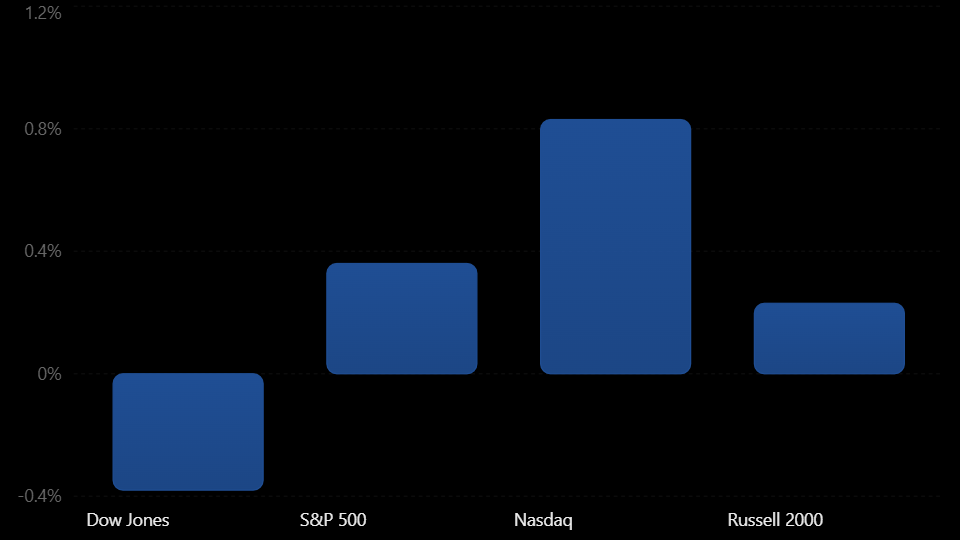
According to the Associated Press, the S&P 500 closed at 7,568.92, up 0.36%, while the Nasdaq Composite finished at 25,372.01, gaining 0.83%. The Dow Jones Industrial Average declined 0.38% to 51,786.72. The Russell 2000 added approximately 0.23% to close at 2,812.45. Most S&P 500 constituents nevertheless finished lower, highlighting the narrow nature of the recovery. Source: AP market report.
Reuters subsequently reported that S&P 500 futures fell around 1.2% and Nasdaq futures declined more than 2% in an early November 4 snapshot, as political uncertainty weighed on sentiment. The 10-year Treasury yield also moved lower, reaching approximately 4.906% in that report. These were developing market movements, not final cash-market results.
Rather than predicting an exact index level, investors can better prepare by examining three possible market scenarios. Each depends on how corporate profits, inflation, financing costs and policy developments evolve.
Wall Street’s Latest Rebound: Why the Three Major Indexes Are Sending Different Signals
The November 3 session offered a useful reminder that the Dow Jones, S&P 500 and Nasdaq do not represent identical investment exposures. The Nasdaq’s stronger performance reflected renewed buying in major technology and semiconductor shares, while the Dow experienced pressure from weaker components, including Apple.

The recovery followed a difficult stretch for technology stocks. The Nasdaq-100 had recently entered correction territory, meaning it had fallen at least 10% from its October 6 closing high. Investor concerns included the scale of AI infrastructure spending, lofty valuations and uncertainty about how quickly investment in computing capacity will translate into lasting profits.
| Index | Nov. 3 close | Daily change |
|---|---|---|
| Dow Jones | 51,786.72 | -0.38% |
| S&P 500 | 7,568.92 | +0.36% |
| Nasdaq Composite | 25,372.01 | +0.83% |
| Russell 2000 | 2,812.45 | +0.23% |
Source: Associated Press. Closing figures are historical, not current quotes.
The divergence matters because the S&P 500 and Nasdaq can receive substantial support from a relatively small number of influential companies. When heavyweight technology stocks rise, they can lift index returns even while many other businesses struggle.
Investors should therefore monitor market breadth, equal-weighted index performance, small-cap shares and sector participation alongside headline index movements. A broad advance supported by many industries would generally provide stronger evidence of improving market confidence than a rally concentrated in a handful of large companies.
Bullish Scenario: What Could Drive the Dow, S&P 500 and Nasdaq Higher?
A constructive market scenario would require several developments to align. Corporate earnings would need to remain resilient, inflation would need to moderate without a sharp economic slowdown, and AI investments would need to demonstrate credible commercial returns. Under those circumstances, investors could become more comfortable paying higher valuations for businesses with durable growth prospects.
Earnings data provide a reason not to dismiss this possibility. Nasdaq’s October 2026 market review reported that, by October 30, approximately 60% of S&P 500 companies had reported quarterly results. The blended earnings growth rate was 30.2% year over year, while 82% of reporting companies exceeded earnings-per-share estimates. Revenue growth stood at 13.4%. These figures reflected the reporting companies and estimates available at that point, rather than final results for the entire index. Source: Nasdaq October review.
If earnings strength broadens beyond a narrow group of AI-related companies, the S&P 500 could receive support from multiple sectors. The Dow could benefit from improving industrial, financial and consumer-business performance, while the Nasdaq could respond positively to better technology earnings and improving confidence in AI spending.
Lower Treasury yields could provide another tailwind if they reflect easing inflation and a stable economic outlook. Falling energy prices could also reduce operating expenses for transport companies and improve household purchasing power.
Nevertheless, a bullish scenario should not be confused with a guaranteed rally. Strong economic growth can sometimes push bond yields higher, while unexpectedly robust demand may complicate inflation forecasts. The most favorable environment would combine sustainable earnings expansion with manageable inflation and financing costs.
Neutral Scenario: Choppy Trading, Sector Rotation and Mixed Earnings
A neutral scenario would involve the market moving sideways or experiencing repeated rallies and pullbacks as investors balance encouraging business results against elevated valuations and policy uncertainty.
This possibility deserves serious consideration because market leadership can change without a major collapse in corporate earnings. Semiconductor shares might continue attracting buyers while consumer companies, financial stocks or other sectors experience inconsistent performance. Investors could rotate between growth, value, defensive and cyclical businesses as new economic data arrive.
The earnings season illustrates this tension. Companies may deliver respectable revenue growth but still disappoint if analysts expected even stronger results. Management commentary on hiring, capital expenditure, component prices, financing requirements and consumer demand could become more important than headline earnings beats.
Treasury yields could also remain volatile as investors respond to employment figures, inflation reports and Federal Reserve communications. In such an environment, the Dow, S&P 500 and Nasdaq might alternate between gains and losses without establishing a lasting direction.
For readers, the neutral scenario emphasizes patience and selectivity. A market without a clear trend does not necessarily mean investment opportunities have disappeared. However, short-term breakouts can fail, and investors should avoid assuming that every rebound signals the beginning of a sustained bull market.
Bearish Scenario: Expensive AI Stocks Meet Higher Costs and Weaker Growth
The bearish scenario would become more plausible if earnings expectations deteriorated while inflation or borrowing costs remained restrictive. Expensive technology shares could be particularly vulnerable if investors begin questioning whether expected AI revenue can justify the enormous sums committed to infrastructure.
A critical issue is the difference between capital expenditure and investment returns. AI infrastructure requires chips, servers, power, cooling systems and data-center construction. These investments can create significant opportunities for suppliers, but they also increase financing needs and depreciation expenses for purchasers.
Apple’s November 3 share-price decline offered another example of how costs can influence sentiment. The company reported a 47.9% gross margin for its September quarter and indicated a December-quarter margin outlook of approximately 45% to 46%, with rising memory costs contributing to investor concerns. Its shares fell around 1.9% despite better-than-expected quarterly results.
An additional threat would be an energy-driven inflation shock. Higher oil prices could increase transportation and production expenses while reducing consumers’ disposable income. If inflation pressures limit the Federal Reserve’s flexibility, interest-sensitive valuations could face further compression.
A more severe downturn could also emerge if employment deteriorates sharply, credit conditions tighten or geopolitical risks disrupt trade and energy supplies. Under this scenario, the Dow, S&P 500 and Nasdaq could all come under pressure, although their relative performance would depend on sector composition and earnings exposure.
No single indicator confirms a bearish market outcome. Investors should watch whether weakening market breadth, disappointing corporate guidance, credit stress and rising volatility begin reinforcing one another.
What This Means for You: The Signals Investors Should Monitor Next
For individual investors, the most useful approach is to identify observable conditions that would strengthen or weaken each scenario instead of relying on a single index forecast.
The following dashboard can help readers organize their market research.
| Market signal | More constructive evidence | Warning signs |
|---|---|---|
| Corporate earnings | Improving guidance and cash flow | Downgrades and margin pressure |
| AI investment | Better monetization and returns | Spending rises faster than revenue |
| Treasury yields | Inflation eases without growth shock | Persistent inflation or financial stress |
| Oil prices | Stable supply and easing costs | Supply disruption and sustained spikes |
| Market breadth | More sectors and stocks advance | Rally depends on few mega-cap stocks |
| Policy outlook | Greater clarity on business rules | Uncertainty around spending and regulation |
These are analytical indicators, not mechanical trading rules. Each requires context. For example, lower bond yields may help valuations, but a sharp decline associated with recession fears may not be positive for equities.
Investor Takeaway: Review concentration risk, liquidity needs, investment horizons and exposure to individual companies before reacting to market headlines. Diversification can reduce dependence on particular sectors or stocks, although it cannot eliminate market losses. Investors should also distinguish a company’s business prospects from the price its shares currently command.
For long-term investors, a disciplined process may be more valuable than attempting to anticipate every short-term market swing. For active traders, volatility can create opportunities as well as risks, but leverage, overnight gaps and rapid changes in liquidity can magnify losses.
Future Outlook: What Could Move US Stocks Next?
The next direction for Wall Street will depend on the interaction between earnings, inflation, interest rates, oil prices and policy developments. A sustained recovery would likely require stronger confidence in corporate profitability and a less disruptive macroeconomic environment. A prolonged period of uncertainty could instead produce volatile, range-bound trading.

Future Outlook: In the bullish case, improving earnings, successful AI monetization and easing inflation could support broader market participation. In the neutral case, earnings resilience may offset valuation concerns, leaving indexes vulnerable to alternating rallies and pullbacks. In the bearish case, disappointing guidance, rising costs, persistent inflation or economic deterioration could deepen selling pressure.
The November 4 election reaction is an additional uncertainty rather than a complete explanation for market direction. Reuters reported that early results suggested Democrats could gain control of the House, while the Senate outcome remained uncertain in that snapshot. Potential implications for fiscal stimulus, regulation and AI infrastructure policy were among the issues investors considered. Actual legislative outcomes will depend on final results and subsequent political processes.
The most important upcoming developments include fresh employment and inflation data, remaining corporate earnings reports, Treasury yield movements, energy-market conditions and Federal Reserve communications. Investors should also monitor whether market participation broadens beyond the largest technology companies.
Ultimately, the Dow Jones, S&P 500 and Nasdaq forecast should be understood as a framework for evaluating possibilities, not a promise about future prices. The strongest investment decisions begin with evidence, valuation discipline and an understanding of risk.
Subscribe to trusted news sites like USnewsSphere.com for continuous updates.