In a stark and unprecedented rebuke, German President Frank-Walter Steinmeier publicly declared that the United States is destroying the world order it once helped establish, warning that the rules-based global system is now at risk of collapsing into a “den of robbers” where the most powerful wield unchecked influence.
Steinmeier’s forceful speech has rapidly become one of the most discussed international political statements in recent weeks, drawing global attention to rising tensions in transatlantic relations. His comments — delivered at a high-profile symposium in Berlin — mark a rare moment of overt criticism from a leading European statesman toward Washington, sparking debate among diplomats, strategists, and analysts around the world.
Understanding Steinmeier’s Message: A Departure From Diplomatic Restraint
Frank-Walter Steinmeier — Germany’s largely ceremonial but deeply respected president — delivered a rare and direct criticism of the United States. Traditionally, European leaders temper such remarks with diplomatic caution. But Steinmeier’s tone was unmistakably blunt: the world order is under threat, and the United States is a central catalyst in that upheaval. Deutschland
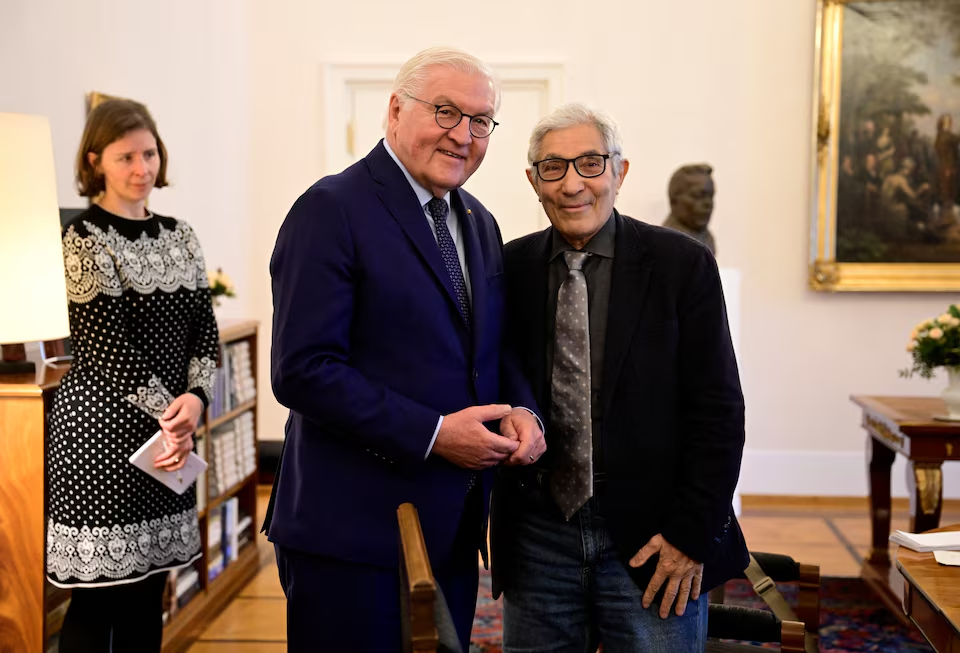
He voiced concern that global democracy is being attacked “as never before.” Comparing two historical ruptures — Russia’s invasion of Ukraine and recent U.S. foreign policy decisions — Steinmeier argued that the breakdown of international norms is no longer theoretical, but unfolding in real time.
Unlike other heads of state, Steinmeier did not mince words. He warned that if powerful nations operate without restraint, weaker countries could be left defenseless, with global institutions paralyzed and unable to enforce legal or humanitarian protections. His speech prompted both applause and alarm across think tanks and international forums.
This level of criticism signals that deep fractures may be emerging in long-standing transatlantic partnerships that once formed the backbone of post-World War II stability.
Context: What Sparked the Accusations Against the United States
Steinmeier’s remarks didn’t occur in a vacuum. A series of U.S. policy actions in recent months — including military interventions, approaches to diplomacy with countries like Venezuela, and shifts in alliances — have fueled concern among foreign policy experts.
A prominent example often cited in connection with Steinmeier’s speech was the U.S.-backed ousting of Venezuelan President Nicolás Maduro, which many international observers viewed as controversial and indicative of an aggressive foreign posture.
Beyond direct military or political interventions, analysts point to broader patterns of U.S. disengagement from multilateral frameworks, withdrawal from international treaties, and an increasing preference for unilateral action. These trends, critics say, undermine the very rules-based system the United States championed during the 20th century.
At least one public opinion poll in Germany shows growing skepticism toward the United States as a reliable partner, suggesting Steinmeier’s message reflects broader public sentiment rather than isolated elite opinion.
Reactions From European Leaders: France Joins the Critique
Steinmeier was not alone in expressing concern. French President Emmanuel Macron echoed similar sentiments, criticizing the U.S. for “turning away from traditional allies” and weakening global institutions during recent interactions.
Together, these remarks suggest that some European capitals may be reconsidering their strategic alignment with Washington. Macron has also advocated for greater European autonomy in defense and foreign policy — a significant shift for a continent long dependent on American security guarantees.
The combined statements from Germany and France point toward a potentially historic realignment in Western geopolitical leadership, one that could see Europe asserting more independence from U.S. policy influence in global affairs.
Global Democracy and the Erosion of International Norms
Steinmeier’s underlying concern goes beyond bilateral relations: he is warning about the erosion of democratic values at a global level.
When powerful nations act without regard for shared norms, international law, or the sovereignty of smaller states, the results can be destabilizing. Steinmeier used evocative language — including the phrase “den of robbers” — to describe a world where the strong take what they want, unchecked by rules or accountability.
Political scientists have long pointed out that the post-World War II system — built on institutions like the United Nations, NATO, and multilateral treaties — has helped prevent open conflict between major powers. A breakdown of that system could usher in an era of heightened geopolitical competition and insecurity.
There’s also evidence from think tanks and geopolitical risk analysts that U.S. policy decisions in recent years — including trade disputes, treaty exits, and military actions — have contributed to uncertainty among allies. One influential report even noted the U.S. may be undermining “its own global order,” amplifying instability.
United States Response and Official Statements
The White House and U.S. officials have not publicly echoed Steinmeier’s assessment. Instead, American policymakers have sought to defend recent decisions as lawful, necessary, and aligned with U.S. national interests. Statements emphasize the importance of American leadership while rejecting claims that the U.S. seeks to dismantle international systems.
To date, no direct rebuttal has been issued addressing Steinmeier’s central charge, and diplomatic channels remain open but cautious. U.S. engagement with NATO and other alliances continues, even as European leaders vocalize frustration with perceived unilateralism.
If Washington chooses to challenge Steinmeier’s narrative publicly, the rhetoric could escalate transatlantic tensions, potentially reshaping diplomatic discourse for years to come.
Implications for the Future: Geopolitical Consequences and Forecasts
The ripple effects of Steinmeier’s statements are only beginning to be felt. For decades, U.S. leadership was regarded as a central pillar of the global order — shaping economic frameworks, security alliances, and diplomatic norms.
Now, analysts say we may be entering a period of geopolitical realignment, where:
- Alliances are re-evaluated — Europe, India, Brazil, and other powers may pursue more independent approaches, reducing reliance on any single hegemon.
- International institutions face pressure — if trust in multilateral systems erodes, smaller states may seek bilateral power relationships instead.
- Global democracy trends shift — as institutions weaken, authoritarian and revisionist powers could gain influence, challenging democratic norms.
Experts also warn that if the perception of U.S. unpredictability persists, countries might diversify their strategic partnerships or focus on regional blocs as alternatives to global consensus structures.
This evolving landscape could shape international diplomacy, trade, security cooperation, and human rights advocacy for a generation. Reuters
Conclusion: A Turning Point in Global Diplomacy
German President Frank-Walter Steinmeier’s bold warning about the United States “destroying world order” has opened an intense and necessary debate on the state of global governance. This moment is more than a bilateral critique — it reflects shifting geopolitical dynamics, deepening questions about international norms, and growing calls for cooperation beyond traditional alliances.
Whether Steinmeier’s message prompts policy change, sparks diplomatic reform, or reshapes alliances, one thing is clear: the world is witnessing a significant reevaluation of the rules and relationships that have governed international affairs for decades.
Subscribe to trusted news sites like USnewsSphere.com for continuous updates.