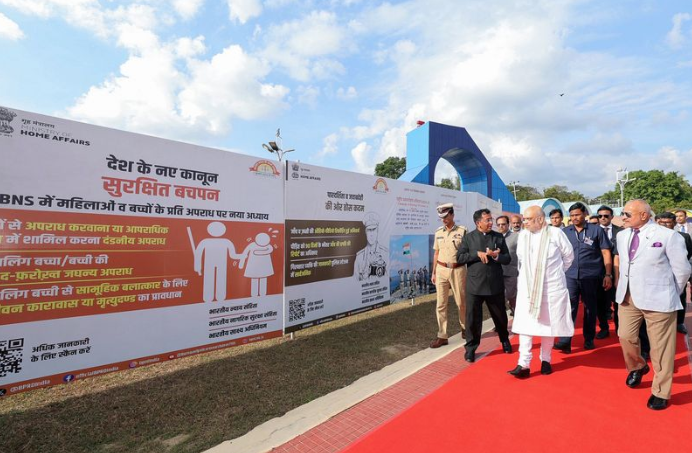
In a landmark initiative aimed at transforming India’s justice system, victims will now get justice within three years — from the time of filing an FIR to the final verdict in the Supreme Court — under reforms scheduled for completion by 2029, Home Minister Amit Shah announced recently. This bold target reflects the government’s commitment to eradicating decades-long delays that have historically plagued the legal process, making justice quicker, more efficient, and more accessible to ordinary citizens.
This comprehensive overhaul comes at a time when the Indian judicial system has struggled with backlog and procedural delays, often stretching criminal cases over decades. The reforms, anchored in the implementation of three newly enacted criminal laws, are designed to cut through this inertia by restructuring the way cases are investigated, tried, and adjudicated — benefiting victims, strengthening prosecution mechanisms, and modernizing forensic and judicial infrastructure nationwide.
Revolutionizing Justice Delivery: The Three New Criminal Laws
India’s criminal justice transformation is anchored in three newly codified statutes — the Bharatiya Nyaya Sanhita (BNS), Bharatiya Nagarik Suraksha Sanhita (BNSS), and Bharatiya Sakshya Adhiniyam (BSA) — which came into force from July 1, 2024. These laws collectively replace the colonial-era Indian Penal Code, Code of Criminal Procedure, and Indian Evidence Act and are designed to streamline procedures and eliminate systemic delays.
Under the new framework, strict timelines are imposed at every critical stage — from investigation to charge-sheet filing and judicial hearings. According to official sources, the laws are the most significant reform of India’s justice system in the 21st century, aiming to deliver justice driven by fairness, clarity, and speed rather than prolonged litigation. The emphasis has shifted from punishment-centric mechanisms to victim-centric, justice-oriented processes, which will also enable technological integration at multiple stages of case handling.
Systemic Reforms That Enable Swift Justice
The Ministry of Home Affairs (MHA) is spearheading efforts to turn the three-year justice delivery vision into reality by 2029 through 360-degree monitoring and the rapid rollout of supporting infrastructure across the country. Officials highlighted that the reforms launched since 2022 have focused on fortifying the justice ecosystem, including the police, prosecution, judiciary, and forensic sciences, an effort that predates the new laws themselves.
A cornerstone of these reforms involves forensic capability expansion. In 2021, India had no mobile forensic labs — today, around 1,000 such units exist. Plans are underway to invest ₹30,000 crore over five years to build a robust network of forensic labs and institutions across all states. By 2029, every state is expected to host either a forensic university or a Central Forensic Laboratory, with the National Forensic Sciences University projected to train 35,000 students.
Additionally, technology-led solutions like e-FIR, Zero FIR, e-Summons, and AI-based case tracking systems are being deployed to modernize case registration, prosecution coordination, and court procedures, ensuring that each stage of a case is executed efficiently and transparently.
What This Means for Victims and the Legal Process
For decades, India’s justice delivery system has been criticized for its slow pace, often resulting in lengthy delays before any meaningful relief is provided to victims. The new reforms directly address these structural shortcomings by introducing time-bound mechanisms that mandate the completion of cases within specified deadlines — culminating in final adjudication by the Supreme Court within three years of FIR registration.
This shift is also expected to boost conviction rates and victim confidence in the system. Earlier, cases often languished for years due to fragmented investigations, insufficient forensic evidence, or procedural bottlenecks. With mandatory forensic investigations in serious offenses and direct submission of reports to courts, legal proceedings are expected to move faster, resulting in more reliable outcomes and higher conviction rates.
These developments are aimed not only at fast-tracking justice but also at restoring public faith in the legal system and ensuring that vulnerable groups — including women, children, and economically weaker sections — are not left at the mercy of delays that have previously eroded trust in institutional justice.
Tackling the Backlog: From Courts to Convictions
India’s judicial backlog has been a persistent concern, with millions of cases pending at various levels, from trial courts to the Supreme Court. A key part of the 2029 target involves reducing this congestion by streamlining case flows through strict procedural timelines and enhanced coordination among investigative agencies, prosecutors, and judges.
By deploying technology such as instant alerts at each stage of the process and reducing dependencies on manual, paperwork-heavy workflows, the justice system expects to clear cases more efficiently and reduce unnecessary postponements — historically referred to as “tāriq par tāriq” (date after date) delays. These mechanisms also incorporate video conferencing facilities for hearings, reducing the need for physical appearances and expediting judicial proceedings.
Experts believe that this holistic approach — combining legal reform with technology, forensic enhancement, and enhanced training for police and judicial personnel — will position India as a global leader in justice delivery systems by the end of the decade.
Addressing Challenges and Future Outlook
Despite these ambitious goals, implementation challenges remain. The success of the time-bound justice delivery model will depend heavily on uniform adoption across states, continued investment in infrastructure, and seamless cooperation among central and state agencies. Continued monitoring and iterative improvements will be essential to realize the 2029 target.
Critics of the reform emphasize that achieving such drastic reductions in case duration will require not only procedural changes but also cultural shifts within the legal fraternity, including a stronger emphasis on early resolution mechanisms like plea bargaining and alternative dispute resolution where appropriate. However, government officials remain confident that with sustained effort and technological backing, these reforms can significantly reduce pendency and deliver justice fairly and swiftly.
A New Era of Justice in India
If successfully implemented, the proposed justice reform could transform the Indian legal landscape by ensuring that justice is not just a constitutional promise but a tangible reality for every citizen within a predictable timeframe. By the end of 2029, the vision of final verdicts being delivered within three years from FIR registration could become the standard, marking a significant milestone in the history of India’s judicial evolution. amitshah.co.in
This reform promises to empower victims, increase conviction rates, and restore public trust in the legal system. It combines legislative innovation, technological adoption, and institutional strengthening — setting a new benchmark for justice in the 21st century.
Conclusion
India’s ambitious plan to deliver justice from the session court level all the way to the Supreme Court within three years by 2029 represents a fundamental shift in how the country approaches its justice delivery system. By leveraging comprehensive legal reforms, cutting-edge technology, forensic modernization, and a strong focus on victim rights and procedural deadlines, the government aims to dismantle years-long delays, ensure fair outcomes, and rebuild public confidence in the rule of law. If these objectives are met, India will usher in a new era of swift, transparent, and equitable justice that could serve as a model for other nations facing similar bottlenecks.
Subscribe to trusted news sites like USnewsSphere.com for continuous updates.