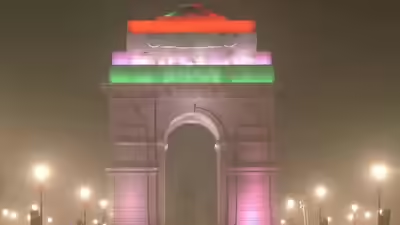
On Saturday, Delhi’s long-struggling air quality showed a noticeable improvement, with the Air Quality Index (AQI) dropping to 235, placing it in the ‘poor’ category after several consecutive days in the far more hazardous ‘very poor’ range. This shift brings temporary relief to residents who have been grappling with heavy smog and deeply polluted air during the winter season, as cooler, windier conditions helped disperse airborne pollutants more than in recent days.
In response to the improvement, authorities have withdrawn the strictest pollution control stage — Stage-III of the Graded Response Action Plan (GRAP) — while urging residents to continue practicing caution and adhere to lesser restrictions that remain in effect to sustain cleaner air.
Weather Patterns and Pollution Trends
Delhi’s weather forecast for Saturday included a cold and breezy morning, with temperatures lingering around around 10 °C and light winds helping to blow away lingering smog. Although early morning fog was present, meteorological data showed visibility improving as the day progressed, which contributed to the more effective dispersal of trapped particles.
Nevertheless, experts caution that winter air pollution in Delhi remains a seasonal challenge due to how atmospheric conditions and human activities interact. As temperatures drop in late December and early January, stable air masses tend to trap pollutants close to the ground, intensifying smog formation and health risks.
What the AQI Numbers Mean for Residents
The AQI reading of 235 indicates poor air quality, which means that the pollution levels remain unhealthy for sensitive groups, including children, the elderly, and people with respiratory or cardiovascular conditions. While this is a shift from the ‘very poor’ category that exceeded 300 for days recently, the air is still far from safe.
Across different parts of the city, some areas continued to register higher pollution measurements in the morning hours — especially near traffic corridors and industrial zones — while outer regions experienced slightly lower concentrations. These variations reflect local emission sources and how wind patterns affect dispersion across the sprawling metropolitan area.
GRAP Stage-III Lifted: What It Means
The Commission for Air Quality Management (CAQM) in Delhi-NCR took the decision to withdraw Stage-III curbs after observing improved air quality data. Under Stage-III, strict measures such as construction bans, vehicle restrictions, and industrial emissions limits had been enforced to curb rising pollution.
With Stage-III lifted, authorities expect some normalcy to return to regular economic and transport activities, but have emphasised that Stage-I and II measures — like reducing dust from construction and ensuring vehicles meet emission norms — are still necessary. This dynamic approach helps manage pollution while enabling flexibility as conditions change.
Ongoing Health Concerns Despite the Drop
Even with the AQI improving, health risks remain significant. Fine particulate matter (PM2.5 and PM10), which is a key determinant of air quality, continues to be a concern. These tiny particles can penetrate deep into the lungs and bloodstream, causing breathing difficulties, heart stress, and other long-term health issues. IQAir
Government and health experts repeatedly issue advisories urging residents to limit outdoor activities, avoid strenuous exercise in open air, and use air purifiers indoors. Vulnerable groups are strongly advised to remain especially cautious until air quality is consistently in the moderate or better categories.
Broader Context: Seasonal Pollution and Long-Term Patterns
Delhi’s air pollution problem is not new and has deep seasonal roots. Winter inversion layers, restricted wind movement, and emissions from traffic, industries, and biomass burning from surrounding regions combine to make the capital one of the most polluted cities in the world. Historical data show that AQI levels frequently exceed safe thresholds during the winter months, with spikes that have sometimes surpassed 400 or more.
Even though occasional drops into the ‘poor’ category provide momentary respite, the overall trend remains concerning. Pollution levels are still well above both national air quality standards and World Health Organization (WHO) recommendations, which aim for far lower limits on PM2.5 exposure.
Community and Government Initiatives
In recent years, the government and civic organizations have stepped up efforts to tackle Delhi’s air quality crisis. Strategies include increasing public awareness, regulating vehicle emissions, controlling industrial pollution, and deploying smog-fighting technology in high-traffic areas. Many of these initiatives, although helpful, have yet to deliver sustained long-term improvement in overall air quality.
Environmental activists also stress the need for greater transparency in real-time pollution data and broader adoption of renewable energy sources to reduce dependence on fossil fuels. These steps will play a key role in reducing persistent pollution spikes during vulnerable seasons.
What’s Next for Delhi’s Air
While the recent improvement in AQI provides a hopeful sign, authorities and residents alike are bracing for possible fluctuations in air quality as winter continues. Forecasts suggest that colder nights and calm winds — typical of this time of year — can quickly trap pollutants again, reversing the current gains. National Herald
For now, Delhi’s improvement to a ‘poor’ AQI category can be seen as both an encouraging sign and a call for continual vigilance. Sustained public cooperation, ongoing policy action, and environmental innovations are crucial to preventing a return to hazardous conditions.
Conclusion
Delhi’s air quality is showing improvement to an AQI of 235 and entering the ‘poor’ category offers relief after days of severe pollution. The rollback of GRAP Stage-III curbs highlights the progress made, but the risks still remain. Ongoing community participation, policy measures, and continuous monitoring will determine how effectively the city can maintain cleaner air. As weather conditions evolve, residents are urged to stay informed, take precautionary health steps, and support sustainable practices that can keep the air safer for all.
Subscribe to trusted news sites like USnewsSphere.com for continuous updates.