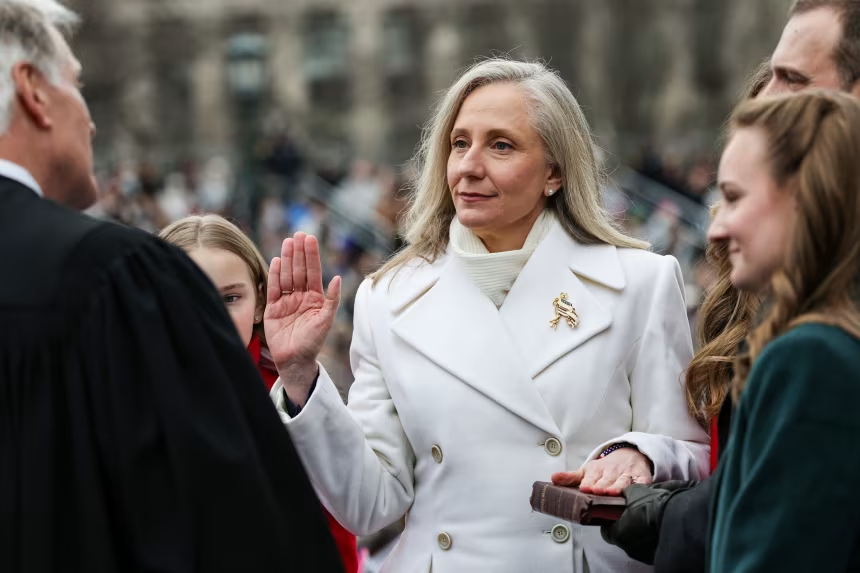
Abigail Spanberger was sworn in as Virginia’s 75th governor on January 17, 2026, making history as the first woman to ever hold the office in the Commonwealth’s nearly 250-year history.
Spanberger, a Democrat and former U.S. Representative, won the 2025 gubernatorial election by a decisive margin, defeating Republican Winsome Earle-Sears and flipping the governor’s mansion after years of Republican leadership. Her victory has been interpreted as part of a broader Democratic resurgence in the Commonwealth, with implications for both state policy and national party strategy.
Virginia’s Capitol in Richmond buzzed with energy and history on inauguration day, drawing crowds and signals of a new political chapter. Spanberger took the oath of office alongside groundbreaking leaders, including Ghazala Hashmi — Virginia’s first Muslim and Indian American lieutenant governor — and Jay Jones, the first Black attorney general in state history.
A Historic Day Steeped in Symbolism and Progress
The inauguration itself blended longstanding tradition with powerful symbolism. Spanberger opted for a white outfit, breaking from the traditional morning suits typically seen at gubernatorial inaugurations and instead paying tribute to the women’s suffrage movement.
Speakers and attendees referenced past struggles and future hopes, linking this moment to generations who fought for civil rights and equal representation. The Capitol steps — where suffragists once protested — became the stage for what many are calling a symbolic turning point in Virginia politics.
Beyond the ceremony, Virginia’s inaugural weekend included a parade and community celebrations that brought diverse groups together in recognition of this milestone. Organizers themed the festivities “United for Virginia’s Future,” highlighting unity and forward momentum.
Spanberger’s Vision: Unity, Affordability, and Policy Priorities
In her delivered inauguration address and subsequent interviews, Gov. Spanberger made clear her priorities for the Commonwealth. She emphasized the need for bipartisan cooperation, reducing the costs of living, expanding healthcare access, strengthening education, and preventing gun violence.
She also critiqued federal policies, especially those tied to immigration and healthcare, saying these issues have strained families and communities across Virginia. Within hours of taking office, Spanberger signed 10 executive orders aimed at reversing previous state directives and directing her administration toward policy goals that reflect these priorities.
Among the orders was one that rescinded an earlier mandate requiring local law enforcement to assist federal immigration enforcement — a clear shift in state law enforcement priorities.
New Leadership at the Helm and What It Means for Virginia
Spanberger’s ascent isn’t symbolic alone — she brings to office significant practical shifts. Her administration has already begun shaping the future of higher education governance, with new board appointments for major universities like the University of Virginia and George Mason University following several resignations.
State Democrats now hold majorities in both legislative chambers, positioning Spanberger’s leadership to enact legislation without heavy resistance. This political alignment also sets the stage for redistricting efforts ahead of the 2026 midterm elections.
Given Virginia’s unique rule that governors cannot serve consecutive terms, Spanberger’s immediate focus is on impact and legacy, laying the groundwork for policies that could redefine Virginia’s governance long after her term ends.
Why This Matters Now: Implications Beyond Virginia
This moment resonates beyond state lines. Spanberger’s inauguration is being watched as a bellwether for Democratic strategies ahead of the 2026 U.S. midterms. Her success in a historically swing state underscores potential shifts in voter sentiment and party dynamics nationwide.
Her leadership also arrives amid national debates over reproductive rights, public safety, healthcare affordability, and immigration — issues that are not only top of mind in Virginia but also central in electoral politics across the country.
Furthermore, the evident diversity in Virginia’s newly inaugurated statewide leadership — with historic firsts for women, Muslim Americans, and Black elected officials — reflects demographic and cultural shifts that will continue to influence American political landscapes.
Challenges and Expectations
While Spanberger’s inaugural moments were filled with optimism, the tasks ahead are significant. Leaders in Richmond and across Virginia will need to address economic pressures, healthcare access, education reform, and partisan divides within the state.
Analysts also suggest that Spanberger’s pragmatic and centrist approach may position her as a contender for national leadership roles in the future, with some pointing toward potential interest in federal office.
Yet for now, her focus remains on uniting Virginians around shared goals and making measurable progress on the priorities laid out in her first hours in office.
Subscribe to trusted news sites like USnewsSphere.com for continuous updates.