
Trump Accounts are changing how Americans can save and invest for children, and the new $2,500 employer contribution rule is one of the most important features for working families to understand. The accounts officially launched on July 4, 2026, and the IRS now allows parents, guardians and other authorized individuals to make an election to establish an account for an eligible child.
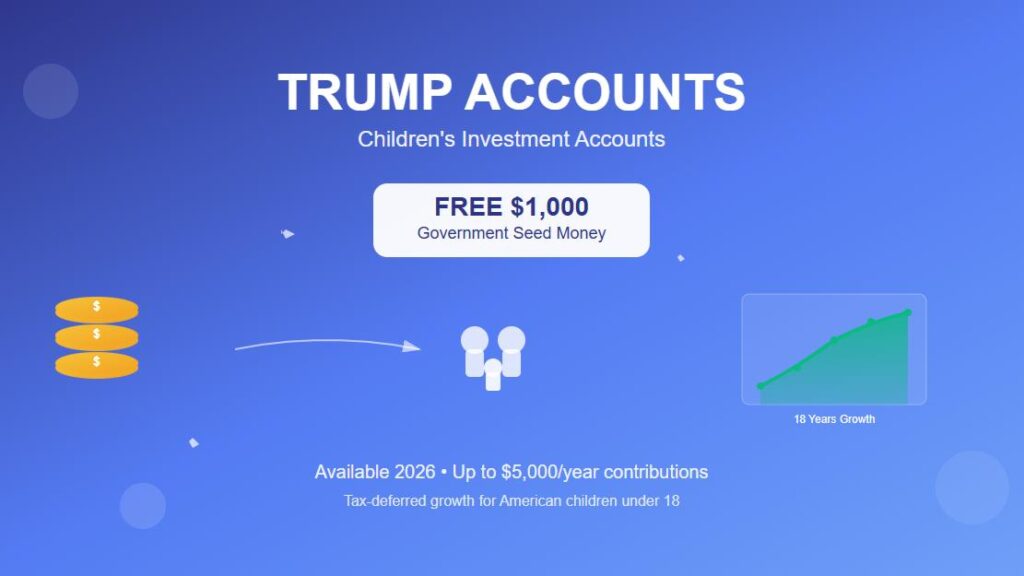
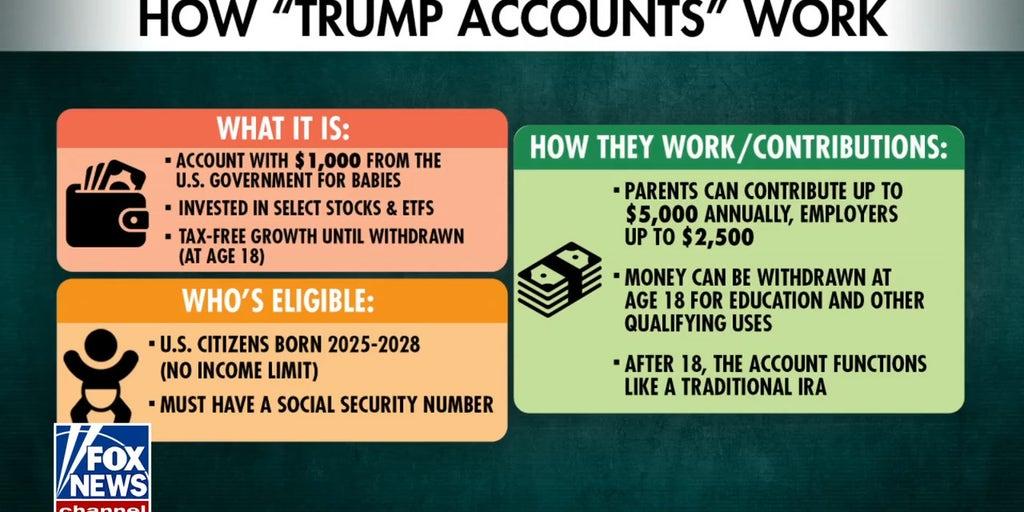
The program combines a government-funded $1,000 pilot contribution for qualifying children with the ability for families, employers and other eligible contributors to add money. During the growth period, most contributions are subject to a $5,000 annual limit, while employers can contribute as much as $2,500 per year under a qualifying employer program without that amount being included in the employee’s gross income.

That makes Trump Accounts particularly interesting for parents who have access to an employer willing to offer the benefit. But there is an important detail that could easily be misunderstood: the $2,500 employer provision does not mean a family automatically gets $1,000 from the government, $5,000 from parents and another $2,500 from an employer every year. The contribution rules have limits and exceptions that families need to understand before deciding how to use the account.
What Is a Trump Account and Who Qualifies?
A Trump Account is a new type of traditional individual retirement account established under federal law for the exclusive benefit of an eligible child. The child is the account beneficiary and owner, while an authorized individual can make the election to establish the initial account.
For an initial Trump Account, the child generally must not have reached age 18 before the end of the calendar year in which the election is made and must have a Social Security number. The separate $1,000 pilot contribution has narrower eligibility: the child must be a U.S. citizen, have a valid Social Security number and be born between January 1, 2025, and December 31, 2028.
Parents and guardians are not the only people who can be involved. IRS guidance allows parents, guardians and other authorized individuals to make the election, while contributions can come from individuals, employers, governments and certain nonprofit organizations under the applicable rules. The child remains the beneficiary of the account.
The program is already attracting substantial interest. Treasury said on July 27 that 7 million children had enrolled, with 86% coming from families earning less than $200,000. Earlier Treasury reporting in July had already said more than 6.5 million families had signed up.
How the $1,000 Federal Contribution and $2,500 Employer Rule Work
The federal government’s $1,000 pilot contribution is designed for eligible children born during the 2025–2028 period. It is a one-time contribution rather than an annual $1,000 payment. Families must make the appropriate election; the IRS specifically says the $1,000 contribution is not simply automatic for every child without an election.
The employer provision works differently. Beginning July 4, 2026, an employer can contribute up to $2,500 per year to the Trump Account of an employee or the employee’s dependent under a qualifying Trump Account contribution program. When the requirements are met, that employer contribution is excluded from the employee’s gross income.

The critical point for parents is that the $2,500 employer contribution generally counts toward the account’s $5,000 annual contribution limit during the growth period. For example, if an employer contributes $2,500 for a child’s Trump Account, there could generally be up to another $2,500 of other contributions subject to the applicable annual limit. The $1,000 pilot contribution is treated separately from that annual limit.
This could make employer benefits especially valuable. A worker whose company offers the benefit could potentially direct part of the family’s child-saving strategy through the workplace instead of relying entirely on after-tax household income. But employers are not required to provide the benefit simply because the law permits it.
For employees, that means the first practical question is not “How do I claim the $2,500?” but rather “Does my employer have a qualifying Trump Account contribution program?”
What Can the Money Be Invested In?
Trump Accounts are not ordinary savings accounts where parents can choose from unlimited investments. During the growth period, federal rules place significant restrictions on what the money can be invested in.
IRS guidance says eligible investments generally must track a broad equity index consisting primarily of U.S. companies, avoid leverage and meet a maximum annual fee-and-expense threshold of 0.1% of the investment balance. The rules are designed to keep the accounts focused on low-cost, broadly diversified U.S. equity exposure rather than speculative or highly complex investments.
The S&P 500 is one example of the type of U.S. stock-market index referenced in IRS and Treasury explanations. That does not mean parents can simply buy any individual S&P 500 stock inside the account. The investment must satisfy the specific eligibility requirements established under the Trump Account rules.
What this means for you: families should think of a Trump Account primarily as a long-term investment vehicle, not a short-term emergency fund. The investment restrictions and withdrawal rules are deliberately designed around long-term accumulation.
That long investment horizon can make compounding particularly important. A contribution made when a child is very young potentially has many years to grow before the child reaches adulthood. But investment returns are never guaranteed. A U.S. stock-market investment can rise and fall, and families should not assume that historical returns will automatically repeat.
Tax Treatment and What Happens at Age 18
Trump Accounts are structured as traditional IRAs, which means their tax treatment is different from an ordinary taxable brokerage account. During the growth period, contributions from individuals are generally not deductible, while the account can receive certain government, employer and other permitted contributions under separate rules. Investment growth receives tax-deferred treatment under the applicable IRA framework.
The employer provision has an especially notable tax feature. Up to $2,500 of qualifying employer contributions per year is excluded from the employee’s gross income, provided the contribution is made under the required employer program. IRS employer guidance also establishes reporting requirements, including a new Form W-2 Box 12 code for qualifying employer contributions.

During the growth period, withdrawals are generally prohibited, subject to limited exceptions such as certain excess contributions, qualified rollovers and death-related distributions. This means parents should not view the account as money they can freely withdraw whenever a family expense appears.
The rules change when the child reaches the relevant age. IRS proposed regulations explain that the special Trump Account growth-period rules generally end at the beginning of the calendar year in which the beneficiary turns 18. After that, the rules governing traditional IRAs generally apply.
That is one of the most important features—and potential drawbacks—for parents. The account ultimately belongs to the child. Parents cannot assume that the money will remain under parental control indefinitely once the child reaches adulthood.
Trump Accounts vs. 529 Plans and Custodial Accounts
Trump Accounts should not automatically replace a 529 college savings plan. They are designed differently.
A 529 plan is primarily an education-focused savings vehicle with rules and tax advantages centered on qualified education expenses. A Trump Account is a special type of traditional IRA intended to provide long-term investment savings for the child, with restrictions during childhood and traditional-IRA rules generally applying after the growth period. The IRS itself notes that families can have a 529 and a Trump Account at the same time.
That difference matters when choosing where to put limited savings. A family primarily focused on future college expenses may find a 529 particularly useful because its design is centered on education. A family seeking a broader long-term investment account for a child may consider a Trump Account as an additional tool.
A custodial account, such as a UTMA or UGMA account, is different again. It is a non-retirement custodial investment arrangement rather than a Trump Account. IRS officials have specifically described Trump Accounts as having special contribution, investment, distribution and reporting rules that ordinary non-retirement custodial accounts do not have.
| Feature | Trump Account | 529 Plan | Custodial Account |
|---|---|---|---|
| Main purpose | Long-term child investment | Education savings | General child assets |
| Federal $1,000 pilot | Yes, if eligible | No | No |
| Employer contribution | Up to $2,500 under rules | Depends on employer plan | Generally no equivalent |
| Investment restrictions | Significant | Plan-specific | Generally broader |
| Access during childhood | Generally restricted | Qualified withdrawals allowed | Custodial rules apply |
| At adulthood | Traditional IRA rules generally apply | Plan rules continue | Custody generally changes under state law |
| Education focus | No | Yes | No |
The comparison shows why there is no universal “best” account. A parent could potentially use multiple vehicles for different objectives rather than treating Trump Accounts, 529 plans and custodial accounts as mutually exclusive choices.
Investor Takeaway: Is a Trump Account Worth Using?
Investor takeaway: the most valuable feature may not be the $1,000 government contribution by itself. The bigger opportunity for some working families could be the combination of early investing, long-term compounding and a qualifying employer contribution.
Consider a simplified example. If an employer contributes $2,500 in a year and the family contributes another $2,500 under the applicable annual limit, the account could receive $5,000 of ordinary contributions for that year. If the child also qualifies for the separate $1,000 pilot contribution, that federal amount is outside the ordinary $5,000 annual limit.
However, families should not assume that the account is automatically better than every other savings option. The investment menu is restricted, withdrawals are limited during childhood, and the account ultimately becomes subject to traditional IRA rules after the growth period.
The Future outlook is nevertheless significant. Trump Accounts are likely to become a recurring financial-planning topic as more employers decide whether to offer contributions and as families begin comparing the accounts with 529 plans, custodial accounts and other ways of building wealth for children.
The program also has a potentially large behavioral effect. Treasury has promoted the accounts not only as an investment vehicle but also as a way to increase financial participation and financial literacy among young Americans. The official Trump Accounts platform now provides tools for families to view balances and manage their accounts.
For parents, the smartest approach is to start with the objective: education, general wealth building, early adulthood expenses or long-term retirement savings? Once that goal is clear, the differences between a Trump Account, 529 and custodial account become much easier to evaluate.
Future Outlook
Trump Accounts are still a new program, and some implementation details are continuing to develop. The IRS has issued guidance and proposed regulations covering eligibility, elections, contributions, investments and distributions, while additional regulations are expected to clarify more of the rules.
The employer contribution provision could become one of the most closely watched features. If large employers begin adding Trump Account contributions to their benefits packages, the program could become substantially more important for middle- and upper-income working families. If relatively few employers adopt the benefit, its practical impact will be more limited.
There is also an important long-term question: what happens when millions of children who received Trump Accounts reach adulthood? The accounts are designed to transition into the traditional IRA framework, potentially giving young adults an asset that can remain invested for decades. That could make the program relevant far beyond childhood savings.
At the same time, parents should remember that investment markets carry risk. A low-cost U.S. equity fund can decline significantly during a market downturn. The federal $1,000 contribution does not guarantee investment profits, and the eventual value of an account will depend on contributions, market performance, fees and time.
The Bottom Line
Trump Accounts have moved from a policy proposal into a functioning savings and investment program. Contributions can now begin, parents can submit elections electronically through the IRS, and millions of families have already signed up.
The $2,500 employer contribution rule could be particularly valuable, but it needs to be understood correctly: it is an employer contribution ceiling under a qualifying program and generally counts toward the $5,000 annual contribution limit during the growth period. It is not an automatic extra $2,500 on top of that limit.
For families with an employer offering the benefit, a qualifying contribution could provide a meaningful way to put more money to work for a child without adding the same amount to the employee’s taxable income. For families without that benefit, the Trump Account can still provide access to the federal pilot contribution when the child qualifies and can serve as another long-term investment option.
But the best strategy is not necessarily to choose one account and ignore the others. Trump Accounts, 529 plans and custodial accounts have different purposes. Understanding those differences—and considering the family’s goals, tax situation, investment horizon and need for access to the money—is more important than simply choosing the newest program.
For specific tax or investment decisions, families should consult a qualified tax professional or financial adviser because individual circumstances can change the outcome.
Subscribe to trusted news sites like USnewsSphere.com for continuous updates.