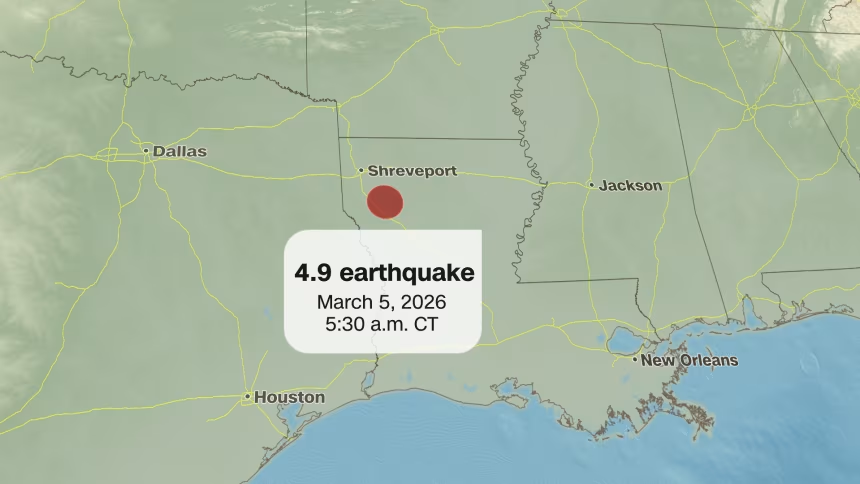
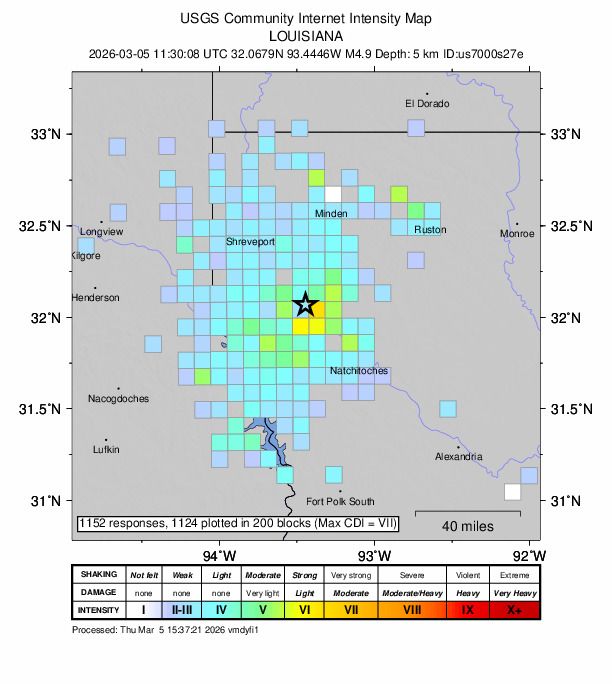
Louisiana earthquake activity surprised residents early Thursday morning when a rare magnitude 4.9 earthquake struck northwest Louisiana near Coushatta and Edgefield around 5:30 a.m. local time. Thousands of people across Shreveport, southern Arkansas, and parts of eastern Texas reported feeling their homes shake as the ground tremor spread through the region. According to data from the U.S. Geological Survey (USGS), the quake occurred at a shallow depth of about 3.1 miles, making the shaking easier for people to feel even though the magnitude was considered moderate.
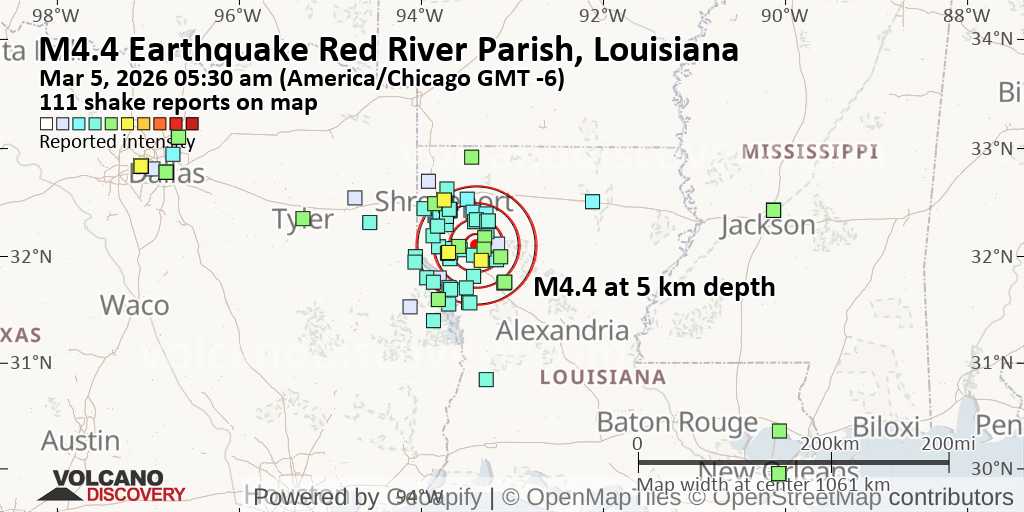
Residents described hearing rattling pipes, shaking furniture, and brief vibrations that woke them from sleep. Early reports confirmed that there were no major injuries or structural damage, but the event quickly became national news because earthquakes are uncommon in Louisiana. Experts say the tremor is one of the strongest recorded in the state in recent decades, highlighting how rare seismic activity is in this part of the United States.
This unexpected quake matters now because it has raised questions about regional fault lines, possible aftershocks, and how prepared southern states are for seismic events that rarely occur.
Early Morning Tremor Startled Residents Across Three States
The Louisiana earthquake struck shortly after sunrise when many residents were still asleep. People across the ArkLaTex region — where Arkansas, Louisiana, and Texas meet — reported feeling the shaking at roughly the same time. In Shreveport and surrounding communities, residents described beds moving, doors rattling, and light fixtures swaying during the brief tremor.
More than 1,100 people submitted “felt reports” to the USGS earthquake monitoring system within hours of the event. Security cameras and doorbell footage in towns like Coushatta captured the moment homes vibrated for several seconds. Although the shaking felt strong to residents unfamiliar with earthquakes, officials confirmed that the event was not powerful enough to cause widespread structural damage.
USGS Confirms Magnitude 4.9 With Shallow Epicenter
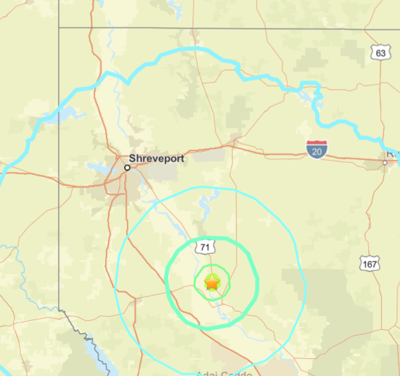
Seismologists initially measured the Louisiana earthquake at magnitude 4.4 before upgrading it to magnitude 4.9 after reviewing additional seismic data. The epicenter was located north of Edgefield in Red River Parish, approximately 36 miles southeast of Shreveport.
The earthquake occurred at a depth of about 5 kilometers (3.1 miles) below the surface. Shallow earthquakes like this often produce stronger shaking at ground level compared to deeper events. Scientists explained that while a 4.9 magnitude quake is considered moderate, it can still be widely felt when it occurs near the surface and close to populated areas.
Experts say earthquakes of this magnitude usually cause minor shaking but rarely lead to major destruction. This explains why residents felt the quake clearly while infrastructure across the region remained largely unaffected.
One of the Strongest Earthquakes in Louisiana History
What made this event particularly significant is its ranking among the strongest earthquakes ever recorded in Louisiana. Historical records show that the state’s largest earthquake occurred in 2006 near Grand Isle, measuring magnitude 5.3.
The March 2026 Louisiana earthquake is considered the second-largest seismic event recorded in the state, making it a rare geological moment for the region. Louisiana typically experiences only small tremors each year, many of which are too weak to be noticed by residents.
Because of this rarity, even moderate shaking generated significant attention from scientists and emergency officials. The event also serves as a reminder that earthquakes can occur outside traditional high-risk areas like California and Alaska.
Why Earthquakes Are Rare but Possible in Louisiana
Many Americans associate earthquakes with the West Coast, but seismic activity can happen almost anywhere in the United States. Louisiana sits far from major tectonic plate boundaries, which explains why earthquakes there are uncommon.
However, smaller underground fault lines still exist beneath parts of the southern United States. Geological stress within these faults can occasionally release energy, creating small to moderate earthquakes. Scientists note that similar rare tremors have occurred in neighboring states such as Texas, Arkansas, and Mississippi.
Another reason eastern earthquakes can be widely felt is the type of rock beneath the region. Unlike the fractured geology of the West Coast, eastern rock formations transmit seismic waves more efficiently, allowing shaking to travel farther across multiple states.
Aftershocks and Monitoring Efforts Continue
Following the Louisiana earthquake, seismologists began closely monitoring the region for potential aftershocks. Aftershocks are smaller earthquakes that sometimes occur after the main event as underground stress continues to adjust.
Meteorologists and geological experts say minor aftershocks are possible, although they are typically much weaker than the original quake. Emergency officials have encouraged residents who felt the tremor to submit reports through the USGS system, which helps scientists improve seismic mapping and monitoring.
Local authorities and state emergency offices also reviewed infrastructure and public safety conditions following the quake. Initial assessments confirmed that roads, bridges, and buildings remained safe, and no evacuation orders were issued.
Why This Louisiana Earthquake Matters Now
The March 2026 Louisiana earthquake highlights how seismic events can occur unexpectedly even in regions not typically known for earthquakes. While the event caused minimal damage, it serves as a reminder that natural hazards are not limited to traditional risk zones.
Scientists say events like this provide valuable data about underground fault systems in the southern United States. Each earthquake helps researchers better understand how stress builds beneath the Earth’s crust and how seismic waves travel through different geological formations.
For residents, the quake also sparked increased awareness about earthquake preparedness. Even though Louisiana remains a low-risk region for major earthquakes, experts recommend basic safety knowledge, such as identifying safe places indoors and preparing emergency kits.
As monitoring continues, geologists will study the event to determine whether it represents a one-time tremor or part of a broader pattern of small seismic activity in the region.
Subscribe to trusted news sites like USnewsSphere.com for continuous updates.