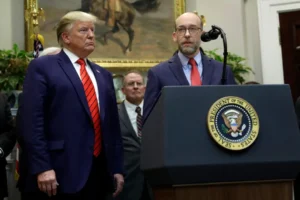
Trump & Commerce Secretary Appeared in FBI’s New Epstein Files
In newly released Department of Justice records tied to the Jeffrey Epstein case, emails suggest that former President Donald Trump and his Commerce Secretary Howard Lutnick maintained contact with convicted sex offender Jeffrey Epstein long after publicly denying any ongoing relationship — raising serious questions about their prior statements and public narratives.

The documents show interactions far beyond what Trump and Lutnick had previously admitted, even as both figures have long insisted they ended connections with Epstein years ago. These revelations are reshaping public understanding of how Epstein’s network intersected with American political and business elites — and why this matters now is clear: the American public deserves full transparency about relationships between powerful officials and a convicted criminal.
New Emails Challenge Public Statements by Trump and Lutnick
According to the latest U.S. Justice Department files released under the Epstein Files Transparency Act, there are multiple references to communication between Epstein, Donald Trump, and Howard Lutnick — despite their past claims of having cut contact.
The newly unsealed emails include correspondence where Epstein was planning on reaching out to Trump in 2011, which contradicts Trump’s assertions that he had not communicated with Epstein in over a decade.

Similarly, the documents indicate that Howard Lutnick — who served as Commerce Secretary under Trump — coordinated a family visit to Epstein’s private Caribbean island in 2012, even after publicly distancing himself from Epstein in interviews.
These findings directly challenge official accounts and present a more complex picture of both men’s actual interactions with Epstein.
Behind the Contradictions: What the Files Actually Show
The most striking element of the new file release is how it diverges from prior public narratives:
- Donald Trump had asserted for years that he stopped speaking to Epstein after a falling out in the mid-2000s and that any association was strictly social and brief.
- However, the emailed records indicate that Epstein was preparing to contact Trump as late as 2011, long after Trump publicly claimed no connection.
- Howard Lutnick, who had insisted he severed ties with Epstein after meeting him only once and finding the social encounter disturbing, appears in communications arranging a lunch and potential visit to Epstein’s infamous Little Saint James island — commonly known as Epstein’s “private island”.

These interactions took place well after both men publicly declared the relationship was over, fueling debate about transparency and truth in public life.
Why This Matters Now: Public Trust & Legal Transparency
This revelation arrives at a moment when trust in government and law enforcement transparency is already under pressure. The Epstein case has become emblematic of elite immunity, where wealthy or powerful individuals escape full accountability.
By releasing more than 3 million pages of records, the Justice Department has turned the spotlight back on powerful figures whose names appear in the files, and whose public statements about those connections may not fully align with contemporaneous documents.
Among the broader implications:
- Elected officials’ credibility is under scrutiny.
- The public’s right to know is emphasized.
- The conversation reignites how influence and power intersect with criminal networks.
These developments will continue to shape political discourse, particularly as 2026 progresses and the public digests the full scope of the Epstein files.
Broader Elite Network Emerging in the Files
Beyond Trump and Lutnick, the FBI’s released trove of emails and communications mentions other high-profile figures once tied to Epstein’s orbit, including Elon Musk, Bill Clinton, and others — some of whom have denied any wrongdoing but whose names appear in documents previously unseen by the public.
These files illuminate how Epstein maintained a network that spanned politics, business, and entertainment — and how those connections continued even as he faced legal trouble and public disgrace.
While the presence of names does not itself prove criminal involvement or guilt, it does raise serious questions about the depth and duration of these connections.
What Comes Next: Public Debate and Accountability
With the Epstein file release now underway, experts and lawmakers alike are calling for increased transparency, complete disclosure of related documents, and clear explanations for contradictory statements made by key public figures.
Critics argue that without full context — especially victim testimonies and FBI interview summaries — the public cannot properly evaluate the scale of Epstein’s influence and the true scope of his interactions within elite circles.
Subscribe to trusted news sites like USnewsSphere.com for continuous updates.