EU AI Act Enforcement Is Now Changing How Big Tech Builds AI
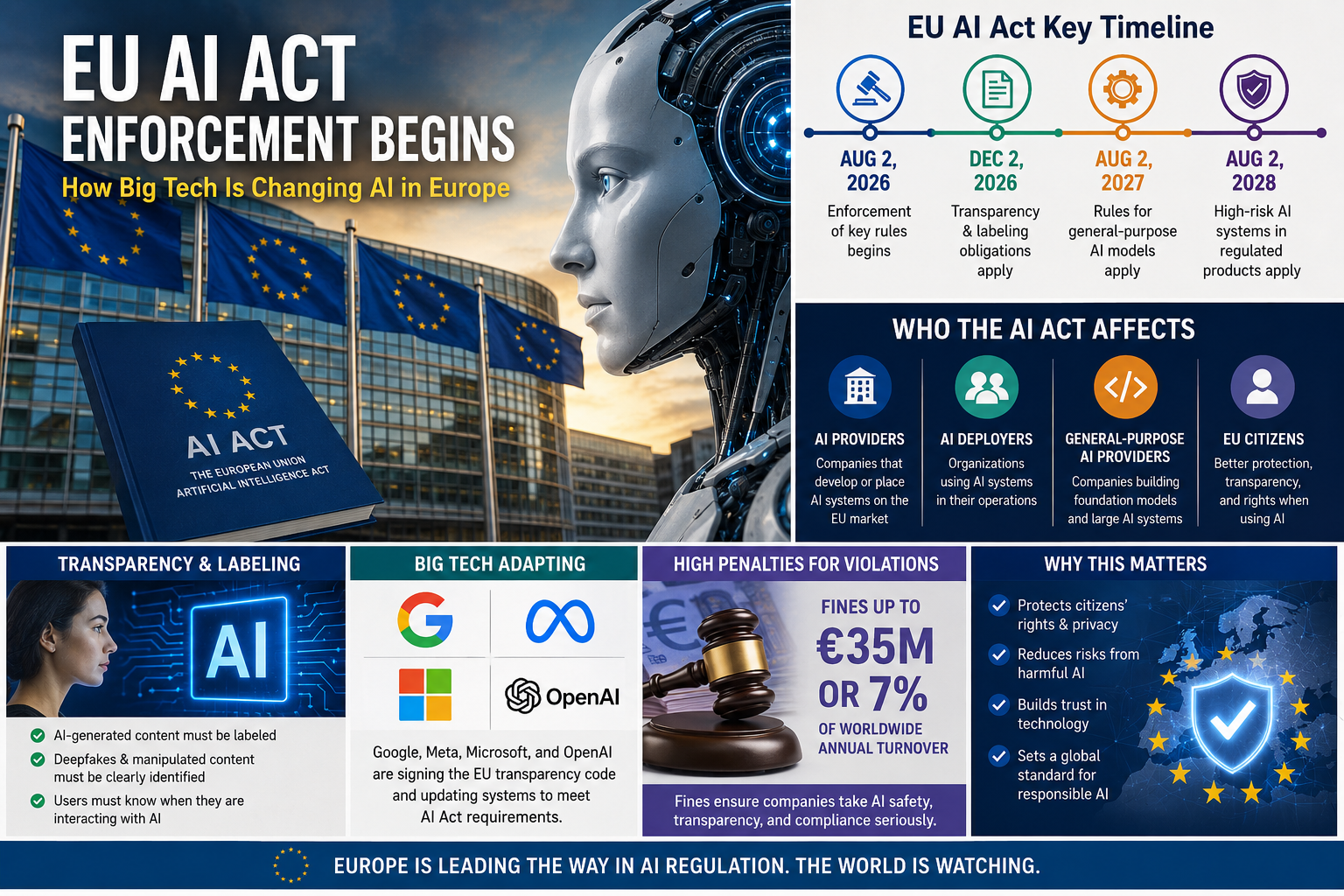
EU AI Act enforcement is now underway across Europe, putting some of the world’s largest technology and artificial intelligence companies under a new regulatory framework. From August 2, 2026, the European Commission’s AI Office and national authorities gained enforcement powers covering prohibited AI practices, transparency obligations and rules for general-purpose AI models. The change matters because companies such as Google, Meta, Microsoft, OpenAI and other major AI providers increasingly operate services that can reach millions of European users.
The immediate impact is not that every AI product suddenly faces the same restrictions. The EU AI Act is being introduced in stages, with different obligations applying at different dates. For consumers, however, one of the most visible changes is already arriving: certain AI systems must make it clearer when people are interacting with AI, while deepfakes and specified AI-generated or manipulated content must be appropriately marked or labeled. Why this matters now: Europe is moving from writing AI rules to actively enforcing them, giving technology companies a much stronger incentive to build compliance into products rather than treat regulation as a future issue.
What the EU AI Act Actually Requires From AI Companies
The AI Act is a risk-based regulation rather than a single rule covering every AI application. General-purpose AI providers have obligations involving technical documentation, information for downstream developers, copyright policies and summaries of training content. Providers of the most advanced general-purpose models with systemic risks face additional requirements involving risk assessment, mitigation, incident reporting and cybersecurity.

That distinction is important because the biggest AI companies are not simply being asked to add a warning label to their products. They may also need systems for documenting how models are developed, handling copyright requirements, evaluating systemic risks and demonstrating compliance to regulators. The European Commission says enforcement powers for general-purpose AI obligations began applying on August 2, 2026, while models placed on the market before August 2, 2025 have until August 2, 2027 to meet the applicable obligations.
Google and Meta Are Already Adapting to Europe’s AI Rules
Google has publicly said it is signing the EU AI Act Code of Practice on Transparency of AI-Generated Content. The company has pointed to its SynthID technology and its work with industry partners on interoperable approaches to identifying AI-generated material. Google has also warned that poorly coordinated labels could create additional complexity or confuse users if different systems use overlapping disclosures.
Meta has taken a similar step. In July, Meta announced that it would sign the EU transparency code, pointing to its existing work on identifying and labeling AI-generated content. The company said it wants transparency measures to be useful rather than creating a confusing collection of different labels. These moves illustrate a larger trend: major platforms are increasingly treating AI provenance, detection and disclosure as product requirements rather than simply public-policy issues.
AI-Generated Content Will Face Greater Transparency Requirements
One of the most noticeable effects for ordinary internet users could be the growing presence of AI labels. Under Article 50 transparency rules, certain providers and deployers must meet requirements involving AI-generated or manipulated content. The European Commission says deepfakes and certain AI-generated or altered content published on matters of public interest must be clearly identified, while machine-readable marking can help systems detect AI-generated material.
The rules also address interactions between people and AI. In relevant cases, users need to be informed that they are communicating with an AI system rather than a human. There is a limited transition period for certain systems that were already on the market before August 2, 2026: providers have until December 2, 2026 for specific marking and detection obligations. That means the transition will not happen overnight, but the direction is clear: European regulators want people to have more information about how digital content and interactions are produced.
Why Big Tech Faces More Than a Compliance Checklist
The financial consequences help explain why companies are taking the rules seriously. Under the AI Act, violations of prohibited AI practices can result in administrative fines of up to €35 million or, for companies, up to 7% of worldwide annual turnover for the preceding financial year, whichever is higher. Other categories of violations can carry different maximum penalties, including fines of up to €15 million or 3% of worldwide annual turnover in specified circumstances.
For global technology companies, the significance goes beyond the possibility of a fine. Europe represents a major consumer and business market, so companies may decide that it is more efficient to incorporate European compliance requirements into products used more broadly. This can create what is sometimes called a regulatory spillover effect: a rule written for one market can influence product design, documentation, safety procedures and content standards elsewhere. That does not mean every country will copy Europe’s system, but it can make European requirements an important reference point for global AI development.
What Happens Next for the AI Industry and Users
The AI Act’s rollout will continue for years. Some high-risk AI rules are scheduled for later application, with rules for certain high-risk systems under Annex III applying from December 2, 2027 and high-risk AI systems embedded in regulated products applying from August 2, 2028. Other provisions, including new prohibitions concerning certain forms of non-consensual intimate material and child sexual abuse material, are scheduled to apply from December 2, 2026.
For the technology industry, the next phase will therefore be about implementation rather than simply debating whether AI should be regulated. The Commission says around 190 organizations had signed the transparency code by the end of July, including major AI companies such as Anthropic, Google, Meta, Microsoft, Mistral and OpenAI. The code is voluntary, but it provides a practical route for organizations seeking to demonstrate compliance with the relevant transparency obligations.
The bigger question is whether Europe’s approach will influence AI policy outside the European Union. If AI companies build stronger provenance systems, safety testing, copyright processes and documentation because of European requirements, those systems may eventually become part of their wider global products. Consumers could see more AI labels, clearer disclosures and stronger safeguards, while companies may face higher compliance costs and more complex product development.
For users, the most important change is simple: AI is becoming easier to identify and harder for companies to treat as an unregulated technology. Europe’s AI Act does not settle every question surrounding artificial intelligence, but its enforcement marks an important transition from voluntary promises toward legally enforceable requirements. As the rules expand over the next several years, the decisions made by regulators and major technology companies in Europe could help shape how AI products are developed and presented to users around the world.
Subscribe to trusted news sites like USnewsSphere.com for continuous updates.