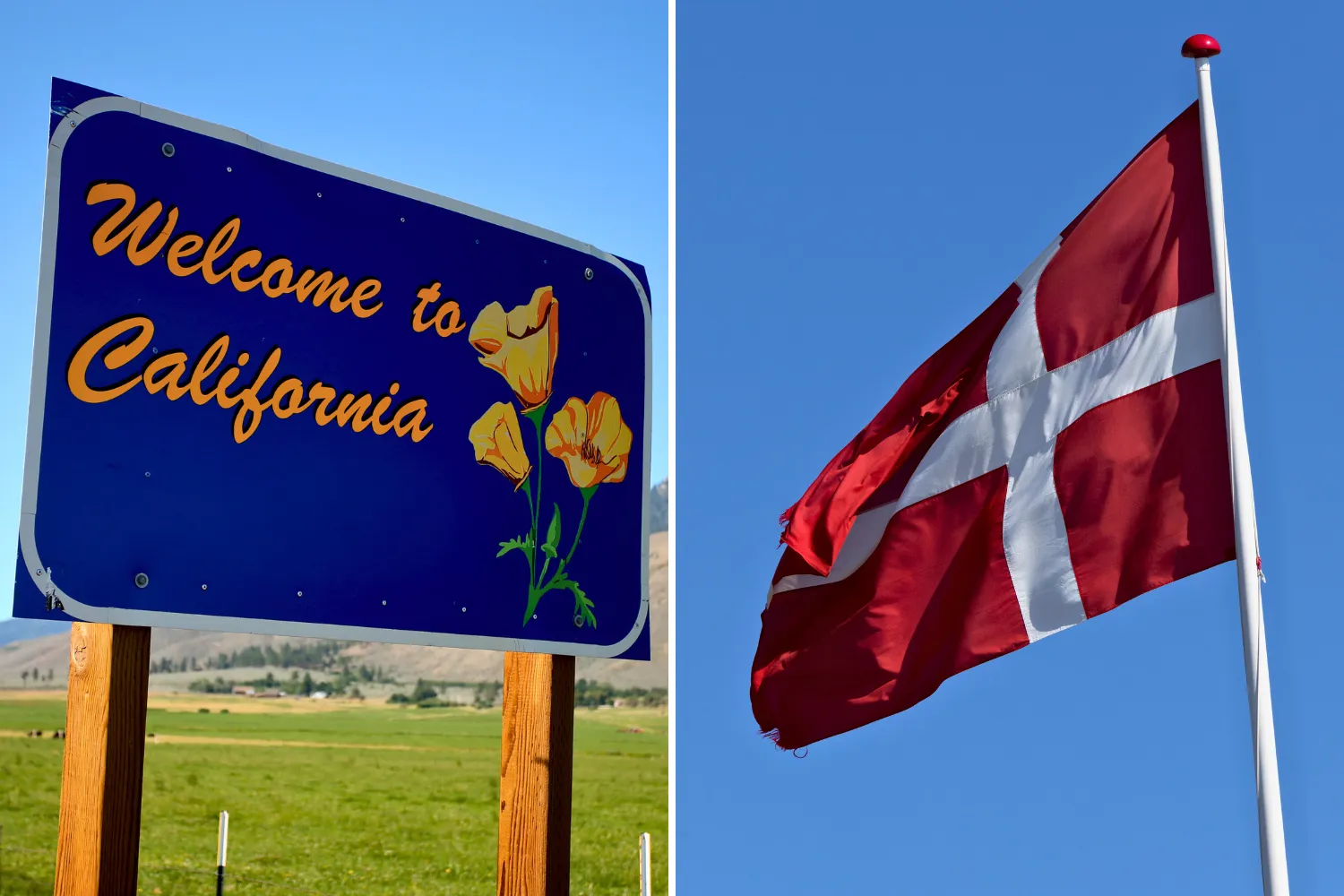
A satirical petition urging Denmark to buy California has exploded online, gathering hundreds of thousands of signatures as a humorous but sharp rebuttal to former U.S. President Donald Trump’s renewed push to acquire Greenland, drawing intense international reaction and sparking political debate.
The petition, launched under the tongue-in-cheek name “Let’s Buy California from Trump,” imagines the Danish kingdom purchasing California — rebranding it “New Denmark,” bringing Danish universal healthcare, bike lanes, and even hygge culture to Hollywood. What began as satire has quickly crossed into mainstream international news and social media threads, making it one of the most talked-about topics in political humor and public online engagement today.
The Roots: From Greenland to California Satire
At the heart of this digital phenomenon is President Trump’s continued interest in American expansionism — specifically his push to discuss acquiring Greenland, an autonomous territory under Danish sovereignty. That idea alone was controversial and widely criticized in Europe and the U.S.
In response, a group of internet creators and political satirists, led by activist Xavier Dutoit, took a page from Trump’s own playbook and flipped it on its head by proposing that Denmark should “buy” California, the United States’ most populous and economically powerful state.
This parody petition, hosted on Denmarkification.com, initially called for a $1 trillion crowdfunding campaign to fund this imaginary purchase. It explains, in mock seriousness, that Denmark should seek more “sunshine, palm trees, and roller skates” while promising bike lanes in Beverly Hills and even a Viking-helmet-wearing Mickey Mouse.
Why People Are Signing the Petition
At first glance, the petition is comedic — and that’s the point. It functions as political performance art, harnessing the power of internet virality to make a statement about public frustration with official rhetoric and geopolitical posturing.
By the latest reports, well over 244,000 people have signed the petition, with many participants signing more as a protest against political uncertainty and as a humorous way to promote international conversation.
Social media responses are mixed but overwhelmingly playful. Some Californians joked they’d love the deal, while others highlighted serious aspects of U.S. policy differences with Denmark’s social programs. Threads and posts across platforms show the hashtag and petition popping up as a meme, political commentary, and reflective social critique.
What the Petition Says About Public Opinion
Beyond humor, this petition reveals deeper currents of public opinion and international relations. In Denmark and Greenland, opposition to Trump’s Greenland strategy has been strong, with massive protests and diplomatic pushback from European leaders. Thousands of Danish citizens signed petitions against selling Greenland, and a large fraction views U.S. policies skeptically.
This satire taps into that sentiment. It uses exaggerated parody to highlight what many see as flawed or overly aggressive talk about territory acquisition — turning the tables in a creative, public way.
The Broader Reaction: Humor Meets Real Political Debate
The petition’s spread is a lesson in how digital culture can shape political conversation. Traditional news outlets have covered the petition extensively, often framing it as both funny and symbolic of broader geopolitical tensions. Coverage ranges from serious analysis of U.S.–European diplomatic friction to lighthearted pieces emphasizing the petition’s absurdity.
Europeans, especially Danish commentators, have used the petition to assert that their social policies — like healthcare, labor rights, and public infrastructure — contrast sharply with current U.S. political discourse, suggesting a cultural critique embedded within the humor.
Meanwhile, critics in the U.S. see the viral movement as a form of internet activism — not to be taken seriously in policy terms, but impactful in how it mobilizes discussion and brings attention to how political leadership interacts with global opinion. Discussions on Reddit alone show thousands of comments debating the merits, symbolism, and humorous value of the petition.
Why This Matters Now
This trending petition is more than just a satire — it reflects how global audiences react to geopolitical announcements made online. In a world where a satirical petition can gain hundreds of thousands of real signatures in days, digital activism and humor intersect with global politics in significant ways.
It captures a moment where public discourse is shaped not just by traditional media but by collective digital participation, meme culture, and social commentary that resonates across borders.
What Comes Next?
While the petition’s scenario is fictional and has no legal effect on U.S. sovereignty, its continued popularity shows how digital platforms can influence political perceptions and bring attention to underlying sentiments about international relations. It may inspire similar campaigns in other contexts and illustrates how humor becomes a tool in political expression.
Whether for laughs or for deeper reflection on geopolitical rhetoric, this viral campaign underscores the role of online engagement in shaping modern public debate.
Subscribe to trusted news sites like USnewsSphere.com for continuous updates.