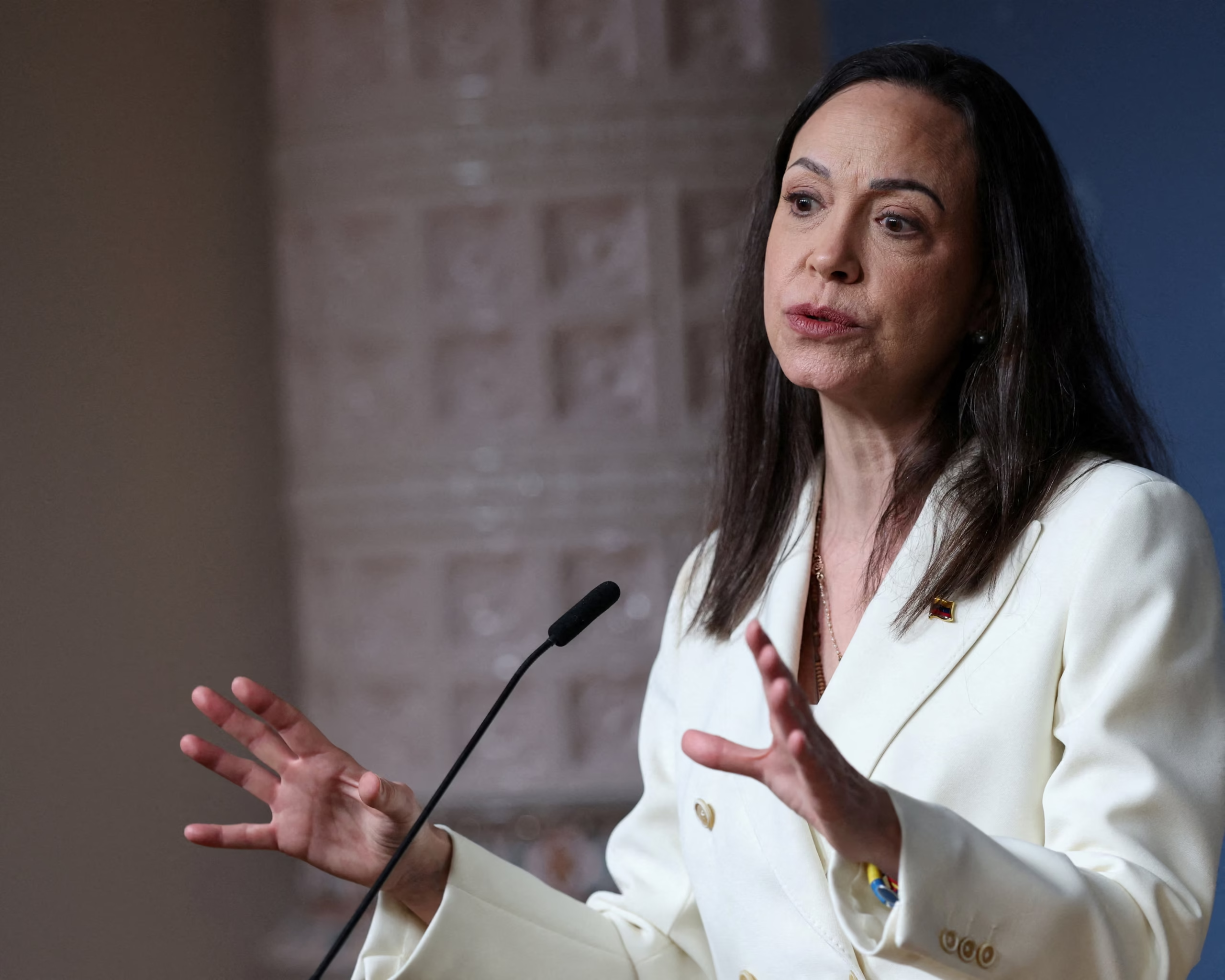
The 2025 Nobel Peace Prize was awarded to Venezuelan opposition leader María Corina Machado in October 2025 for her “tireless work promoting democratic rights” in her country and her advocacy against authoritarian rule. In a move that surprised international observers, Machado publicly expressed her wish to share or even give this Nobel Peace Prize to former U.S. President Donald Trump, praising his administration’s role in a U.S.-led military operation in Venezuela that ended with the capture of President Nicolás Maduro.
However, the Norwegian Nobel Institute and the Nobel Committee issued a firm statement rejecting her proposal — explaining that once a Nobel Prize is awarded, it is final, permanent, and non-transferable under the statutes defined by Alfred Nobel’s will and the Nobel Foundation.
Machado’s Nobel Peace Prize and Her Gesture of Gratitude
María Corina Machado rose to international prominence for her leadership in Venezuela’s opposition movement, resisting authoritarian policies and advocating for democratic transition. These efforts culminated in the Nobel Peace Prize being awarded to her on October 10, 2025.
From the moment the award was announced, Machado dedicated it not just to the Venezuelan people, but also to Donald Trump — an unusual and symbolic gesture, given Trump’s long-standing interest in winning a Nobel Peace Prize and his administration’s highly controversial actions in global affairs.
In early January 2026, Machado reiterated this dedication during a high-profile interview with U.S. media, underscoring her belief that the U.S. action in Venezuela was a significant step toward ending dictatorship and promoting democratic governance. Her remarks transformed what is traditionally a symbolic honor into a politicized diplomatic statement — one that put the Nobel Institute in an unusual position of responding to political messaging tied directly to global military and political events.
Why the Nobel Institute Rejected the Proposal
The core issue at the heart of this controversy lies in the Nobel Prize’s rules:
- Nobel Peace Prizes are not transferable, cannot be revoked, and cannot be shared with another person once awarded.
- The Nobel Foundation’s statutes, established by Alfred Nobel’s will, strictly define how and to whom the prizes are awarded, and these decisions are considered final.
In an official statement released in January 2026, the Nobel Institute emphasized that the decision to award a Nobel Prize stands for all time and cannot be undone or altered, regardless of subsequent suggestions by the laureate.
This clarification from Nobel officials was meant to preserve the integrity of the Nobel Prize and shield it from becoming subject to political bargaining or reinterpretation after the fact. The statement acknowledged that while winners can dedicate their prize money or express personal gratitude, the title itself remains non-transferable once conferred.
Experts say this response upholds the Nobel institution’s long-held tradition of remaining apolitical once its awards are announced. Nobel committees traditionally do not comment on recipients’ later actions, which is part of what gives the awards their enduring credibility.
Donald Trump’s Reaction and Political Consequences
Former President Trump, known for his outspoken pursuit of global recognition, publicly acknowledged that he would consider it a great honor to receive the Nobel Peace Prize if offered by Machado.
However, the Institute’s rejection of Machado’s offer means that Trump cannot legally or institutionally be named a co-recipient or transfer the award. Nobel officials made it clear that while the monetary component of the prize could theoretically be shared, the title and recognition cannot be reassigned.
This episode has also revealed fractures within U.S. political discourse:
- Supporters of Trump praised Machado’s gesture, seeing it as evidence of U.S. influence in global democratic movements.
- Critics argued that politicizing the Nobel Prize in this way could undermine its purpose, which is to honor efforts toward peace, not to reward military action, however controversial.
- Some political analysts suggest that Machado’s decision to publicly link her award with Trump may have complicated her own credibility back home and abroad.
The Broader Geopolitical Context
This controversy cannot be understood in isolation. It intersects with ongoing political turmoil in Venezuela, U.S. foreign policy, and debates over the role of international institutions.
The backdrop includes a dramatic U.S. military operation in Venezuela that resulted in the removal and arrest of Nicolás Maduro, the long-time president accused of authoritarianism and corruption. Maduro was transferred to the U.S. on drug trafficking and narcoterrorism charges, amplifying global debate about sovereignty, intervention, and justice.
For many Venezuelans, Machado’s Nobel recognition symbolized international support for democratic change, but her alignment with U.S. military actions drew criticism both domestically and internationally — raising questions about the balance between advocacy and foreign involvement.
The Nobel Committee’s response reaffirms that moral authority in peace efforts is not always aligned with military success or geopolitical aims, and that awards like the Nobel Peace Prize are meant to honor peaceful change and reconciliation.
What This Means for the Future of Nobel Awards
The Nobel Institute’s statement sets a clear precedent for how similar situations will be handled in the future:
- Laureates cannot unilaterally alter the terms of the award after it is presented.
- The Nobel Prize remains protected from political reallocation, even when laureates seek to make symbolic gestures.
- Future controversies may arise if recipients publicly associate the prize with ongoing political events, but the underlying rules are unlikely to change.
Scholars of international relations and peace studies will monitor the fallout from this case to understand how major awards adapt to an increasingly polarized world stage.
A Historic Nobel Controversy With Lasting Ripples
The Nobel Institute’s rejection of María Corina Machado’s offer to share her Peace Prize with Donald Trump has become a defining moment in how global awards are perceived in modern geopolitics. It reinforces the strict rules governing Nobel honors and highlights the tension between symbolic recognition and political advocacy.
This episode shines a spotlight on the ongoing struggle for democratic governance in Venezuela, the complex roles played by global leaders, and the enduring influence of institutions like the Nobel Committee in shaping international norms.
Subscribe to trusted news sites like USnewsSphere.com for continuous updates.