AOC Slams Operation to Capture Maduro as an Oil-Driven Regime Change That Threatens Global Law and Regional Stability
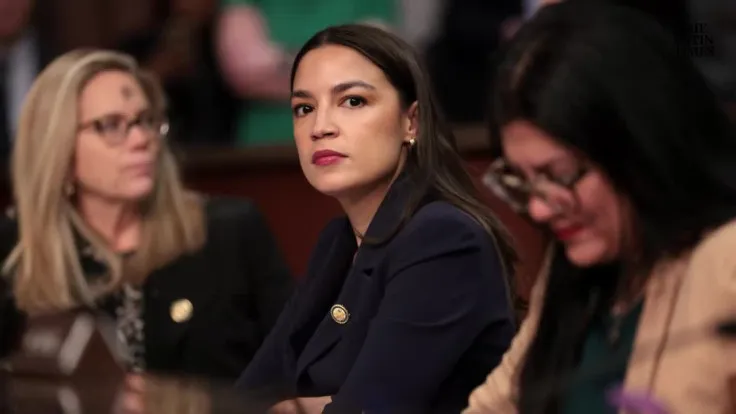
In a powerful and sharply worded response, U.S. Representative Alexandria Ocasio-Cortez publicly denounced the U.S. military operation that led to Venezuelan President Nicolás Maduro’s capture, calling it less about narcotics enforcement and much more about securing control over oil and pushing for regime change. Her statement — which quickly gained attention across social media and major news outlets — frames the dramatic capture as a political distraction and a dangerous escalation of U.S. foreign intervention.
The operation, carried out on January 3, 2026, involved elite U.S. forces executing a surprise raid in Caracas that resulted in Maduro and his wife, Cilia Flores, being taken into custody and transported to New York on federal charges related to narco-terrorism and drug trafficking. U.S. authorities have heralded the mission as a decisive blow against transnational crime, but critics — including lawmakers and world leaders — argue that it oversteps legal boundaries and shakes the foundation of international norms.
U.S. Political Backlash: Oil or Law Enforcement?
AOC’s criticisms centered on the argument that the Trump administration is using the guise of legal action to push a long-suspected goal of securing Venezuela’s vast oil reserves. Ocasio-Cortez questioned the sincerity of the U.S. government’s narcotics rationale, pointing out that if the mission were truly about drug trafficking, previous pardons for high-profile traffickers would not have been granted.
Her social media statements quickly spread across political circles, sparking fierce debate within Congress. While some Democratic lawmakers echoed her view that the operation represents a reckless act of unilateral force, others in her party expressed nuanced perspectives, combining calls for accountability with cautious acknowledgment of Maduro’s human rights record.
Several Republican figures, meanwhile, praised the operation as a lawful take-down of a corrupt leader responsible for years of narcotics flows into the U.S. Some supporters noted long-standing indictments against Maduro and argued the mission was justified under U.S. authority to pursue justice.
This stark divide in U.S. politics reflects broader strategic tensions: whether the operation signals a renewed era of direct foreign intervention or a targeted enforcement action within the scope of legal jurisdiction.
What Happened on the Ground: A Rare Military Operation
The Maduro capture did not unfold overnight. According to military and official sources, the mission — described internally as one of the most complex in recent U.S. history — relied on months of covert intelligence, careful planning, and precision execution. U.S. special operations forces carried out a surprise strike in the early hours of the morning, using helicopters and advanced coordination to breach Maduro’s compound with overwhelming force.
President Trump later described the operation in vivid terms, likening portions of the assault to a “television show” and emphasizing the speed and precision with which U.S. forces achieved their objective. He also announced plans for a temporary U.S. role in governing Venezuela until what he described as a “safe and judicious transition” could be arranged.
Despite the administration’s framing, questions about the legal basis for such an operation have multiplied. The mission was carried out without prior congressional authorization — a fact that critics say violates the U.S. Constitution’s allocation of war powers.
International Outrage Over Sovereignty and Law
Beyond U.S. borders, reaction has been swift and overwhelmingly critical. Governments across Latin America and around the world condemned the raid as a violation of Venezuela’s sovereignty and a dangerous precedent in international relations.
Leaders such as Brazil’s President Luiz Inácio Lula da Silva decried the operation as an unacceptable breach of sovereignty, while Mexico asserted that military aggression threatens regional stability and undermines international law. China and Russia, both reliable allies of Venezuela in prior years, strongly condemned the intervention, calling it a blatant use of force against a sovereign state.
The United Nations also expressed alarm, suggesting that the use of military force without independent international justification could set a “dangerous precedent” for global norms on sovereignty and the use of force. Officials have hinted at the possibility of convening an emergency meeting to address the crisis.
This widespread pushback signals a diplomatic challenge ahead for the United States, which now finds itself isolated on this decision even among some traditional allies.
Humanitarian and Regional Stability Concerns
While political leaders spar over legality and motives, ordinary citizens and analysts worry about the human cost and regional impact of the raid. Venezuela has been in a prolonged political and economic crisis for years, with millions of citizens displaced and struggling under deteriorating conditions.
Critics argue that the sudden removal of Maduro could exacerbate instability, risking a power vacuum that fuels civil unrest, humanitarian emergencies, and potential conflict among rival factions. Some voices in the Venezuelan diaspora and within Latin America have raised concerns that the operation will further polarize the nation, making constructive dialogue and peaceful reconciliation even harder to achieve.
Moreover, humanitarian organizations warn that without a clear and inclusive political transition plan, the country could worsen its economic collapse and social fragmentation.
The Oil Factor: Strategic Interests at Play
One of the central points of contention in interpreting the U.S. operation is Venezuela’s massive oil reserves, among the largest in the world. Trump’s statements about restoring and revitalizing Venezuela’s oil production have fueled speculation that securing these resources played a significant role in the strategic calculus.
Critics contend that oil may have been a driver behind the decision, arguing that global energy interests and competition with nations like China and Russia could lie beneath the surface of official narratives. Supporters of the operation dismiss these claims, focusing instead on Maduro’s track record and alleged criminal activities.
Whatever the underlying motives, the intersection of strategic interests, economic leverage, and geopolitical rivalries makes this episode far more complex than a straightforward law enforcement action.
Legal and Ethical Implications for Global Order
The extraordinary nature of capturing a sitting head of state on foreign soil raises profound legal and ethical questions. Traditionally, sovereign immunity protects leaders from being pursued by foreign militaries unless there is an explicit international legal basis such as Security Council authorization or mutual legal agreements.
Critics argue that bypassing these mechanisms undermines the established rules-based order and could embolden other nations to apply similar logic — potentially with far more destabilizing consequences. TIME
Supporters counter that Maduro’s alleged crimes justify extraordinary measures and that U.S. courts have the right to prosecute when international criminal activity directly impacts American citizens. Regardless of perspective, the event is likely to be dissected in legal and academic circles for years to come.
What Comes Next: Transition and Global Repercussions
After the initial shockwaves, the focus now shifts to what happens next in Venezuela and on the world stage. Key unresolved questions include how governance in Caracas will operate, whether U.S. forces will maintain a presence, and what mechanisms will guide the political transition.
Regionally, governments are reevaluating their alliances and strategies. Some Latin American nations are pushing for coordinated diplomatic responses through multilateral institutions, while others urge dialogue and caution.
Global powers like China and Russia may exploit the situation to bolster their influence elsewhere, arguing that U.S. interventionism undermines multilateral cooperation and respect for national sovereignty.
Conclusion
The U.S. capture of Nicolás Maduro represents a defining moment in modern international politics — a dramatic blend of military power, geopolitical interests, legal controversy, and global backlash. U.S. Representative Alexandria Ocasio-Cortez’s condemnation of the operation as being driven by oil and regime change has amplified an already heated debate over motives and legitimacy.
As the world watches closely, the unfolding consequences — diplomatic, legal, economic, and humanitarian — will continue to shape perceptions of American foreign policy and the broader international order for years to come.
Subscribe to trusted news sites like USnewsSphere.com for continuous updates.