
Regional bank consolidation is becoming one of the most closely watched themes in the U.S. financial sector as regulators appear more receptive to bank mergers and large institutions reassess how much scale they need to compete.
The renewed discussion follows a fresh wave of speculation surrounding Citigroup and Wells Fargo, two of the largest U.S. banks that have comparatively more room than some of their biggest rivals to pursue a sizable domestic bank acquisition. A recent CNBC analysis identified five regional lenders that could make strategic sense in a hypothetical transaction: Fifth Third Bancorp, Huntington Bancshares, Citizens Financial Group, KeyCorp and Regions Financial. Importantly, none of those five banks has been announced as an acquisition target by Citi or Wells Fargo. The list is an analytical screen based on factors such as deposits, branch footprints, geography and strategic fit.
That distinction matters for investors. The story is not that five banks are “for sale.” The bigger story is whether the economics and regulatory environment are creating a new period in which regional banks may increasingly have to choose between getting bigger, acquiring specialized capabilities or becoming acquisition candidates themselves.
Why regional bank consolidation is back in focus
The U.S. banking industry has spent years operating under significant regulatory and strategic constraints. The regional-bank crisis of 2023 made balance-sheet strength, liquidity and risk management even more important, while large-bank mergers faced considerable scrutiny. But the M&A environment has become more constructive. Skadden noted that U.S. bank M&A rebounded sharply in 2025 and argued that community and regional-bank consolidation could remain active in 2026 as regulatory conditions become more predictable.
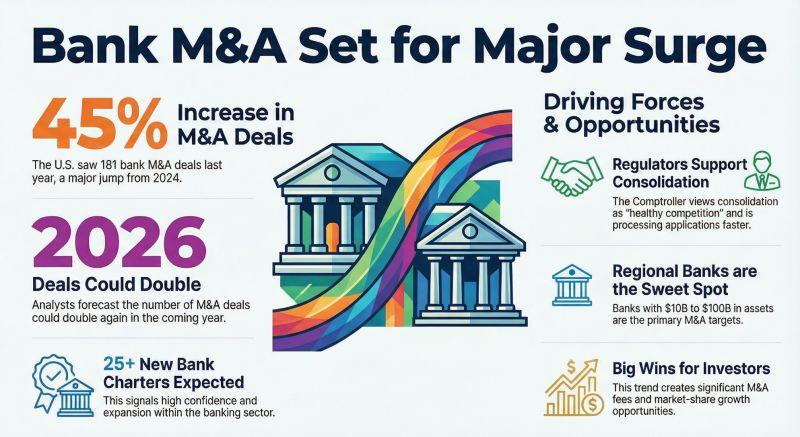
Industry analysts are also seeing a more favorable backdrop for regional-bank valuations. S&P Global reported in February that KBW CEO Tom Michaud viewed 2026 as a potentially strong environment for regional banks because of improving profitability, excess capital, changing regulation and recovering M&A activity. Fidelity similarly described the sector as entering a potentially transformative period, pointing to industry consolidation, improved rate dynamics and stronger profitability.
Still, investors should not confuse a friendlier regulatory environment with an imminent merger boom. Data cited in the latest CNBC analysis showed that North American bank M&A value actually declined by more than half during the first six months of 2026 versus the comparable period of 2025, to about $30.1 billion. Strong bank earnings and higher share prices can also make shareholders less willing to accept acquisition offers unless the strategic premium is compelling.
Five regional bank stocks investors should watch
The five names attracting attention are Fifth Third Bancorp (FITB), Huntington Bancshares (HBAN), Citizens Financial Group (CFG), KeyCorp (KEY) and Regions Financial (RF). Each offers a different combination of deposits, commercial banking, retail banking, geographic reach and potential scale advantages.
| Bank | Ticker | Why investors are watching |
|---|---|---|
| Fifth Third Bancorp | FITB | Large Midwest/Southeast footprint and recent Comerica combination |
| Huntington Bancshares | HBAN | Growing super-regional platform and Texas/Carolinas exposure |
| Citizens Financial | CFG | Strong Northeast/Mid-Atlantic franchise and commercial banking |
| KeyCorp | KEY | Middle-market banking and broad geographic footprint |
| Regions Financial | RF | Southern and Texas deposit franchise |
The CNBC analysis specifically highlighted these five institutions as logical candidates when screening for a bank large enough to matter to a potential acquirer but still small enough to fit within regulatory constraints. The analysis also mentioned Zions as a particularly interesting geographic fit for Wells Fargo and First Horizon as a possible fit for Citigroup, demonstrating that the five-bank list is not exhaustive.
For investors, the important question is therefore not simply “Which bank will be bought?” It is “Which banks have the franchise characteristics that could become more valuable as consolidation accelerates?”
Fifth Third and Huntington show how scale is already changing
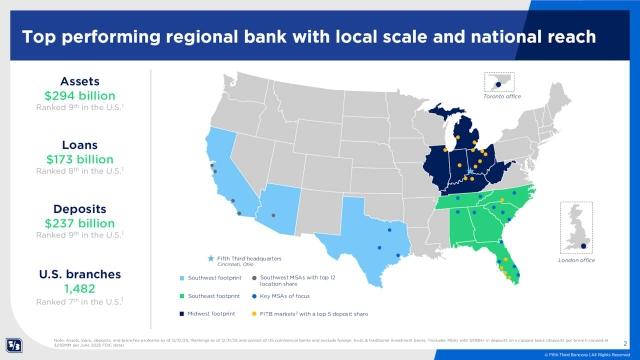
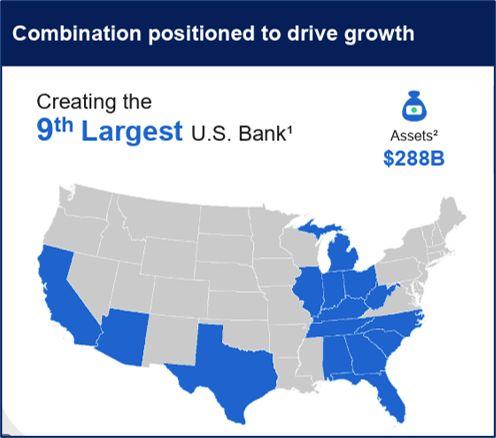
Fifth Third Bancorp may be one of the clearest examples of the consolidation trend because it has already completed a major transaction. Fifth Third acquired Comerica in an all-stock transaction valued at approximately $10.9 billion, creating a bank with roughly $288 billion of assets at announcement and making it the ninth-largest U.S. bank by that measure. The transaction closed in early 2026.
Its second-quarter results show how dramatically the combined institution has expanded. Fifth Third reported more than $300 billion in total assets during Q2 2026, while average deposits reached approximately $231.5 billion, up 42% from a year earlier. The bank also reported $2.5 billion of consumer deposits generated through the Comerica Southwest marketing campaign and said its efficiency metrics were improving as integration progressed.
Huntington presents a different version of the same scale argument. The company completed its acquisition of Cadence Bank in February 2026 after previously acquiring Veritex, creating a much larger super-regional franchise. By June, Huntington had completed the major systems conversion associated with Cadence. Its second-quarter results showed $727 million of net income, while average loans reached $189.3 billion and average deposits rose to $18.8 billion—or 9%—from the prior quarter, with the acquisitions contributing substantially to the year-over-year expansion.
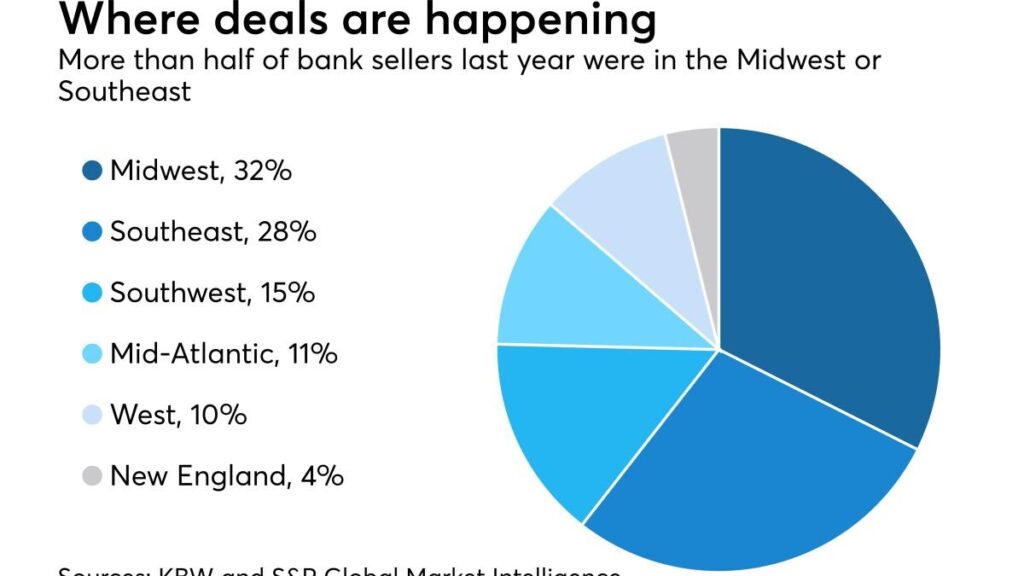
Investor takeaway: Fifth Third and Huntington demonstrate that consolidation is not merely theoretical. Regional banks are already using acquisitions to build scale, enter faster-growing markets and broaden their funding and revenue bases.
Citizens, KeyCorp and Regions bring different strategic advantages
Citizens Financial Group offers a particularly interesting franchise because of its concentration in the Northeast and Mid-Atlantic markets. Its second-quarter 2026 results showed net income of $587 million, up 35% year over year, while earnings per share increased 41% to $1.30. Net interest income rose 14% year over year, fees increased 9%, and average deposits grew by approximately $2.3 billion sequentially.
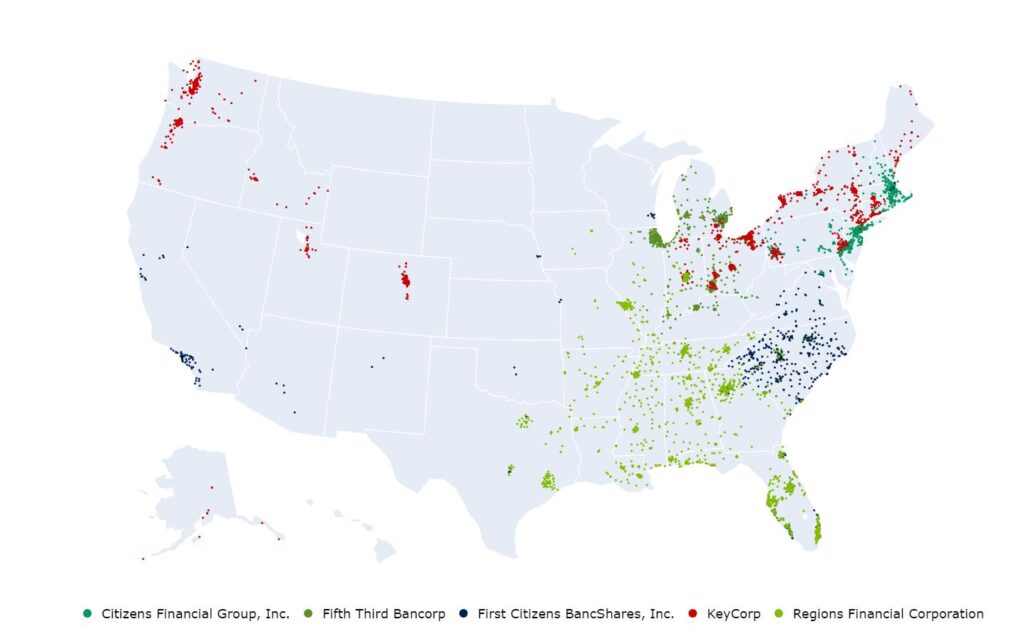
KeyCorp brings another strategic profile. The Cleveland-based bank reported Q2 2026 net income of $472 million, or $0.44 per diluted share, with revenue increasing 7% year over year and net interest income rising 9%. Commercial and industrial loans increased $2.1 billion, or 3%, sequentially, while its CET1 ratio stood at 11.2%. Those figures point to a bank with meaningful commercial relationships and capital capacity even without assuming that an acquisition is imminent.
Regions Financial stands out because of its Southern and Texas footprint. Regions reported second-quarter 2026 earnings of $549 million and diluted EPS of $0.64. The company highlighted a low-cost deposit base, with interest-bearing deposit costs of 1.69%, while its CET1 ratio was 10.7%. Its geographic exposure across the South, Midwest and Texas makes the bank strategically interesting in any hypothetical discussion about expanding a national or super-regional franchise.
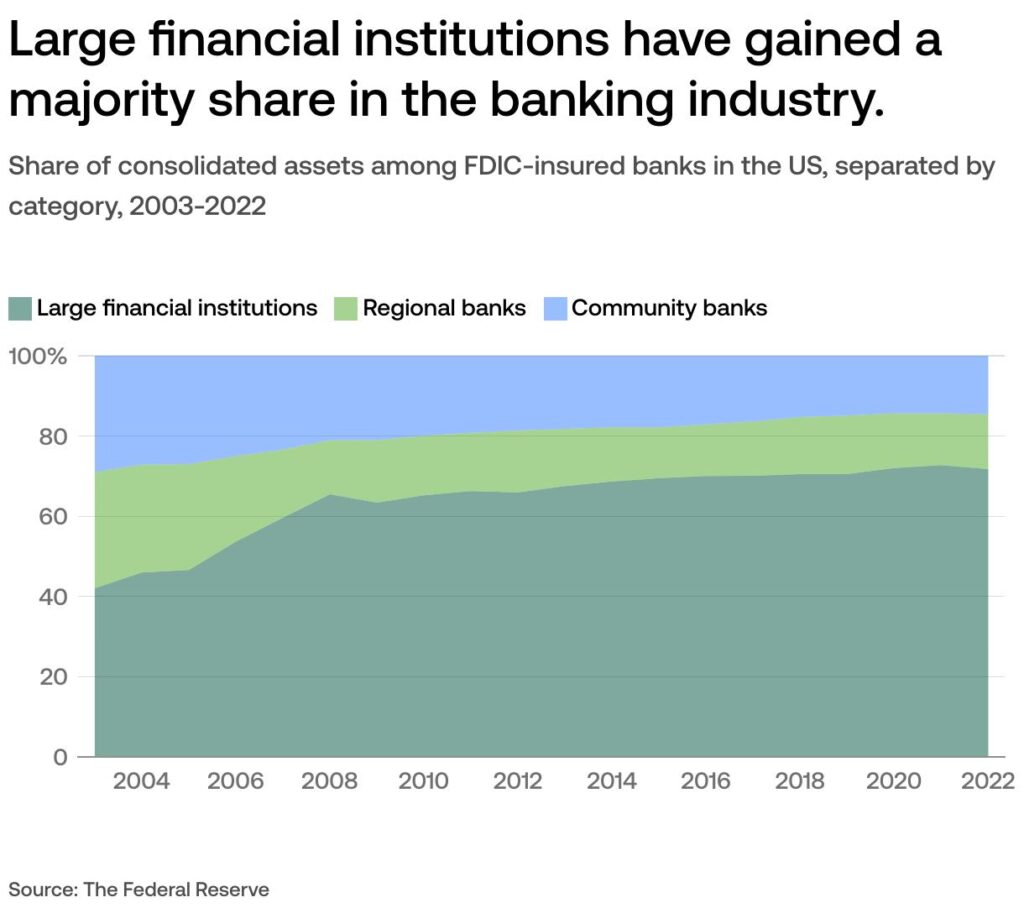
The common thread is not that these banks are sitting around waiting for an offer. It is that each owns assets that could become strategically valuable in a more consolidated banking industry: deposits, commercial relationships, branch networks, technology platforms and geographic density.
What this means for you
For bank-stock investors, a potential consolidation cycle can create two very different outcomes. A bank that becomes an acquisition target could receive a takeover premium, but the opposite can also happen: management may decide that buying competitors is less attractive than returning capital to shareholders or investing organically.

The five stocks should therefore be evaluated on their underlying businesses rather than on takeover speculation alone. Investors should monitor net interest margins, deposit growth, credit quality, tangible book value, capital ratios, efficiency ratios and management commentary on mergers and acquisitions. A bank with strong fundamentals can remain attractive even if no transaction ever occurs.
There is also a major regulatory consideration. The nationwide deposit-cap framework remains an important constraint on very large bank combinations. The latest Federal Reserve data shows JPMorgan and Bank of America at the top of the U.S. banking system, while Citigroup and Wells Fargo rank third and fourth by domestic commercial-bank assets. The same data illustrates why scale alone does not determine whether a transaction can happen.
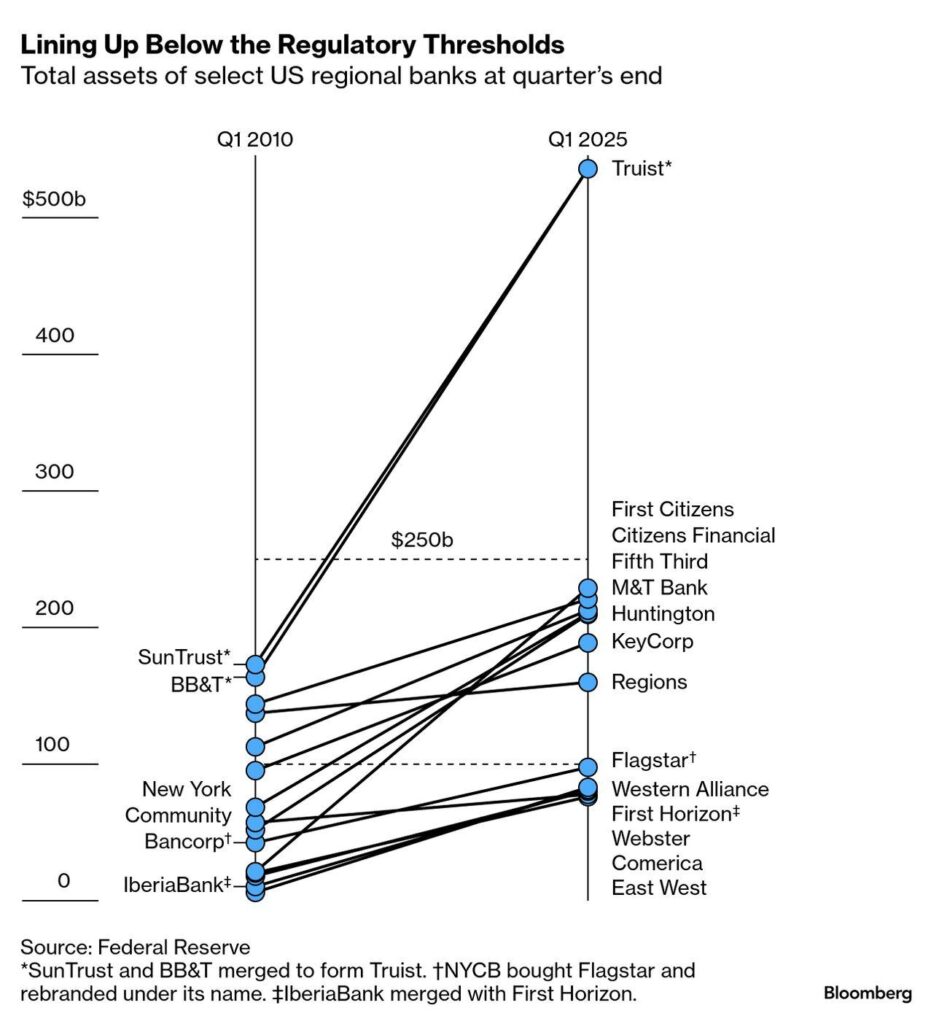
Investors should also watch what the acquiring bank gives up to complete a transaction. Paying too much for deposits or branches can destroy shareholder value even if the resulting institution is larger. Integration expenses, technology conversions, employee retention, credit losses and branch overlap can all reduce the expected benefits.
Investor takeaway and future outlook
The strongest investment case for watching regional banks in 2026 is therefore broader than the possibility of a takeover. The sector is entering a period in which scale itself may become a competitive advantage. Larger institutions can spread technology, cybersecurity, artificial-intelligence investment and regulatory costs across a bigger balance sheet. Bain has projected that regional-bank mergers could eventually produce one to three new banks with at least $1 trillion in assets by 2030, while the number of regional banks could fall substantially.
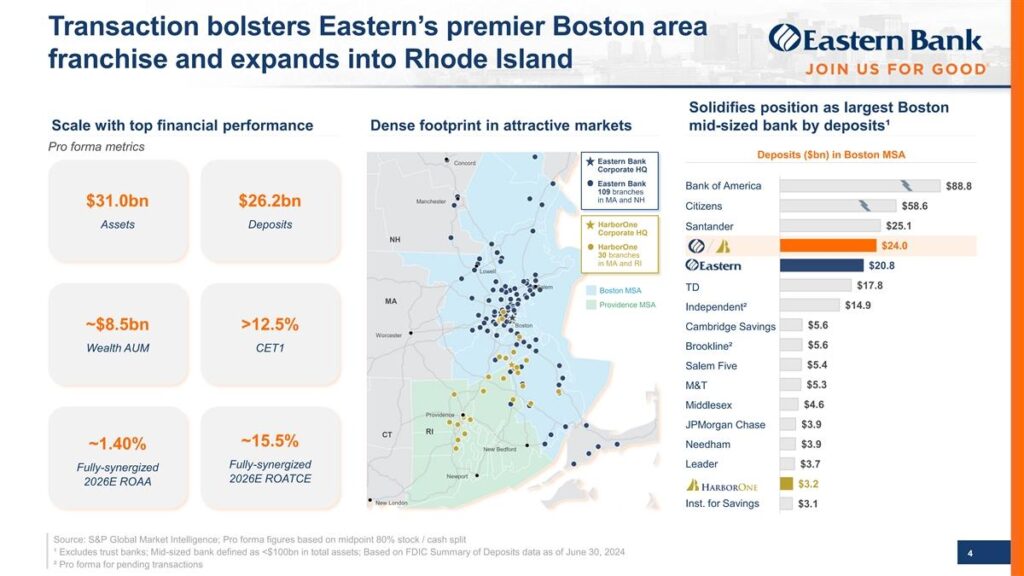
That does not mean the next deal will necessarily involve Wells Fargo, Citigroup or any of the five banks discussed here. In fact, the most important signal could come from regional banks merging with each other. PNC, U.S. Bancorp and Truist have frequently been discussed as possible building blocks for a larger super-regional institution, while smaller regional and community banks may also seek partners to improve technology investment and operating efficiency.
Future outlook: The next phase of U.S. banking consolidation is likely to be selective rather than indiscriminate. Strong banks may demand substantial premiums before agreeing to sell, while buyers will increasingly compare the potential return from acquisitions with share repurchases, organic growth and investments in technology.
For the five stocks in focus—Fifth Third, Huntington, Citizens, KeyCorp and Regions—the most useful approach is to watch the fundamentals first and M&A headlines second. Their current results show that several already have substantial scale, growing deposits or improving profitability. If consolidation accelerates, those characteristics could make them strategically important. But until a company, buyer or regulator announces a transaction, these banks should be viewed as potential candidates in a consolidation scenario, not confirmed acquisition targets.
For investors, that distinction is crucial. Merger speculation can move bank stocks quickly, but sustainable returns ultimately depend on earnings power, credit quality, capital discipline and the price paid for growth. The regional-bank sector may be entering a new consolidation era, but the winners will not necessarily be the banks that simply become bigger. They will be the institutions that turn greater scale into stronger returns for shareholders.
Subscribe to trusted news sites like USnewsSphere.com for continuous updates.