Bank accounts, savings rates and financial security are becoming increasingly important for Americans as interest rates shift, banks change account terms and consumers face a growing number of financial scams. The biggest mistake may not be choosing the wrong bank—it may be assuming that a bank account automatically provides the best combination of safety, interest income, accessibility and protection.
As of August 2026, the Federal Reserve is maintaining a federal funds target range of 3.50% to 3.75%, following its July policy decision. That matters because changes in the federal funds rate can eventually influence what banks are willing to pay savers. At the same time, current savings-account comparisons show a striking difference between ordinary deposit rates and the best high-yield savings offers. Recent market coverage put the national average savings rate at about 0.38%, while some competitive high-yield accounts were offering as much as 4.50% APY.
That difference makes the modern banking decision more complicated than simply asking, “Which bank should I use?” Americans need to consider APY, FDIC insurance, monthly fees, overdraft rules, withdrawal restrictions, minimum balances, account accessibility, fraud protections and whether the advertised interest rate can change.
Why Savings Rates Matter More Than Many Americans Realize
A savings account paying 0.38% and another paying 4.50% can look similar on a bank statement because both are technically savings accounts. The financial outcome, however, can be very different. On $10,000, a 0.38% annual rate produces roughly $38 in interest before taxes, while a 4.50% APY would produce roughly $450 if the rate remained unchanged for a full year and the balance stayed constant. Actual results vary because APYs, compounding and account conditions differ.
The FDIC’s published national-rate data illustrates why consumers should not assume that the rate offered by their existing bank represents the market. Its April 2026 data showed a 0.38% national savings rate, while money-market deposits averaged 0.57% and one-year CDs averaged 1.53%. More recent consumer-market comparisons have continued to show substantially higher yields at selected high-yield savings accounts.
This does not mean everyone should immediately move every dollar to the account advertising the highest APY. A promotional rate may have balance limits, direct-deposit requirements, minimum balances, withdrawal restrictions or other conditions. Some high-yield accounts are also entirely online, which can be inconvenient for consumers who regularly need branch services or cash deposits.
The smarter approach is to compare the entire account rather than the headline number. A slightly lower rate from a bank with excellent access, no maintenance fee and useful automated savings tools could be more valuable to some households than an account offering a higher advertised rate with complicated conditions.
The $250,000 FDIC Rule Is Crucial to Understand
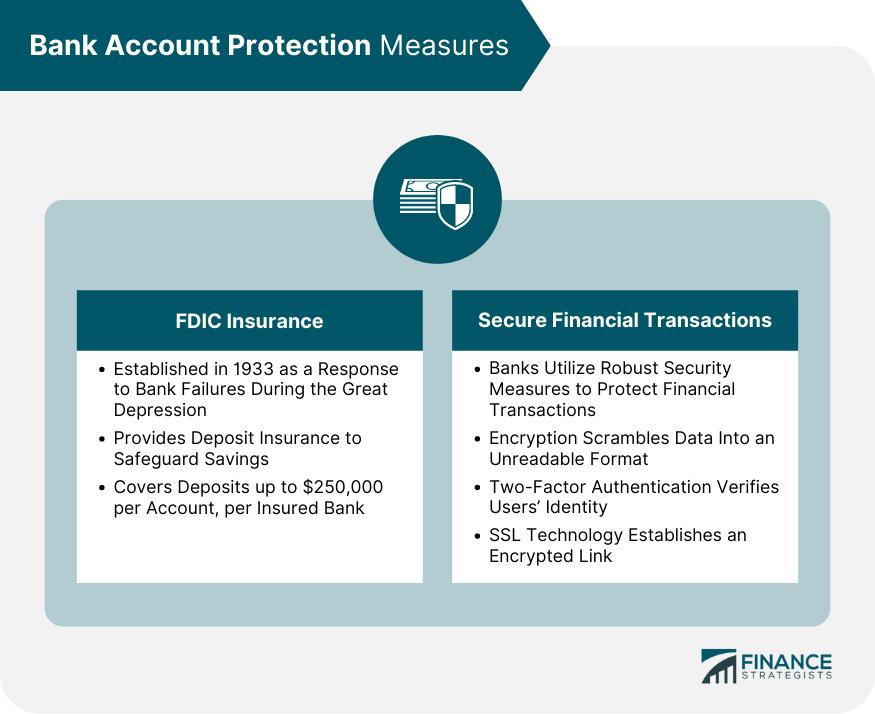
One of the most important banking mistakes is misunderstanding FDIC insurance. The standard FDIC deposit-insurance limit is $250,000 per depositor, per FDIC-insured bank, for each ownership category. This means someone with $300,000 in several single-owner deposit accounts at the same bank cannot simply assume the entire amount is insured because the money is spread between checking, savings and CDs.
The FDIC generally combines deposits held in the same ownership category at the same insured institution when determining coverage. However, different ownership categories can receive separate coverage when the applicable requirements are satisfied. Joint accounts, certain retirement accounts and qualifying trust accounts are examples of categories that can have separate coverage.
This distinction becomes especially important for people holding large cash balances, business owners, retirees, families receiving proceeds from a home sale and anyone temporarily holding substantial cash before making a major purchase. Simply opening several accounts at different branches of the same bank does not create separate FDIC coverage; deposits at separately chartered insured banks are treated differently.
Another common misunderstanding is assuming everything purchased through a bank is FDIC-insured. FDIC insurance covers qualifying deposit products such as checking accounts, savings accounts, money-market deposit accounts and CDs. It does not insure stocks, bonds, mutual funds, annuities, life-insurance policies or crypto assets merely because they are held through a financial institution.
What This Means for You: The Banking Mistakes That Can Cost Real Money
The first mistake is leaving substantial savings in a low-paying account for years without checking the rate. Banks can have dramatically different pricing strategies, and consumers who never compare accounts can quietly lose hundreds or thousands of dollars in potential interest over time.

The second mistake is focusing only on APY and ignoring fees. The CFPB notes that banks and credit unions may charge monthly maintenance fees, although many waive them when customers satisfy conditions such as maintaining a required balance or receiving direct deposits. Institutions must disclose applicable fees, and changes to certain fees require notice. Before switching accounts, consumers should calculate the actual annual benefit after fees rather than comparing APYs alone.
The third mistake is misunderstanding overdraft protection. The CFPB explains that consumers generally must affirmatively opt in before a bank can charge an overdraft fee for paying ATM and one-time debit-card transactions. However, checks and recurring electronic payments can operate under different rules. A consumer who assumes “overdraft protection” is always free or automatically beneficial could end up paying unnecessary charges.
The fourth mistake is treating a savings account like a checking account without checking transaction rules. Financial institutions may impose restrictions or fees connected to excessive withdrawals, minimum balances or other account conditions. Consumers should therefore match the account to its purpose: everyday spending money generally belongs in an accessible transaction account, while emergency savings and money earmarked for future needs can be placed in an account designed to earn more interest.
The fifth mistake is ignoring account-security alerts. Americans should enable transaction notifications, use strong unique passwords, protect authentication codes and regularly review statements. An unexpected transfer, debit-card purchase or account change should not be dismissed as a minor inconvenience. Fast detection can make a major difference when dealing with unauthorized activity.
Investor Takeaway: Safety, Yield and Liquidity Must Work Together
For investors and savers, the key lesson is that cash management is itself part of financial planning. Money needed for near-term expenses generally has a different job from money intended for long-term growth. Emergency savings should prioritize accessibility and stability, while money that will not be needed for a defined period may be suitable for comparing CDs, money-market deposits or other appropriate cash-management options.
The current interest-rate environment reinforces the importance of reviewing cash periodically. The Federal Reserve’s July 2026 decision kept the federal funds target at 3.50% to 3.75%. Because deposit rates can respond to changes in monetary policy and competition among banks, a rate that looks attractive today may not remain at the top of the market indefinitely.
There is also a broader financial-security lesson. The FDIC reported two U.S. bank failures during 2026 through its latest 2026 summary, one in January and one in May. That number does not mean ordinary depositors should panic—FDIC insurance exists specifically to protect qualifying deposits when an insured bank fails—but it does reinforce why understanding insurance coverage is better than relying on assumptions.
For people with balances above the standard insurance threshold, the solution should be deliberate rather than improvised. Consumers can examine ownership categories and, where appropriate, consider distributing deposits among separately chartered FDIC-insured institutions. The FDIC provides an Electronic Deposit Insurance Estimator to help consumers evaluate their coverage.
The goal is not to chase every extra fraction of a percentage point. It is to build a cash strategy that balances security, yield, liquidity and simplicity.
Future Outlook: Rates, Digital Banking and Fraud Will Keep Changing
The banking landscape is likely to remain dynamic. Savings rates will continue to respond to Federal Reserve policy, market competition and banks’ demand for deposits. Some institutions may lower APYs when market conditions change, while others may continue using attractive rates to bring in new customers. That makes periodic account reviews more valuable than choosing an account once and forgetting about it.
Digital banking will also continue to reshape how Americans manage savings. Online banks can sometimes offer competitive yields because they operate with different cost structures, but consumers should evaluate customer service, ATM access, transfer limits, deposit availability and security features alongside the APY. A high rate is useful only if the account works reliably for the customer’s actual needs.
Fraud is another reason to pay attention. Banking security increasingly depends on consumers recognizing suspicious messages, fake bank calls, impersonation attempts and unauthorized transactions. Consumers should avoid clicking financial links from unexpected messages and should contact their bank through an independently verified telephone number or official website when something looks suspicious.
The most resilient banking strategy is therefore not based on predicting the next rate move or finding one “perfect” account. It is based on periodically checking whether your bank is still competitive, confirming that deposits are properly insured, understanding fees and withdrawal rules, maintaining enough liquid emergency savings and protecting account credentials.
For American households, the biggest financial-security improvement may come from a simple annual banking review. Check the APY. Check the fees. Check the FDIC status. Check the insurance exposure. Check the overdraft settings. Check the beneficiaries and account ownership. Then ask whether each account still has a clear purpose.
That process can turn an ordinary bank account into a more effective part of a household’s broader financial plan.
Bottom line: Americans do not need to panic about changing banking rules or interest rates, but they should stop treating bank accounts as “set it and forget it” products. The difference between a low-yield account and a competitive one can be meaningful, while misunderstanding FDIC coverage or overdraft rules can create avoidable risk. The strongest financial strategy is to keep cash where it is safe, accessible and appropriately compensated—while reviewing the arrangement whenever rates, fees or personal circumstances change.
This article is for general informational purposes and is not individualized financial, tax or investment advice. Account rates and terms can change. Verify current terms directly with the financial institution and confirm FDIC or applicable NCUA coverage before moving money.
Subscribe to trusted news sites like USnewsSphere.com for continuous updates.