The European Union is on the brink of halting a major trade deal with the United States after President Donald Trump threatened new tariffs on eight European countries unless they agree to sell Greenland to the United States, a strategic Arctic island. This unexpected escalation has sparked political outrage, raised economic alarms in Brussels, and thrown transatlantic relations into a dangerous downward spiral, with potential long-term implications for European markets and global trade.
Why this matters now: The standoff arrives at a moment when Europe and the U.S. are already grappling with security concerns in the Arctic, mounting geopolitical competition with China and Russia, and pressures on global supply chains. The tariff threat, tied to Greenland politics rather than traditional trade negotiations, has upended a recently negotiated EU-US trade framework and could derail future cooperation.
A Trade Deal Once Within Reach, Now in Jeopardy
Over the past year, the United States and the European Union have been working toward a new trade agreement intended to reduce tariffs and stabilize economic ties after years of tension. Under this framework, the U.S. agreed not to impose punitive tariffs above certain set levels on European goods, while Europe opened markets more broadly to U.S. industrial and agricultural products.
That deal — hailed as a pragmatic compromise — now stands at risk. European Parliament leaders from key political groups have indicated that they cannot ratify the trade pact if the U.S. continues to threaten tariff increases tied to the Greenland dispute. Manfred Weber, head of the European People’s Party, declared that approval “is not possible at this stage,” effectively blocking the deal’s progression.
This creates uncertainty in global markets and for businesses that had hoped for tariff stability in 2026 and beyond. Analysts warn that breaking off the trade deal could open the door to wider tariff escalation that disrupts supply chains across both sides of the Atlantic.
Greenland Dispute Escalates Into Economic Pressure
President Trump’s tariff threat is tied not to traditional commercial disputes but to a geopolitical skirmish over Greenland — an autonomous territory of Denmark. Trump demanded Greenland be sold to the U.S., describing the island’s strategic position as vital for national security. When Denmark and its European allies rejected the idea outright, Trump responded by announcing 10% tariffs on European imports starting February 1, rising to 25% by June if the dispute remains unresolved.
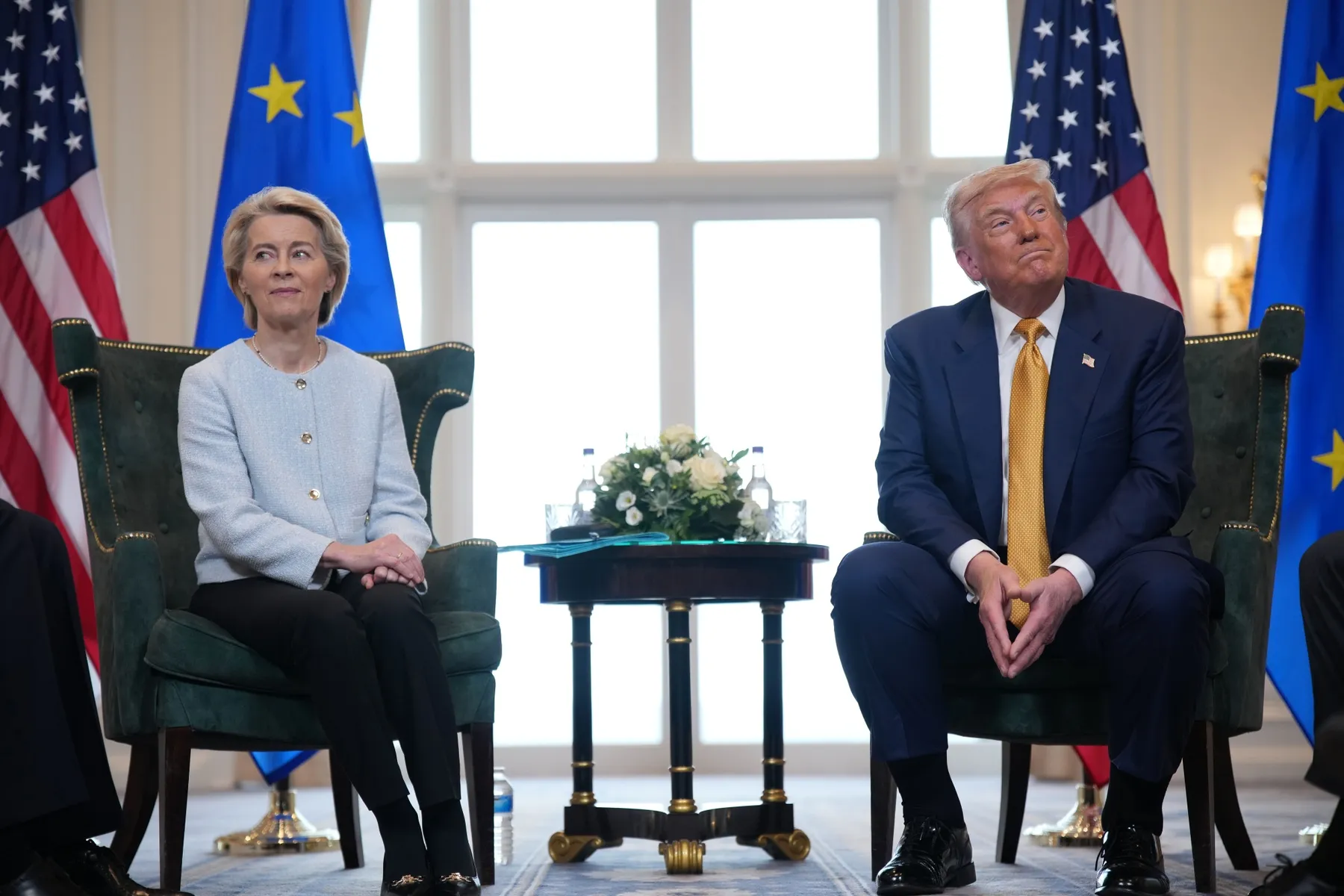
This unusual linkage of tariffs to territorial negotiation has drawn sharp criticism from European leaders. Ursula von der Leyen, president of the European Commission, warned that such actions could “undermine transatlantic relations” and destabilize decades of cooperation.
Political Backlash Across Europe
European leaders reacted strongly. French President Emmanuel Macron said “no amount of intimidation” would shift their stance, emphasizing that sovereignty and collective decision-making are non-negotiable. UK Prime Minister Keir Starmer labeled the tariffs “completely wrong,” highlighting how such measures harm both economies.
EU foreign policy chiefs also argued that dragging NATO allies into a tariff dispute benefits global rivals like China and Russia by weakening Western unity. EU ambassadors are scheduled to meet urgently to coordinate a response, signaling that Europe may adopt countermeasures if Washington continues escalation.
Economic Risks and Market Uncertainty
Economists and trade experts warn that this standoff creates significant economic risk for both sides. If the EU refuses to ratify the trade agreement, tariffs could widen across key sectors like automobiles, agricultural goods, and industrial components — potentially increasing prices for consumers and slowing growth. Businesses that planned investments under the expectation of tariff certainty now face renewed volatility.
Global markets dislike uncertainty, and analysts predict that stock indexes in both the U.S. and Europe could experience volatility if the impasse deepens. Emerging markets that depend on integrated supply chains between the EU and the U.S. may also feel secondary repercussions.
What Happens Next? The Road Ahead
At this stage, a few clear possibilities have emerged:
- The EU could formally suspend or block the trade deal in response to the tariff threat.
- European governments might impose retaliatory tariffs or countermeasures if Washington proceeds.
- The U.S. could attempt to decouple the tariff dispute from trade negotiations, as some officials suggested, to salvage economic cooperation while maintaining political pressure.
Businesses will watch closely, as any prolonged dispute could reshape trade patterns for years.
Why This Matters to Global Citizens
This conflict highlights that international trade agreements are not just about economics but also about political strategy, alliances, and national interests. When trade policy intersects with geopolitics — such as the Greenland issue — it can have far-reaching consequences: affecting jobs, consumer prices, diplomatic relationships, and even the stability of alliances like NATO.
For citizens in both the European Union and the United States, the outcome of this standoff could influence everything from the price of imported goods to the trajectory of future diplomatic cooperation.
Subscribe to trusted news sites like USnewsSphere.com for continuous updates.