The unprecedented politicization of the United States military under President Donald Trump and Defense Secretary Pete Hegseth has drawn stark warnings from senior military figures that the move bears haunting parallels to Joseph Stalin’s notorious purges — a comparison that underscores serious threats to both democratic institutions and global stability.
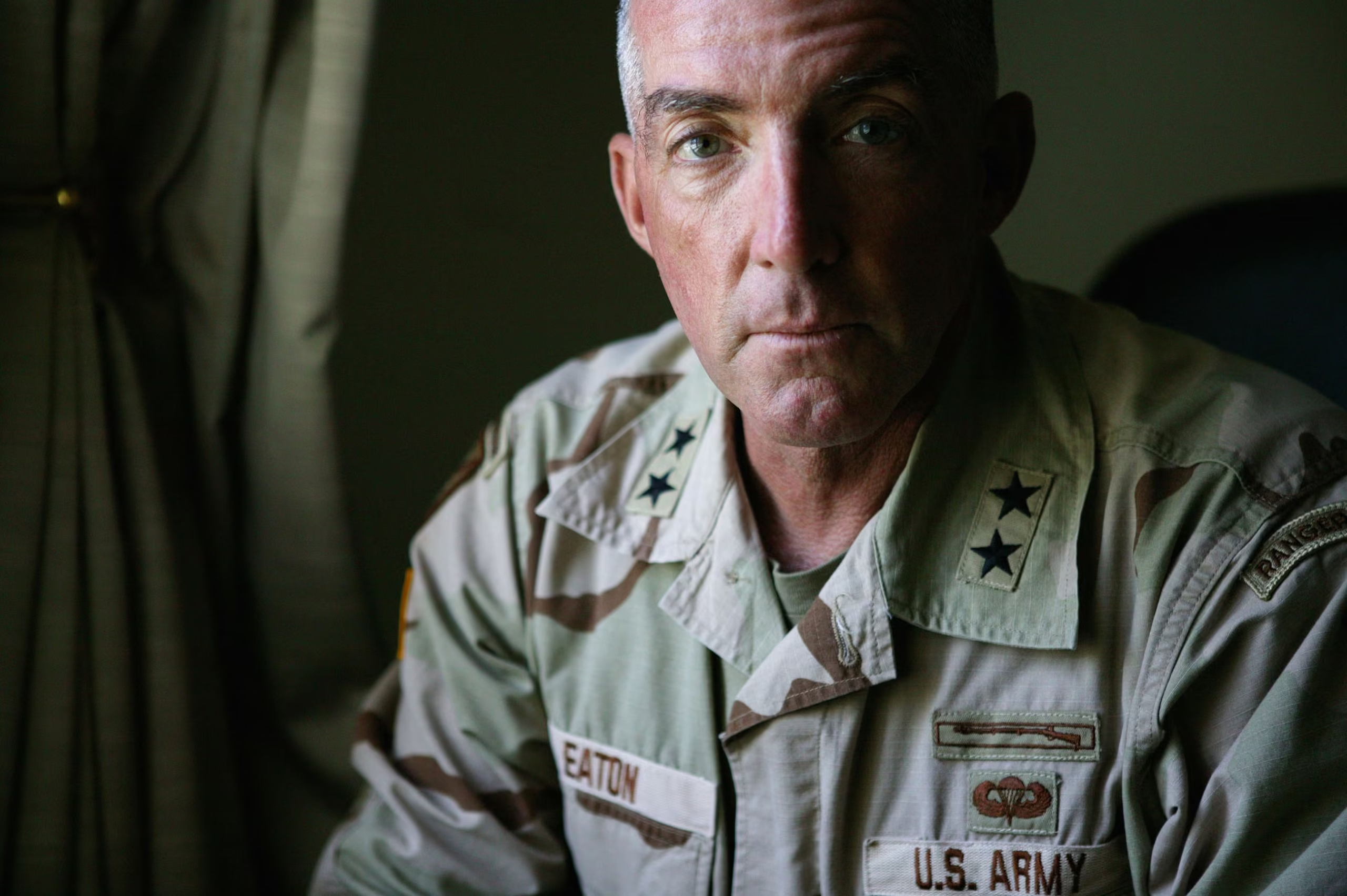
Top retired Major General Paul Eaton, who spent nearly four decades serving in the U.S. Army and helped rebuild Iraq’s army post-invasion, argues that the recent reshaping of the military’s leadership and ethos could leave damage that takes generations to mend. His critique builds on growing global concern over blurred lines between civilian control of the military and political loyalty — a tension at the heart of democratic governance.
Across the U.S. political spectrum, observers are raising alarms that these developments are not only historic but potentially catastrophic for the nonpartisan tradition that has long defined American armed forces.
Why Military Independence Matters in a Democracy
One of the foundational pillars of democratic governance is that the military remains subordinate to the Constitution and civilian oversight, without the need to serve partisan political interests. Civil-military relations scholars have long warned that when political leaders seek loyalty over competence, institutions weaken. In Soviet Russia during the 1930s and 1940s, Stalin infamously removed tens of thousands of experienced officers from command, replacing them with loyalists — a tactic that significantly degraded the Red Army’s effectiveness.
According to Eaton, the current wave of dismissals and replacements among senior U.S. military officers bears a resemblance to this kind of political reshaping. Within weeks of Trump’s inauguration in his second term, a series of firings began:
- The military inspector general — a critical independent watchdog — was removed.
- Senior judge advocates who provided legal oversight were dismissed.
- Top service chiefs, including the chair of the Joint Chiefs of Staff, were replaced with officers seen as politically aligned.
Critics argue that this combination undermines the U.S. military’s apolitical mandate and leaves morale in question at a time when confidence in democratic institutions is already strained. When officers start wondering whether promotions hinge more on political alignment than professional merit, long-term readiness and cohesion can suffer.
The Hegseth Factor: Loyalty or Professionalism?
Central to the debate is Defense Secretary Pete Hegseth, a former television host and Trump loyalist whose ascent to the Pentagon’s top civilian defense post has been both swift and controversial. Unlike his predecessors, who typically rose through national security or military-adjacent policy ranks, Hegseth brought minimal defense bureaucracy experience — but strong political ties to Trump.
General Eaton and other experts contend that Hegseth routinely emphasizes political loyalty over constitutional duty, creating a culture where commanders feel pressure to align with presidential directives even when those directives are contested or legally ambiguous. “He swears fealty to Trump, whereas the military swears an oath to the Constitution,” Eaton was quoted as saying.
This shift in the Pentagon’s internal environment, Eaton argues, risks turning the United States’ once-apolitical armed forces into an extension of a political agenda — a trend that has alarmed legal scholars and civil-military experts alike.
Controversial Military Actions Abroad and At Home
Eaton connects this internal political realignment with broader, more aggressive U.S. military behavior overseas and domestically.
Overseas Force Application
Under the current administration, the U.S. military has engaged in a series of lethal strikes against suspected narco-trafficking vessels far from American shores. One widely criticized incident involved a follow-up strike that killed survivors clinging to the wreckage of a boat — actions to which critics have applied the label “war crime” or “illegal use of force.”
Legal and military doctrine is clear: orders that mandate “kill everyone” without distinction violate established laws of war, and commanders are obliged to refuse manifestly illegal orders.
Domestic Force Use
Domestically, the federal government has deployed National Guard and active duty forces into major U.S. cities without state consent — a step that, according to civil-military law experts, raises significant constitutional and legal questions about the Posse Comitatus Act and the traditional separation between civil law enforcement and military force.
The expansion of military roles within domestic environments has triggered court challenges in states including California, Illinois, and others, where federal authority continues to be contested. These deployments have not only strained federal–state relations but have also left many communities concerned about escalation and civilian harm.
Wider Backlash and Political Battles
The tensions within and around the military have exceeded organizational boundaries and spilled into broader political conflict. Recently, Defense Secretary Hegseth moved to censure Arizona Senator Mark Kelly — a retired Navy captain — for a video Kelly co-produced urging service members to refuse unlawful orders.
Hegseth’s action could lead to Kelly’s retired rank being downgraded and his pension reduced, a decision that sets a remarkable precedent: a sitting U.S. senator facing punitive action from the Department of Defense for speech related to constitutional principles. Kelly and allies argue this step is a politically motivated attempt to chill dissent and intimidate critics — a charge that has intensified partisan divisions and prompted legal scrutiny.
Legal analysts note that existing military law already requires service members to refuse unlawful orders, so tensions over the interpretation of “unlawful” have become a flashpoint. Federal judges previously ruled against certain military deployments in U.S. cities as violating the law, complicating the Pentagon’s claims that it is acting within legal bounds. The Guardian
Historical Parallels and Long-Term Risks
Comparisons to Stalin’s purges are not invoked lightly. Stalin’s execution and imprisonment of high-ranking officers in the 1930s and 1940s not only decimated Soviet command structures but also sowed systemic fear and mistrust. While today’s U.S. actions do not rise to the level of executions or gulags, the strategic logic is similar: remove institutional autonomy and replace it with loyalty-based allegiance.
Academic research on civil-military relations shows that once political control of the military extends beyond constitutional norms, a country risks weakening democratic checks and balances, eroding public trust, and impairing operational effectiveness. Whether this shift will have long-lasting consequences remains to be seen, but the concerns articulated by senior military leaders reflect a deep unease with the current trajectory.
Conclusion: What’s at Stake for America’s Future
The increasing politicization of the U.S. military under President Trump and Defense Secretary Hegseth — marked by rapid personnel changes, controversial legal actions, and deployments both foreign and domestic — represents an inflection point for American civil-military relations. Experts warn that the long-term costs of prioritizing political loyalty over constitutional duty could reverberate far beyond current headlines.
Maintaining an independent, professional military that serves the Constitution rather than a political faction is not just an abstract ideal — it is a practical necessity for a democratic nation with global security responsibilities. At stake is not only the United States’ military effectiveness but the broader integrity of democratic governance itself.
Subscribe to trusted news sites like USnewsSphere.com for continuous updates.