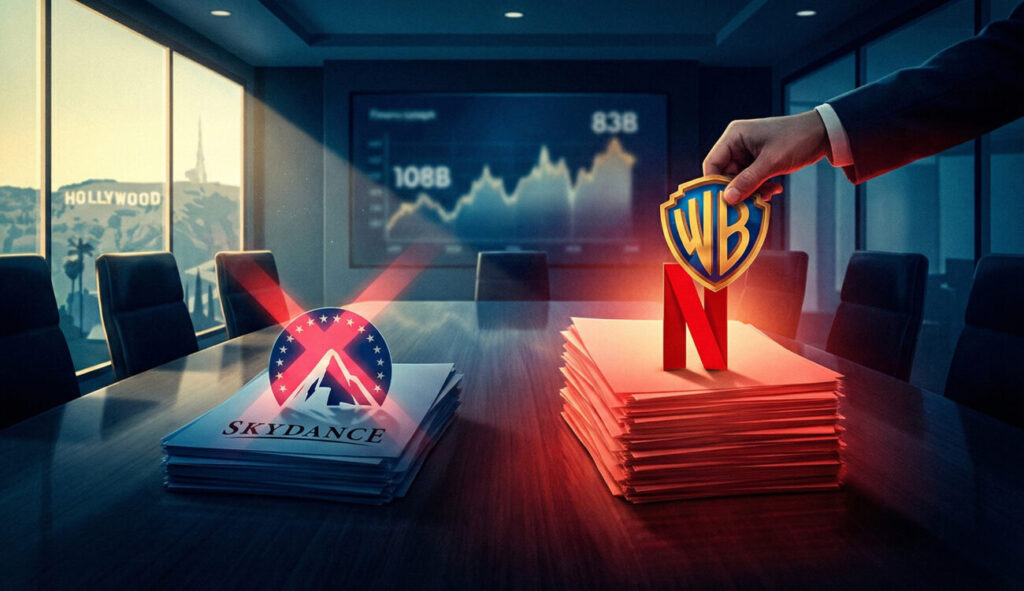
Netflix’s decision to decline increasing its bid for Warner Bros. Discovery (WBD) reshapes one of the most dramatic media industry battles in years and puts Paramount’s higher offer firmly in the lead. This stunning pivot comes after WBD’s board declared Paramount Skydance’s revised proposal a “superior offer” under its existing merger agreement, giving Netflix a brief window to respond — a window the streaming giant chose not to act on.
Now, Paramount — backed by the Ellison family — is positioned to potentially acquire WBD for about $111 billion (roughly $31 per share), far exceeding Netflix’s previous $83 billion proposal. Despite months of intense corporate drama, Netflix said matching Paramount’s valuation would make the deal “no longer financially attractive,” a statement that signals a major strategic shift for the world’s leading streaming service.
This decision doesn’t just pivot the future of Warner Bros. Discovery — it also could redefine competition in streaming, blockbusters, newscasting, and global entertainment. With Paramount now leading the charge, traditional Hollywood power balances could shift dramatically, affecting content libraries, industry jobs, and how audiences access major franchises like Harry Potter, DC superheroes, Top Gun, and more.
Paramount’s Superior Offer and Strategic Edge
Paramount Skydance’s renewed bid caught WBD’s board’s attention not only because of its higher share price but also for the structure and protections it includes, such as reverse termination fees and quarterly cash incentives. These terms aim to reduce deal risk and reassure shareholders — a smart move in a bidding war that so far has spanned months and drawn regulatory scrutiny.
Unlike Netflix’s prior offer — which focused primarily on Warner’s studio and streaming divisions — Paramount’s approach covers the entire Warner Bros. Discovery enterprise, including cable networks, news outlets like CNN, and broader publishing and distribution arms.
Paramount’s move isn’t just financial — it’s strategic. By consolidating assets that span film studios, television networks, and news outlets, the company could more effectively compete with heavyweights like Disney and Comcast. However, this consolidation also attracts antitrust concerns, with critics warning that a merged media empire could reduce competition and elevate prices for consumers.
Netflix’s Strategic Retreat and Long-Term Vision
Netflix, historically focused on organic growth rather than large acquisitions, confirmed it would not raise its bid in response to Paramount’s higher offer. In its official announcement, Netflix’s leadership emphasized that while the acquisition might have created value, the required price made it unattractive under its capital discipline guidelines. Netflix plans to continue investing heavily in new content — around $20 billion this year alone — and expand subscriber offerings without overpaying for legacy assets.
Though Netflix will walk away from the deal, it retains an impressive content strategy and strong market presence. The withdrawal also comes with a financial cushion: Paramount is expected to reimburse a separation fee (breakup cost) of about $2.8 billion, Netflix would owe if the original deal dissolves — a rare financial safety net in big-ticket media mergers.
This retreat may actually boost Netflix’s stock in the short term, as some investors view avoiding legacy Hollywood assets as a relief rather than a loss. However, it also leaves unanswered questions about Netflix’s long-term role in the acquisition-driven future of global content consolidation.
Industry and Regulatory Implications
Paramount’s ambitious bid has drawn the attention of regulators globally. While the U.S. Hart-Scott-Rodino antitrust waiting period has technically expired, the Justice Department and other authorities still reserve the right to intervene if they believe the merger would substantially reduce competition.
Political scrutiny has also surfaced, with public figures arguing that a Paramount-Warner combination could amplify concentrated media power. Critics contend such consolidation could restrict creative diversity and limit consumer options, especially amid already fierce competition among a few dominant media conglomerates.
In this context, regulatory approvals and shareholder votes will be crucial to determining the deal’s future. Paramount’s higher valuation and expanded coverage of WBD’s business might help sway stakeholders, but the company still faces a complex path ahead before closing the acquisition.
What This Means for Consumers and Creators
If completed, a Paramount-Warner combination could reshape film and television production, blending two of Hollywood’s historic studios and their franchises into a single powerhouse. For audiences, this might mean new platform strategies, bundled content offerings, or redesigned streaming experiences.
For creators — actors, directors, writers, and technicians — the deal could have mixed effects. Some see potential for larger-budget productions and wider distribution, while others fear reduced competition might limit opportunities and creative diversity.
Overall, the end of Netflix’s bid marks not just a business shift but a cultural one in entertainment — one that analysts and industry watchers will continue to unpack for months to come.
Subscribe to trusted news sites like USnewsSphere.com for continuous updates.