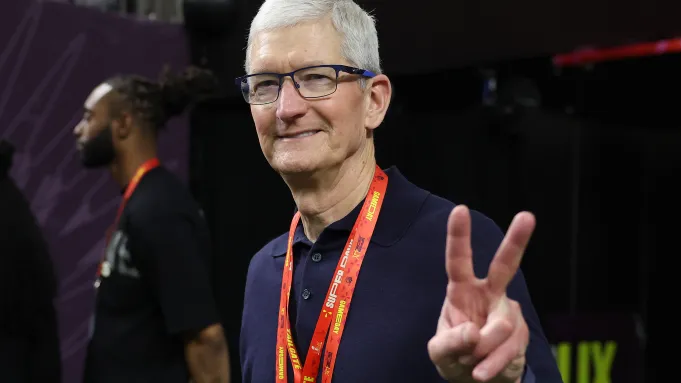
When looking at top leadership pay in the technology world, Apple CEO Tim Cook remains among the most highly compensated executives, with his 2025 total earnings reported at approximately $74.3 million — a slight drop from the previous year but still putting him in the highest echelons of corporate pay.
This comprehensive review goes beyond just the numbers and dives into what this compensation means, how Apple structures executive pay, internal leadership changes, and why analyst chatter around his future continues to grow — ensuring that this news piece is valuable, thorough, and highly relevant for readers and search engines alike.
Breakdown of Tim Cook’s 2025 Compensation
In 2025, Apple disclosed the full details of Cook’s compensation in its annual proxy filing with the U.S. Securities and Exchange Commission, revealing a total pay of around $74.3 million.
The year’s breakdown shows:
- Base salary: $3 million — unchanged for nearly a decade.
- Stock awards: ~$57.5 million — the largest component tied to performance.
- Performance-based incentive pay: $12 million.
- Other compensation: Around $1.76 million — including retirement contributions, insurance, and personal security costs.
This structure demonstrates Apple’s ongoing strategy to reward long-term performance rather than cash pay alone, aligning executive interests with shareholders and motivating continued innovation.
How 2025 Pay Compares to Past Years
Although $74.3 million is staggering in absolute terms, it actually represents a slight decline from the $74.6 million Cook earned in 2024.
The decrease is relatively small — roughly 0.4% year-on-year — and largely reflects marginal changes in equity awards and incentive payouts, not a dramatic shift in company policy.
Investors and analysts interpret this stability in compensation as a sign of Apple’s continued confidence in Cook’s leadership and financial strategy, even as the company navigates competitive pressures in global markets.
Why Equity Awards Dominate Cook’s Pay
Stock awards remain the largest portion of Tim Cook’s compensation because they reflect Apple’s performance and shareholder returns.
This emphasis means:
- When Apple delivers shareholder value and hits financial goals, executives benefit directly.
- The risk and reward are tied closely to how the company performs, maintaining accountability to investors.
- It encourages leadership to prioritize long-term strategies like innovation and expansion into services and new product categories.
Because Apple’s stock performance has largely outpaced the broader market in recent years, these equity incentives have translated into significant compensation packages for senior leaders.
Leadership Changes and What They Signal
Alongside the compensation disclosure, 2025 saw further shifts in Apple’s C-Suite:
- Kevan Parekh, Apple’s new Chief Financial Officer, reported substantial earnings of around $22.4 million.
- Sabih Khan, the newly appointed Chief Operating Officer, earned approximately $27 million.
These figures show that Apple’s executive compensation structure is not limited to its CEO, and that the company aims to retain top talent across its leadership bench.
Parekh’s rise — having joined Apple in 2013 and assumed the CFO role in early 2025 — suggests Apple is preparing for longer-term continuity beyond Cook’s eventual transition from day-to-day leadership.
Market Context: Why Cook’s Compensation Matters
Examining Cook’s compensation is about more than figures on a proxy statement — it reveals how Apple views executive performance amid shifting market dynamics.
In 2025:
- Apple stock saw modest gains compared with major indices.
- Growth in services, wearables, and iPhone sales contributed to strong financial performance, underpinning incentive awards.
However, Apple also faced competitive pressures from other tech giants and ongoing challenges in hardware innovation — making Cook’s leadership and compensation a topic of both admiration and debate among investors.
Public and Market Reaction
News of Tim Cook’s compensation quickly became a talking point across financial media and social networks, with discussions ranging from:
- The necessity of large equity-based pay for long-term leadership commitment.
- Pay ratios between executive leadership and average employees.
- Speculation around Cook’s future role transitioning to Board Chairman and possibly passing the CEO baton.
Critics sometimes point to the high ratio between executive pay and typical worker compensation, fueling broader debates about income inequality in major corporations. Meanwhile, supporters argue that Apple’s performance — especially its market cap hitting historic highs — justifies the compensation structures.
What This Means for Investors and Apple’s Future
For shareholders and market watchers, Tim Cook’s pay package is more than just an annual number; it’s a signal of corporate strategy and confidence.
The continued emphasis on long-term equity:
- Aligns leadership rewards with long-term returns.
- Reinforces the importance of hitting performance goals in a competitive environment.
- Suggests Apple’s board sees no urgent need for drastic compensation overhaul — even as leadership roles evolve.
Investors will be watching how future product cycles, service revenue growth, and global market opportunities influence both Apple’s stock and how executive pay adapts. BI
Conclusion — Tim Cook’s 2025 Compensation in Perspective
Apple CEO Tim Cook’s 2025 compensation of $74.3 million — slightly lower than the previous year — reflects a complex blend of performance-based incentives, long-term equity rewards, and thoughtful corporate governance in one of the world’s most influential companies. As Apple evolves and its leadership transitions unfold, this pay structure will continue to draw significant attention from analysts, investors, and the wider tech community.
Subscribe to trusted news sites like USnewsSphere.com for continuous updates.