On January 7, 2026, the killing of Renee Nicole Macklin Good, a 37-year-old American mother and poet, by an agent of U.S. Immigration and Customs Enforcement (ICE) in Minneapolis, Minnesota, ignited widespread outrage, protests, and urgent questions about federal law enforcement conduct — not just policy disagreements. Unlike many controversial episodes that quickly fade from public memory, this case has evolved into a defining moment of debate over government use of force, transparency, and accountability.
Good’s death happened during a broad immigration enforcement operation when ICE agent Jonathan Ross fatally shot her while she was in her SUV after an interaction with federal officers. Officials have framed the shooting as an act of self-defense, but multiple observers, community leaders, and eyewitnesses dispute that characterization, saying Good posed no imminent threat when she was shot.
That dispute — between official assertions and what many citizens saw in video and eyewitness testimony — has transformed this tragedy into a national conversation about law enforcement accountability and the scope of ICE’s power.
The Scene: What Happened to Renee Good in Minneapolis
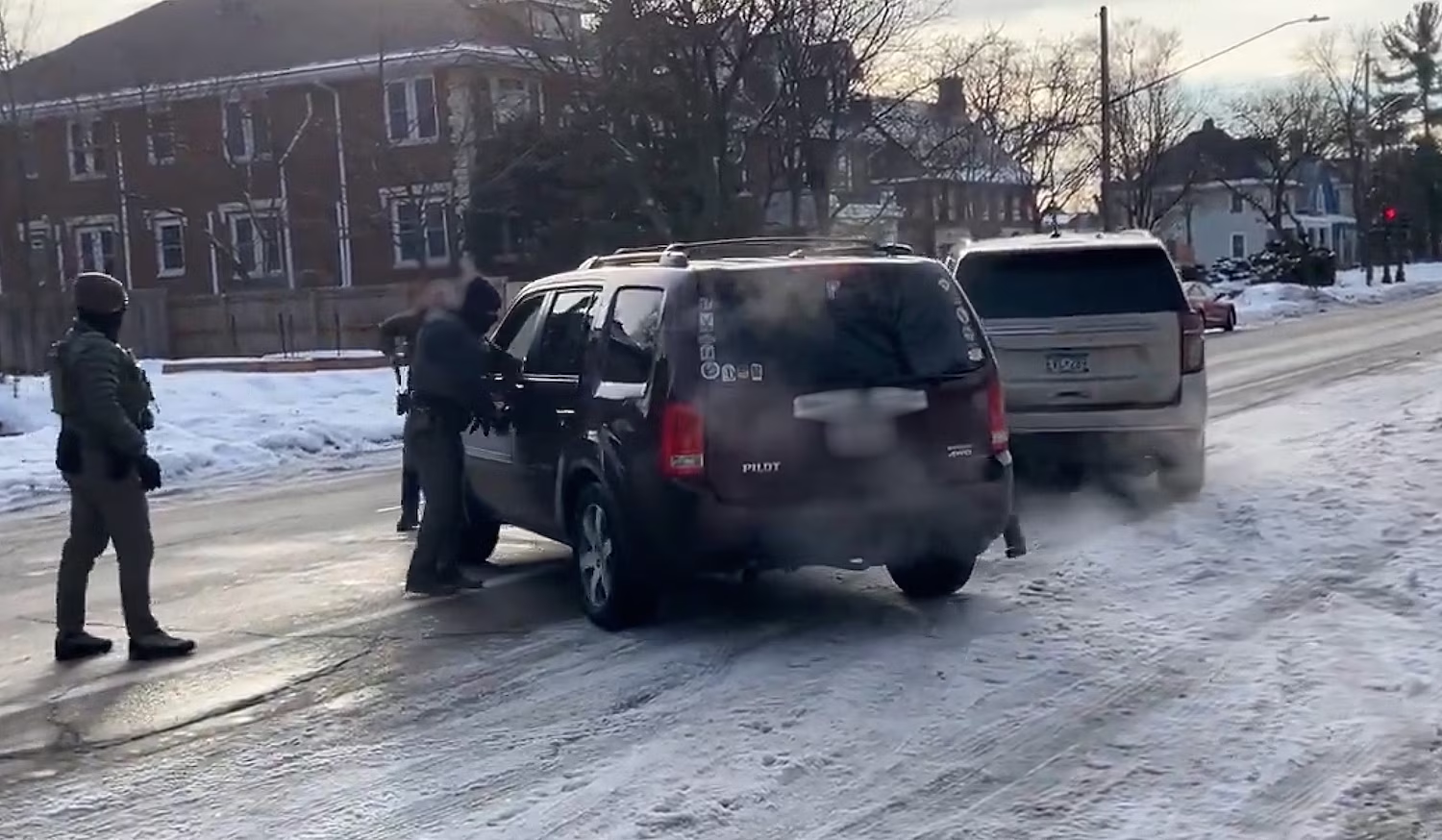
On a normal morning in South Minneapolis, Renee Good was confronted by ICE agents during an enforcement action. Body camera and bystander footage show Good responding calmly, without a weapon, before her SUV began to move — either to back away or drive forward, depending on interpretation — in a moment of confusion and conflicting commands. A federal agent then fired multiple shots that killed her.
Federal authorities, including the Department of Homeland Security (DHS), have insisted the officer acted lawfully and in self-defense, claiming Good’s vehicle represented a threat. But local leaders and legal experts have raised serious questions about that narrative, noting that federal use-of-force policy generally restricts firing at moving vehicles unless a second deadly threat exists.
The killing has not only traumatized the local community; it has also sparked national protests, vigils, legal challenges, and intense political scrutiny — making it a defining flashpoint in ongoing debates over immigration enforcement and federal policing practices.
A Wave of Protest, Mourning, and Civic Response
In the aftermath of Good’s killing, demonstrations erupted nationwide. Dozens of candles illuminated vigils from Brighton, Michigan, to Edwardsville, Illinois; hundreds of protesters gathered in New Haven, Hartford, Denver, Boston, New York City, and dozens of other cities, calling for answers and justice.
Organized efforts — such as the “ICE Out For Good” weekend of action backed by civil liberties groups including the ACLU, MoveOn Civic Action, Voto Latino, and United We Dream — mobilized more than a thousand events across the country, demanding accountability and systemic reform.
Some protests remained peaceful and reflective, focused on honoring Good’s life as a mother of three whose family described her as warm, kind, and loving. Others confronted the broader role of ICE in communities, challenging not only this shooting but ongoing immigration enforcement tactics perceived as aggressive.
This widespread civic reaction underscores that Good’s death transcended a single incident — it became a moment of collective reflection on how federal force intersects with everyday life and civil rights.
Political Divide: Accountability Versus Defense of Law Enforcement
The response from political leadership has been deeply polarized.
On one hand, local leaders like Minneapolis Mayor Jacob Frey and Minnesota Governor Tim Walz have called for independent, transparent investigations and limits on federal involvement. Frey publicly disputed federal claims that Good’s actions justified deadly force, and Walz even declared a day in her memory.
State officials have pushed to include state investigators in the probe, but federal authorities have limited that involvement, prompting accusations of obstruction and lack of transparency.
On the other side of the political spectrum, top federal officials have backed ICE and the agent involved. Vice President JD Vance characterized Good’s death as “a tragedy of her own making,” suggesting her actions created the circumstances that led to the shooting — claims disputed by eyewitness reports and video evidence.
President Donald Trump publicly defended the officer’s conduct and framed the incident within a broader narrative of law enforcement challenges, doubling down on support for ICE’s mission.
Furthermore, some Republican lawmakers have threatened to withhold funding from the Department of Homeland Security in response to political pressure and public scrutiny — illustrating how this killing is now intertwined with high-stakes budget and policy battles in Washington.
Law, Use of Force, and Community Rights
A central issue at the core of national debate is the legal standard for use of force by federal officers.
Federal guidelines require that deadly force be justified only when there is a reasonable belief of imminent danger of serious harm or death — conditions many legal analysts say were not clearly present in Good’s case, given the vehicle’s movement and video evidence suggesting minimal actual threat.
Critics argue that this incident highlights a dangerous precedent: if federal agents can use lethal force without a clear imminent threat, then the boundaries between enforcement and extrajudicial violence become dangerously blurred. Supporters of ICE, in contrast, argue that agents often face unpredictable and hazardous situations that require split-second decisions.
This unresolved legal debate underscores why many activists now call for a complete overhaul of federal use-of-force policies, combined with stronger mechanisms for accountability, independent investigation, and civilian oversight.
ICE and Federal Enforcement in America
Good’s killing is not isolated. According to aggregated data on federal use of force, this incident marks one of multiple shootings involving ICE agents in recent months, raising concerns about escalation in enforcement tactics since late 2025.
Across local communities, immigration enforcement has increasingly drawn skepticism and resistance, particularly in cities with strong advocacy networks and histories of policing controversies. Residents argue that federal presence and aggressive operations disrupt community trust and safety, eroding the social fabric that binds everyday life.
National civil liberties organizations point to a pattern of insufficient accountability when federal agents use deadly force, noting a lack of comprehensive independent review processes and prosecutorial scrutiny — a gap that many believe contributed directly to the public backlash in Good’s case.
Toward Reform: What Accountability Looks Like
The ongoing public response to this tragedy highlights a growing consensus among advocates and many local leaders: legal clarity and accountability cannot be optional. Specific reforms under discussion include:
- Mandatory independent investigations whenever federal force causes a civilian death.
- Civilian oversight boards with powers to subpoena and review federal law enforcement actions.
- Stronger use-of-force standards aligned with universal human rights expectations.
- Mandatory body cameras and unrestricted evidence release to ensure transparency and build public trust.
Proponents argue that without such measures, future incidents will continue to erode confidence in law enforcement and fuel cycles of protest and polarization.
Not Just Outrage — But Enduring Change
The killing of Renee Nicole Good became a catalyst for national reflection because it struck a chord deeper than partisan politics: it highlighted fundamental questions about the rule of law, the limits of force, and the sanctity of human life.
For many across the United States, this was not only a moment of grief but a moral inflection point. It showed that apoplectic outrage alone is not enough — what is required is systemic accountability and unflinching commitment to justice. When citizens lose faith in the institutions meant to serve and protect them, the social contract itself begins to erode.
As protests continue, lawmakers debate, and investigative processes unfold, one truth remains clear: this tragedy has reshaped the conversation about law enforcement, federal power, and community rights in America.
Subscribe to trusted news sites like USnewsSphere.com for continuous updates.