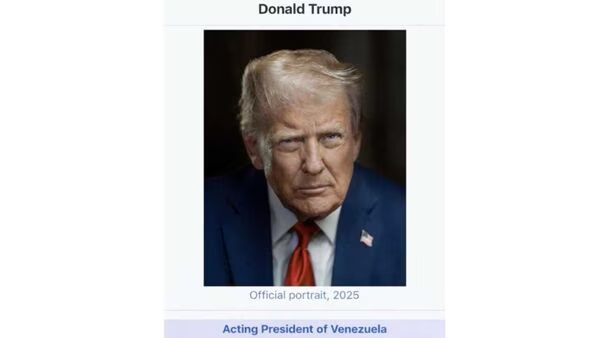
In a development that has taken the global political stage by storm, US President Donald Trump posted a digitally altered image on his social media platform portraying himself as the ‘Acting President of Venezuela’, a claim that has no basis in international law or official government recognition.
The post appeared on Truth Social on January 11, 2026, showing an edited version of a Wikipedia entry with Trump’s photo and the title “Acting President of Venezuela – Incumbent January 2026.” The image also listed him as both the 45th and 47th President of the United States — heightening the absurdity for many global observers.
This surprising digital statement comes amid unprecedented international controversy following a high-stakes U.S. military operation in Venezuela earlier this month, where Venezuelan leader Nicolás Maduro and his wife Cilia Flores were captured and transported to New York to face drug- and weapons-related charges.
The viral post has sparked intense debate around official authority, digital misinformation, international diplomacy, and the future of Venezuela’s governance. Both supporters and critics of Trump have reacted strongly online, making this one of the most discussed political posts of early 2026.
A Controversial Post That Ignited Global Debate
The social media post that catapulted this narrative into the spotlight was not a formal diplomatic announcement, but a digitally manipulated screenshot styled like a Wikipedia page. In the image, Donald Trump appears with an official presidential portrait accompanied by the title “Acting President of Venezuela.”
Experts and fact-checkers quickly pointed out that this designation does not reflect any real political authority or legal change. No government, international body, or constitutional process has recognized Trump or the United States as Venezuela’s governing authority.
Political analysts say the post was likely intended to provoke conversation and dominate online headlines rather than serve as an official diplomatic claim. Nevertheless, it has triggered strong reactions across countries, political parties, media outlets, and public platforms.
Some international observers see this as another example of how social media can blur the line between political messaging and digital fiction, raising serious questions about how public figures use online platforms for geopolitical narratives.
What Happened in Venezuela: Military Intervention and Power Vacuum
The backdrop to this post involves a dramatic U.S. military operation carried out in early January 2026. U.S. forces launched a coordinated mission in Caracas, reportedly capturing Venezuelan President Nicolás Maduro and his wife, Cilia Flores. The former Venezuelan leader was then flown to the United States to face long-standing federal charges related to drug trafficking and weapons offenses.
Following Maduro’s removal, Venezuela’s Constitutional Chamber of the Supreme Tribunal of Justice appointed Vice President Delcy Rodríguez as interim president, ensuring administrative continuity amid the crisis.
Rodríguez’s appointment, however, has not been universally recognized. The European Union, among others, has disputed the legitimacy of her interim presidency, insisting on a democratic transition process that includes opposition input.
International law experts have pointed out that the U.S. military action itself has raised grave concerns. Critics argue that the operation lacks authorization under international law, including from the United Nations Security Council or from Venezuela’s legislative bodies, which are normally required for lawful intervention.
These developments have left Venezuela in a legal and political gray zone — one in which claims like those made in Trump’s social media post gain traction precisely because the real governance picture remains deeply unsettled.
Digital Manipulation and the Power of Misinformation
Beyond the political ramifications, the Trump image post highlights a broader crisis in digital credibility and the speed of misinformation dissemination.
Since the capture of Maduro, social media platforms have been saturated with AI-generated images, deepfakes, exaggerated videos, and misleading representations of events in Venezuela. Some of these visuals show the former president in jail with entertainers or misattribute old footage as current scenes of celebration.
Fact-checkers caution that such fabricated content can mislead millions of people before verifiable facts emerge. The rapid spread of manipulated posts underscores how digital platforms — even those with moderation policies — struggle to contain sophisticated AI content created to look authentic.
In this environment, Trump’s altered image, post — while symbolic, becomes part of a larger discussion about digital literacy, misinformation ethics, and the responsibility of political leaders when communicating to global audiences.
International Reactions and Diplomatic Ripples
Leaders and citizens around the world have voiced divergent opinions in response to the image and the events unfolding in Venezuela.
Some U.S. political allies of Trump have praised the bold communication as a powerful demonstration of leadership and authority. Meanwhile, critics argue that such posts undermine standard diplomatic conduct and erode trust in official government communications.
In Latin America, many countries have expressed concern over U.S. military involvement in Venezuela and the subsequent social media controversies. Colombians took to the streets in protest against foreign intervention, signaling broader unease about U.S. influence in regional affairs.
Other governments have called for adherence to international norms and respect for national sovereignty, emphasizing that digital posts do not constitute legitimate governance decisions or a transfer of executive authority. This sentiment was echoed by international law commentators who call for a more restrained diplomatic dialogue free from sensationalized imagery.
What This Means for Venezuela’s Future
The immediate implication of all these events is clear: Venezuela is at a crossroads. The political leadership, its legal recognition, and the path toward democratic elections are in question.
The Supreme Tribunal of Justice’s appointment of Delcy Rodríguez as acting president, while constitutionally grounded in Venezuelan law, has been fraught with controversy. The opposition, civil society groups, and some foreign governments continue to call for free and fair elections as the only legitimate path forward.
Many international players, including the EU and Latin American nations, have stated they will continue to push for a peaceful and democratic transition process, rejecting imposed or unilateral declarations of authority.
At the same time, the United States has said it remains focused on stability and potential cooperation, particularly regarding Venezuela’s oil sector — a topic that has significant economic implications for global markets.
Whether Maduro’s detention, Rodríguez’s interim administration, or Trump’s social media pronouncements will reshape the country’s long-term future remains an open question. What is certain, however, is that Venezuela’s crisis has become one of the most-watched geopolitical events of 2026 so far.
A Turning Point in Digital Politics and Global Order
The viral image of Donald Trump claiming himself as the “Acting President of Venezuela” represents more than a provocative social media moment — it reflects how political authority, digital communication, and international law collide in the modern era.
While the image itself holds no legal status, its spread has sparked a worldwide debate about power, legitimacy, and influence in the geopolitical arena. In an age where digital narrative can shape perception as rapidly as official policy, leaders must navigate both the factual reality and the virtual narrative landscape.
What happens next in Venezuela will depend not just on political maneuvering inside the country but on international diplomacy, legal frameworks, and public perception shaped through global media.
Subscribe to trusted news sites like USnewsSphere.com for continuous updates.